🔧 Torque Converter Holding Tool Calculator
Calculate required holding force, bolt torque, and tool engagement for torque converter removal & installation
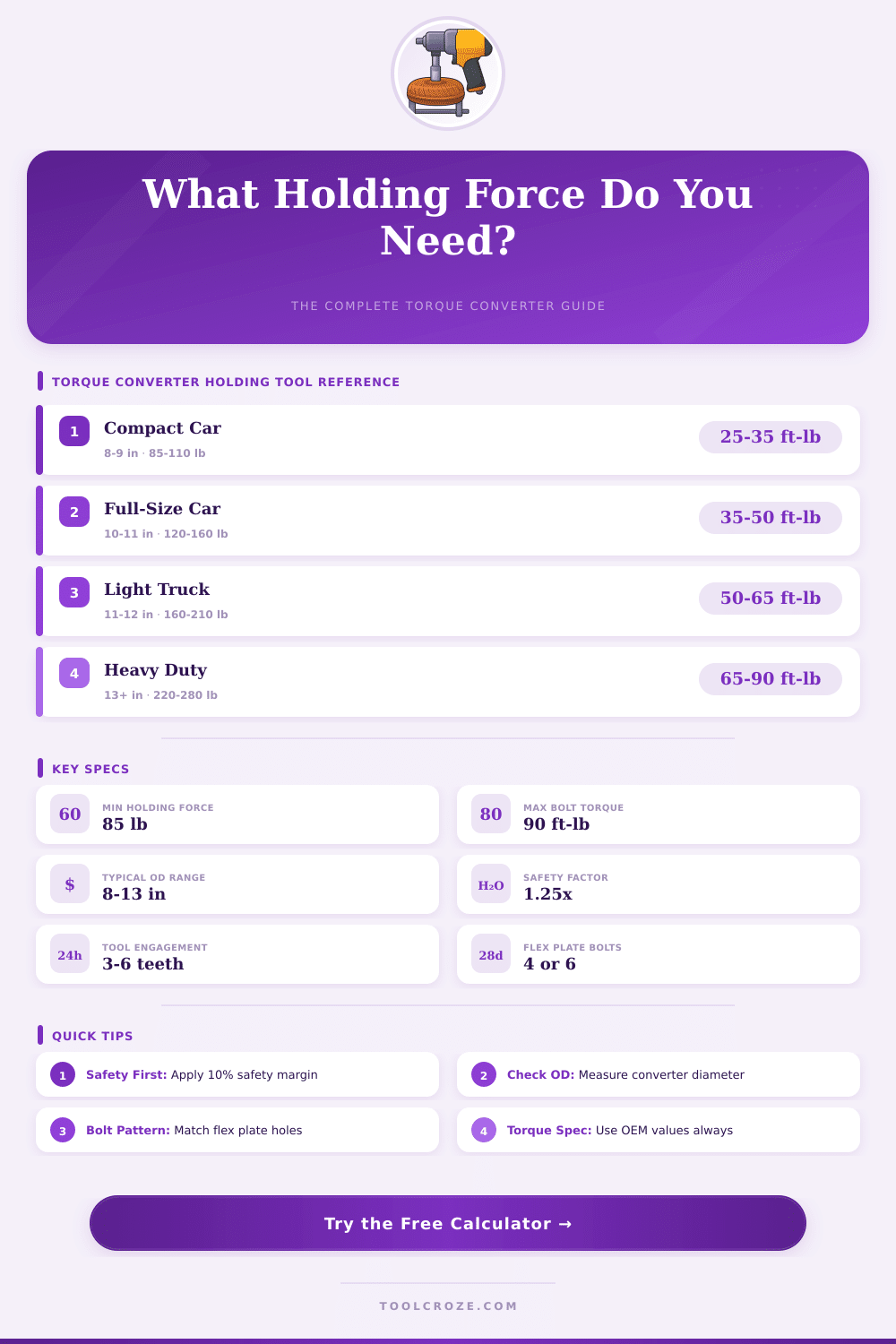
| Vehicle Class | Converter OD (in) | Flex Plate Bolts | OEM Bolt Torque (ft-lb) | Min Holding Force (lb) | Rec. Tool Width (in) |
|---|---|---|---|---|---|
| Compact / Import FWD | 8.0 – 9.0 | 4 | 20 – 28 | 85 – 110 | 1.0 – 1.5 |
| Full-Size Car RWD | 10.0 – 11.0 | 6 | 30 – 45 | 120 – 160 | 1.5 – 2.0 |
| Light Truck / SUV | 11.0 – 12.0 | 6 | 40 – 60 | 160 – 210 | 1.5 – 2.0 |
| Heavy Duty Truck | 12.5 – 14.0 | 6–8 | 60 – 90 | 220 – 280 | 2.0 – 2.5 |
| Performance / Racing | 8.5 – 10.5 | 6 | 25 – 40 | 100 – 150 | 1.5 – 2.0 |
| Medium Duty Diesel | 12.0 – 13.5 | 8 | 55 – 80 | 200 – 260 | 2.0 – 2.5 |
| Bolt Size | Thread Pitch | Grade / Class | Torque Range (ft-lb) | Torque Range (N·m) | Typical Application |
|---|---|---|---|---|---|
| M8 | 1.25 mm | 10.9 | 15 – 22 | 20 – 30 | Compact / Import |
| M10 | 1.50 mm | 10.9 | 25 – 38 | 34 – 52 | Mid-size Car |
| M12 | 1.75 mm | 10.9 | 40 – 58 | 54 – 79 | Full-Size / Truck |
| 3/8-16 UNC | 16 TPI | Grade 8 | 28 – 35 | 38 – 47 | Classic American |
| 7/16-14 UNC | 14 TPI | Grade 8 | 42 – 55 | 57 – 75 | Truck / Muscle Car |
| 1/2-13 UNC | 13 TPI | Grade 8 | 65 – 90 | 88 – 122 | Heavy Duty |
| Tool Type | Converter OD Range | Max Load Capacity | Engagement Points | Typical Material | Best For |
|---|---|---|---|---|---|
| Ring-Type Strap Wrench | 8–10 in | 150 lb | Full ring | Steel / Fabric | Compact / Import |
| Flex Plate Lock Bar | All sizes | 300 lb | 1–2 teeth | Hardened Steel | Removal only |
| Spanner Wrench (2-pin) | 8.5–12 in | 200 lb | 2 pins | Cr-V Steel | General purpose |
| Band Clamp Tool | 9–14 in | 280 lb | Band contact | Alloy Steel | Trucks / Heavy |
| Ring Gear Holder | All sizes | 400 lb | 3–6 teeth | Hardened Steel | High-torque installs |
| Custom Fab Plate | Variable | 500+ lb | 4–8 bolts | Plate Steel | Racing / Heavy Duty |
| Vehicle / Trans | Converter OD (in) | Bolt Torque (ft-lb) | Est. Converter Weight (lb) | Min Holding Force (lb) |
|---|---|---|---|---|
| GM 4L60E / 4L65E | 10.75 | 46 | 20 | 145 |
| GM 4L80E | 11.50 | 46 | 28 | 175 |
| Ford 4R100 / E4OD | 11.00 | 54 | 26 | 160 |
| Ford 6R80 | 10.25 | 37 | 18 | 130 |
| Chrysler 545RFE | 10.50 | 45 | 22 | 150 |
| Honda / Acura (ATF) | 8.00 | 22 | 10 | 88 |
| Toyota A340 / U250 | 8.75 | 25 | 12 | 95 |
| Allison 1000 | 13.50 | 74 | 36 | 240 |
The torque converter works as a device that passes the spinning energy from the engine to the transmission. It is made up of a kind of liquid coupling, with some extra parts added to improve how well it works. In a vehicle with automatic transmission, this converter sits between the engine and the transmission where it does almost the same task as the coupling in a car with manual gearbox.
Think of it as a hydraulic pump that carries the energy of the engine straight to the transmission.
How a Torque Converter Works
Only cars fitted with automatic transmissions use torque converters. Vehicles with manual transmissions depend on a coupling instead. Thanks to the torque converter, the engine can stay working even when the wheels come to a full stop.
It allows a bit of sliding, so that the car can stay in idle state during the drive, without risk of engine stalling.
In the torque converter, one of the main parts is the stator. It looks like a small fan, but it does not rotate. The stator forces the liquid to twist and adds more torque to the output shaft, when the speed of that shaft strongly differs from the input.
Without the stator, the converter would simply be a liquid coupling, which at bottom is only a sliding coupling. Torque converters multiply the torque. Here is the main reason why they are called torque converters and not simply liquid couplings.
While starting form full stop, one part of the torque converter spins more quickly than the other. That difference in speeds grows the torque that reaches the transmission. The more torque the engine makes, the more quickly the car speeds up.
Modern torque converters include a lock feature. At high speeds, it locks the converter in a direct one-to-one ratio, so that know energy is lost inside. Some new cars even have a coupling for the torque converter, which is a big round plate pressing against the flywheel and that creates a direct mechanical link, instead of liquid.
Buyers of fancy cars want a smoother ride, and the action of torque converters helps as a cushion between engine and transmission. New turbo diesel trucks handle huge amounts of torque, and normal couplings would not be able to hold the link between that force and the pull of heavy goods. The torque converter takes care of that task.
When talking about climbing slopes, the change of the torque converter ranks among the best changes for clear improvement. Some notice around thirty percent increase in the pull. The nice speed sits around 2400 turns per minute for street and strip driving.
At stoplights, slowly pressing the gas gives energy before reaching 2400 RPM, but releasing the brake and strongly speeding up hardlylifts the nice speed to a higher level.