🪚 Table Saw Blade Speed Calculator
Calculate recommended RPM, feed rate, and cutting time for any material and blade combination
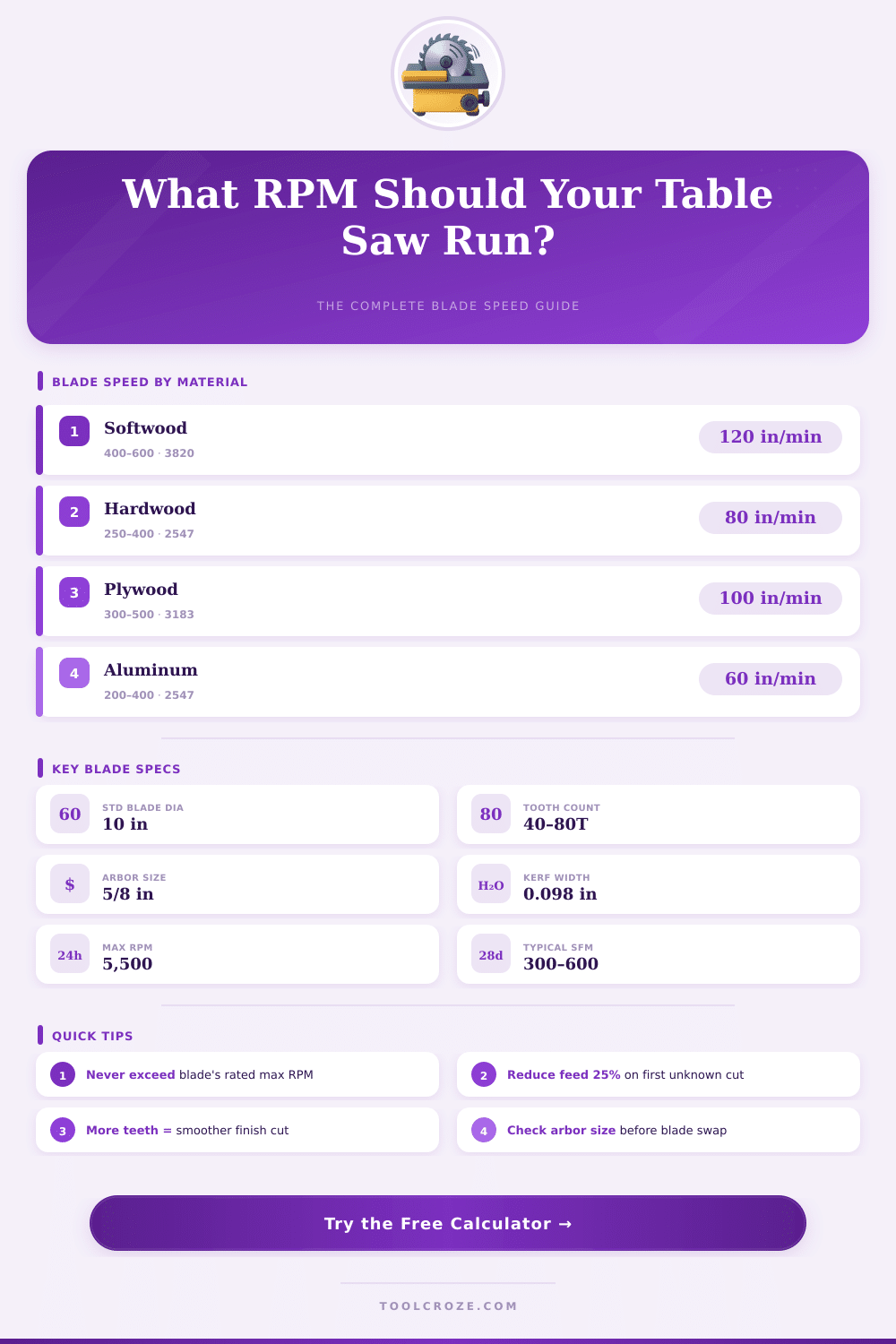
| Material | Rec. SFM | RPM (10" Blade) | RPM (7.25" Blade) | Feed Rate (in/min) | Chip Load/Tooth (in) |
|---|---|---|---|---|---|
| Softwood (Pine/Cedar) | 400–600 | 1,528–2,292 | 2,107–3,161 | 80–150 | 0.008–0.012 |
| Hardwood (Oak/Maple) | 250–400 | 955–1,528 | 1,317–2,107 | 50–100 | 0.004–0.007 |
| Plywood (Cabinet) | 300–500 | 1,146–1,910 | 1,580–2,633 | 60–120 | 0.005–0.009 |
| MDF | 300–500 | 1,146–1,910 | 1,580–2,633 | 60–110 | 0.005–0.008 |
| Melamine / Laminate | 280–450 | 1,070–1,719 | 1,475–2,370 | 50–100 | 0.004–0.007 |
| Aluminum Sheet | 200–400 | 764–1,528 | 1,053–2,107 | 30–80 | 0.002–0.004 |
| Acrylic / Plastic | 150–300 | 573–1,146 | 790–1,580 | 20–60 | 0.003–0.006 |
| OSB / Chipboard | 250–450 | 955–1,719 | 1,317–2,370 | 60–110 | 0.005–0.008 |
| Blade Type | Diameter | Teeth | Kerf (in) | Arbor | Max RPM | Best For |
|---|---|---|---|---|---|---|
| General Purpose ATB | 10" | 40T | 0.098 | 5/8" | 5,500 | Softwood, Plywood |
| Fine Crosscut ATB | 10" | 80T | 0.087 | 5/8" | 5,500 | Hardwood, Melamine |
| Ripping FT | 10" | 24T | 0.118 | 5/8" | 5,500 | Softwood Rips |
| Combination | 10" | 50T | 0.098 | 5/8" | 5,500 | Mixed Cuts |
| Thin Kerf ATB | 10" | 40T | 0.071 | 5/8" | 6,000 | Underpowered Saws |
| Non-Ferrous TCG | 10" | 80T | 0.098 | 5/8" | 5,500 | Aluminum, Brass |
| Dado Stack | 8" | 24T outer | 0.25–0.75 | 5/8" | 4,000 | Dadoes, Grooves |
| Circular 7.25" | 7.25" | 40T | 0.071 | 5/8" | 6,000 | Portable Saws |
| Project | Typical Dimensions | Blade Rec. | Est. RPM | Est. Time/Cut |
|---|---|---|---|---|
| 2x4 Framing Crosscut | 1.5" x 3.5" x 96" | 40T ATB | ~3,820 | 2–4 sec |
| 3/4" Plywood Rip | 0.75" x 48" x 96" | 40T ATB | ~3,820 | 45–60 sec |
| Hardwood Furniture Board | 1" x 6" x 48" | 60–80T ATB | ~2,547 | 30–50 sec |
| MDF Cabinet Panel | 0.75" x 24" x 48" | 60T ATB | ~3,183 | 30–45 sec |
| Aluminum Sheet 1/8" | 0.125" x 12" x 24" | 80T TCG | ~2,547 | 25–40 sec |
| Deck Board 45° Miter | 1.5" x 5.5" x 120" | 40T ATB | ~3,820 | 5–8 sec |
The Blade Speed of a Table Saw is one of those topics that often stays unclear when folks choose what tool to buy. The RPM that the maker points usually relates to the speed of the engine not to the real Blade Speed of the arbor. So it can trick a bit, if one does not know what to mind.
Most Table Saws work somewhere between 3 000 and 4 000 RPM. For a typical 10-inch Table Saw the arbor spins at around 3 800 RPM, which is a bit more than the standard motor speed of 3 450 RPM. For instance, the Grizzly mix of 3 HP states 4 300 RPM.
How Fast a Table Saw Blade Should Turn
One 10-inch Powermatic makes its blade turn at 4 000 RPM, which requires a big pulley when it connects to an engine of 1 725 RPM. The top speed for almost all 10-inch blades is 6 000 RPM, so a 1:1 ratio of pullyes works very well.
The standard motor speed depends directly on the blade width and on the advised speed. With a bigger blade one must turn it more slowly, to reach the right speed at the teeth. A small blade, rather, spins more quickly to have the same tooth speed.
Here is the reason that routers with changing speed exist; for big bits with big width one requires fewer RPM. Routers can reach around 15 000 RPM, which can create troubles with bigger knives.
In woodworking the tools widely have very different speeds. From Table Saws to small routers the range goes from around 3 000 RPM to even 50 000 RPM. If the engine of a Table Saw spins at 10 000 RPM, it probably has something similar too a router engine, not fit for an industrial Table Saw.
There is a sweet spot for the Blade Speed. For woodworking one advises around 130 to 170 feet per second. Most Table Saws reach RPM that puts them in the range of 130 to 180 feet per second.
One can measure the cutting speed also by surface feet per minute, and that should not mix with the rate by which one pushes the material through the saw.
The type of blade also matters. All blades for Table Saws sit on the same pole. Blades with few teeth and deep gullets cut more quickly, but those with many teeth and shallow gullets give smoother slices.
If one uses a rip blade for crosscutting, the process lasts longer and makes rougher surfaces. The crosscut blade almost does not help for faster cutting in final works.
When the saw is well set up, the Blade Speed does not truly need to be the main issue. More serious is the rate of speed. A slow blade requires slow pushing with the same blade.
If the blade slows during the cutting, then the material goes too quickly through it. Dirty or dull blades can make the saw seem weak. Built-up pitch on blades one can remove by a dip in Simply Green.
Also one can change the size ofpulleys to add or lower the speed.