🔧 Stainless Steel Bolt Torque Calculator
Calculate accurate torque values for stainless steel bolts — supports A2-70, A4-80, A4-100, and custom grades
| Bolt Size | A2-70 Dry (Nm) | A4-80 Dry (Nm) | A4-100 Dry (Nm) | A4-80 Lubed (Nm) | A4-80 Anti-Seize (Nm) | Proof Load (kN) |
|---|---|---|---|---|---|---|
| M4 x 0.7 | 2.5 | 3.0 | 3.8 | 2.3 | 2.0 | 5.8 |
| M5 x 0.8 | 5.0 | 6.3 | 7.9 | 4.7 | 4.1 | 9.3 |
| M6 x 1.0 | 8.7 | 11 | 13.6 | 8.2 | 7.1 | 13.7 |
| M8 x 1.25 | 21 | 26 | 33 | 20 | 17 | 25.6 |
| M10 x 1.5 | 42 | 52 | 66 | 39 | 34 | 40.9 |
| M12 x 1.75 | 72 | 90 | 113 | 68 | 59 | 59.2 |
| M14 x 2.0 | 115 | 144 | 180 | 108 | 94 | 81.3 |
| M16 x 2.0 | 178 | 222 | 278 | 167 | 145 | 110 |
| M20 x 2.5 | 347 | 433 | 542 | 325 | 282 | 176 |
| M24 x 3.0 | 600 | 750 | 938 | 562 | 488 | 257 |
| M30 x 3.5 | 1180 | 1475 | 1844 | 1106 | 960 | 398 |
| M36 x 4.0 | 2050 | 2563 | 3203 | 1922 | 1669 | 571 |
| Bolt Size | A2-70 Dry (ft-lb) | A4-80 Dry (ft-lb) | A4-100 Dry (ft-lb) | Lubed (ft-lb) | Anti-Seize (ft-lb) | Proof Load (lbf) |
|---|---|---|---|---|---|---|
| 1/4-20 UNC | 5.5 | 6.8 | 8.5 | 5.1 | 4.4 | 2650 |
| 5/16-18 UNC | 11 | 13.8 | 17.2 | 10.3 | 9.0 | 4350 |
| 3/8-16 UNC | 20 | 25 | 31 | 18.7 | 16.3 | 6200 |
| 7/16-14 UNC | 32 | 40 | 50 | 30 | 26 | 8400 |
| 1/2-13 UNC | 48 | 60 | 75 | 45 | 39 | 11900 |
| 9/16-12 UNC | 69 | 86 | 108 | 65 | 56 | 15200 |
| 5/8-11 UNC | 96 | 120 | 150 | 90 | 78 | 19400 |
| 3/4-10 UNC | 168 | 210 | 263 | 157 | 137 | 28800 |
| 7/8-9 UNC | 275 | 344 | 430 | 258 | 224 | 39500 |
| 1-8 UNC | 414 | 517 | 647 | 388 | 337 | 52000 |
| Condition | K-Factor | Torque Effect | Best Used For | Notes |
|---|---|---|---|---|
| Dry (clean, no lube) | 0.20 | Baseline | General assemblies | Most conservative |
| Lightly Oiled (SAE 30) | 0.15 | −25% vs dry | General machined parts | Common in engineering |
| Anti-Seize (copper-based) | 0.13 | −35% vs dry | High-temp, marine | Prevents galling |
| Zinc Plated Contact | 0.17 | −15% vs dry | Mixed fastener assemblies | Coating adds friction |
| PTFE Thread Tape | 0.12 | −40% vs dry | Pipe fittings, plumbing | Very low friction |
| Cadmium Plated | 0.11 | −45% vs dry | Aerospace (legacy) | Restricted in EU |
| Molybdenum Disulfide | 0.13 | −35% vs dry | High-load joints | Extreme pressure lube |
| Waxed / Dry Film | 0.12 | −40% vs dry | Automated assembly | Consistent torque |
| Application | Typical Bolt Size | Grade | Rec. Torque (Nm) | Rec. Torque (ft-lb) | Lube Rec. |
|---|---|---|---|---|---|
| Hose clamps / pipe fittings | M6 or 1/4-20 | A2-70 | 8–10 | 6–7.5 | PTFE tape |
| Marine deck hardware | M8–M10 | A4-80 | 20–40 | 15–30 | Anti-seize |
| Outdoor furniture / structures | M8 or 5/16-18 | A2-70 | 18–22 | 13–16 | Dry |
| Exhaust / high-temp flange | M10–M12 | A5-70 | 40–70 | 30–52 | Anti-seize |
| Food equipment / sanitary | M8–M12 | A4-80 | 22–68 | 16–50 | Dry or food-grade |
| Chemical plant flanges | M16–M24 | A4-80/100 | 167–562 | 123–415 | Anti-seize |
| Structural steel connections | M20–M30 | A4-100 | 500–1800 | 369–1327 | Dry or oiled |
| Pool / spa hardware | M8 or 3/8-16 | A4-80 | 20–25 | 15–18 | Anti-seize |
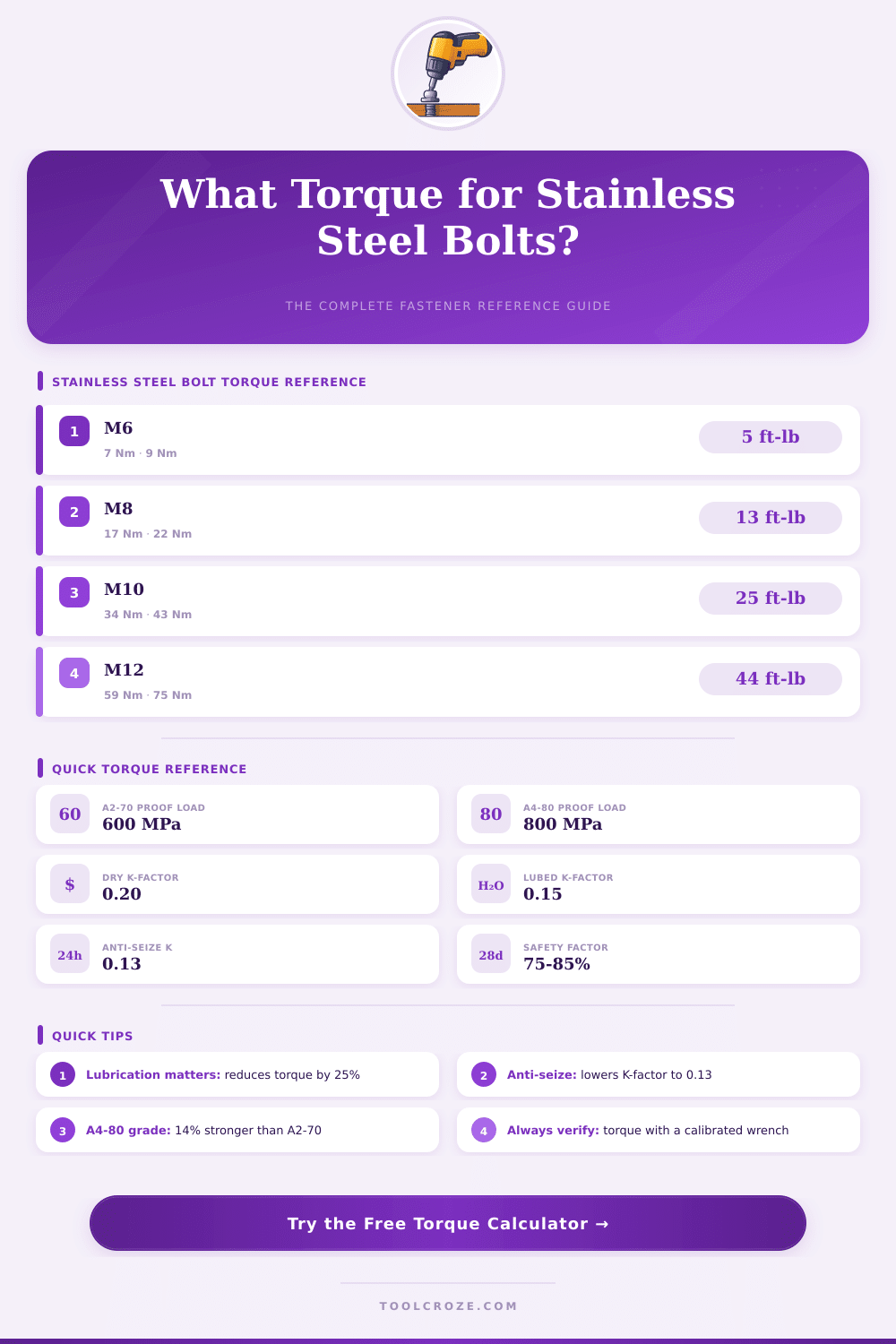
When using anti-seize on stainless bolts, reduce your target torque by approximately 35% compared to the dry value. Applying the same dry torque value to a lubricated bolt will over-stress the fastener and can cause yielding or fracture.
Stainless steel bolts are highly susceptible to galling (cold welding) during tightening. Always apply anti-seize paste to threads on bolts M10 and larger, or in high-vibration environments. Tighten slowly and steadily with a torque wrench — never use an impact driver on stainless.
It matters a lot to get the right torque for bolts from stainless steel. Every size of bolt requires precise torque which helps to keep the parts together. The goal is to form solid and lasting links so knowing the right amounts is key.
Charts about torque are available for stainless steel and other seals in form of tables. They describe various materials, for instance 18-8 stainless steel, 316 stainless steel, silicon bronze, monel, brass and 2024-T4 aluminium. For example, a stainless steel bolt of type 4-40 from 18-8 stainless steel requires 5.2 inch-pounds, while same size from 316 stainless steel requires about 5.5 inch-pounds.
Right Torque for Stainless Steel Bolts
A stainless steel bolt 6-32 from 18-8 stainless steel needs 9.6 inch-pounds, and from 316 it requires 10.1 inch-pounds. Versions from brass and aluminium for those same bolts need less torque.
Small screws with Allen-head from stainless steel, as sizes 4-40, 6-32, 8-32, 10-24 and 10-32, have torque values close to those of grade-2 bolts in same size. Most seals from stainless steel reach only level under grade 5 bolt force, except in case of special types. Such bolts are flexible and show low fource for break compared with grade-5 or grade-8 bolts.
There is one annoying cause that one must consider. It happens commonly between stainless steel and aluminium. A bit of oil can stop that, but adding oil requires lowering the torque values.
Specs for torque usually count for clean and dry threads. Any oil on threads can cause strain.
Bolts from stainless steel, when strained, commonly strip their threads before breaking the shaft. Part of the reason is the hardening during work. On bolts with small diameter, the surface of thread involves a bigger part of the total area, which makes the situation more sensitive.
Using two much torque almost ensures that the bolt will not be possible to remove or reuse later. With full engagement of thread, the shaft of screw should be the weak spot compared with the female threads, so it will break before they strip.
Some makers created their own values for torque, to reach good clamping. Makers of bolts commonly have their own lubricant and give different specs according to usage of that lubricant. The materials of threads in bolts also matter.
A stainless steel bolt thread in aluminium of 2xxx-series is an important factor for torque values. The other material can change the friction between parts.
If one tightens only until hand tight, the torque usually sits between 10 and 15 foot-pounds. In bigger uses, the amounts change a lot. For a standard half-inch stainless steel bolt, it is around 50 foot-pounds.
Even so, some uses of jackplate require 80 foot-pounds for half-inch stainless bolts. In case of other usage with half-inch bolts, that keeps down a cover tight with O-ring, it requires 125 foot-pounds. It is best to reach thefinal torque in steps, instead of fully tightening one bolt before moving to the next.