⚡ Power Wire Gauge Calculator
Find the correct AWG wire size for any DC or AC circuit — enter your load, voltage, and run length for an instant recommendation.
| AWG | Diameter (mm) | Area (mm²) | DC Resistance (Ω/1000ft) | Ampacity — Open Air | Ampacity — In Conduit | Common Applications |
|---|---|---|---|---|---|---|
| 0000 (4/0) | 11.68 | 107.2 | 0.049 | 230A | 195A | Service entrances, feeders |
| 000 (3/0) | 10.40 | 85.0 | 0.062 | 200A | 165A | Large feeders |
| 00 (2/0) | 9.27 | 67.4 | 0.078 | 175A | 145A | Feeders, service |
| 0 (1/0) | 8.25 | 53.5 | 0.098 | 150A | 125A | Feeders, sub-panels |
| 1 | 7.35 | 42.4 | 0.124 | 130A | 110A | Sub-panels, feeders |
| 2 | 6.54 | 33.6 | 0.156 | 115A | 95A | Sub-panels, HVAC |
| 4 | 5.19 | 21.1 | 0.248 | 85A | 70A | HVAC, dryers |
| 6 | 4.11 | 13.3 | 0.395 | 65A | 55A | Ranges, AC units |
| 8 | 3.26 | 8.37 | 0.628 | 50A | 40A | Electric ranges, water heaters |
| 10 | 2.59 | 5.26 | 0.999 | 35A | 30A | Dryers, large appliances |
| 12 | 2.05 | 3.31 | 1.588 | 25A | 20A | General outlets, 20A circuits |
| 14 | 1.63 | 2.08 | 2.525 | 20A | 15A | Lighting, general outlets 15A |
| 16 | 1.29 | 1.31 | 4.016 | 13A | — | Extension cords, fixtures |
| 18 | 1.02 | 0.82 | 6.385 | 10A | — | Low-voltage lighting, appliances |
| 20 | 0.81 | 0.52 | 10.15 | 7.5A | — | Thermostat wire, signal |
| 22 | 0.64 | 0.33 | 16.14 | 5A | — | Control wiring, sensor leads |
| AWG | Max Run @ 15A | Max Run @ 20A | Max Run @ 30A | Max Run @ 50A | Voltage Drop / 100ft @ 20A (120V) |
|---|---|---|---|---|---|
| 14 | 50 ft | 37 ft | — | — | 9.7V (8.1%) |
| 12 | 80 ft | 60 ft | 40 ft | — | 6.1V (5.1%) |
| 10 | 126 ft | 95 ft | 63 ft | 38 ft | 3.8V (3.2%) |
| 8 | 200 ft | 150 ft | 100 ft | 60 ft | 2.4V (2.0%) |
| 6 | 318 ft | 238 ft | 159 ft | 95 ft | 1.5V (1.3%) |
| 4 | 505 ft | 379 ft | 253 ft | 152 ft | 0.96V (0.8%) |
| Condition | Derating Factor | Notes |
|---|---|---|
| Ambient 30°C (86°F) | 1.00 | NEC base rating temperature |
| Ambient 40°C (104°F) | 0.91 | Typical attic / warm climate |
| Ambient 50°C (122°F) | 0.82 | Hot climate, near heat source |
| Ambient 60°C (140°F) | 0.71 | Very hot environments |
| 2–3 conductors in conduit | 1.00 | Standard NEC table |
| 4–6 conductors in conduit | 0.80 | Bundled wires |
| 7–9 conductors in conduit | 0.70 | Heavily bundled |
| 10+ conductors in conduit | 0.50 | Very heavily bundled |
| Continuous load (3h+) | 0.80 | NEC 210.19(A) rule |
| Direct buried (UF cable) | 0.85 | Soil temp factor |
| Application | Typical Amps | Voltage | Rec. AWG (Copper) | Max Run (3% Drop) | Notes |
|---|---|---|---|---|---|
| LED Light Strip | 5A | 12V DC | 18 AWG | 20 ft | Keep runs short on 12V |
| Car Audio Amplifier | 40A | 12V DC | 8 AWG | 10 ft | Use OFC copper recommended |
| General Outlet 15A | 15A | 120V AC | 14 AWG | 50 ft | Standard NEC circuit |
| General Outlet 20A | 20A | 120V AC | 12 AWG | 60 ft | Kitchen, bathroom circuits |
| Electric Dryer | 30A | 240V AC | 10 AWG | 100 ft | NEMA 14-30 outlet |
| EV Charger (Level 2) | 48A | 240V AC | 6 AWG | 150 ft | Dedicated 60A circuit |
| Solar Panel String | 20A | 24V DC | 10 AWG | 30 ft | Use UV-rated wire |
| Sub-Panel Feed | 60A | 240V AC | 4 AWG | 200 ft | THHN in conduit |
| Generator Transfer | 100A | 240V AC | 1 AWG | 100 ft | THHN in conduit |
| Boat Bilge Pump | 7A | 12V DC | 14 AWG | 15 ft | Tinned marine wire |
Wire measures the diameter of Wire. It points how many amps a Wire can safely bear, along with its resistance and weight. The American system of Wire, known also as AWG, sets the rating of Wire diameter and safe bearing.
This ensures that electrical circuits stay safe and work well. The AWG system is based on the number of pulls during Wire making Rather than the metric method, that counts the cross area in square millimeters.
How to Choose the Right Wire Size
Every Wire size is meant to bear a certain amount of electrical current. If one uses too thin a Wire for the task, it can overheat. Here is the reason: thinner Wire has bigger resistance, that turns energy into heat.
When the Wire size is too small for the power, the Wire warms, energy gets lost and voltage drops happen. This way the device or the whole home risks catching fire.
The tables of Wire size are useful a lot during buying of Wire by size. Their charts commonly point the maximum amps for copper and aluminum wires, along with typical insulations. It risks safety, if one tries too push more power through a circuit than the Wire lasts.
One chooses the size by current, not by voltage. First one estimates the maximum current need, later the length to check, if the voltage drop in Wire is too big for the usage.
A good way is to count the Voltage Drop Index and later check the table of Wire size. The right rating is that with the lowest VDI and capable rating, that still beats the planned VDI and the current through the Wire.
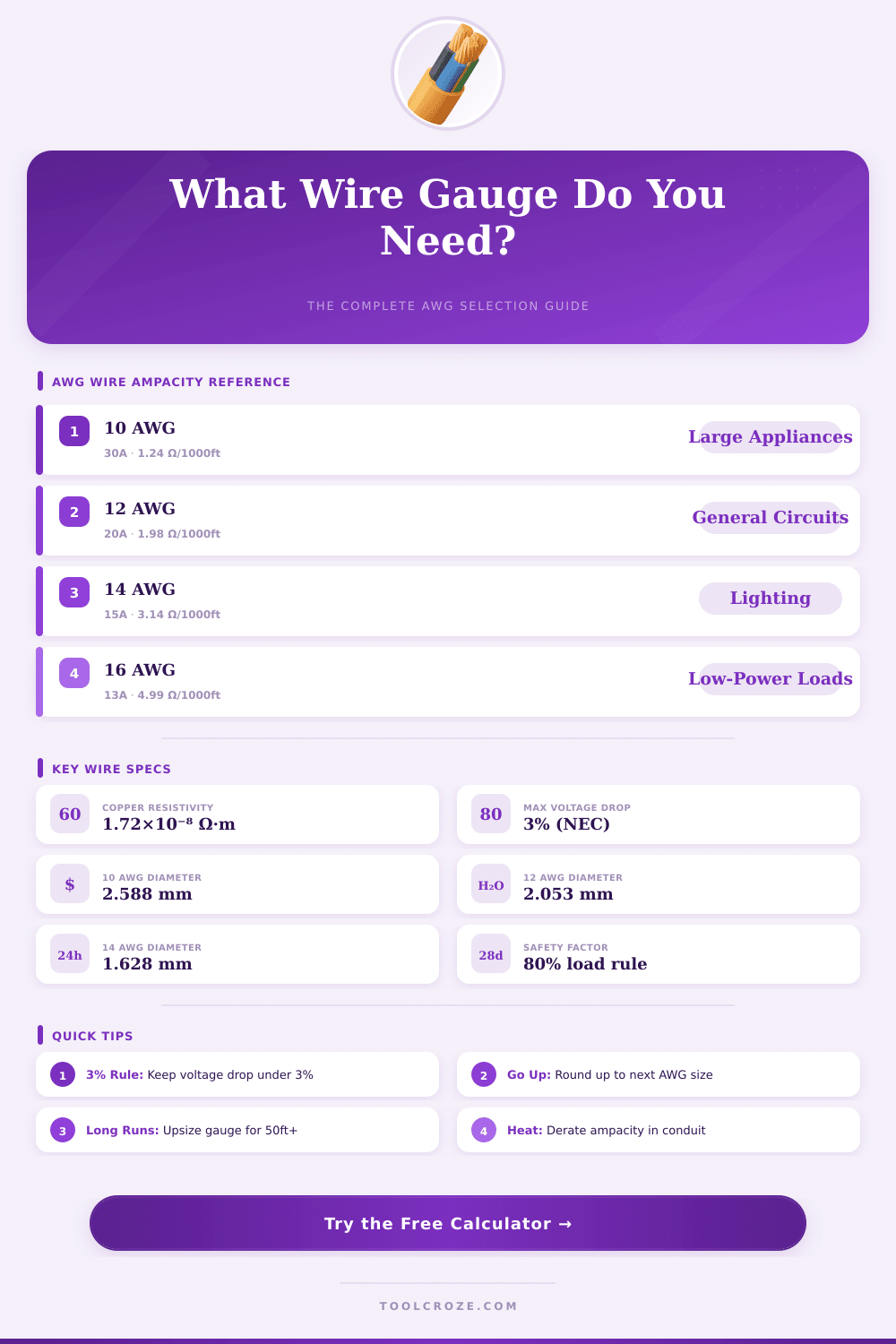
In United States, outlets usually use 14 AWG copper for 15-amp circuit or 12 AWG copper for 20-amp. For 15 amps, 14-size is enough, but 12-size gives a bit of reserve against mistakes. Using 12 AWG through a whole 20-amp circuit is the most reliable way, although it costs more and the thick wires slow the work.
One should not run anything except low-power devices, like home lamps, on 16-size Wire.
For car sound, one should not use more than 4-size power Wire for a subwoofer. The prices of car audio Wire dropped, and the gains of thick wires are worth the tiny extra cost over 8 or 10-size. 18-size Wire works for 2 to 4-amp loads, if the length does not pass some meters.
For extension cords, the advised rating depends on the amp load, cord length and allowed voltagedrop. The goal is to keep the voltage drop at around 3 to 5 percent for tender devices.
Power cords must be big enough, to avoid voltage drops between the power source and the circuit, that would pass the source sensitivity. Correctly choosing the Wire size matters always.