⚙️ Northern Tool Torque Converter Calculator
Calculate stall torque, output speed, drive ratio, and belt load for go-kart, mini bike, and small engine torque converters
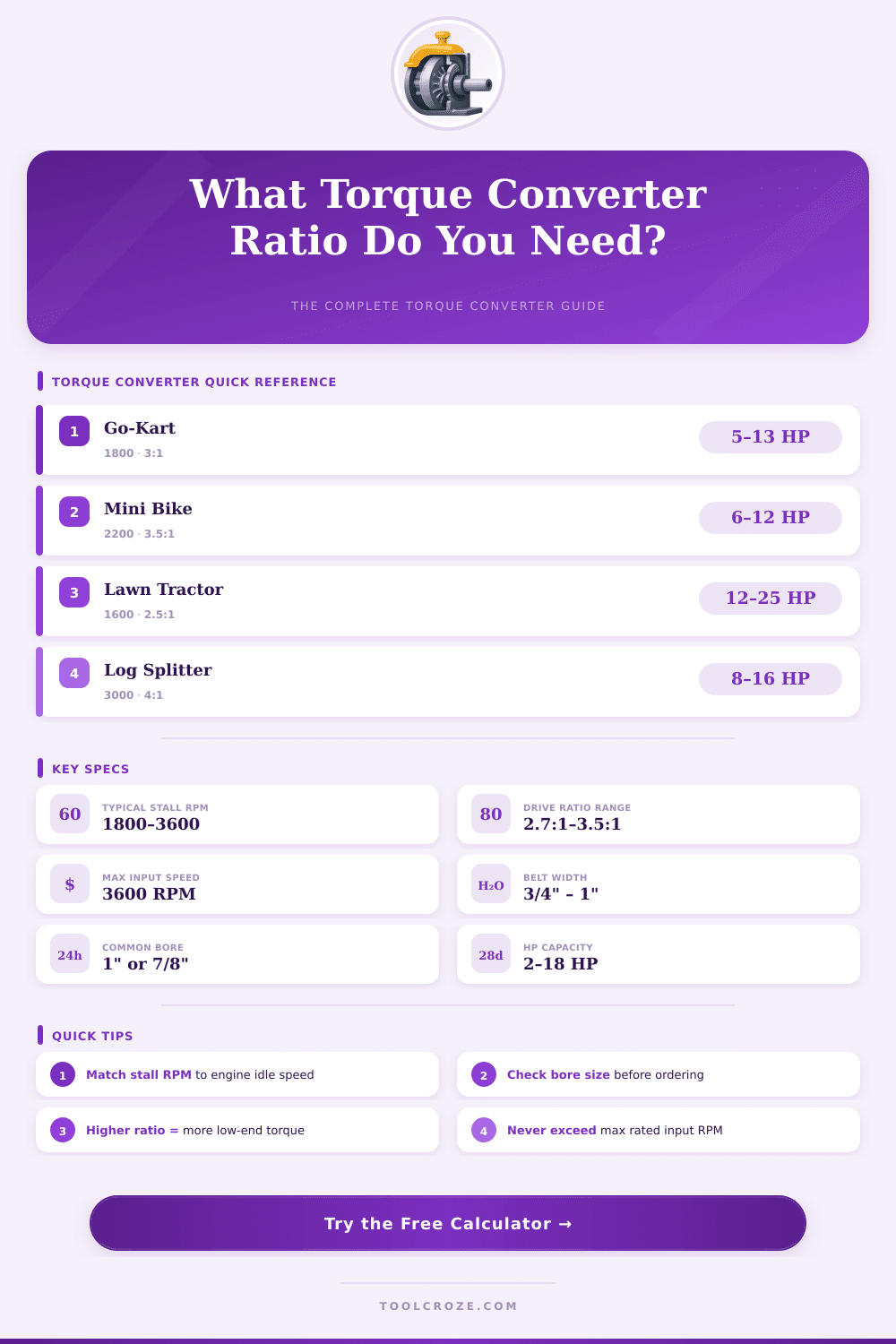
| Converter Series | HP Capacity | Belt Width | Stall RPM Range | Drive Ratio | Bore Size | Best Application |
|---|---|---|---|---|---|---|
| Comet 30 Series | Up to 8 HP | 3/4" | 1400–2200 | 3.0:1 | 3/4" or 1" | Go-karts, mini bikes (light) |
| Comet 40/44 Series | Up to 18 HP | 7/8" | 1600–3000 | 3.5:1 | 1" | Go-karts, utility vehicles |
| Comet 94C Series | Up to 25 HP | 1" | 2000–3600 | 2.7:1 | 1" or 1-1/8" | Heavy-duty, ATVs |
| Max-Torque CAT99 | Up to 13 HP | 3/4" | 1800–2800 | 3.0:1 | 3/4" or 1" | Go-karts, performance |
| Yerf-Dog Generic | Up to 6 HP | 3/4" | 1400–1800 | 2.8:1 | 3/4" | Youth karts, budget builds |
| Comet 20 Series | Up to 5 HP | 1/2" | 1200–1800 | 2.5:1 | 5/8" | Mini bikes (very light) |
| Application | Engine RPM | Stall RPM | Drive Ratio | Output RPM (High) | Typical Speed |
|---|---|---|---|---|---|
| Youth Go-Kart (5 HP) | 3000 | 1600 | 3.0:1 | 1000 | 18–25 MPH |
| Standard Go-Kart (6.5 HP) | 3600 | 1800 | 3.0:1 | 1200 | 25–35 MPH |
| Racing Go-Kart (13 HP) | 3600 | 2200 | 3.5:1 | 1030 | 35–50 MPH |
| Mini Bike (6 HP) | 3600 | 1800 | 3.0:1 | 1200 | 20–30 MPH |
| Mini Bike Heavy (10 HP) | 3600 | 2400 | 3.5:1 | 1030 | 28–40 MPH |
| Lawn Tractor (18 HP) | 3000 | 1600 | 2.5:1 | 1200 | 4–8 MPH |
| Log Splitter (8 HP) | 3600 | 3000 | 4.0:1 | 900 | PTO/Pump Drive |
| Generator Drive (5 HP) | 3600 | 2800 | 2.5:1 | 1440 | Fixed-speed drive |
| Project | Vehicle Weight | Wheel Dia. | Recommended Series | Drive Ratio | Stall RPM |
|---|---|---|---|---|---|
| Youth Kart Build | 250–300 lbs | 5" | Comet 30 | 3.0:1 | 1600 |
| Adult Kart Build | 350–450 lbs | 6" | Comet 40/44 | 3.5:1 | 1800 |
| Mini Bike Restore | 200–280 lbs | 5" | Comet 30 or Max-Torque | 3.0:1 | 1800 |
| Trail Utility Vehicle | 600–900 lbs | 10" | Comet 94C | 2.7:1 | 2200 |
| Riding Mower Rebuild | 400–700 lbs | 8" | Comet 40/44 | 3.5:1 | 1600 |
| Performance Racing Kart | 300–380 lbs | 6" | Max-Torque CAT99 | 3.0:1 | 2200 |
Torque Converters form a key part in the way autos work. They increase the torque, and that is the main advantage. Hence one calls them Torque Converters rather than simple fluid couplings.
The stator of such a converter matters a lot for doing this task well.
How to Replace a Torque Converter
When dealing with replacing a Torque Converter value to know some spots. One must use a torque wrench or socket of the right size for the bolts, that sets the converter to the flexplate. Common mistakes among beginners are not seating the converter fully in the transmission.
Installation sometimes requires a bit of pressure. Such converters cost a lot and are exactly balanced, hence one cares about them, although gentle force commonly is needed for setting them well. For control, one can insert a guide rod in the old converter, measure the depth, and then compare with the new.
Usually the splines simply do not engage perfectly.
Flexplates are needed because of the nature of this task. One option is renting it for the weekend. The procedure includes dropping the transmission, sliding the flexplate backwards, pulling the old Torque Converter, placing the new, pushing the transmission back forward and then raising it until it meets with teh engine.
For reaching the nuts of the Torque Converter, one can remove the two bolts on the back side of the bell cover at the bottom part of the transmission, and then use a socket on the front pulley to turn the engine until the nut of the converter shows. For the bolts you do not need special tools, only a ratchet and deep socket. Even so on certain machines, like the 580C, the converter must come out with special removal tools, and pulling the bell with the shuttle as a unit is the best weigh.
Replacing a Torque Converter with another with the same stall rating as the original should not change the transmission. For upgrades, stores like FTI, Revmax or Circle D offer good converters. Some autos come with stall converters in the range of 2800 to 3200 rpm.
Custom converters commonly are built to be more efficient than the standard, by using stronger internals.
Northern Tool offers torque wrenches, and some compare them to models from Harbor Freight. The Northern Tool wrenches cost around 29.99 dollars in store, rather than 9.99 dollars at Harbor Freight. The digital torque wrench from Northern Tool measures inch-pounds and foot-pounds.
Northern Tool also sells short wrenches, and the thicker metal on it feels better, with standard ones available in big sizes. A torque adapter with accuracy of about ±0.2 percent canserve as a cheap tool for calibration.