⚙️ Hydraulic Cylinder Rod Buckling Calculator
Calculate critical buckling load using Euler's formula — enter rod geometry, material, and end conditions to check if your cylinder rod is safe.
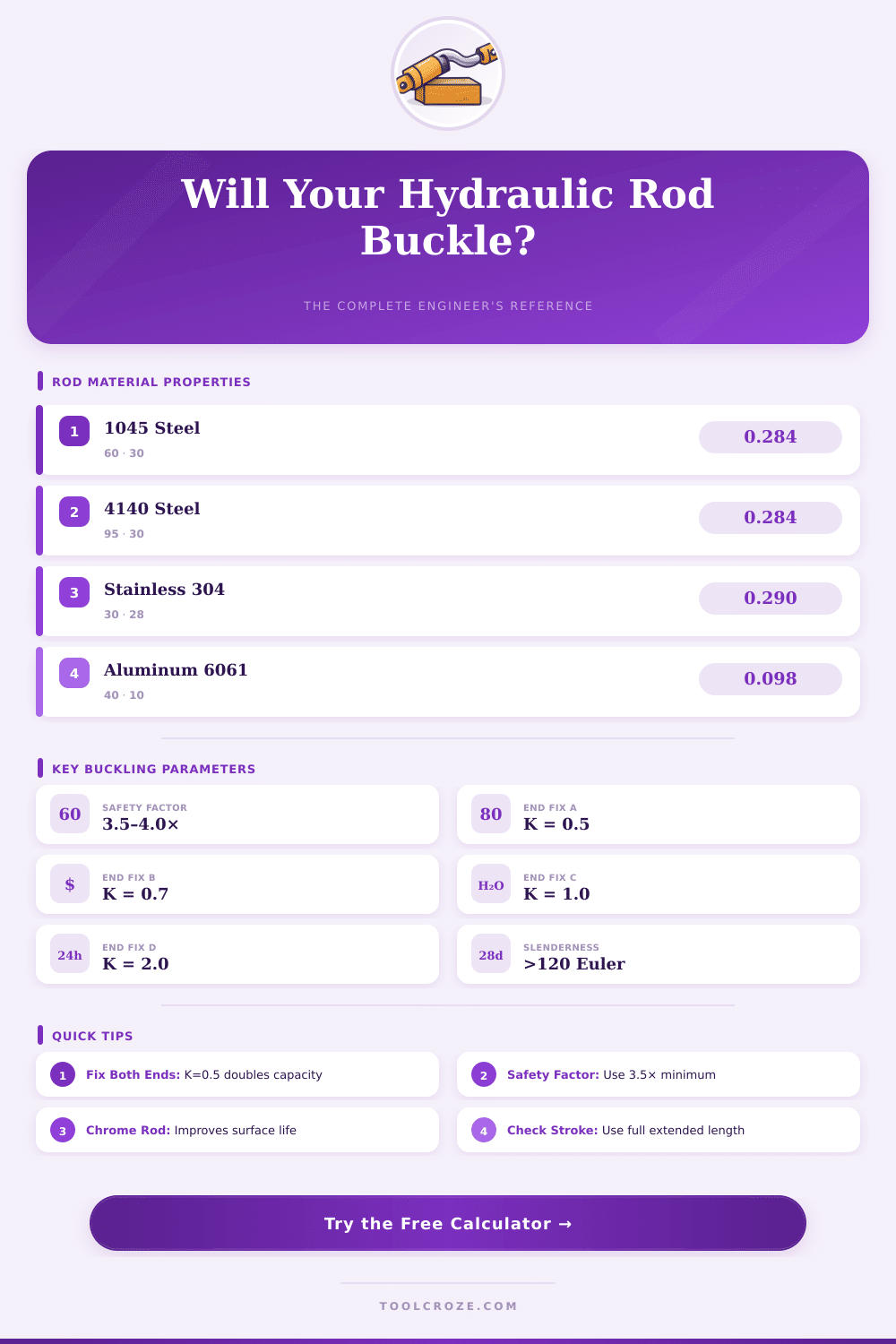
| Material | E (Mpsi) | E (GPa) | Yield (ksi) | Tensile (ksi) | Density (lb/in³) | Typical Use |
|---|---|---|---|---|---|---|
| 1045 Steel (Chrome) | 30 | 207 | 60 | 90 | 0.284 | General hydraulic cylinders |
| 4140 Alloy Steel | 30 | 207 | 95 | 110 | 0.284 | High-pressure cylinders |
| 4340 Alloy Steel | 30 | 207 | 125 | 145 | 0.284 | Heavy-duty / aerospace |
| Stainless 304 | 28 | 193 | 30 | 75 | 0.290 | Corrosive environments |
| Stainless 316 | 28 | 193 | 30 | 75 | 0.290 | Marine / chemical |
| Aluminum 6061-T6 | 10 | 69 | 40 | 45 | 0.098 | Lightweight / low pressure |
| Titanium Gr 5 | 16.5 | 114 | 120 | 130 | 0.160 | Aerospace / high strength |
| Condition | K Factor | Effective Length | Relative Capacity | Typical Cylinder Mount |
|---|---|---|---|---|
| A — Both Ends Fixed | 0.5 | L / 2 | 4× vs pinned-pinned | Rigid clevis both ends |
| B — Fixed – Pinned | 0.7 | 0.7L | 2× vs pinned-pinned | Trunnion + clevis pin |
| C — Both Ends Pinned | 1.0 | L | Baseline | Clevis both ends (standard) |
| D — Fixed – Free | 2.0 | 2L | 0.25× vs pinned-pinned | Flange mount, free end |
| Rod Dia (in) | Rod Dia (mm) | Area (in²) | I (in⁴) | r (in) | Max Pinned Load at 24in* (lbf) |
|---|---|---|---|---|---|
| 0.75 | 19 | 0.442 | 0.0155 | 0.1875 | 3,994 |
| 1.00 | 25 | 0.785 | 0.0491 | 0.2500 | 12,650 |
| 1.25 | 32 | 1.227 | 0.1198 | 0.3125 | 30,861 |
| 1.50 | 38 | 1.767 | 0.2485 | 0.3750 | 64,048 |
| 2.00 | 51 | 3.142 | 0.7854 | 0.5000 | 202,537 |
| 2.50 | 64 | 4.909 | 1.9175 | 0.6250 | 494,480 |
| 3.00 | 76 | 7.069 | 3.9761 | 0.7500 | 1,025,019 |
| 3.50 | 89 | 9.621 | 7.3662 | 0.8750 | 1,898,882 |
| 4.00 | 102 | 12.566 | 12.566 | 1.0000 | 3,240,572 |
* Critical buckling load using Euler's formula, K=1.0 (pinned-pinned), E=30 Mpsi (1045 steel), L=24 in. For reference only — always apply safety factor.
| Slenderness Ratio (KL/r) | Failure Mode | Formula to Use | Notes |
|---|---|---|---|
| < 40 | Plastic yielding dominant | P = Sy × A | Compression strength governs |
| 40 – 120 | Inelastic buckling | Johnson Parabola | Transition region — use Johnson formula |
| > 120 | Elastic (Euler) buckling | P = π²EI / (KL)² | Euler's formula applies here |
| > 200 | Highly slender | Euler's formula | Avoid — very low buckling resistance |
The rod of a hydraulic cylinder forms the base that has a really big role in every such device. It binds the piston to the head of the hydraulic cylinder. It moves always forward and backwards what causes friction, so it requires to meet strict technical standards.
Rods usually are made of cold rolled steel, later covered by a thick chrome layer. That extra layer is about 0.001 inches thick, which gives the surface hardness between 69 and 71 according to Rockwell C. Like this the outside becomes much more resistant. Currently there are two main kinds of rods.
Hydraulic Cylinder Rods and How to Care for Them
One of them have only chromium on the surface and stay soft inside. The second kind passes through hardening and chrome plating, so the outer quarter of the diameter receives deep hard coating, while the inside stays more flexible.
Even so not all rods have chromium or hardening. Some are made from simple steel, and even from stainless. For use only indoors, rod from plain base steel without chromium happens more commonly than many believe.
Chromium is not always needed, when the rod does not face heavy conditions.
Common materials for rods include 1045-steel and 4140-steel, both with chrome plating. One buys rods from specialists in hydraulics as commodity, and them one forms according too need of the finishes. Removing chromium for threads is a usual process.
Under the chrome layer the rod stays soft and easily machined.
About the hydraulic cylinder itself, the step from that exits the rod is called rod finish. The other step is the blind finish. Hydraulic fluid flows in and out through holes in the body.
If pressure touches the piston, the hydraulic cylinder extends. If pressure touches the rod part, it retracts. In reality hydraulic cylinders make bigger force during extending than while retracting, because of the different areas of the piston and the rod side.
Hydraulic cylinders with tied rod enjoy popularity, because one easily takes them apart for attention. They have clevis settings and allow quick taking apart for repair. Many such hydraulic cylinders with tied rod are standard items in stocks, so one delivers them soon.
Some of them last until 2500 PSI working pressure and use tubes from highly strong cold-drawn steel for more durability.
Scratches and marks on rods commonly force leaks. Even little rust spots or dents can damage seals and cause messes. Replacing chromium is a typical repair, that many hydraulic workshops offer.
Some turn to special products like Belzona 1121 for heavy scratches and dents. Without good chromium seals quickly fail. Fixing a hydraulic cylinder in a workshop can cost some hundreds of dollars, if one does not replace therod, so sometimes one simply buys new for more sense.