⚙️ Hydraulic Cylinder Force Calculator
Calculate push force, pull force, cylinder speed, flow rate, and power for any hydraulic cylinder
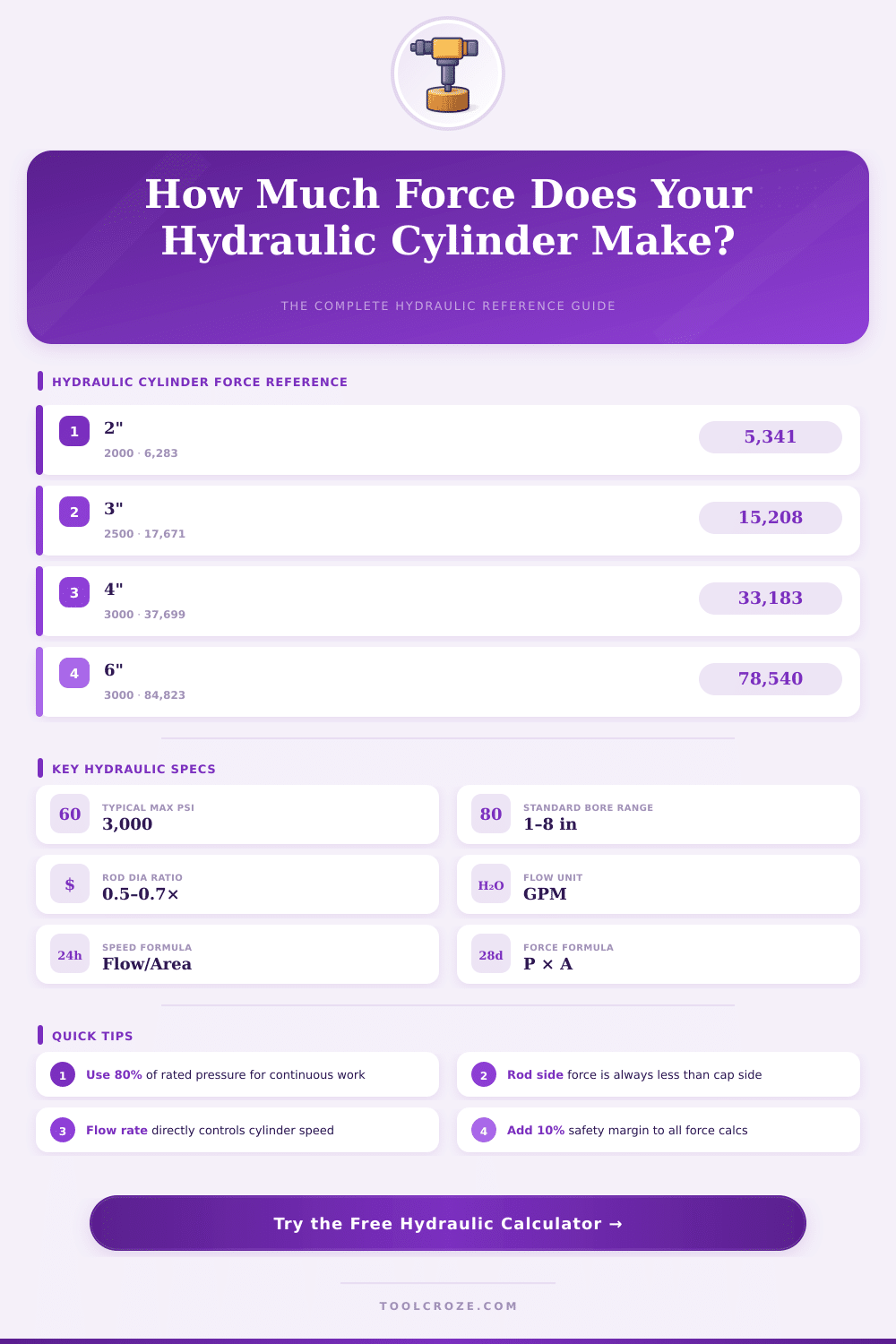
| Bore (in) | Rod (in) | @ 1500 PSI Push (lbf) | @ 2500 PSI Push (lbf) | @ 3000 PSI Push (lbf) | @ 2500 PSI Pull (lbf) |
|---|---|---|---|---|---|
| 1.5 | 0.75 | 2,651 | 4,418 | 5,301 | 3,529 |
| 2.0 | 1.0 | 4,712 | 7,854 | 9,425 | 6,283 |
| 2.5 | 1.25 | 7,363 | 12,272 | 14,726 | 9,817 |
| 3.0 | 1.5 | 10,603 | 17,671 | 21,206 | 14,137 |
| 3.5 | 1.75 | 14,434 | 24,053 | 28,864 | 19,242 |
| 4.0 | 2.0 | 18,850 | 31,416 | 37,699 | 25,133 |
| 5.0 | 2.5 | 29,452 | 49,087 | 58,905 | 39,270 |
| 6.0 | 3.0 | 42,412 | 70,686 | 84,823 | 56,549 |
| Bore (in) | Flow 5 GPM (in/min) | Flow 10 GPM (in/min) | Flow 15 GPM (in/min) | Flow 20 GPM (in/min) | Flow 30 GPM (in/min) |
|---|---|---|---|---|---|
| 2.0 | 116.0 | 232.0 | 347.9 | 463.9 | 695.9 |
| 3.0 | 51.6 | 103.1 | 154.7 | 206.3 | 309.4 |
| 4.0 | 29.0 | 58.0 | 87.0 | 116.0 | 174.0 |
| 5.0 | 18.6 | 37.1 | 55.7 | 74.3 | 111.4 |
| 6.0 | 12.9 | 25.8 | 38.7 | 51.6 | 77.4 |
| Application | Typical Pressure | Typical Bore Range | Typical Flow | Typical Max Force |
|---|---|---|---|---|
| Agricultural Equipment | 1,500–2,000 PSI | 1.5"–3" | 5–15 GPM | Up to 28,000 lbf |
| Construction / Excavator | 3,000–5,000 PSI | 2.5"–8" | 20–60 GPM | Up to 400,000 lbf |
| Log Splitter | 2,000–3,000 PSI | 2"–5" | 3–10 GPM | Up to 60,000 lbf |
| Hydraulic Press | 2,500–5,000 PSI | 3"–12" | 5–20 GPM | Up to 500+ tons |
| Mobile Hydraulics | 2,000–3,500 PSI | 2"–6" | 10–40 GPM | Up to 150,000 lbf |
| Industrial Machinery | 1,000–3,000 PSI | 1.5"–5" | 5–30 GPM | Up to 100,000 lbf |
| Bore (mm) | Rod (mm) | @ 100 bar Push (kN) | @ 200 bar Push (kN) | @ 250 bar Push (kN) | @ 200 bar Pull (kN) |
|---|---|---|---|---|---|
| 40 | 22 | 12.6 | 25.1 | 31.4 | 17.3 |
| 50 | 28 | 19.6 | 39.3 | 49.1 | 27.0 |
| 63 | 36 | 31.2 | 62.4 | 78.0 | 42.4 |
| 80 | 45 | 50.3 | 100.5 | 125.7 | 68.4 |
| 100 | 56 | 78.5 | 157.1 | 196.3 | 108.5 |
| 125 | 70 | 122.7 | 245.4 | 306.8 | 168.0 |
| 160 | 90 | 201.1 | 402.1 | 502.7 | 274.9 |
The force of a hydraulic cylinder simply comes from the energy that it gives to finish tasks, whether one raises heavy objects, push, draw or move things from one place to another, from spot A to B. One commonly calls it the skill to lift loads, and truly it means the cylinder will last the work that you lay on it.
Here the key cause: the made force depends on two main things that are involved. Multiply the hydraulic pressure by the usable area of the plunger, and you receive the result. It is simple…
How to Calculate Hydraulic Cylinder Force
The formula for force in pounds matches pressure in PSI times the area of the plunger in square inches. So everything turns around the level of pressure that you use, and the size of the plunger itself.
When one pumps hydraulic fluid in the cylinder, it pushes the front of the plunger. The harder one pushes that fluid, so with higher pressure, the biggre force the plunger creates. That force then directly applies to the needs of the work.
Combine big diameter of the cylinder with strong hydraulic pressure, and you have the secret for mighty push.
To estimate the area of the plunger, use only basic geometry. Take the number pi, multiply it by the square of the diameter, then divide by four. That is the usual calculation for circles, that you probably learnt before.
If you want a fast idea about the force or the tonnage, simply multiply your maximum pressure by that area of the plunger.
Now about double-sided cylinders, they work in both directions. But hear it becomes interesting: the force does not stay same in both ways. During draw, the rod of the plunger takes space, what closes part of the inner area of the cylinder.
That gives less surface for the fluid to act. Because of that the force during draw needs another formula, subtract the area of the rod from that of the cylinder, then multiply the difference by the pressure.
There is also beauty in how forces move between cylinders of different sizes. Push 100 pounds on a smaller plunger, and a bigger cylinder on the other end gives a stronger result. But if the diameters match, what enters, exits likewise, 100 pounds stay 100 pounds.
Move one plunger in six inches, and the other also travels just as long.
Steady pressure keeps the force stable. Here is why good design of the plunger and good seals are so important… They help to keep the pressure steady and everything under control.
When the diameter of the cylinder grows, you need to strengthen the wall and the whole structure to last it, even if the pressure stays the same. For any work with hydraulic machinery, understanding how one makes and counts force is absolutelykey. Use the right force for every task, and everything will run smooth and well.
The bigger the cylinder, the more ability to lift you have available.