🔧 Hydraulic Cylinder Flow Rate Calculator
Calculate flow rate, piston speed, cycle time & force for any hydraulic cylinder — imperial or metric
| Bore (in) | Std Rod (in) | Cap Area (in²) | Rod Area (in²) | Net Area (in²) | Ratio (rod/bore) |
|---|---|---|---|---|---|
| 1.5 | 0.625 | 1.77 | 0.31 | 1.46 | 0.42 |
| 2.0 | 1.0 | 3.14 | 0.79 | 2.36 | 0.50 |
| 2.5 | 1.25 | 4.91 | 1.23 | 3.68 | 0.50 |
| 3.0 | 1.5 | 7.07 | 1.77 | 5.30 | 0.50 |
| 3.5 | 1.75 | 9.62 | 2.41 | 7.21 | 0.50 |
| 4.0 | 2.0 | 12.57 | 3.14 | 9.43 | 0.50 |
| 5.0 | 2.5 | 19.63 | 4.91 | 14.73 | 0.50 |
| 6.0 | 3.0 | 28.27 | 7.07 | 21.21 | 0.50 |
| 7.0 | 3.5 | 38.48 | 9.62 | 28.86 | 0.50 |
| 8.0 | 4.0 | 50.27 | 12.57 | 37.70 | 0.50 |
| Piston Speed (in/s) | Extend Flow (GPM) | Retract Flow (GPM) | Extend Force (lbf) | Retract Force (lbf) | Power (HP) |
|---|---|---|---|---|---|
| 1.0 | 3.3 | 2.4 | 31,416 | 23,562 | 1.9 |
| 2.0 | 6.5 | 4.9 | 31,416 | 23,562 | 3.8 |
| 3.0 | 9.8 | 7.3 | 31,416 | 23,562 | 5.7 |
| 4.0 | 13.1 | 9.8 | 31,416 | 23,562 | 7.6 |
| 5.0 | 16.3 | 12.2 | 31,416 | 23,562 | 9.5 |
| 6.0 | 19.6 | 14.7 | 31,416 | 23,562 | 11.4 |
| 8.0 | 26.2 | 19.6 | 31,416 | 23,562 | 15.2 |
| 10.0 | 32.7 | 24.5 | 31,416 | 23,562 | 19.0 |
| Fluid Type | Viscosity (cSt @ 40°C) | Max Pressure (PSI) | Temp Range (°F) | Vol. Eff. Impact |
|---|---|---|---|---|
| Mineral Oil ISO 32 | 32 | 5000 | 14 to 176 | None |
| Mineral Oil ISO 46 | 46 | 5000 | 14 to 203 | None |
| Mineral Oil ISO 68 | 68 | 5000 | 32 to 212 | None |
| Water-Glycol | 46 | 2500 | 14 to 140 | –3 to –5% |
| Phosphate Ester | 46 | 4000 | 32 to 212 | –1 to –2% |
| Biodegradable HEES | 46 | 4000 | 14 to 203 | –2 to –3% |
| Application | Bore (in) | Stroke (in) | Pressure (PSI) | Flow (GPM) | Speed (in/s) |
|---|---|---|---|---|---|
| Log Splitter | 2.0–3.0 | 24–30 | 2000–3000 | 3–10 | 2–4 |
| Dump Truck Hoist | 4.0–5.0 | 48–96 | 2500–3000 | 10–25 | 2–5 |
| Excavator Arm | 4.0–6.0 | 36–60 | 3000–4500 | 15–40 | 3–8 |
| Hydraulic Press | 4.0–8.0 | 12–24 | 2500–5000 | 2–15 | 1–3 |
| Tractor 3-Point | 2.5–3.5 | 8–16 | 2000–2500 | 4–10 | 3–6 |
| Forklift Mast | 2.5–4.0 | 60–120 | 2000–3000 | 5–15 | 3–6 |
| Steering Cylinder | 2.0–2.5 | 6–12 | 1500–2500 | 2–6 | 4–10 |
| Snow Plow Angle | 1.5–2.0 | 6–10 | 1500–2500 | 1–4 | 3–8 |
The flow control is simply the control of any hydraulic device, it decided how quickly the cylinder truly moves. The speed of your hydraulic cylinder and the response of the whole setup depends entirely on the amount of fluid that you push through it. If you lose the flow, you lose the speed.
That is very direct cause.
How Flow Controls Hydraulic Cylinder Speed
Here the basic idea behind everything. The speed of the piston rod comes from simple relation: flow divided by the useful surface of the piston. Otherwise said, V match Q divided by Ae.
V show the speed, Q the flow, and Ae the useful area, that works against the load. If you double the flow in the hydraulic cylinder, the piston move twice more quickly. One hydraulic cylinder, that receives 5 gallons in minute, will move at half the pace of that, that has 10 gallons in minute, if everything else stays same.
Good part of all this is, that the flow stays steady, no matter how heavy a load you push against. A hydraulic cylinder, that moves at 0.1 metre in second, will maintain exactly that speed, whether it raises 10 kilos or 100. The total flow does not adjust, because the moiton itself does not affect it.
Here where things become tricky: hydraulic cylinders do not extend and withdraw at same pace, and that surprises many. During extension you have the whole surface of the piston for work. During retraction the rod takes space in the hydraulic cylinder, so that stay only a smaller ring area for push.
Because speed matches flow divided by area, that smaller surface during retraction does the pull faster. Same flow, fewer area, more motion. The rod also reduces the force, that you can make during retraction, because it reduces the working surface.
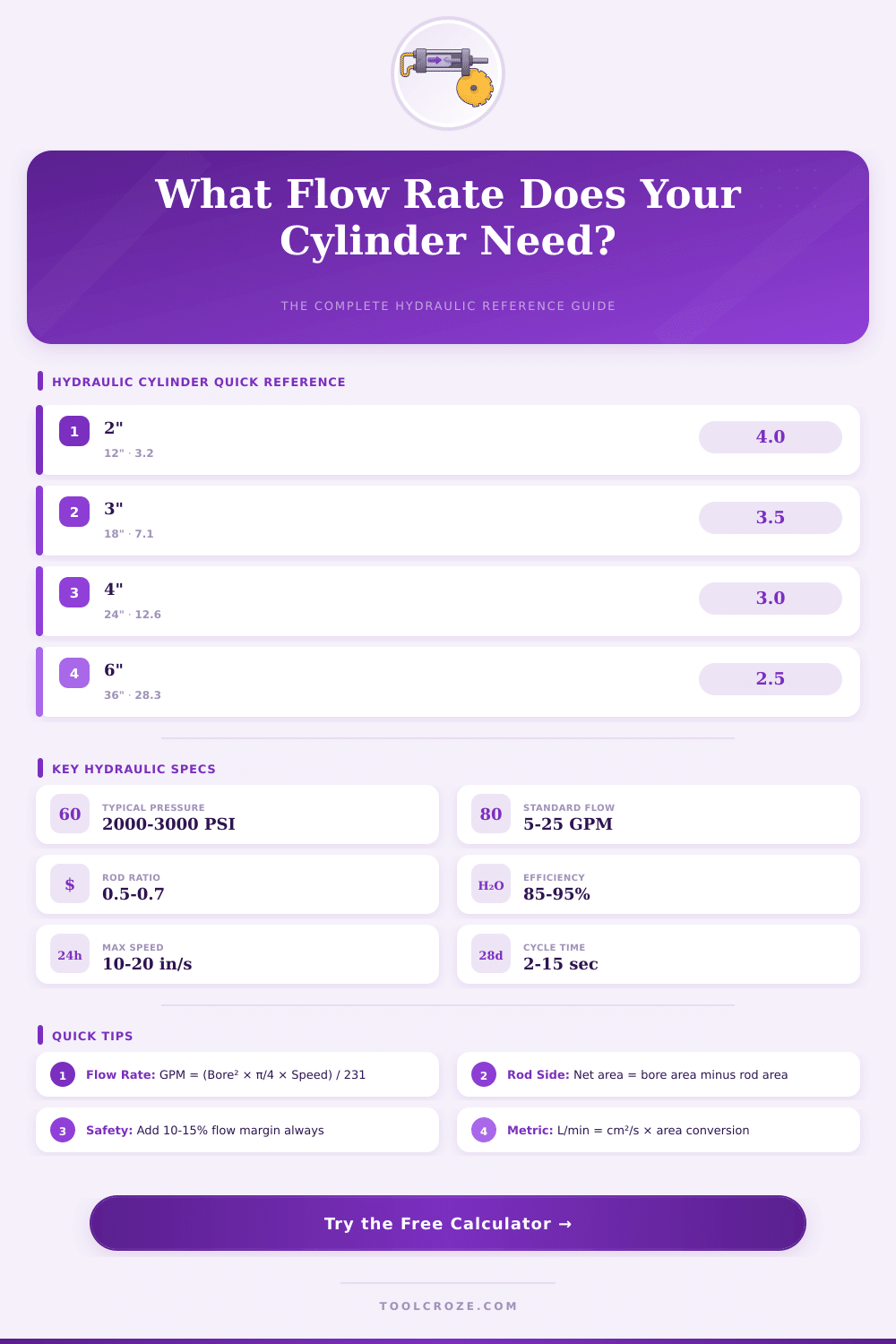
The math for all this exists, and it is not that hard. To find the extension speed in inches per minute, you divide the flow in cubic inches per minute buy the internal area in square inches. If you work with gallons per minute, the calculation becomes a bit more tricky: you multiply 12 by 60, then by the cylinder speed in feet per second and the area in square inches, then divide by 231 to convert cubic inches to gallons.
Simple control valves are truly the center for controlling the speed of the device. In most systems one slows the hydraulic cylinders by restricting the flow at the ports themselves. Such valves install directly at the ports or the lines, that feed them.
If you cut the main flow and force the fluid through a smaller opening, the pressure drops mount, the flow drops, and your hydraulic cylinder slows down exactly.
When you install a system with several hydraulic cylinders, that operate together, you must add the needs of each to get the whole flow demand. Do not forget to count for actual losses, pressure drops, fluid leaks and errors in valves and hydraulic cylinders add up. Beyond the formulas, also the mechanical efficiency, the behavior of the fluid andthe skill of the materials all play their role.