🔌 Extension Cord Size Calculator
Find the correct wire gauge, check voltage drop, and verify safe amperage for any cord length and load.
| Gauge (AWG) | Resistance (Ω/1000ft) | Resistance (Ω/km) | Max Amps (Cord) | Max Amps (In-Wall) | Typical Use |
|---|---|---|---|---|---|
| 18 AWG | 6.39 | 20.9 | 10A | 14A | Lamp cords, light loads |
| 16 AWG | 4.99 | 16.4 | 13A | 18A | TVs, fans, small tools |
| 14 AWG | 3.14 | 10.3 | 15A | 20A | Power tools, heaters |
| 12 AWG | 1.98 | 6.53 | 20A | 25A | Heavy tools, compressors |
| 10 AWG | 1.24 | 4.07 | 30A | 35A | Large compressors, welders |
| 8 AWG | 0.778 | 2.55 | 40A | 55A | Industrial / generator loads |
| 6 AWG | 0.491 | 1.61 | 55A | 75A | Large generator, sub-panel |
| Gauge (AWG) | 25 ft Drop | 50 ft Drop | 100 ft Drop | 150 ft Drop | 200 ft Drop |
|---|---|---|---|---|---|
| 18 AWG | 2.4V (2.0%) | 4.8V (4.0%) | 9.6V (8.0%) | 14.4V (12.0%) | 19.2V (16.0%) |
| 16 AWG | 1.9V (1.6%) | 3.7V (3.1%) | 7.5V (6.2%) | 11.2V (9.3%) | 15.0V (12.5%) |
| 14 AWG | 1.2V (1.0%) | 2.4V (2.0%) | 4.7V (3.9%) | 7.1V (5.9%) | 9.4V (7.8%) |
| 12 AWG | 0.7V (0.6%) | 1.5V (1.2%) | 3.0V (2.5%) | 4.5V (3.7%) | 5.9V (4.9%) |
| 10 AWG | 0.5V (0.4%) | 0.9V (0.8%) | 1.9V (1.6%) | 2.8V (2.3%) | 3.7V (3.1%) |
| Cord Type | Jacket Rating | Indoor / Outdoor | Temp Range | Common Gauge | Typical Use |
|---|---|---|---|---|---|
| SPT-1 / SPT-2 | Thermoplastic | Indoor only | 0° to 60°C | 16–18 AWG | Lamps, phone chargers |
| SJT | Thermoplastic | Indoor | -10° to 60°C | 14–16 AWG | Small appliances |
| SJTW | Thermoplastic, Weather | Indoor/Outdoor | -40° to 60°C | 12–16 AWG | Outdoor tools, general |
| STW | Thermoplastic, Water | Indoor/Outdoor/Wet | -40° to 60°C | 10–14 AWG | Wet environments, pumps |
| SOW | Rubber, Oil/Water Res. | Heavy outdoor/industrial | -40° to 90°C | 10–12 AWG | Construction, generators |
| SEOW | Elastomer, Oil Res. | Industrial/outdoor | -40° to 90°C | 8–12 AWG | Industrial equipment |
| Appliance / Tool | Typical Amps | Typical Watts | Min Cord Gauge | Notes |
|---|---|---|---|---|
| LED / CFL Lights | 0.5–1A | 5–100W | 18 AWG | Very low draw |
| Laptop / Phone Charger | 1–3A | 45–300W | 18 AWG | Low draw |
| Box Fan / Ceiling Fan | 1–4A | 50–400W | 16 AWG | Inductive load |
| TV / Monitor | 1–4A | 50–400W | 16 AWG | Resistive/electronic |
| Power Drill | 4–9A | 500–1000W | 14 AWG | Motor load |
| Shop Vacuum | 7–12A | 800–1400W | 14 AWG | Motor load |
| Space Heater | 8–15A | 1000–1500W | 14 AWG | Resistive, sustained |
| Circular Saw | 12–15A | 1400–1800W | 12 AWG | High startup current |
| Table Saw | 15–20A | 1800–2400W | 12 AWG | Dedicated circuit ideal |
| Air Compressor (small) | 12–15A | 1500–1800W | 12 AWG | High startup, 3x FLA |
| Air Compressor (large) | 15–25A | 2000–3000W | 10 AWG | High startup |
| Welder (small MIG) | 20–30A | 2400–3600W | 10 AWG | Check duty cycle |
Choosing the right size of extension cord matters more than many folks think. If the extension cord is too thin for the task, it can cause heat buildup and reduce the flow of power. The main trouble happens because of buildup of heat and energy because of the resistance inside the cord.
So that is the reason to choose it well.
How to Pick the Right Extension Cord Size
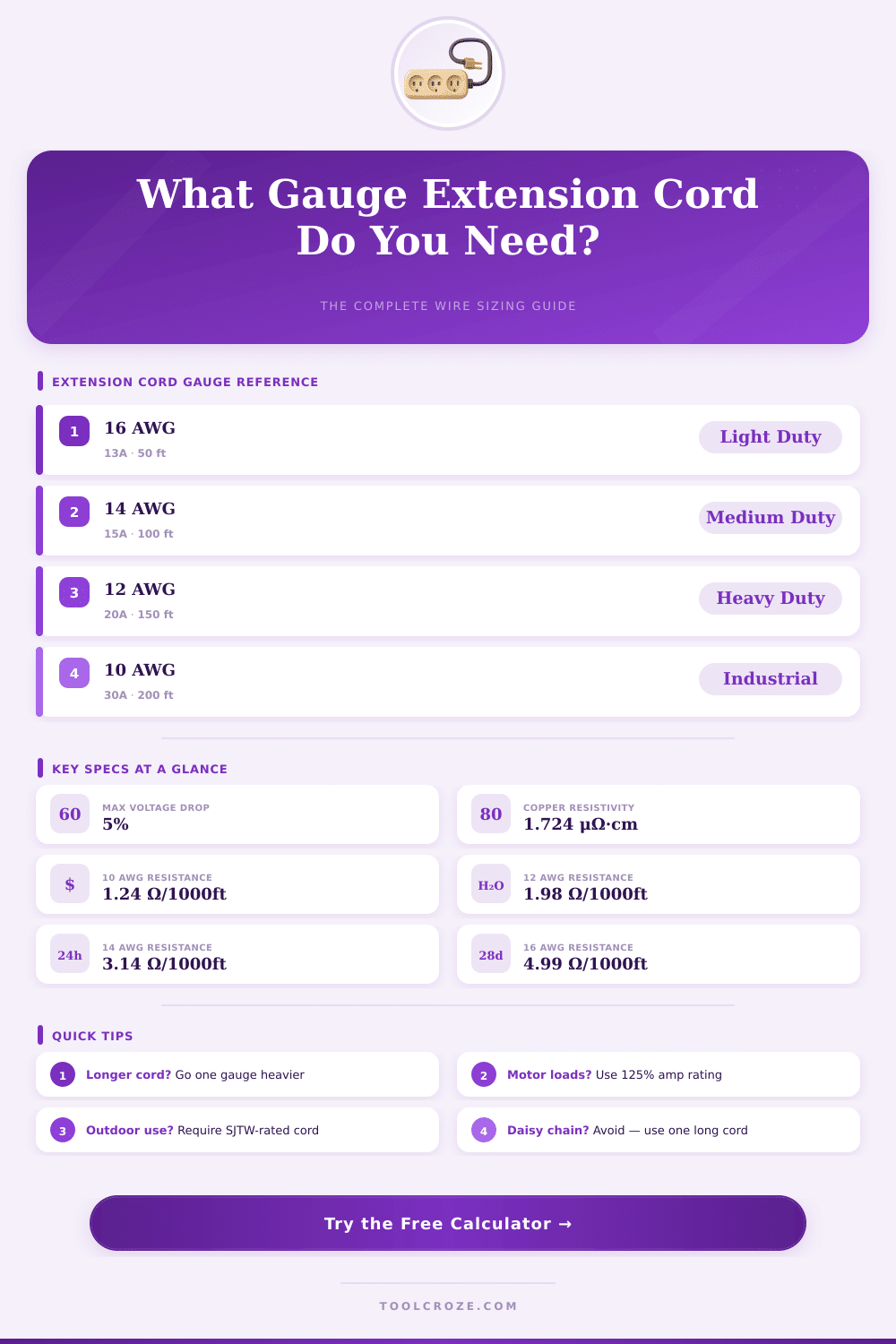
The size of extension cord one measures by AWG, what stands for American Wire Gauge. The numbers go from 18 to 8 or 10. Here the trick: a lower number shows thicker cord.
Like this, 12-gauge cord carries more energy than 16-gauge. For lamps one usually uses 18-gauge. 12-gauge are heavy and hold 20 amps.
8-gauge cord belongs to the thickets cords available.
Labels like 16/3 appear on many cords. The first number points the gauge of the wire, and the second says how many conductors it carries. For instance 12/3 has wire of 12-gauge with three conductors: neutral, hot and ground.
For light tasks extension cord of 18 AWG, 16 AWG or 14 AWG works. The best choice depends on the length of the cable. For heavy jobs one chooses 14 AWG, 12 AWG or 10 AWG.
With 14/3 cord you can safely reach 12 to 13 amps. Many users find this size enough for most tasks.
Also the length matters a lot. Home extension cord usually runs 6 to 15 feet. For distances above 50 feet, one should use thicker cord, too escape voltage drop because of the natural resistance of the wire.
A 100-foot cord creates high resistance, so one does not find them for more than 15 amps. Small tools commonly work well on a 100-foot 16-gauge cord.
Cheap extension cord sometimes seems thicker because of extra coating. Always check the real gauge marked on it. Search the number with AWG after it.
Buying 12-gauge cord is a good choice. Rather than have several different, one 12-gauge serves for almost everything. Simply take it and use.
A 25-foot length reaches the most in a garage and coils up easily. Good cords last years, if one cares for them. A handy set is made up of one 100-foot, two 50-foot and two 25-footcords.
Other parts, like voltage and types of settings, also matter, but they belong to other topics than the size of the cord itself.