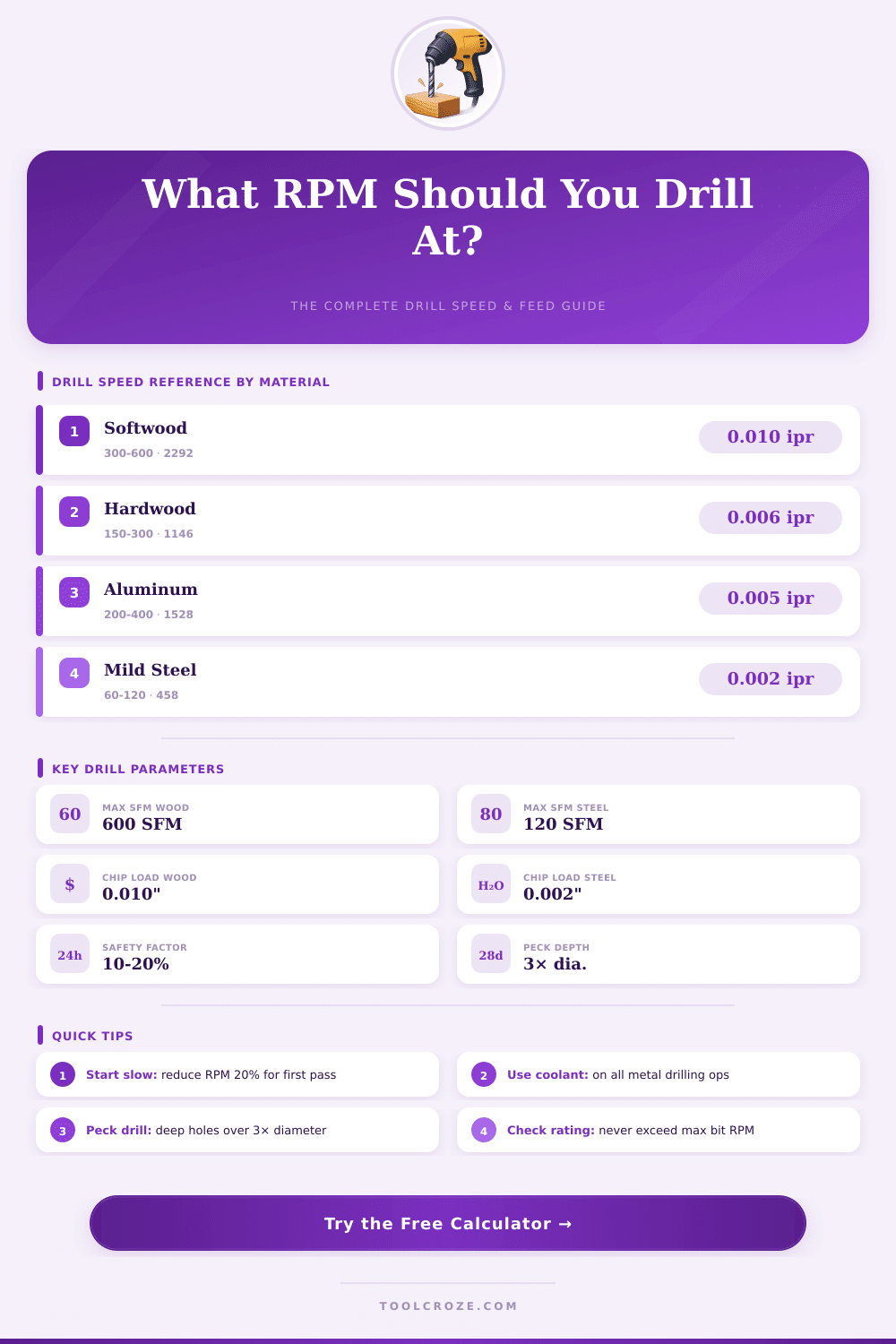
🔧 Drill Speed & Feed Calculator
Calculate recommended RPM, feed rate, cutting time, and more for any drill bit and material combination.
| Material | SFM Range | RPM (1/4" bit) | RPM (1/2" bit) | RPM (3/4" bit) | Feed Rate (ipr) | Chip Load (in) |
|---|---|---|---|---|---|---|
| Softwood | 300–600 | 4,584–9,167 | 2,292–4,584 | 1,528–3,056 | 0.008–0.012 | 0.008–0.012 |
| Hardwood | 150–300 | 2,292–4,584 | 1,146–2,292 | 764–1,528 | 0.005–0.009 | 0.005–0.009 |
| Plywood / OSB | 250–500 | 3,820–7,639 | 1,910–3,820 | 1,273–2,546 | 0.006–0.010 | 0.006–0.010 |
| MDF | 300–500 | 4,584–7,639 | 2,292–3,820 | 1,528–2,546 | 0.006–0.010 | 0.006–0.010 |
| Aluminum | 200–400 | 3,056–6,111 | 1,528–3,056 | 1,019–2,037 | 0.003–0.006 | 0.003–0.006 |
| Mild Steel | 60–120 | 917–1,833 | 458–917 | 306–611 | 0.001–0.003 | 0.001–0.003 |
| Stainless Steel | 20–50 | 306–764 | 153–382 | 102–255 | 0.001–0.002 | 0.001–0.002 |
| Cast Iron | 50–80 | 764–1,222 | 382–611 | 255–407 | 0.002–0.004 | 0.002–0.004 |
| Acrylic / Plastics | 200–400 | 3,056–6,111 | 1,528–3,056 | 1,019–2,037 | 0.004–0.008 | 0.004–0.008 |
| Brass / Bronze | 100–200 | 1,528–3,056 | 764–1,528 | 509–1,019 | 0.003–0.005 | 0.003–0.005 |
| Bit Type | Flutes | Point Angle | Max RPM (1/2") | Best Materials | Notes |
|---|---|---|---|---|---|
| HSS Twist Drill | 2 | 118° | 3,500 | Wood, Plastic, Soft Metal | General purpose, widely available |
| HSS Coated (TiN) | 2 | 118° | 4,000 | Steel, Aluminum, Stainless | +50% longer life vs plain HSS |
| Cobalt (M35) | 2 | 135° | 3,800 | Stainless, Hardened Steel | Best for tough metals, heat resistant |
| Solid Carbide | 2–4 | 130° | 15,000+ | All materials (with coolant) | Longest life, brittle — use rigid setup |
| Brad Point | 2 | 180° spur | 2,500 | Wood only | Clean holes, no walking, no metal |
| Spade Bit | 2 | Flat | 1,500 | Softwood, Plywood | Large holes, rough finish acceptable |
| Forstner Bit | 2 | Flat with rim | 1,200 | Hardwood, Plywood, MDF | Flat-bottom holes, very clean finish |
| Step Drill | 2 | 135° | 3,000 | Thin Sheet Metal, Plastic | Multiple hole sizes, sheet metal specialty |
| Bit Size (in) | Bit Size (mm) | Wood RPM | Steel RPM | Alum. RPM | Feed (ipr) Wood | Feed (ipr) Steel |
|---|---|---|---|---|---|---|
| 1/16" (0.0625) | 1.6 mm | 18,333 | 3,667 | 12,222 | 0.004 | 0.001 |
| 1/8" (0.125) | 3.2 mm | 9,167 | 1,833 | 6,111 | 0.005 | 0.001 |
| 3/16" (0.1875) | 4.8 mm | 6,111 | 1,222 | 4,074 | 0.006 | 0.001 |
| 1/4" (0.25) | 6.35 mm | 4,584 | 917 | 3,056 | 0.007 | 0.002 |
| 5/16" (0.3125) | 7.9 mm | 3,667 | 733 | 2,444 | 0.008 | 0.002 |
| 3/8" (0.375) | 9.5 mm | 3,056 | 611 | 2,037 | 0.008 | 0.002 |
| 1/2" (0.5) | 12.7 mm | 2,292 | 458 | 1,528 | 0.010 | 0.003 |
| 5/8" (0.625) | 15.9 mm | 1,833 | 367 | 1,222 | 0.011 | 0.003 |
| 3/4" (0.75) | 19.1 mm | 1,528 | 306 | 1,019 | 0.012 | 0.004 |
| 1" (1.0) | 25.4 mm | 1,146 | 229 | 764 | 0.014 | 0.005 |
Get the right drill pace and step depend on good balance. The used pace ranges according to the best mix of various parts. With time, one learns more to set the pace, choose the tool and improve the product, so that the drilling stay cost efficient.
The pace points where haste twists the drill, usually in RPM. The step gives the tool motion along the axis of the future hole. Both these parts matter, and mistakes in their setup can create troubles soon.
Setting the Right Drill Speed and Feed
One finds handy formulas for that count. The surface feet in minute gets value from 0.2618 times drill diameter times RPM. Inches in revolution matches inches in revolution, multiplied by means of RPM.
Those formulas take data as surface pace and diameter of the tool for finding the drill pace, and they consider the number of flutes, drill pace and load of the chip for guessing the step.
Handy thumb rule for drilling iron materials say, that the step matches 0.001 inches in revolution for every 1/16-inch of drill diameter, plus or minus 0.001 inches totally. For the pace, one aims at 80 surface feet in minute for lightweight work in material of 100 Brinell hardness, and one drops by 10 surface feet for every extra 50 points of Brinell hardness. Simple other way for drill pace is split the cutting pace each four by the diameter of the bit.
For low-carbon steel the usual pace is around 100. So, 400 divided by diameter of the bit gives the RPM. In bigger bit, the pace slows and the step grows.
The pace is inversely tied too the diameter of the drill. It really matters.
Some starting advice is set the drill pace between 700 and 1000 RPM for steel, or around 2000 for aluminum. When colored chips or fast wear of the drill appear, one slows the work. The settings of pace and step are only suggested start values, that one can expand under good conditions of the work.
Deep holes need special care. One calls deep hole something more than five times the diameter. The deeper the hole, the harder one gets the chips out.
So, one should drop the pace and step, where deeper the hole is. The peck drilling helps to remove chips from deep holes.
For stainless steel, one needs stronger step pressure, so that the bit cuts instead of rubbing the surface. Lightweight drill pressure does not give enough weight. Big machines nicely handle hard materials.
Running a drill too quickly without right step candestroy the bit soon. Only the pace does not suffice. The good balance between pace and step stops the drill from overheating and making red-hot havoc instead of good chips.