💎 Diamond Saw Blade RPM Calculator
Calculate optimal RPM, surface speed (SFM), feed rate & cutting time for diamond blades on any material
| Material | Rec. SFM | Mohs Hardness | Grit Bond | Wet / Dry | Blade Type |
|---|---|---|---|---|---|
| Concrete (Standard) | 9,000–9,500 | 6–7 | Soft bond | Both | Segmented |
| Reinforced Concrete | 6,000–7,000 | 6–7 | Medium bond | Wet preferred | Segmented |
| Asphalt | 10,000–11,000 | 5–6 | Soft bond | Dry | Segmented |
| Granite | 8,500–9,500 | 6–7 | Hard bond | Wet | Continuous rim |
| Marble | 7,500–8,500 | 3–4 | Medium bond | Wet | Continuous rim |
| Limestone / Sandstone | 8,000–9,000 | 3–5 | Soft bond | Both | Segmented |
| Ceramic Tile | 9,500–10,500 | 7–8 | Hard bond | Wet | Continuous rim |
| Porcelain (Vitrified) | 9,000–10,000 | 7–8 | Very hard bond | Wet | Turbo rim |
| Glass | 10,000–12,000 | 5.5 | Very hard bond | Wet only | Sintered rim |
| Brick / CMU Block | 8,500–9,500 | 5–6 | Soft bond | Both | Segmented |
| Blade Dia. (in) | Blade Dia. (mm) | Max RPM (typical) | Max SFM @ Max RPM | Common Application | Arbor Size |
|---|---|---|---|---|---|
| 4” (4.5") | 114 mm | 13,300 | 15,788 | Angle grinder tile/concrete | 7/8" |
| 5" | 125 mm | 11,500 | 15,062 | Angle grinder concrete | 7/8" |
| 7" | 180 mm | 8,700 | 15,978 | Circular saw tile/granite | 5/8" |
| 9" | 230 mm | 6,600 | 15,551 | Angle grinder concrete | 5/8"–11 |
| 10" | 254 mm | 5,500 | 14,399 | Table saw granite/tile | 5/8" |
| 12" | 305 mm | 4,800 | 15,080 | Miter saw masonry | 1" |
| 14" | 356 mm | 4,000 | 14,661 | Masonry saw / cut-off saw | 1" |
| 16" | 406 mm | 3,600 | 15,080 | Floor saw concrete | 1" |
| 18" | 457 mm | 3,200 | 15,080 | Floor saw / slab saw | 1" |
| 20" | 508 mm | 2,800 | 14,661 | Large slab saw | 1-1/4" |
| Project | Blade | Material | Rec. RPM | Feed Rate | Method |
|---|---|---|---|---|---|
| Bathroom floor tile | 7" continuous | Ceramic tile | 6,800 | 3–5 in/min | Wet |
| Patio paver cuts | 7" segmented | Concrete | 6,500 | 4–8 in/min | Dry |
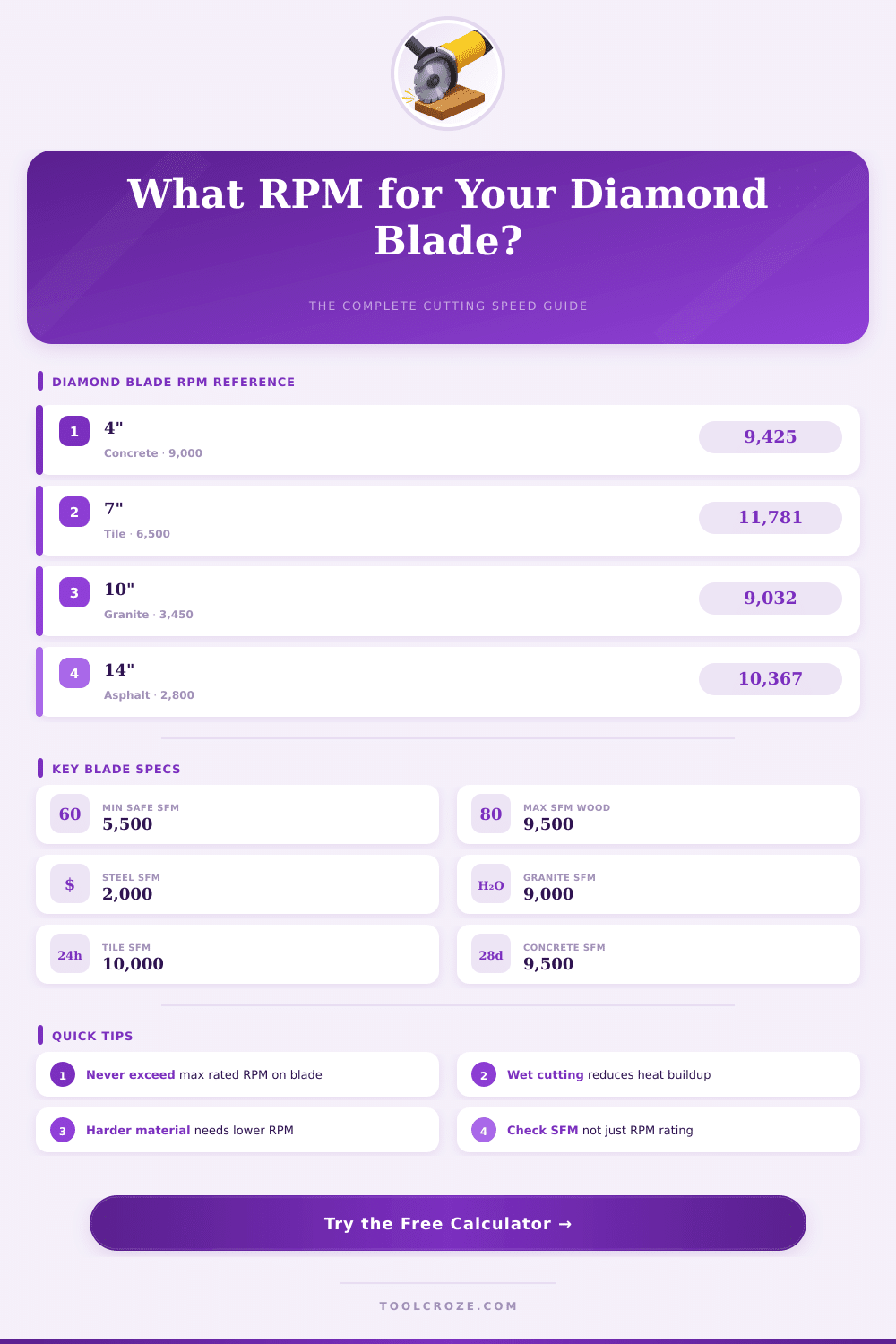
| Granite countertop | 10" continuous | Granite | 3,450 | 2–4 in/min | Wet |
| Driveway expansion joint | 14" segmented | Asphalt | 2,800 | 8–15 in/min | Dry |
| Marble backsplash | 4.5" turbo | Marble | 11,000 | 2–3 in/min | Wet |
| Block wall opening | 14" segmented | Brick/CMU | 3,200 | 3–6 in/min | Dry |
| Porcelain plank floor | 7" turbo rim | Porcelain | 6,200 | 1.5–3 in/min | Wet |
| Concrete foundation | 14" segmented | Rebar concrete | 2,600 | 2–4 in/min | Wet |
Diamond saw blades work most well in a certain range of RPM, and going outside that limit can cause serious damage. We talk about possible damage of the blade itself and the danger of heavy injury or even something worse. Here no scare; only pure truth.
The highest allowed RPM is marked directly on the steel core of the blade and passing it should not happen ever.
Always Check the Blade’s Maximum RPM
So, there is SFPM, Surface Feet Per Minute. A value to know. It shows how quickly the edge of the blade actually slips through the material that one works with.
The usual value is around 9 500 SFPM for good results. To reach the right speed, you will have to match the diameter of your blade to the RPM levels that are listed in the table.
The type of edge on your blade seriously affects how it handles the pace. Blades with solid edge require more slow and careful usage, because they lack holes for removing heat. Without those spaces, they overheat too soon.
Designs with segments, notches or splits are different (they spread heat more well), so that they handle higher RPM. Such forms work especially for strong cuts in difficult materials using fast machines. Either way, good cooling at any speed extends the life of the blade and helps to keep the cuts more clean.
The kind of material also determines what RPM values work. Concrete and masonry widely operate best at around 10 percent more then the basic readings. And for dense materials like tiles or stones?
Here one must slow, drop your pace by 10 to 25 percent under the standard. On the other hand, soft and rough materials require faster spinning, bigger steps and plenty of water flowing through them. Commonly higher pace extends the life of the diamond saw blade, although it does not always boost the actual cutting.
Various saws operate in very different ranges of pace. A small saw maybe uses a third horsepower engine at 1 725 RPM and holds 32 ounces of coolant. Another type can have an engine of 800 to 3 400 RPM with only a 16-ounce tank.
Commonly used angle grinders spin between 9 000 and 10 000 RPM, while round saws usually stay at around 5 000 RPM. Reciprocating saws sit between 3 000 and 4 000 RPM. One blade for masonry that I saw was rated for a maximum of 15 250 RPM, and it has a cut width of around 2.2 millimeters.
Blades less than seven inches in diameter best suit angle grinders and their matching RPM limits. Always check the maximum RPM mark on your blade. If you turn it too quickly, the steel plate can bend and lose its flat form.
Passing the maximum brings risk of overheating, warping or even total failure. The bigger the diameter of the blade, the less high must be your RPM, and the same happens when onecuts harder materials.
Yet before installing any blade, there is one basic check: do the RPM of your saw match what the blade is designed for? This question stays the same, regardless of what you cut.