🔧 CNC Drill Speed & Feed Calculator
Calculate optimal RPM, feed rate, and cutting time for any drill bit and material
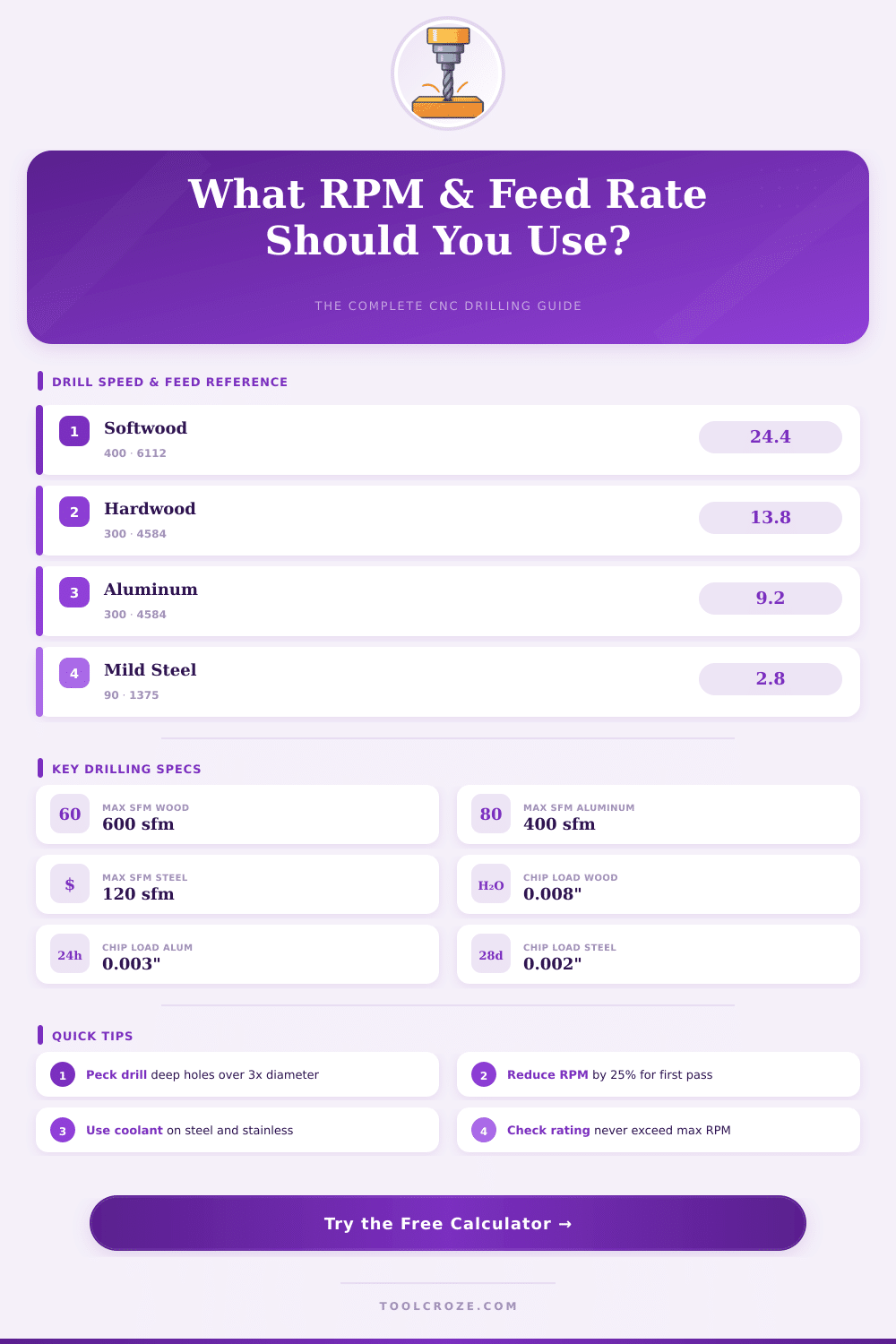
| Material | Rec. SFM | RPM (1/8") | RPM (1/4") | RPM (1/2") | Chip Load (in/tooth) | Feed Rate (ipm, 2-fl) |
|---|---|---|---|---|---|---|
| Softwood (Pine) | 300–600 | 18,335 | 9,167 | 4,584 | 0.006–0.010 | 18–24 |
| Hardwood (Oak) | 200–400 | 12,223 | 6,112 | 3,056 | 0.004–0.006 | 12–18 |
| Plywood | 250–500 | 15,279 | 7,639 | 3,820 | 0.005–0.007 | 15–21 |
| MDF | 300–500 | 15,279 | 7,639 | 3,820 | 0.006–0.008 | 18–24 |
| Aluminum 6061 | 200–400 | 12,223 | 6,112 | 3,056 | 0.002–0.004 | 6–12 |
| Mild Steel 1018 | 60–120 | 3,667 | 1,833 | 917 | 0.001–0.003 | 2–6 |
| Stainless 304 | 30–70 | 2,138 | 1,069 | 535 | 0.001–0.002 | 1.5–4 |
| Brass | 150–300 | 9,167 | 4,584 | 2,292 | 0.002–0.004 | 4–8 |
| Acrylic | 300–500 | 15,279 | 7,639 | 3,820 | 0.004–0.008 | 8–16 |
| Cast Iron | 50–90 | 2,748 | 1,374 | 687 | 0.001–0.002 | 1–3 |
| Bit Size | Diameter (in) | Diameter (mm) | Flutes | Max RPM (HSS) | Recommended Materials | Drill Type |
|---|---|---|---|---|---|---|
| #60 Wire | 0.040 | 1.02 | 2 | 24,000 | Soft metals, PCB | Twist |
| 1/16" | 0.0625 | 1.59 | 2 | 20,000 | Wood, plastic, soft metal | Twist |
| 1/8" | 0.125 | 3.18 | 2 | 15,000 | All materials | Twist |
| 3/16" | 0.1875 | 4.76 | 2 | 10,000 | All materials | Twist |
| 1/4" | 0.250 | 6.35 | 2 | 8,000 | All materials | Twist |
| 5/16" | 0.3125 | 7.94 | 2 | 6,400 | Wood, aluminum, steel | Twist |
| 3/8" | 0.375 | 9.53 | 2 | 5,500 | Wood, aluminum, steel | Twist / Brad Pt |
| 1/2" | 0.500 | 12.70 | 2 | 4,000 | Wood, aluminum, mild steel | Twist / Brad Pt |
| 5/8" | 0.625 | 15.88 | 2 | 3,200 | Wood, aluminum | Twist / Spade |
| 3/4" | 0.750 | 19.05 | 2 | 2,700 | Wood, soft metals | Spade / Forstner |
| 1" | 1.000 | 25.40 | 2 | 2,000 | Wood, soft metals | Forstner / Spade |
| Project | Bit Size | Material | Rec. RPM | Feed (ipm) | Notes |
|---|---|---|---|---|---|
| Pocket Holes (Kreg) | 3/8" | Softwood 3/4" | 3,800 | 15 | Stepped pocket bit |
| Shelf Pin Holes | 1/4" | Plywood | 6,000 | 18 | 5mm spacing jig |
| Hinge Cup (Euro) | 35mm (1-3/8") | Hardwood / Ply | 1,200 | 8 | Forstner bit, 15mm deep |
| Bolt Clearance | 1/4" (7mm) | Mild Steel | 1,500 | 3 | Use cutting fluid |
| Countersink #8 | 3/16" pilot | Hardwood | 5,500 | 12 | 82° countersink |
| PCB Pilot Holes | 1/16" | FR4 / Acrylic | 18,000 | 6 | Carbide recommended |
| Dowel Holes | 3/8" | Hardwood | 4,500 | 12 | Brad-point bit |
| Pipe Threading Pilot | 27/64" | Mild Steel | 1,200 | 2 | For 1/2" NPT tap |
Find the right speed and feed rate during drilling on a CNC Drill is often difficult. The speed point how fast the spindle turns and one measures it in RPM. Feed rate shows how the drill pushes itself into the material normally in inches per minute (IPM) or millimeters per minute (mm/min).
Both settings work together, and wrong values can break the tools or badly damage the bits.
Find the Right Speed and Feed for CNC Drilling
There is a simple core formula that helps to count everything. The surface foot speed (SFM) gets its value from 0.2618 times the diameter of the drill and times the RPM. For feed rate in IPM one multiplies the step per revolution (IPR) times the RPM.
Also for milling and drilling the formula for feed rate can appear as load per flute times the number of flutes and times the RPM. These rules count for milling and drilling works.
The SFM values differ according to the diameter of the used tool. A drill of 4 mm at 7500 RPM reaches around 273 SFM, while a 13 mm drill with the same speed would raech almost 995 SFM. The speed is inversely proportional to the diameter of the drill.
For bigger drills one must use lower RPM. Also the feed rate depends on the speed.
A simple method for drilling on milling machines is to divide 152 by the diameter of the drill to find the RPM, then multiply that RPM by 0.003 for the feed rate. For instance, for a drill of 0.5 inches with 0.01 inches per revolution, multiplying 800 RPM by 0.01 one receives 8.0 inches per minute four the feed rate. The actual values for speed must range according to the kind of material and the condition of the used tool.
Apps for phones and online calculators can quickly figure those numbers. One famous app estimates speed, feed rate, cutting speed and load per tooth for any drilling job on a CNC Drill. Some programs even generate speeds and feed rates according to the particular machine, tools, setup and the material that one machines.
One must mind that some calculators use step per tooth instead of per revolution at drills, which gives wrong results. Adding the right setting for a standard spiral drill can correct that.
Also the coolant plays a big role. Using a small drill at 8000 RPM with a feed rate of 50 to 60 IPM, one does well with flood coolant. Without good coolant, that feed rate one should halve at least.
Aluminum often causes troubles because of buildup that collects on the flutes of the drill, especially in deep holes. Peck helps to remove chips from the hole. Micro drills, like bits of 0.5 mm for circuit boards, easily break.
Testing different feed rates, for instance 10 mm per minute or 25 mm per minute with peck cycle, is worth the effort. Watching the chip andadapting the settings always is a wise step.