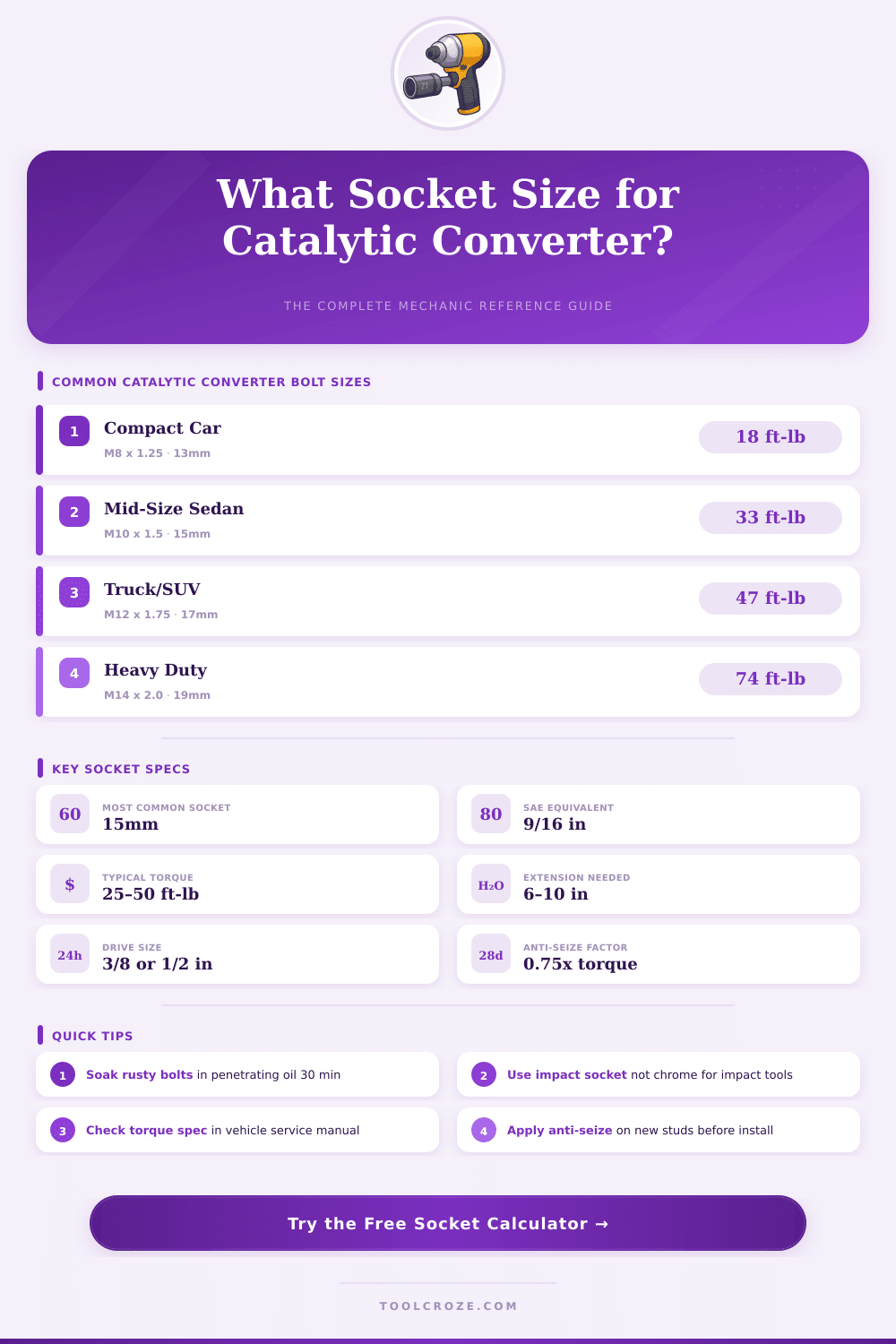
🔧 Catalytic Converter Socket Size Calculator
Find the exact socket, torque spec & wrench size for any catalytic converter bolt
| Bolt Size | Thread Pitch | Socket (mm) | SAE Equiv. | Torque (Nm) | Torque (ft-lb) | Drive Size |
|---|---|---|---|---|---|---|
| M6 | 1.0mm | 10mm | 3/8 in | 10–12 | 7–9 | 1/4 in |
| M8 | 1.25mm | 13mm | 1/2 in | 22–25 | 16–18 | 3/8 in |
| M10 | 1.5mm | 15mm | 9/16 in | 40–50 | 30–37 | 3/8 in |
| M12 | 1.75mm | 17mm | 11/16 in | 60–70 | 44–52 | 1/2 in |
| M14 | 2.0mm | 19mm | 3/4 in | 90–110 | 66–81 | 1/2 in |
| M16 | 2.0mm | 24mm | 15/16 in | 130–160 | 96–118 | 1/2 in |
| Bolt Size | Thread | Socket (SAE) | Socket (mm) | Torque (ft-lb) | Drive Size | Grade 5 |
|---|---|---|---|---|---|---|
| 1/4 in | 20 TPI | 7/16 in | 11mm | 6–9 | 1/4 in | 10 ft-lb |
| 5/16 in | 18 TPI | 1/2 in | 13mm | 12–15 | 3/8 in | 17 ft-lb |
| 3/8 in | 16 TPI | 9/16 in | 14mm | 25–33 | 3/8 in | 31 ft-lb |
| 7/16 in | 14 TPI | 5/8 in | 16mm | 38–50 | 3/8 in | 49 ft-lb |
| 1/2 in | 13 TPI | 3/4 in | 19mm | 55–75 | 1/2 in | 75 ft-lb |
| 9/16 in | 12 TPI | 7/8 in | 22mm | 85–105 | 1/2 in | 110 ft-lb |
| Vehicle | Bolt Size | Socket Needed | Torque Spec | Extension | Notes |
|---|---|---|---|---|---|
| Honda Civic / Accord | M10 x 1.5 | 15mm | 40–47 Nm (30–35 ft-lb) | 6 in / 150mm | Often flanged nuts |
| Toyota Camry / Corolla | M10 x 1.5 | 15mm | 43–50 Nm (32–37 ft-lb) | 6 in / 150mm | Spring bolt system |
| Ford F-150 (Gas V8) | M12 x 1.75 | 17mm | 60–68 Nm (44–50 ft-lb) | 8 in / 200mm | Two flanged nuts/side |
| Chevy Silverado 1500 | M12 x 1.75 | 17mm | 60–70 Nm (44–52 ft-lb) | 8 in / 200mm | Slip joint also present |
| BMW 3-Series (E90/F30) | M10 x 1.5 | 15mm | 50–60 Nm (37–44 ft-lb) | 6 in / 150mm | Pre-cat & post-cat differ |
| Dodge Ram 1500 (5.7 Hemi) | M14 x 2.0 | 19mm | 90–110 Nm (66–81 ft-lb) | 10 in / 250mm | Heat shields in way |
| VW Golf / Jetta (TDI) | M8 x 1.25 | 13mm | 20–25 Nm (15–18 ft-lb) | 4 in / 100mm | Smaller diesel flanges |
| Ford Mustang GT (5.0) | M10 x 1.5 | 15mm | 47–54 Nm (35–40 ft-lb) | 6 in / 150mm | Y-pipe style exit |
| Condition / Lubricant | Torque Factor | Example M10 | Notes |
|---|---|---|---|
| Dry / New (standard) | 1.00x | 47 Nm | Factory spec baseline |
| Anti-seize (copper) | 0.75x | 35 Nm | Reduces clamping friction |
| Engine oil on threads | 0.85x | 40 Nm | Slight reduction |
| Heavily corroded | N/A | — | Soak in penetrating oil first |
| Stainless to stainless | 1.10x | 52 Nm | Galling risk, use anti-seize |
| Thread locker (medium) | 0.90x | 42 Nm | Reduced due to locking compound |
Work with catalytic converter can be difficult and choosing the right size of the socket makes all the difference. Various cars require different sizes for the bolts, so knowing what fits already settles half of the problem. For some cars, 15 mm deep socket fits for the front and rear bolts.
On other vehicles one requires a 16 mm socket to loosen the bolts that connect the exhaust tube to the catalytic converter. There are also cars where a 14 mm socket seems like it should work, but it ends too big, while 13 mm is too small. Here a half-size socket helps for the task especially if the bolt heads are corroded and weak.
Socket Sizes and Tools for Catalytic Converter Work
Corrosion truly is the biggest problem. Bolts on catalytic converters are exposed to high heats and moisture, so they stick in their place over time. Spraying piercing oil on the bolts a few nights before the start of the work truly helps.
Use a breaker bar to add force, when teh bolts do not want to loosen. Lightly beating the bolt heads with a hammer can help break the rusty links and loosen them.
Important is also finding the right access. Sometimes a long extension with a pivot at the end together with the socket is the only way to reach hardly accessible places. A 15 mm pivot socket can simplify the work more then one expects.
When the heat shields block the way, remove them first with a 10 mm ratchet to open the space, so that the socket reaches the upper bolts. Those bolts of the heat shields commonly are strongly corroded, so a 10 mm socket simply slips on them or the bolt can break entirely.
Some catalytic converters connect to the exhaust manifold with covers that have unusual heads. One car had something that looked like a rounded-rectangular form instead of the usual hexagonal. Engines from the same period used inverted Torx sockets for those covers.
A 6-point 14 mm socket works well for stubborn protective bolts, and if the cover exits together with the bolt, hold it in a vise and use an exterior Torx socket to separate them.
Oxygen sensors also play a part in this task. Usually there is at least one sensor upstream and one downstream of the catalytic converter. Removing the sensors before pulling the converter is commonly a wise step.
A special socket for O₂ sensors helps, but sometimes the sensor sits so close to the engine that none of the available sockets fits over it. Disconnecting the flange first, one can create enough clearance. Hitting with a rubber mallet on the extension can free the stuck sensor, and then it unscrewsmanually.
Bolts that break are a real risk. One common size of bolt threading is M10. If a bolt snaps, finding the right replacement for the cover can be hard, because they sometimes differ from the standard double-sided end of the manifold.