⚡ Brushless Motor HP Calculator
Calculate horsepower, torque, and power output for any brushless motor application
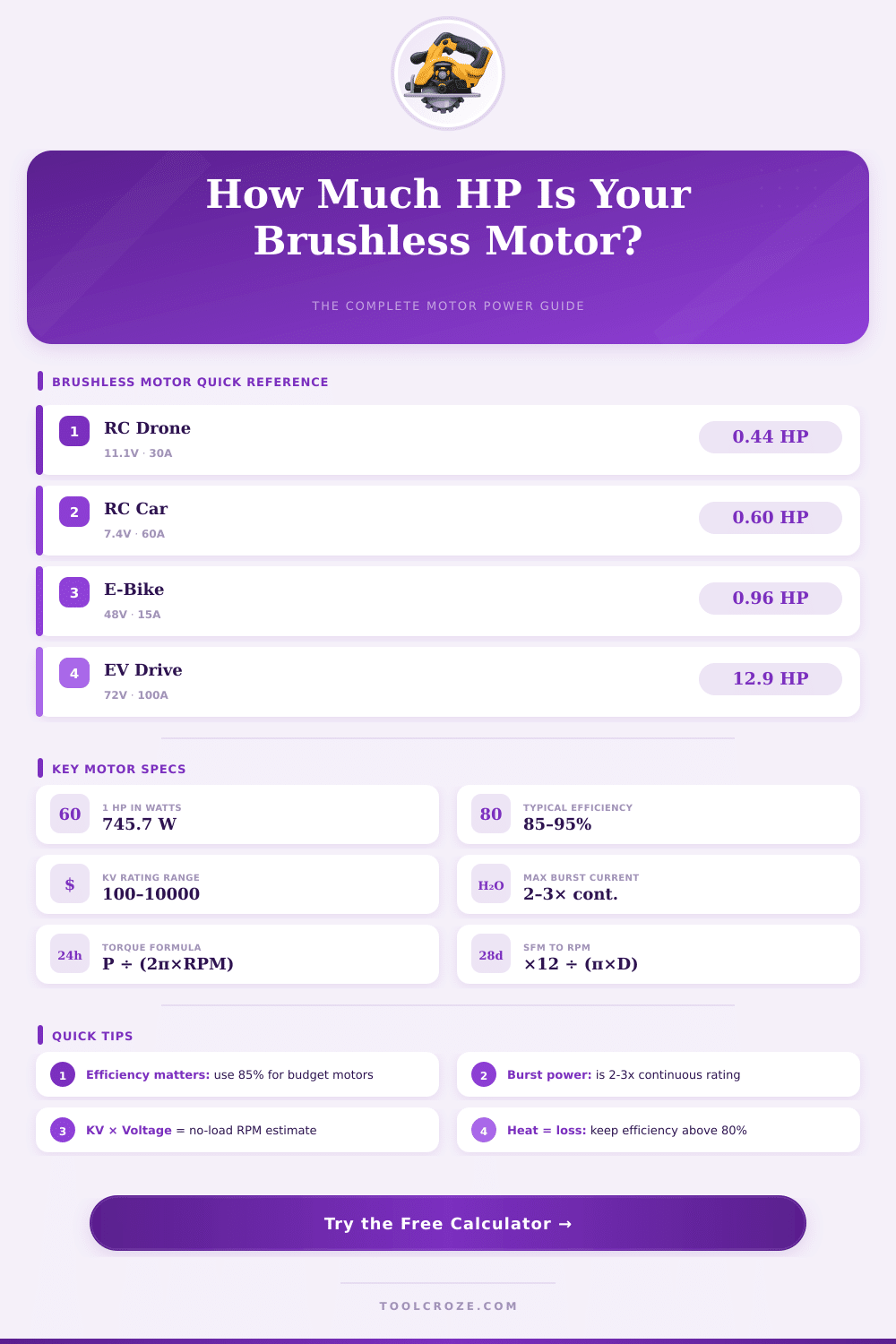
| Application | Typical Voltage | Typical Current | Efficiency | Est. HP Range | KV Range |
|---|---|---|---|---|---|
| RC Car (Sport) | 7.4V (2S) | 40–80A | 80–88% | 0.4–0.8 HP | 3000–7000 |
| RC Car (Pro/Comp) | 14.8V (4S) | 80–150A | 85–92% | 1.3–3.0 HP | 2200–4000 |
| FPV Drone (5") | 14.8V (4S) | 25–35A | 82–90% | 0.4–0.7 HP | 2300–2700 |
| FPV Drone (7") | 22.2V (6S) | 20–40A | 83–91% | 0.6–1.3 HP | 1200–1700 |
| RC Airplane | 11.1V (3S) | 20–50A | 80–88% | 0.3–0.8 HP | 800–1400 |
| E-Bike (250W) | 36–48V | 6–10A | 85–92% | 0.3–0.5 HP | 5–15 (Hub) |
| E-Bike (1000W) | 48–72V | 15–25A | 87–93% | 1.1–1.8 HP | 8–20 (Hub) |
| EV Scooter | 48–60V | 20–40A | 85–92% | 1.3–3.2 HP | 40–100 |
| CNC Spindle | 36–48V | 8–30A | 88–95% | 0.4–1.9 HP | 1000–3000 |
| Small EV | 72–96V | 80–200A | 90–96% | 8–34 HP | 50–150 |
| KV Rating | Typical Use | Recommended Voltage | No-Load RPM @ Voltage | Pole Count | Typical Prop/Load |
|---|---|---|---|---|---|
| 100–300 | Large E-Planes / Helis | 22–44V (6–12S) | 2200–13200 | 14 | 16"–22" prop |
| 300–700 | E-Bikes / Large Drones | 22–48V (6–12S) | 6600–33600 | 12–14 | 10"–16" prop |
| 700–1200 | RC Planes / Mid Drones | 11–22V (3–6S) | 7700–26400 | 8–12 | 8"–12" prop |
| 1200–2000 | CNC Spindles / RC Cars | 7–14V (2–4S) | 8400–28000 | 6–8 | 5"–8" prop |
| 2000–4000 | RC Cars / Racing Drones | 7–14V (2–4S) | 14000–56000 | 4–6 | 3"–5" prop |
| 4000–10000 | High-Speed RC / Mini Quads | 3.7–7.4V (1–2S) | 14800–74000 | 2–4 | 2"–4" prop |
| Watts (W) | Horsepower (HP) | kW | Torque @ 1000 RPM (ft·lb) | Torque @ 1000 RPM (N·m) | Torque @ 5000 RPM (ft·lb) |
|---|---|---|---|---|---|
| 100W | 0.134 HP | 0.1 kW | 0.95 ft·lb | 0.955 N·m | 0.19 ft·lb |
| 250W | 0.335 HP | 0.25 kW | 2.37 ft·lb | 2.387 N·m | 0.47 ft·lb |
| 500W | 0.671 HP | 0.5 kW | 4.74 ft·lb | 4.775 N·m | 0.95 ft·lb |
| 750W | 1.006 HP | 0.75 kW | 7.12 ft·lb | 7.162 N·m | 1.42 ft·lb |
| 1000W | 1.341 HP | 1.0 kW | 9.49 ft·lb | 9.549 N·m | 1.90 ft·lb |
| 2000W | 2.682 HP | 2.0 kW | 18.98 ft·lb | 19.098 N·m | 3.80 ft·lb |
| 5000W | 6.705 HP | 5.0 kW | 47.45 ft·lb | 47.746 N·m | 9.49 ft·lb |
| 10000W | 13.41 HP | 10.0 kW | 94.90 ft·lb | 95.493 N·m | 18.98 ft·lb |
A brushless motor became a favourite option for many applications, from strong tools to models with radio-control and similar industrial devices. They operate entirely differently than brushed engines, in quite a lot of ways. In brushed engines, metallic parts called brushes press against the spinning part to deliver electricity to the coils inside.
But brushless motor engines entirely skip those brushes and instead use electronics to send the power to the coils at the right moment. The coils are on the fixed part while the spinning rotors carry the magnets.
How Brushless Motors Work and Why They Are Used
Because of the absence of brushes, that causes friction and wear, brushless motor engines give more energy and work better than brushed engines of same size. Also, they have a high ratio of power to weight so one chooses them for things like radio-controlled planes or battery operated drills. A big advantage is the lower energy use, which is especially important for wireless tools that depend on batteries.
When dealing about horsepower, brushless motor engines cover a broad range. It is possible to find little samples that put out only some watts, and then already exist giants. For instance, one brushless motor with 27 mm width and 16 mm height truly can reach more than 1 horsepower at 14 volts.
At the bigger end, some top engines put out more then 10 horsepower during short moments. Even one radio-controlled engine reaches 19 kilowatts, which matches 25 brake horsepower.
A 750-watt brushless motor permanent electricity engine matches to 1 horsepower. That kind carries permanent magnets in the rotors and can control speed of 300 to 4000 RPM when combined with an inverter. It ends up tinier and more light than a three-phase induction engine.
One 1-horsepower brushless motor installation usually costs between 200 and 800 dollars, and the control adds another 150 to 400 dollars. The energy use sits around 830 to 850 watts, if one considers the losses because of imperfect efficiency.
The main downside is the high cost and the trouble. Brushless motor engines require electronic control units to operate. When one of them breaks, one commonly simply dumps it, while a brushed engine sometimes it is possible to fix only by changing the brushes.
Also there exist problems with the control boards in brushless motor tools.
Even little brushless motor tools with horsepower commonly beat bigger brushed versions in many situations. Brushless motor engines truly are stronger, more lasting and more efficient than brushed of same size. Even so, at certain levels of horsepower, the permanent magnets in the rotors could become too big or too expensive, which would limit the maximum size of brushless motor engines.
Because of that, for modeling targets, reaching more than 120 horsepower equivalent with brushless motor systems does not truly happen commonly. Although, for most everyday and hobby uses, brushless motor engines with theirhorsepower ratings offer real progress in performance.