
Lately I’m feeling pretty frustrated when it comes to finishing projects with wood. I’ve got all the lumber and tools and can’t seem to get the “right” fastener for anything! Will this screw strip? Will it split my wood? How do I know which screw is best?
Screws isn’t just nails with threads on them! Knowing the difference in screw style and size are a matter of how materials and physics work. Understanding these things help prevent failure and creates joints capable of lasting decades.
How to Choose the Right Screw for Your Project
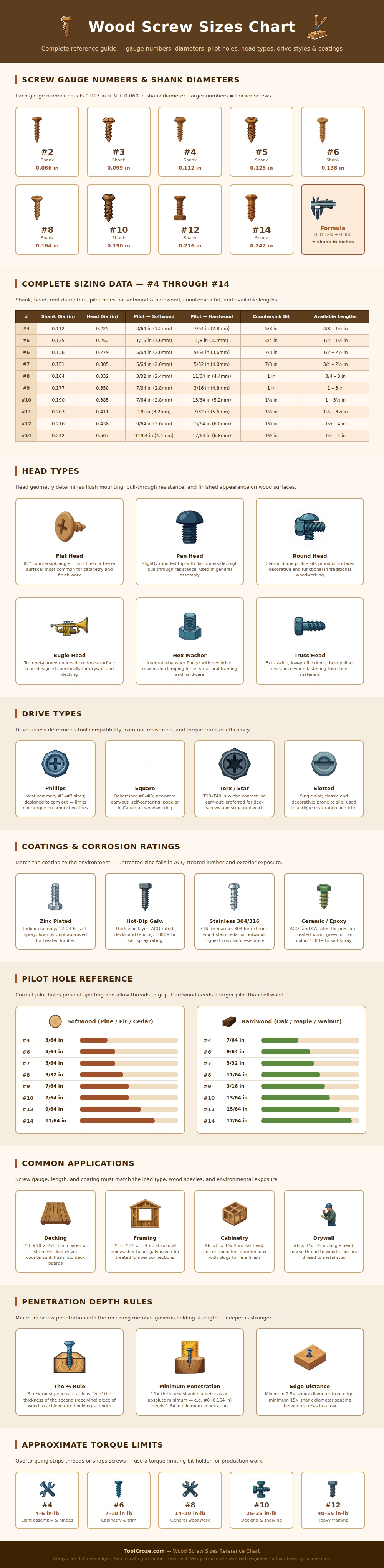
To eliminate all guesswork from buying hardware, I’ve graphed this out into a chart (above) matching shank diameter with gauge numbers. You’ll note the higher the gauge number the thicker the screw. The relationship is linear and predictable. A number six screw is a lot thinner then a number twelve screw. And why does the thickness matter? It matters because more wood fiber give the thread more to grab onto. Use a screw that are too thin for the load and you’re relying on friction where you need mechanical interlock. Or it will rely on friction and the joint fail.
I know some folks will tell you it’s not necessary. Some projects turn out fine without them, while others falls apart. Pilot holes make all the difference. This infographic provides recommended drill bit diameters based off wood type (hardwood or softwood). The tighter the grain, the less forgiving the material. Hardwood fibers is unforgiving and so dense that they won’t allow a screw to penetrate when forced if it doesn’t have enough clearance. The board cracks instead of the screw sink in. A few seconds drilling out a pilot hole save an afternoon of frustration. Softwoods can be more forgiving but are still best guided around edges which is where there’s greatest risk of blow-out.
The angle of the screw relate to the head type (pan vs flat), which affects both aesthetics and mechanical advantage. Pan heads sits slightly proud of the surface, providing good pull-through resistance for general assembly; flat heads are cleaner on cabinet doors, where they sink below the surface. Since gates and workbenches is subject to side-to-side forces, the extra height of a pan head allow more of the screw thread to grip above the material. Once again, a small difference in shape have a big structural impact.
Square drive is another consideration, since it centers better than a Phillips head. Phillips heads were originaly made this way so they would slip out when tightened too much, preventing over-tightening in factory settings. That bit of design failure continue tripping up the home improver to this day.
The second part of that equation is also important: coating. What you get is OK-looking zinc plating right out of the package, which will fail rapidly once wet or under pressure-treated lumber chemical conditions. If you’re hanging anything on a fence or deck, then either stainless steel or hot-dip galvanized coatings is what you’ll want, because they won’t corrode (and stain your wood red/green). The chart makes that clear, with decorative interior vs. Exterior structure categories clearly laid out and explained. A nice-looking deck can become a rusty nightmare in two seasons time if that’s missed.
Respect the material limits of the wood and the fastener, both has their limitations. Always strive for adequate penetration depth; preferably with the screw penetrating the receiving member at a minimum of two times the screw’s diameter. You should of matched the screw’s gauge to the density of the wood. Use the proper sized pilot hole. Select a coating appropriate for the environment. Your projects will last far beyond the drying time of the glue.
Less is not more in the sense of finding the strongest screw, but rather finding the right one for the job at hand.
