Wood Movement Calculator
Estimate solid wood expansion, shrinkage, panel allowance, service EMC, and restraint risk from species, board width, grain orientation, moisture change, temperature, RH, finish, and panel count.
📌 Furniture and project presets
Load a real furniture scenario, then tune the species, orientation, moisture range, service humidity, finish condition, and panel count.
⚙ Board, climate, and restraint inputs
Calculation breakdown
🧪 Species movement grid
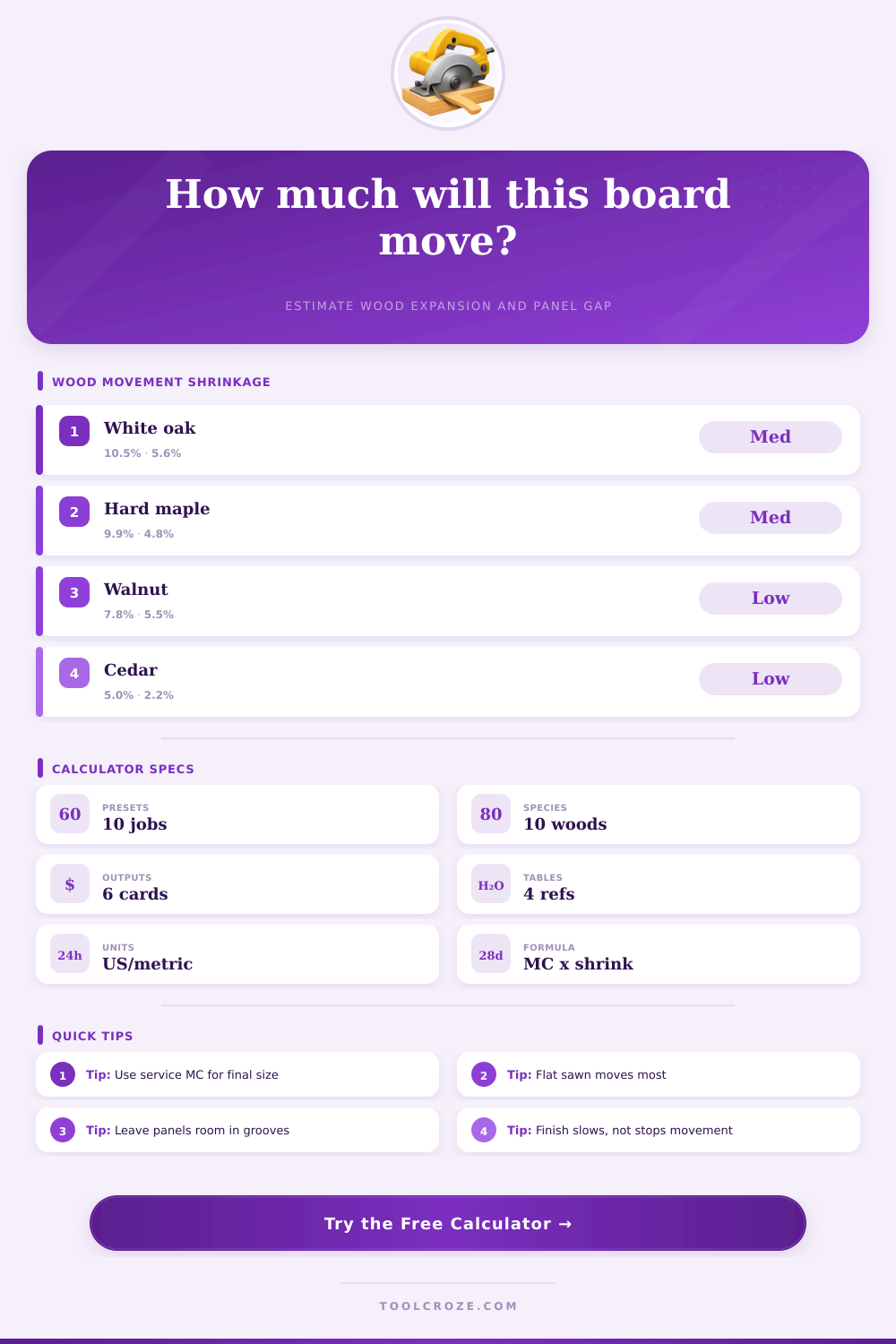
Reference shrinkage values are total green-to-oven-dry percentages. The calculator prorates them by moisture change below fiber saturation.
📚 Wood movement reference tables
| Species | Tangential shrinkage | Radial shrinkage | Furniture note |
|---|---|---|---|
| White oak | 10.5% | 5.6% | Medium movement, strong quarter-sawn benefit |
| Hard maple | 9.9% | 4.8% | Moves noticeably in wide table and cabinet panels |
| Black walnut | 7.8% | 5.5% | Moderate and predictable for wide furniture tops |
| Western red cedar | 5.0% | 2.2% | Low movement but outdoor RH range is large |
| Grain orientation | Coefficient basis | Expected movement | Best use |
|---|---|---|---|
| Flat sawn | Tangential shrinkage | Highest | Tabletops, shelves, broad boards |
| Rift sawn | 65% tangential, 35% radial | Medium | Legs, rails, cleaner face stability |
| Quarter sawn | Radial shrinkage | Lowest | Door panels, drawer fronts, musical parts |
| Mixed glue-up | Average of tangential and radial | Medium | Alternating growth-ring panel glue-ups |
| RH at 70 deg F | Approx EMC | Common season | Planning note |
|---|---|---|---|
| 30% | 6% | Heated winter room | Boards shrink toward the dry-season size |
| 45% | 8.4% | Moderate indoor shop | Common build target for furniture |
| 60% | 11% | Humid indoor period | Panels expand from a dry-shop build |
| 80% | 16% | Outdoor or damp storage | Use large allowances and drainage gaps |
| Project detail | Typical gap strategy | Risk if tight | Calculator result to use |
|---|---|---|---|
| Frame-and-panel door | Split allowance between grooves | Panel buckles or frame opens | Per-edge allowance |
| Solid tabletop | Slotted fasteners across width | Top cracks at fasteners | Free width change |
| Drawer front overlay | Leave seasonal reveal around front | Sticking reveals in humid months | Recommended allowance |
| Breadboard end | Pinned center, elongated outer holes | End splits or top tears | Free plus safety factor |
💡 Practical tips
Wood moves due to an change in dimensions of the wood based off a amount of moisture contained within the wood. Wood expands when it absorb moisture from the air, but wood shrink when it loses moisture to the air. These changes in humidity and temperature within the rooms throughout the year cause the movement within the wood.
This movement have to be accounted for in the creation of joinery; the movement of the wood may cause the joinery to fail. The calculator presented here will calculate the movement of the wood based on the specific type of wood, the grain of the wood, and the change in moisture content. The movement of the wood can be broken down into tangential movement and radial movement.
How Wood Swells and Shrinks with Moisture
Tangential movement is the movement of the wood that occur with the growth rings of the wood, and such movement is usually larger then radial movement. Radial movement is the movement of the wood that occur radially from the tree, and such movement is usually smaller then tangential movement. If the wood is flat sawn, the wood movement will follow the tangential movement percentage.
However, if the wood is quarter sawn, the wood movement will follow the percentage of the radial movement. The calculator combine these two percentages to calculate the total movement that the wood may experience based on the grain of the wood that is selected. The environmental conditions will impact the moisture content of the wood, which in turn will impact the movement of the wood.
The relative humidity of the room will dictate the equilibrium moisture content of the wood. For instance, if the room has low humidity level during the winter months, the wood will lose moisture, causing the wood to shrink. Conversely, during the summer months when the humidity rates in the room are high, the wood will absorb moisture from the air, leading to the wood expand.
Thus, moisture content will change in response to environmental conditions. It is important for craftspeople to account for this and not to assume that the moisture content of the wood will always remain the same as the moisture content at the time that the wood was first acquire for the project. Factors such as the finish of the wood and how restricted the wood is also plays a roll in the movement of the wood.
For instance, films applied to the wood will slow the wood movement, but will not stop it entirely. If the wood is restricted in some way, such as if it is joined with cross-grain glue joints or if wide boards is screwed together, the stress on the wood due to this restraint may lead to the wood cracking or the joinery break. The calculator will tell the crafter the risk rating that is presented if the restraint being used is too high for the type of wood movement that may occur.
The reference tables provided here can help the crafter to understand the type of movement that the various type of wood will exhibit. Each type of wood has a different percentage of shrinkage, and different grain orientations will exhibit different amount of movement in the wood. However, the calculator will provide the specific movement of the wood for the specific piece of wood that is being consider, as the specific movement of the wood also depends upon the width of the wood and the moisture change that occur within the wood.
To avoid any problems associated with wood movement, the projects that are created should be designed for the extreme conditions of moisture within the air. The highest humidity and the lowest humidity level should be identified for the project, and the wood movement should be calculated for these extreme conditions. If the risk rating for the identified moisture levels is high, methods like floating construction or slotted hole should be used for the project.
These methods will allow for the wood to experience the movement but will not place any stress upon the wood or the joinery.