
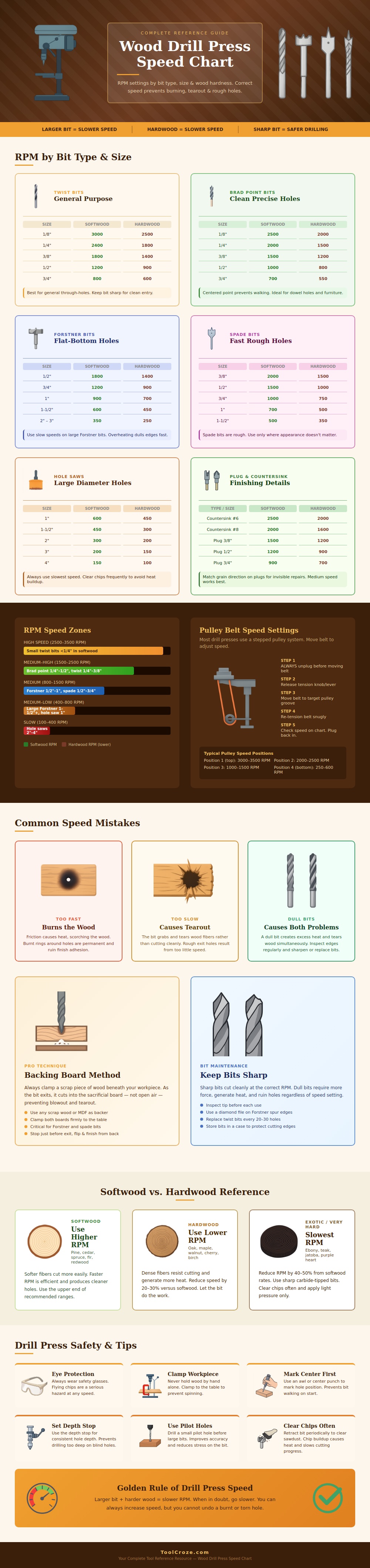
Choosing the right speed for drill in press depends on the size of the bit and the hardness of the wood. Hardness seriously affects the choice of pace. Boring through hardwood generates more friction than through soft wood.
During work with hardwood, use lower speed. Like this you will avoid, that the drill overheats or burn the wood. Usually you require higher pace for little bits.
How to Choose the Right Drill Press Speed
With weak materials high haste operates more well. Practically are usefull to have chart with advices about paces for various materials and bit sizes. Print it and hang beside the machine, that is clear winner.
Common drill press has limitation between 2000 and 3600 RPM. When the chart points too high RPM for your device, work in lower, it will not have to be problem. Some favor to not change speeds commonly, so they stay at one pace for the most work.
1680 RPM commonly works for many causes and stay safe. Some devices have minimum in around 580 RPM. For 2-inch Forstner bit in hardwood use half of that pace.
Big bits require fewer revolutions. Wooden tasks well succeed between 300 and 2000 RPM.
Various bits behave otherwise. Fully carbide drill of 8 mm diameter reaches 6000 RPM in soft wood for fast and pure holes, but need furnished press. Forstner bits warm extremely quickly.
2-inch Forstner in hardwood require much more low pace than the minimum. Devices with 650 or 660 RPM works for bits of 1/16 until 2 inches in pine, aluminum or steel. Paces can jump dramatically, for instance of 660 to 1150 RPM.
Always check, that the bit guard do not slip on the quill shaft. During boring, press the bit against wood progressively.
