Wood Bridge Beam Size Calculator
Estimate preliminary timber beam size, bending demand, shear, bearing, and deflection for small pedestrian, trail, ATV, garden tractor, and utility wood bridges.
📌Bridge Presets
⚙Bridge Beam Inputs
Use clear span between supports and the number of longitudinal beams sharing the deck. This tool assumes simple-span beams with adequate lateral restraint from the deck.
Preliminary Wood Bridge Beam Check
Suggested Beam
-
first size passing basic checksControlling Load
-
pedestrian or wheel eventDeflection
-
service load sagEnd Reaction
-
per beam at each supportBending Use
-
Wheel Share
🌲Selected Timber Spec Grid
1.60E
Adjusted E
945
Adjusted Fb
162
Adjusted Fv
34
Density pcf
📊Pedestrian and Utility Bridge Load Reference
| Bridge Use | Typical Live Load | Wheel Load Check | Common Deflection Limit |
|---|---|---|---|
| Private garden footbridge | 40 psf planning load | None unless equipment crosses | L/240 to L/360 |
| Public trail or park walkway | 60 to 90 psf pedestrian load | Maintenance cart may govern | L/360 |
| Boardwalk in damp service | 60 psf plus wet deck weight | Check mower or small ATV if allowed | L/360 to L/480 |
| ATV or garden tractor bridge | 40 psf background load | 650 to 1200 lb wheel load | L/360 |
| Light service bridge | 60 psf or site requirement | Use the heaviest expected wheel | L/480 for stiff feel |
📐Timber Species and Grade Reference
| Timber Grade or Product | Typical E | Base Fb | Bridge Beam Notes |
|---|---|---|---|
| SPF No. 2 lumber | 1.4E | 875 psi | Short spans and narrow footbridges |
| Douglas Fir-Larch No. 2 | 1.6E | 1050 psi | Good common sawn beam option |
| Southern Pine No. 2 | 1.6E | 1200 psi | Strong treated lumber where available |
| Hem-Fir No. 2 | 1.3E | 850 psi | Check deflection on longer spans |
| Western Red Cedar No. 1 | 1.1E | 750 psi | Light-duty exposed footbridges |
| White Oak structural timber | 1.5E | 1350 psi | Durable heavy timber when graded |
| 1.9E treated LVL | 1.9E | 2600 psi | Engineered product approval required |
| 24F treated glulam | 1.8E | 2400 psi | Useful for deeper exposed beams |
📏Beam Size Reference
| Nominal or Product Size | Actual Size | Section Modulus | Typical Small Bridge Use |
|---|---|---|---|
| 2x10 sawn beam | 1.5 in x 9.25 in | 21.4 in³ | Short narrow pedestrian spans |
| 2x12 sawn beam | 1.5 in x 11.25 in | 31.6 in³ | Garden and trail footbridges |
| 4x10 timber | 3.5 in x 9.25 in | 49.9 in³ | Stiffer exposed utility beams |
| 6x10 timber | 5.5 in x 9.25 in | 78.4 in³ | Small ATV or mower bridges |
| 6x12 timber | 5.5 in x 11.25 in | 116.0 in³ | Longer utility spans |
| 3-1/8 x 12 glulam | 3.125 in x 12 in | 75.0 in³ | Engineered exposed bridge beam |
💧Wet Service and Deflection Reference
| Condition | Strength Factor | Stiffness Factor | Use in Bridge Planning |
|---|---|---|---|
| Covered or dry service | 1.00 | 1.00 | Roofed bridge or indoor utility span |
| Outdoor damp treated timber | 0.90 | 0.95 | Typical open footbridge planning |
| Wet service frequent saturation | 0.85 | 0.90 | Boardwalks, splash, poor drying |
| Severe wet or splash zone | 0.80 | 0.85 | Use for conservative screening only |
🛞Bridge Preset Details
| Preset | Span and Deck | Load Case | Starting Beam |
|---|---|---|---|
| Narrow trail bridge | 6 ft span, 3 ft deck | 50 psf pedestrian | 2x8 SPF No. 2 |
| Garden footbridge | 8 ft span, 4 ft deck | 40 psf pedestrian | 2x10 Douglas Fir |
| Park path bridge | 10 ft span, 5 ft deck | 60 psf pedestrian | 2x12 Douglas Fir |
| Wetland boardwalk | 14 ft span, 6 ft deck | 60 psf damp service | 4x12 treated Southern Pine |
| ATV trail bridge | 12 ft span, 5 ft deck | 850 lb wheel | 6x10 Southern Pine |
| Service boardwalk | 20 ft span, 6 ft deck | 1200 lb wheel | 24F treated glulam |
💡Wood Bridge Beam Tips
The thing about wood bridges is that they’re always a little bit of an adventure until you discover that adding several inches of length to your bridge can double the beam size you need. Wood bridge design is what’s known as a “quiet math” problem: it’s not just about selecting the heaviest wood possible and praying. There’s also the matter of shear capacity and bending strength, and then there’s the way any given structure will actualy sag under weight. Luckily, the calculator above has already figured out the tricky mix of material properties, loads, and spans. Leaving the rest to you (and the physical reality of the bridge you’ll be carrying).
The span is where most folks begin and rightfully so. The longer the span, the deeper it need to be, assuming everything else stays the same. So a twelve foot span on a deck will need much more depth than a ten foot span on a deck of the same width. The longer the span, the greater its bending moment, which grows at a rate proportional to the square of the span length. That means a ten percent increase in distance might necessitate a 15% bigger beam to maintain low stress levels. The suggested beam size output reflect that reality.
How to Choose the Right Wood for Your Bridge
Are you stretching an ordinary two-by-twelve over an eighteen-foot span? This tool will soon tell you that there’s no way Douglas Fir can meet that bending demand. Two options present themselves: use multiple beams to distribute the load, or bump up to a four-by-twelve timber. Either option alters the project in terms of both look and amount of work needed.
Intuition can also fail us with live load. Codes assume more than just pedestrians crossing the bridge, and sometimes even plan for maintenance vehicles. You can set the pedestrian load from 40-100 pounds per square foot. That’s not the weight of the bridge, but rather the weight of people and things they carry. Railings, deck boards and fasteners is covered by the dead load. Heavy steel railings or a thick wearing surface raise the dead load. The calculator will add all this up into total demand placed on each beam. It’s simply an addition. But omitting the dead load is quite common. That results in beams that are too small and visibly sag within a year of use.
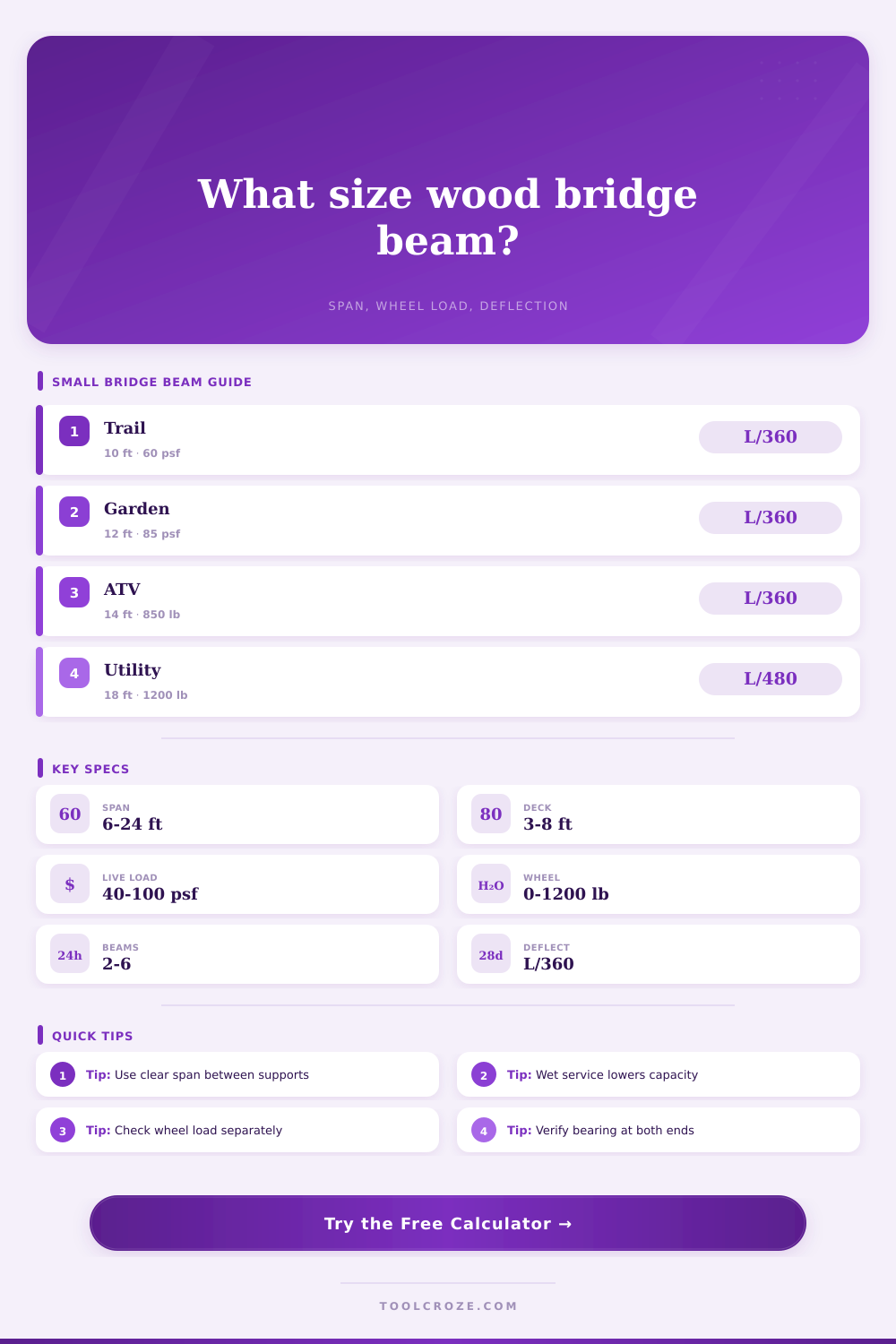
Then there’s wheel loads. With a distributed crowd load the force is spread across the span. But with a single tractor wheel it focuses its force into a very small spot; the tool models this as a point load in the middle of the span. This is what typically controls the bridge design for a utility bridge. Notice there’s an option here to say how many beams will be sharing that wheel load. If your deck is stiff and nailed together well, then that wheel load spreads to adjacent beams. If your planks are widely spaced or loose, then one beam gets all the brunt of the impact. Unless you’ve checked to see how stiff the deck is, it’s best to go the other way, assume less sharing. This can change the required section modulus significantly; for example, compare the 850-pound ATV wheel to the light foot traffic scenario shown in the table on this page.
Strength is also greatly impacted by moisture. Few outdoor beams stays dry. Because of the wet service adjustment, the calculator takes into account reduced stiffness and allowable bending strength of wet wood. But don’t view it as a penalty; it’s simply a fact of life. When wood gets wet, it soaks it up and swells. Some of that structural capability goes away. If you ignore this, you’ll end up with beams that are unsafe and springy in wet weather. Depending on where your beam is located (splash zone vs. Dry covered service), the tool uses standard reduction factors for both stiffness and strength. So you know that the recommended size won’t fail on a rainy or snowy day (and not just on a sunny one).
Sizing beams for safety and deflection limits for comfort
There is also a comfort component to deflection limits. Even if a bridge is perfectly strong, bouncing up and down violently when you walk on it makes you feel unsafe. A comfortable pedestrian bridge has a “sag” that doesn’t exceed a certain percentage of the total length. That limit is called the L/360 limit, while a more strict limit might be L/480. The calculator will demand a larger beam to keep the sag minimal. The calculator will ask for a wider beam so that the sag remains small. Also note: this is where engineered wood products such as glulam or LVL excel. They can provide greater stiffness in smaller widths. This is good from both a structural and visual standpoint with exposed beams.
Why is that? How do you size a bridge beam? Well, it’s one of those things where span, material and use are all a give and take. And the tool will help get you to a starting point, but then use your experience and eyeball it. You should of used this before building. Are the bearings long enough at each end? Can the connections resist the cutting forces? A properly sized beam is the backbone of a good bridge. It transforms an opening in the terrain into a dependable road, solid and steady beneath your feet.