Wood Beam Point Load Calculator
Check reactions, bending stress, and deflection for a simply supported beam before you cut, build, or load it.
| Actual size | Section | I | S |
|---|---|---|---|
| 2x4 | 1.5 x 3.5 in | 7.99 in^4 | 4.56 in^3 |
| 2x6 | 1.5 x 5.5 in | 37.1 in^4 | 13.7 in^3 |
| 2x8 | 1.5 x 7.25 in | 67.7 in^4 | 18.7 in^3 |
| 4x6 | 3.5 x 5.5 in | 88.4 in^4 | 32.1 in^3 |
| Load spot | Reaction split | Moment shape | Use case |
|---|---|---|---|
| Center | 50 / 50 | Peak middle | Shelf / bench |
| Quarter | 75 / 25 | Offset peak | Header / lintel |
| Third | 67 / 33 | Broad peak | Deck beam |
| Near support | High / low | Short lever | Localized load |
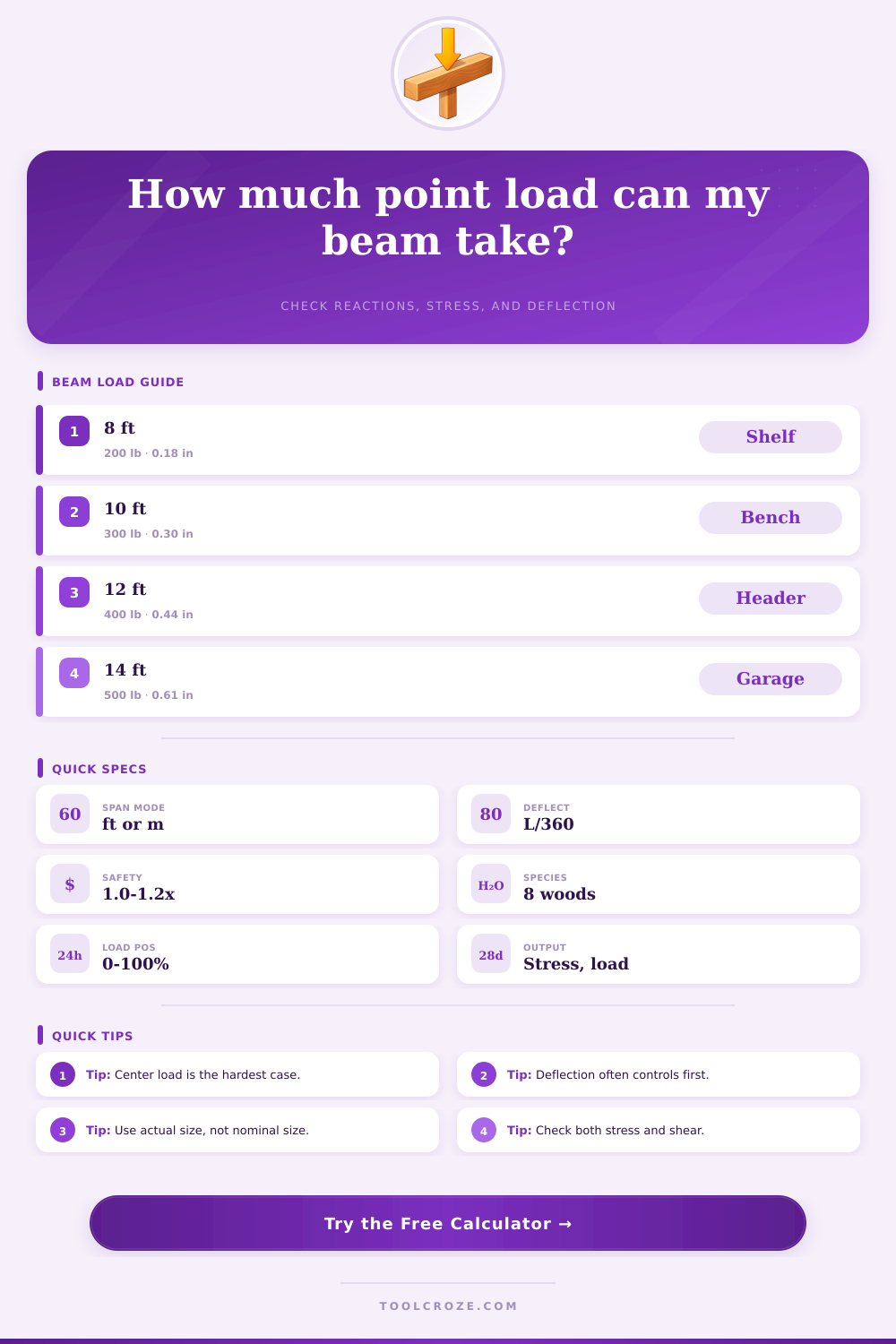
Use this wood beam point load calculator to compare reactions, bending stress, and deflection for a simply supported beam. It is a quick planning check for span and size.
When you are selecting wood beams for your project, you must consider the effect that a point load will have upon the wood beam. A point load are a weight that is placed onto a single spot upon the wood beam. A point load will cause a wood beam to bend more than a uniform load will.
When you calculate the forces that the point load will create upon the wood beam, you can calculate the stresses that the beam will have to bear. These stresses includes bending stress, reactions of the supports, and deflection. Bending stress is the stress that acts upon the fibers of the wood beam when the point load attempts to snap the beam.
How a Point Load Affects a Wood Beam
Bending stress will be highest at the point load. The reactions of the supports is the force that the posts will exert upon the wood beam in order to support the load of whatever is resting upon the beam. The reactions at the supports will change depending upon where the point load is placed upon the beam.
Finally, deflection is the amount that the beam will sag vertical under the point load. Deflection will become the limiting factor for a wooden beam before the bending stress of the beam reaches the strength of the wood beam that can be forced to bend. The position at which the point load is placed upon the wood beam will change the way in which the beam responds to the load.
If the point load is placed into the center of the wood beam, then each support will exert a reaction force to the beam that bears fifty percent of the point load. When a point load is placed in the center of the beam, the bending moment that the beam creates within is at its maximum value. If, however, the point load is moved along the beam, then the reaction forces of the supports will no longer be even.
For instance, if the point load is placed one-quarter of the way along the length of the beam, then the force that is exerted upon the support closest to the point load will bear seventy-five percent of the point load, while the support that is the furthest from the point load will bear twenty-five percent of the point load. Thus, the position of the point load will impact the reactions that the supports of the beam create, which means that the position of the point load must be known in order to properly calculate the requirement of the wood beam. The species of wood that will be utilized in the creation of the wooden beam will impact the strength of the beam.
For instance, wood species like Douglas fir and southern pine are recognized as having high bending strengths, which makes them popular choices for constructing headers. These types of wood are utilized in construction of headers because of their ability to resist the high loads that is placed upon them. Other types of wood, like spruce, pine, or hemlock, have less bending strength than Douglas fir.
Thus, spruce, pine, and hemlock species is used in constructions for applications that do not require the beams to resist as much bending stress. Finally, another factor related to the species of the wood is the modulus of elasticity of the wood species. The modulus of elasticity is a measurement of how much that type of wood resists deflection.
Wood species with high moduli of elasticity will bend less than wood species with low moduli of elasticity. Thus, using a species of wood with a high modulus of elasticity will help to prevent the beam from experiencing excessive deflection. The depth of the wood beam is a more important measurement to consider than the width of the beam.
The depth of the beam impacts the resistance of the beam to bending more than the width of the beam do. The resistance to bending of the beam will increase more if the depth of the beam is increased than if the width of the beam is increased. For instance, if the depth of the beam is doubled, the resistance to bending will increase eightfold.
Beyond the strength of the beam, it is also important to consider the deflection of the beam. The deflection of wooden beams is often limited to maximum allowable deflections of L over 240 for garages, but only L over 480 for living spaces to avoid a bouncy feeling within the structure. In addition to these deflection limits, it is also recommended to include a safety margin of ten or fifteen percent into the calculations to account for factors like knots within the wood beam or the moisture content of the beams.
Many builders make mistakes when calculating the strength of wood beams. One of the most common is not using the actual dimensions of the beams. For instance, 2-by-10 lumber is not actualy 2 inches in width and 10 inches in depth.
The actual dimensions of 2-by-10 lumber are 1-1/2 inches in width and 9-1/4 inches in depth. Thus, using the actual dimensions of the beams will ensure that the calculations regarding the strength of the beams are accurate. Another mistake by many builders is to ignore the location of the point load or to fail to account for the shear stress that may result from the placement of the point load.
It is also important for builders to take into account the grade of the wood. For instance, select structural wood will have higher strength than number two grade wood. Finally, the builder must also account for the connection of the beams to the supporting supports.
For instance, if the beams are connected by bolts or hanging hardware, the builder must consider the strength of those connection to ensure that the beams will not fail at these connections.