🔧 Wood Beam Cantilever Calculator
Compare safe tip load, deflection, bending stress, and required beam depth for shelves, sign arms, awnings, and other wood cantilevers.
📌Preset Beam Jobs
📊Calculator Inputs
✅Beam Results
🧰Wood Species Grid
📋Beam Section Reference
| Nominal size | Actual size | Section modulus | Common use |
|---|
📐Load and Deflection Reference
| Case | Max moment | Deflection | Best for |
|---|
📈Typical Cantilever Projects
| Project | Span | Suggested section | Load note |
|---|
💡Practical Tips
⚠️Safety Note
A cantilevered wood beam is a type of beam that extends from a wall or some other support structure, but does not have any support at the outer end of the beam. Because the cantilevered wood beam is only supported at one end, the force of gravity act upon the cantilevered wood beam. This force creates a type of leverage for the cantilevered wood beam at the point at which it is attached to the wall.
The further the load from the beam is from the wall, the more greater the leverage. Furthermore, the further the load is from the wall, the more stress that will act upon the point at which the cantilevered wood beam is attached to the wall. A load placed at the tip of the cantilevered wood beam will create the maximum amount of bending stress at that attachment point.
How Cantilever Wood Beams Work
A load that is distributed along the entire length of the cantilevered wood beam will distribute the load differently along the beam, but the cantilevered wood beam will still experience bending stress along its length. One of the most important factors to consider for a cantilevered wood beam is its depth. The depth of the cantilevered wood beam should be prioritized over other factors.
Increasing the depth of a cantilevered wood beam will provide more resistance to bending than increasing the width of the beam. If you double the depth of a cantilevered wood beam, the resistance to bending will quadruple. However, if the width of the beam is doubled, there will not be the same increase in the strength of the beam against bending.
Another important factor for a cantilevered wood beam is the amount that the beam will bend under the load placed upon it. Even if the cantilevered wood beam dont break, it may bend to the point where it is visible deflected. The species of wood that is used to construct the cantilevered wood beam will impact the performance of that beam.
Softwoods, like spruce, pine, and fir are commonly used to construct cantilevered wood beams. However, because these softwoods are less stiff than hardwoods, they are likely to deflect under a given load. Hardwoods as well as engineered wood products, like glulam or LVL beams are denser and stiffer than softwoods, so they will allow the beam to extend further from the support structure and experience less deflection.
Furthermore, wood may contain knots along the beam where the wood grain is not as strong as the remainder of the wood; these knots may reduce the strength of the beam by twenty percents or more. Thus, a safety margin should of been included in the construction of the cantilevered wood beam. Adding a safety margin of ten to fifteen percent to the calculations can account for the natural weakness in the wood.
The connection between the cantilevered wood beam and the wall is another important factor to consider in the construction of the beam. The fasteners that are used to attach the cantilevered wood beam to the wall should be strong enough to handle the rotational force as well as the shear force that acts upon the beam at the point of attachment. Lag bolts that are driven into the studs in the wall are more secure than drywall anchors.
Furthermore, if the wall is weak or flexible, or if the rim joist in the wall is likely to flex, then the connection between the beam and the wall may become unstable. Thus, it is important to ensure the strength of the attachment between the beam and the structure of the wall. In calculating the requirements for the cantilevered wood beam, factors like deflection limits must be considered.
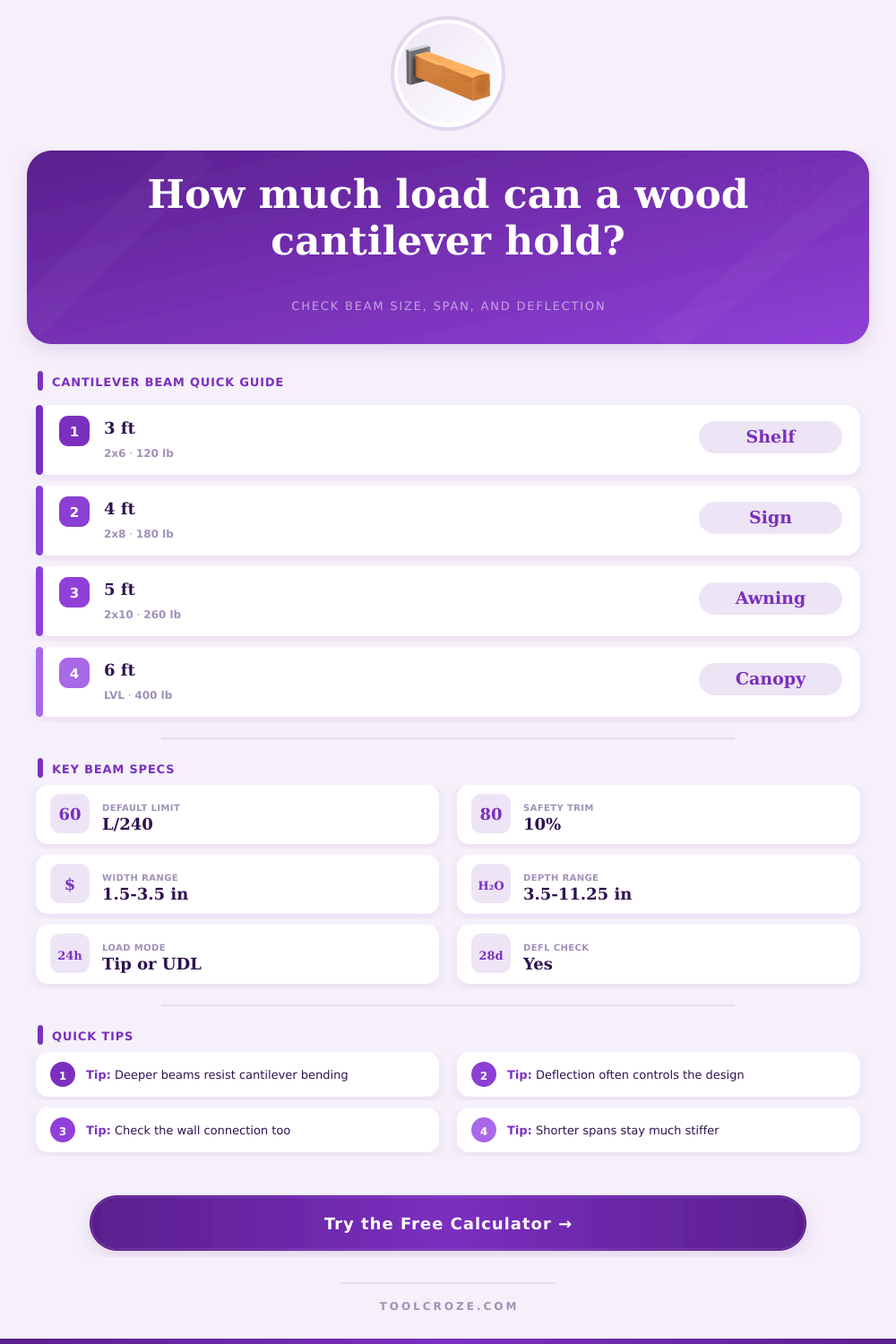
For most applications, the deflection limits for a cantilevered wood beam should not exceed the span of the cantilevered wood beam divided by 240 (L/240). For applications where precision is required, such as countertops, a ratio of L/360 may be used. For applications where precision is not as important, such as shelves for storing items, a ratio of L/240 may be used. Bending stress is another calculation that can be performed for the cantilevered wood beam.
However, for most cantilevered wood beams with spans of less than six feet, stiffness and deflection are the main factors that will impact the required size of the wood beam. Common mistakes in the installation of cantilevered wood beams include placing too much load upon the beam over time. For instance, a person may place various planters or lights along the beam until the beam becomes overloaded with the additional weights.
Another common mistake is ignoring the weight of the cantilevered wood beam itself. For very long spans, the cantilevered wood beam will be extremely heavy and its own weight will be a major portion of the total load placed upon the beam. Finally, another mistake that is often made is ignoring the effects of environmental factor like the wind.
Strong gusts of wind can double the load placed upon an awning or a sign constructed with a cantilevered wood beam. Therefore, it is important to balance the leverage of the cantilevered wood beam against its depth, and to balance the stiffness of that beam against the amount that it will sag under load. By doing so, the cantilevered wood beam will be stable and reliable.