🌲 Wood Beam Calculator
Check span, bending, shear, and deflection limits for simple wood beams using actual sizes, real species data, and uniform load inputs.
Calculation breakdown
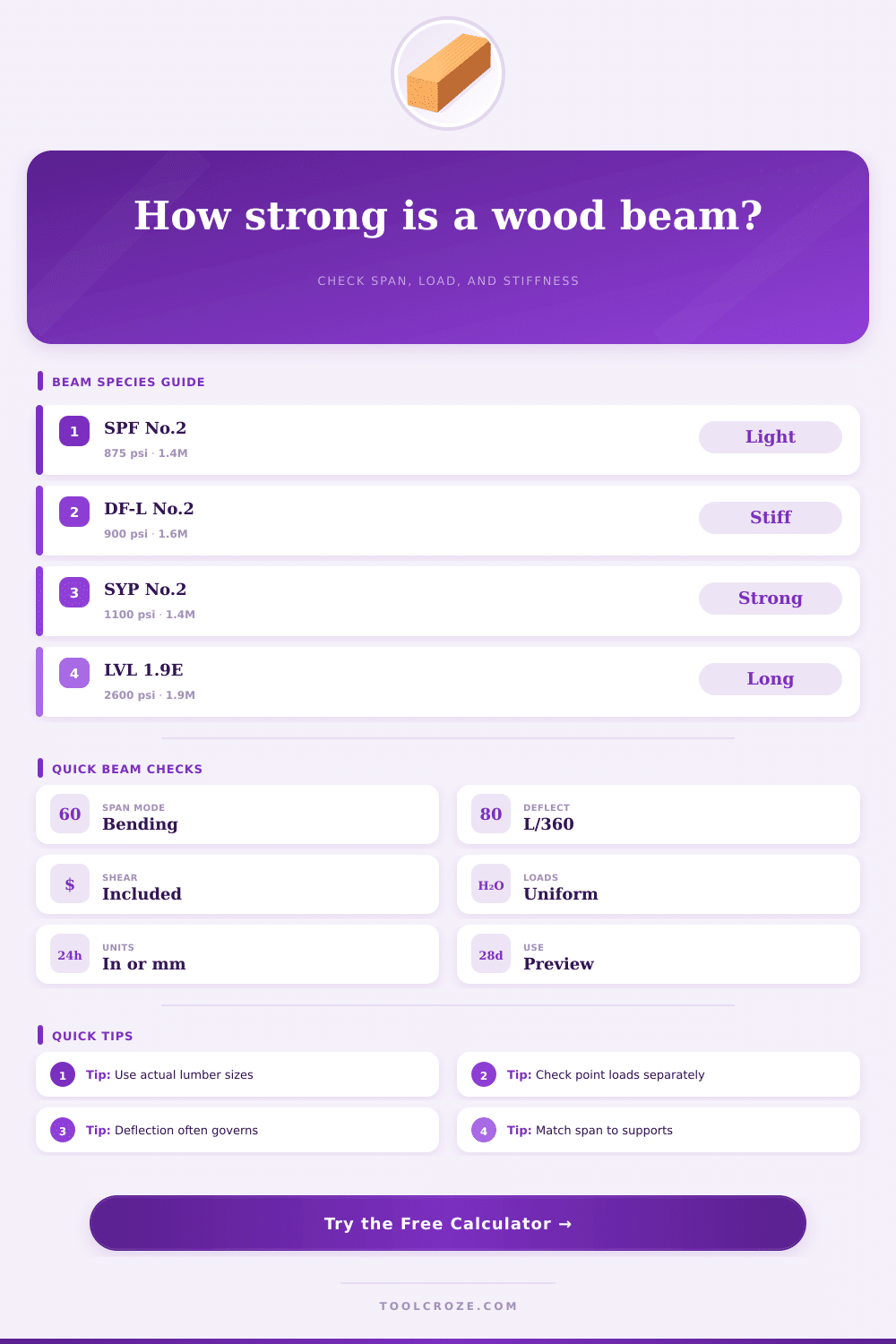
| Species | Fb | E | Note |
|---|---|---|---|
| SPF No.2 | 875 psi | 1.4 Mpsi | Light duty framing |
| Douglas Fir-Larch No.2 | 900 psi | 1.6 Mpsi | Stiff and common |
| Southern Pine No.2 | 1100 psi | 1.4 Mpsi | Higher bending value |
| LVL 1.9E | 2600 psi | 1.9 Mpsi | Long-span engineered beam |
| Nominal | Actual | Area | Use |
|---|---|---|---|
| 2x6 | 1.5 x 5.5 | 8.25 in2 | Shed and shelf |
| 2x8 | 1.5 x 7.25 | 10.88 in2 | Short floor beam |
| 2x10 | 1.5 x 9.25 | 13.88 in2 | Deck and porch |
| 2x12 | 1.5 x 11.25 | 16.88 in2 | Longer simple spans |
| Use | Load | Ratio | Comment |
|---|---|---|---|
| Floor beam | 40 psf | L/360 | Common occupancy |
| Deck beam | 60 psf | L/360 | Outdoor live load |
| Roof beam | 20 psf | L/240 | Snow or roof service |
| Shelf beam | 20 psf | L/180 | Light storage use |
Wood beams are horizontal, that bear the weight of spaces between vertical supports like columns or walls. They carry the weight of floors, roofs or decks and move it to the foundations. A wood beam rests only on two posts at its ends without support in the middle.
Those elements move weight of roof, floor or walls to vertical supports like posts or foundations
Wood Beams: Types and Uses
Wood beams and timber species come in many types, among them hardwood, cedar, cypress, Douglas fir and Western cedar. Premium white pine, Western cedar and Douglas fir wood beams are available for construction at competitive prices. Doug fir is good for build, though it does not look beutiful.
For looks you can use red maple or oak, because both have higher elasticity and strength than Doug fir.
Real wood beams you make by hand from premium timbers as knotty alder, white oak or pine. All they show the natural unique charm of real timbers. Custom beams from walnut, red oak, mahogany or poplar also exist, which gives freedom for ceilings, trusses or mantels.
Faux wood beams weigh little, install easily and are rugged. They form them using real wood planks, to reach real wooden texture. Rather than solid wood beams, that serve structure, faux beams usually are made of lightweight materials as high-density foam, fiberboard or mix of wood particles and resins.
Compared with solid beams, box beams are cheaper to buy, ship, install and take care.
Box wood beams can be made by hand from old barnwood with internal hollow space. They suit for cover structures or create classic wooden ceiling looks without the weight of solid beam. Lightweight hollow box beams ease the whole installation.
LVL beams offer other options, in various sizes and lengths. Glue-lam beams allow builders to use mixes of wood grades. Today giant solid wooden beams are rarely available, and drying such without cracks or checks is a risky cause.
Strengthening wood beams with steel is a practical solution. A common way is use steel plates for flitch beams, where metal fits between wooden parts to bear loads. Beam hangers form a special link for wooden beams, visible or concealed.
Brackets and plates help to commonly connect them. Code-approved metal joisthangers with the maker screws or nails matter for good framing.