Wire Rope Stretch Calculator
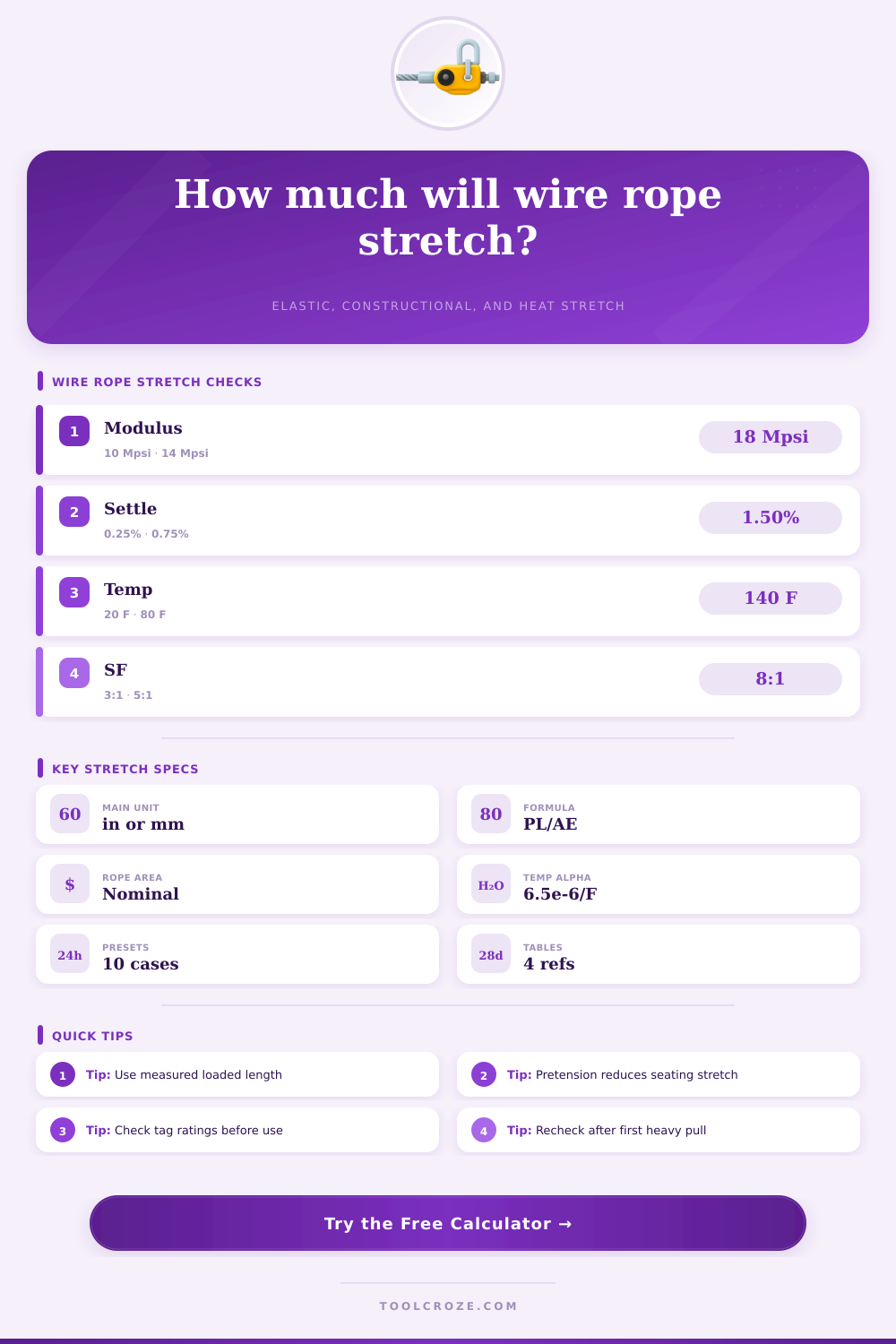
Estimate loaded wire rope elongation from rope length, load, diameter, construction modulus, constructional stretch, temperature change, end allowance, and selected safety factor.
⚙Wire Rope Stretch Presets
📏Stretch Inputs
🧱Rope Modulus and Spec Grid
📊Construction Modulus Reference
| Construction | Typical modulus | Area factor | Constructional stretch |
|---|---|---|---|
| 6x19 IWRC hoisting rope | 12 to 14 million psi | 0.58 to 0.62 | 0.50% to 1.00% |
| 6x36 IWRC flexible rope | 11 to 13 million psi | 0.56 to 0.60 | 0.75% to 1.25% |
| 7x19 aircraft cable style | 9 to 12 million psi | 0.50 to 0.56 | 1.00% to 1.75% |
| 19x7 rotation-resistant rope | 13 to 15 million psi | 0.55 to 0.60 | 0.40% to 0.90% |
| Compacted strand rope | 14 to 17 million psi | 0.62 to 0.68 | 0.25% to 0.75% |
📝Diameter and Breaking Force Planning Table
| Rope diameter | Nominal area at 0.58 factor | Rough 6x19 IWRC MBF | 5:1 working screen |
|---|---|---|---|
| 1/4 in | 0.028 sq in | 6,800 lb | 1,360 lb |
| 3/8 in | 0.064 sq in | 14,400 lb | 2,880 lb |
| 1/2 in | 0.114 sq in | 26,600 lb | 5,320 lb |
| 5/8 in | 0.178 sq in | 41,200 lb | 8,240 lb |
| 3/4 in | 0.256 sq in | 58,800 lb | 11,760 lb |
| 1 in | 0.456 sq in | 103,400 lb | 20,680 lb |
🌡Stretch Component Reference
| Component | What it represents | Typical behavior | Calculator input |
|---|---|---|---|
| Elastic stretch | Load based elongation of steel wires | Mostly recovers when unloaded | Load, length, area, modulus |
| Constructional stretch | Strand and core bedding under load | Often permanent after first heavy use | Percent and realized seating factor |
| Thermal movement | Length change from temperature swing | Reversible with temperature | Temperature change and alpha |
| End allowance | Socket, clip, thimble, or take-up allowance | Depends on hardware and adjustment method | Manual allowance field |
🛡Safety Factor Screening Table
| Screen | Calculated ratio | Meaning | Action |
|---|---|---|---|
| Comfortable reserve | At least 125% of selected factor | Stretch estimate is below capacity screen | Still verify rope tag and hardware |
| Near selected factor | 100% to 125% of selected factor | Limited planning room remains | Use stronger rope or reduce load |
| Below selected factor | Less than selected factor | Load exceeds the chosen reserve screen | Do not use as entered |
| Unknown tag | Estimated MBF only | Diameter estimate is not a certified rating | Find the actual rope specification |
💡Stretch Calculation Tips
Wire rope is not a rigid bar; wire rope change length when tension is applied to the wire rope. The steel wires that make up the wire rope stretch when tension is applied, and the strand of the wire rope settle into the core of the wire rope. Additionally, wire rope expands when it is exposed to high temperatures and contract when it is exposed to low temperatures.
Because length is a factor that changes with wire rope tension, it is important to calculate the total elongation of the wire rope rather than guess at it’s movement. To calculate the movement of the wire rope, there are several different input variables that is required. The length of the wire rope is one of the most important variable, but you are to measure the loaded length of the wire rope, not the slack length of the wire rope.
How to Calculate Wire Rope Stretch
The load that is applied to the wire rope is another of the most important variables. The diameter of the wire rope, as well as its construction, is another of the important variable; a 6×19 IWRC wire rope will have a different stretch variable than a 7×19 aircraft cable wire rope with the same diameter. The modulus of the wire rope is a measurement of its stiffness, but that value is an effective one that take into account the helical lay of the wire rope’s strands as well as the type of core that the wire rope utilizes.
Another component of the movement of the wire rope is the constructional stretch of the wire rope. Constructional stretch occurs when the wire rope is first load with a heavy load. The strands of the wire rope bed into the core of the wire rope, and the wires within the strands seat against each other.
Once the constructional stretch has occurred, it does not spring back to its original state when the load is removed from the wire rope. A seating percentage selector can be utilized to determine how much constructional stretch has occurred in the wire rope. If the wire rope is newly purchased, most of the constructional stretch will have occurred with the first heavy load that is place upon the wire rope.
However, if it has been pre-stretched prior to use, the constructional stretch has probably already occur. Temperature changes can affect the length of the wire rope. When the wire rope is exposed to high temperatures, the metal of the wire rope will expand; when the wire rope is exposed to low temperatures, the metal will contract.
These changes to length can move the wire rope several inches, even if no load is place upon the wire rope. The thermal term in the calculation of total wire rope movement takes this thermal movement of the wire rope into account. This component of movement is reversible, so it is important to take into account when the goal is to maintain a constant tension or sag in the wire rope.
One final variable to take into account is the end fitting that are attached to the wire rope. Any end fittings, such as poured sockets, swaged terminals, or turnbuckles, will add to the length of the wire rope. This allowance for length is a value that you are to enter into the calculator, as it will be used to calculate the total stretch of the wire rope.
The safety factor of the wire rope can be screened alongside the calculation of its total stretch. The stretch of the wire rope and its capacity are related to one another. A wire rope that is loaded close to the minimum breaking force of the wire rope will exhibit more elastic stretch of the wire rope than a wire rope that is loaded with less tension.
Additionally, a wire rope that is loaded close to the minimum breaking force of the wire rope will have a smaller safety factor than one that is loaded with less tension. The condition factor of the wire rope allow for its breaking strength to be derated in response to worn, corroded, or old rope. Low safety factor will require changes to the wire rope’s diameter, construction, or working load.
There are a few common mistakes with the calculation of the movement of wire rope. One of the most common is treating constructional stretch as something that will spring back into place when the load is remove from the wire rope; this is not true. Another common mistake is ignoring the difference between the length of the wire rope when it is measured and when it is loaded with tension; these length are not the same.
Finally, one of the last mistakes is measuring the length of the wire rope after it has been tensioned, but applying the constructional stretch allowance a second time to the wire rope after it is tensioned. The total stretch in the wire rope will tell you how to set the turnbuckles that control the length of the wire rope, or how much extra wire rope to allow for the wire rope to remain on the drum to which it is attached. The elastic portion of the total stretch will tell you how much the wire rope will return to its original length when the load is removed from the wire rope.
The constructional and thermal portions will tell you how much permanent or seasonal adjustment need to be made to the length of the wire rope to compensate for the stretch that occur with load and temperature changes. Finally, the total of these three value will tell you the total movement of the wire rope.