Wire Rope Sag Calculator
Estimate sag, rope length, reactions, end tension, and allowable-sag tension from span, unit weight, horizontal tension, point load, temperature stretch, support height difference, and safety factor.
1 Presets
2 Span And Rope Inputs
3 Results
4 Rope, Span, And Spec Grid
5 Catenary And Parabolic Breakdown
6 Sag Profile Samples
| Station | Chord elevation | Uniform catenary sag | Point load addition | Total sag below chord |
|---|
7 Reference Tables
| Rope / cable | Typical weight | Typical EA estimate | Common planning use |
|---|---|---|---|
| 1/8 in 7x7 galvanized aircraft cable | 0.029 lb/ft | 230,000 lb | Small controls, light guard lines |
| 3/16 in 7x19 galvanized aircraft cable | 0.065 lb/ft | 520,000 lb | Garage, shade, and light messenger spans |
| 1/4 in 7x19 galvanized aircraft cable | 0.110 lb/ft | 1,100,000 lb | Drapes, banners, and medium messenger lines |
| 3/8 in 6x19 IWRC wire rope | 0.260 lb/ft | 2,600,000 lb | Heavier shop and support cable layouts |
| 1/2 in 6x36 IWRC wire rope | 0.460 lb/ft | 4,700,000 lb | Longer support spans and heavy tag lines |
| Span condition | Starting sag target | Planning tension check | Notes |
|---|---|---|---|
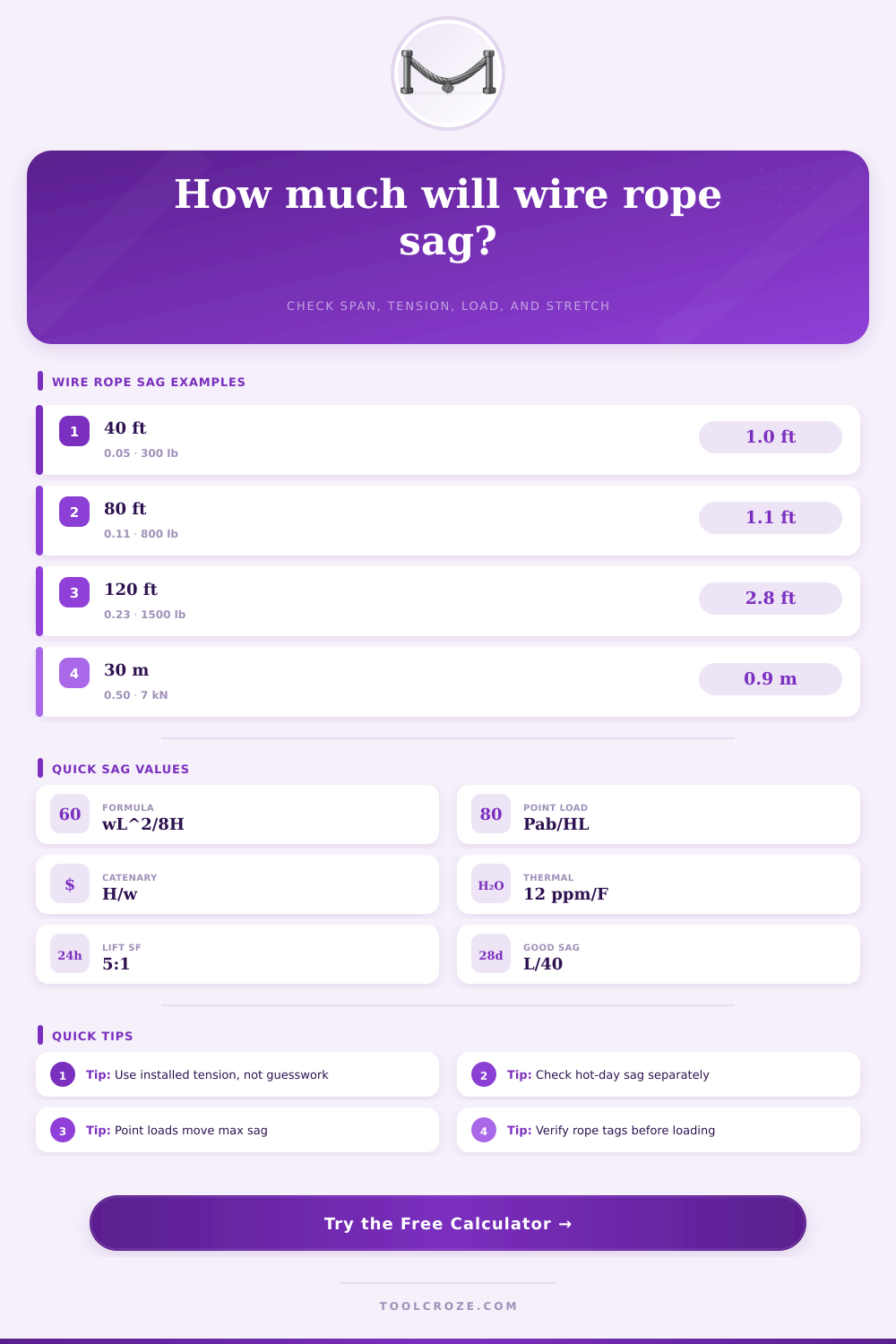
| Short indoor messenger cable | L/60 to L/40 | H = wL^2 / 8f | Often governed by end anchors and installation tension. |
| Outdoor banner or shade wire | L/40 to L/25 | Add wind and temperature review | Hot-day stretch and wind can dominate clearance. |
| Moving trolley or curtain line | L/80 to L/50 | Add rolling point load | Check the load at several stations, not only midspan. |
| Unequal support elevation | Clearance based | Use sag below inclined chord | The low point may move toward the lower support. |
| Formula | Use | Inputs | Result |
|---|---|---|---|
| a = H / w | Catenary constant | Horizontal tension H and unit weight w | Curve scale length |
| f = a(cosh(L/2a) - 1) | Exact equal-support sag | Span L, catenary constant a | Uniform-load sag |
| f = wL^2 / 8H | Parabolic approximation | Span, weight, tension | Quick sag estimate |
| fP = Pab / HL | Point load deflection | Point load P, distances a and b | Added sag at point load |
| Delta L = alpha Delta T L | Temperature stretch | Thermal coefficient and temperature change | Rope length change |
| Material / effect | Typical coefficient | Use in calculator | Planning note |
|---|---|---|---|
| Carbon steel wire rope | 6.0 to 7.0 ppm/deg F | Default 6.5 ppm/deg F | Use cable certificate or manufacturer data when available. |
| Stainless wire rope | 8.8 to 9.6 ppm/deg F | Higher thermal stretch | Outdoor stainless spans can change sag noticeably. |
| Metric steel coefficient | 11 to 13 ppm/deg C | Default metric presets use 12 ppm/deg C | Coefficient must match the temperature unit used. |
| Elastic stretch | H L / EA | Reported as length change | Constructional stretch and seating are not included. |
8 Tips And Safety Note
Wire rope sag is the curve that exists in the middle of a wire rope that is stretched between two points. This is a significant factor in the installation of wire ropes as wire rope sag can create problems with the clearances of the ropes or the rope can contact some of the object below the rope. The variables that contribute to the sag of a wire rope include the span length, the weight of the rope, the horizontal tension, point load, temperature, and the elevation of the supports of the wire rope.
The span length of a wire rope is a primary contributor to sag since the longer the span of the wire rope, the more greater the sag of the wire rope. The longer the span, the greater the increase in the sag of the wire rope, as sag is inversely proportional to the span length of the wire rope. The weight of the wire rope will also contribute to the sag of the wire rope; the greater the weight of the wire rope, the greater the sag.
Why Wire Ropes Sag and How to Measure It
The horizontal tension of a wire rope will counteract some of the sag of the wire rope; the greater the horizontal tension of the wire rope, the smaller the sag of the rope. However, the tension cannot increase to provide more counteraction to the sag of the wire rope because of the physical limit of the wire rope. The position of the point loads will also contribute to the sag of the wire rope.
If a load is not placed at the center of the wire rope, the sag of the wire rope will be deeper on one side of the wire rope than the other. The position of the load can create a deeper sag on the side of the wire rope that is further from the point load. Therefore, if the load can move, the position of the load will change the position of the maximum sag of the wire rope.
To accommodate this, the wire rope designer will need to check the wire rope sag calculator at several positions for the moving load. Additionally, another variable that contributes to sag is the temperature. If the temperature increases, the length of the wire rope will increase; a longer wire rope will have more sag than a shorter wire rope.
Therefore, the wire rope will have more sag if the temperature increase. If the temperature of the rope decreases, the length of the wire rope will also decrease; a shorter wire rope will have less sag than a longer wire rope. Therefore, the wire rope will have less sag if the temperature of the rope decreases.
Therefore, when calculating sag, the wire rope designer must consider the temperature range between the coldest and hottest temperatures at which the wire rope will be installed and in service. The final variable to consider with wire rope sag is the elevation difference of the two support of the wire rope. If one support is higher than the other, the sag of the wire rope will shift toward the lower support.
Therefore, because the supports are of different elevations, the sag of the wire rope will be along an inclined line between the supports rather than along a horizontal line. For long spans of wire ropes, the difference in elevation between the two supports of the wire rope can be great enough to create an impact on the position where the wire rope sag is of most concern. Another value that is used in the calculation of sag is the safety factor.
The safety factor for a wire rope system ensure that the tension of the wire rope during service is within a safe range. The safety factor accounts for dynamic, shock, and static loads on the wire rope, the corrosion of the wire rope, and for the installation of the wire rope into its supports. The safety factor should be higher for wires that are located in public spaces and that are exposed to the element, such as the wind.
For wire ropes that are used indoors for relatively light work, a lower safety factor can be used. However, the safety factor should account for the difference between the static and dynamic loads on the rope during service. The construction of the wire rope can also have an impact upon the sag of the wire rope.
For instance, constructional stretch of a wire rope can occur after the wire rope is loaded with its service loads; this type of stretch is not accounted for in the calculation of sag of a wire rope. Additionally, the radius of the load on the wire rope terminations and the torque of the clips that secure the wire rope to its terminations will also impact the breaking strength of the wire rope. If these factors are ignore in the planning of the installation of the wire rope, the installation of the wire rope can be unsafe.
Common mistakes in the calculation of sag for wire rope systems are the use of the wrong value of tension for the wire rope and the ignoring of the changes in the temperature of the wire rope. For instance, many people make the mistake of entering the breaking strength of the wire rope instead of the actual horizontal tension of the wire rope. This result in the underestimation of the sag of the wire rope.
Another common mistake is the assumption of the position of the low point of sag in the wire rope; the position of the low point is not the center of the span if there are point loads on the wire rope or if the supports are at different elevations. These mistakes can be avoided by using a wire rope sag calculator to calculate the sag of the wire rope; the calculator will automatically account for these variables and will not allow the designer to provide an underestimation of the sag of the wire rope. The goal of the installation of a wire rope is not to eliminate the sag of the wire rope.
Some sag is necessary in the wire rope to ensure that the tension of the wire rope does not exceed the capacity of the anchors that support the wire rope. The goal is to ensure that the sag and the tension of the wire rope are within safe limits. These limits can be determined by running all of the inputs for the wire rope into a model that determine the sag and tension of the wire rope before the purchase of the wire rope or the drilling of the anchors.
After installing the wire rope, the tension and sag of the wire rope should be measured. These measurements can then be compared to the calculated sag and tension of the wire rope. Any difference between these two values will require a check of the initial inputs for the model; the error in the initial inputs will require correction before the installation of the wire rope.
Wire rope sag is a calculation that must be performed before the installation of wire rope to the supports. However, the actual sag and tension of the wire rope should be measured after installation to ensure that the calculations were correct. Any difference between the calculated and actual measurements of the sag of the wire rope will require a review and check of the initial inputs for errors in the calculation of sag; these errors must be corrected before the installation of the wire rope system.