Wire Rope Length Calculator
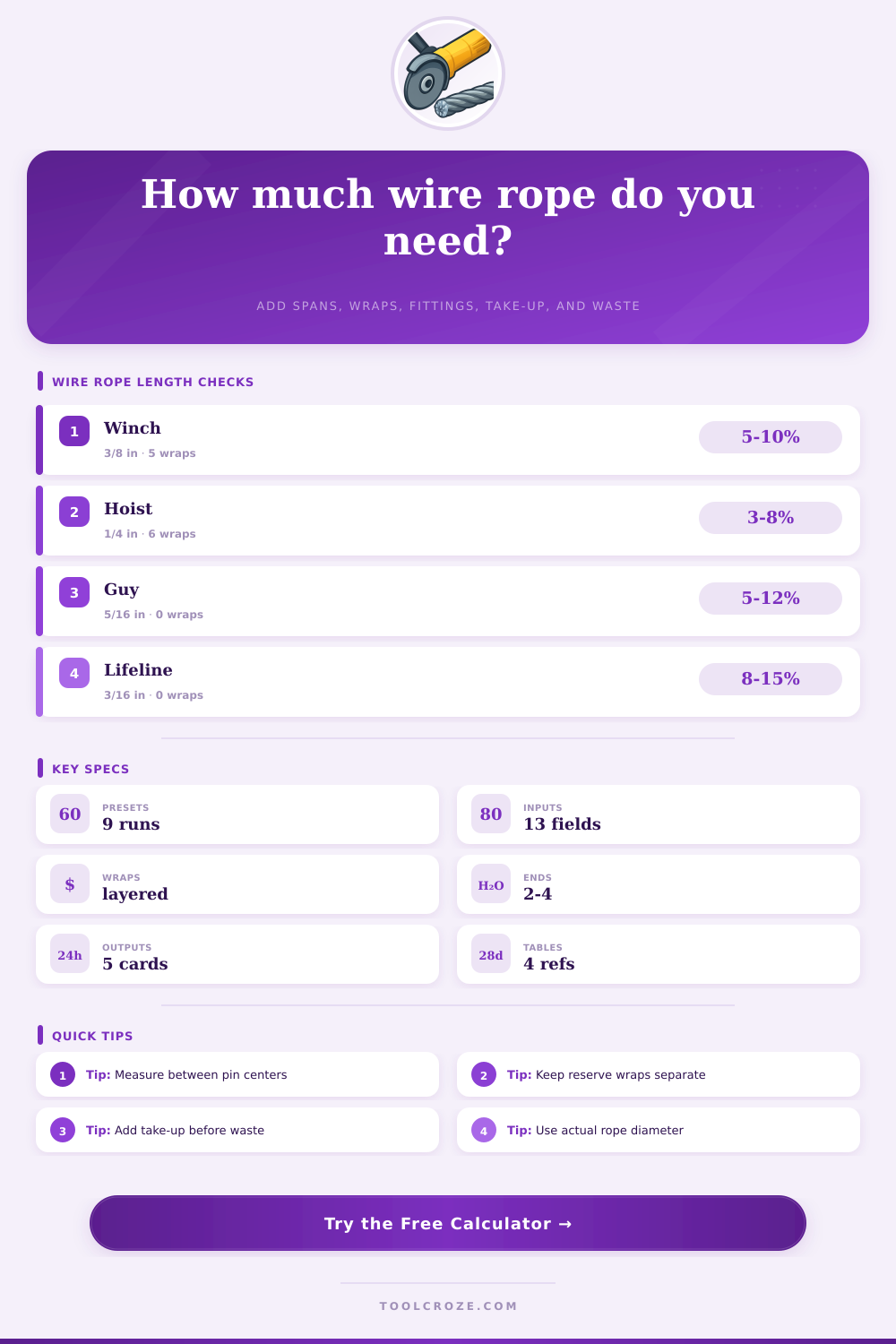
Estimate the wire rope cut length for straight spans, multiple rope parts, drum wraps, layered spooling, minimum reserve wraps, eyes, end fittings, sag allowance, take-up travel, and waste.
⚙Real wire rope length presets
Start from a common rope layout, then replace each dimension with your measured pin-to-pin, fairlead, or drum drawing value.
📐Calculator inputs
Wire rope length result
Full length breakdown
🔧Rope, drum, and spec grid
📋Reference tables
| Wire rope layout | Common measurement basis | Typical reserve | Length note |
|---|---|---|---|
| Trailer or utility winch | Hook travel plus drum wraps | 4-6 wraps | Add fairlead travel and any hook thimble return |
| Shop hoist replacement | Hook path times reeving parts | 6-8 wraps | Use the hoist manual for dead-wrap minimums |
| Guy wire with turnbuckle | Pin center to anchor center | 0 wraps | Subtract or add planned turnbuckle take-up travel |
| Marine lifeline | Terminal pin center to pin center | 0 wraps | Measure after stanchion offsets and hardware style |
| Stage safety cable batch | Finished loop-to-loop length per cable | 0 wraps | Multiply by cable count before waste if cut from one reel |
| End preparation | Planning allowance | Best use | Check before cutting |
|---|---|---|---|
| Plain cut end | 0-0.25 ft / 0-75 mm | Clamped or field-trimmed ends | Allow for cleanup after cutting |
| Swaged sleeve eye | 0.75-1.5 ft / 225-450 mm | Small aircraft cable and safety loops | Thimble size and sleeve maker instructions |
| Flemish eye splice | 1.5-3.5 ft / 0.45-1.1 m | Larger slings and rigging assemblies | Rope diameter and fabricator procedure |
| Swaged socket or stud | 0.3-1.0 ft / 90-300 mm | Standing rigging and lifelines | Terminal pin-to-shoulder dimension |
| Wire rope clips | 1-2.5 ft / 0.3-0.75 m | Temporary or adjustable field terminations | Number of clips and turnback length |
| Rope size | Typical layouts | Drum wrap planning | Allowance cue |
|---|---|---|---|
| 1/8 in / 3 mm | Safety cables, light controls | Small wrap length, tight bend limits | End sleeves usually dominate length |
| 3/16 in / 5 mm | Garage doors, lifelines, flags | Useful for small drums and sheaves | Add hardware-specific terminal length |
| 1/4 in / 6 mm | Shop hoists, light winches | Reserve wraps become noticeable | Check hoist dead-wrap requirement |
| 3/8 in / 10 mm | Recovery and service winches | Layer diameter changes length quickly | Use actual layer and drum barrel diameter |
| 1/2 in / 13 mm | Industrial hoists and pulling | One wrap can add several feet | Use certified assembly drawings |
| Formula item | Expression | Units | Purpose |
|---|---|---|---|
| Straight span subtotal | Run length x parts | ft or m | Counts multiple rope falls or repeated cables |
| Layer diameter | Db + (2L - 1)d | in or mm | Finds the rope centerline for selected layer |
| Working wraps | Wraps x pi x layer diameter | ft or m | Adds rope stored around the chosen drum layer |
| Reserve wraps | Minimum wraps x pi x (Db + d) | ft or m | Keeps non-working dead wraps on the barrel |
| Final cut length | Subtotal x (1 + waste%) | ft or m | Adds trimming and shop handling allowance |
💡Planning tips
Calculating the length of a wire rope run requires that you account for much different segments of that wire rope. The length of the wire rope must account for the length of the wire rope that will be wrap around the drum, the number of reserve wraps that will remain on the drum, the length of the wire rope needed for create the various eyes in the wire rope, the stretch or sag of the wire rope under the load that it will exhibit, and the length of any take-up travel that may be required in the wire rope run. If you dont account for each of these different segment of the wire rope run, the length of the wire rope will be either too short or too long for that run; too short wire rope can be dangerous.
When you use a wire rope calculator, each field within the calculator will require that you understand the specific meaning of that field. The field for the span of the wire rope will ask for the loaded path length of the wire rope that is to be traveled, prior to accounting for the length of the wire rope that will be needed for the creation of the various eye in the wire rope. The number of parts field will ask for the number of times that the wire rope will travel along that same path; the wire rope may travel through multiple parts or falls in the run.
How to Measure the Right Wire Rope Length
The fields for the drum will ask for the diameter of the drum, the number of working wraps of the wire rope that will be on the drum, and the layer number of the wire rope; each successive layer of the wire rope on the drum will increase the circumference of the drum; the wire rope wraps on the drum will have a longer distance to travel on the wire rope if the diameter of the drum increase. The number of reserve wraps of the wire rope that will remain on the drum while the wire rope is extended is also a critical component of the wire rope length; these wraps will ensure that the anchor point of the wire rope does not become attached to the end of the wire rope. Fewer than four or five reserve wrap can be dangerous in that the wire rope will become attached to the end of the wire rope if the system is under load.
The number of reserve wraps should be accounted for separately from the number of working wraps of the wire rope. An additional length of wire rope will be required to permit for the wire rope to travel through the thimble or sleeve that will create the eye in the wire rope. The length of the wire rope required to create the eye in the wire rope will depend upon the diameter of the wire rope, as well as the specific style of that eye.
For instance, a swaged socket will require less length of wire rope than a Flemish eye. The length of the wire rope will also have to account for the sag that will occur in the wire rope; wire rope will stretch with the load that is applied to the wire rope, and the horizontal portion of the wire rope will never be perfectly straight. The length of the wire rope will have to account for sag; the percentage of the span of the wire rope can be accounted for in the calculator.
The length of the wire rope will also have to account for any take-up travel in the system; for instance, turnbuckles or tensioners may shorten the length of the wire rope system. A negative value can be entered into the wire rope length calculator in the fields for take-up travel to account for this potential shortening. Finally, the length of the wire rope will have to account for waste; it is possible that some wire rope will be wasted cutting the ends of the wire rope, or in creating the first eye in the wire rope.
The waste percentage can be accounted for in the wire rope length calculator; it will be a multiplier of the subtotal of the length of the wire rope that is calculated. The percentage of waste can be based off the individual’s habits in cutting wire rope; if an individual is precise with each cut of wire rope, a low waste percentage can be used. However, if an individual is cutting wire rope from bulk reels of wire rope, a higher waste percentage should be accounted for.
In some instances, individuals may make some common mistake when calculating the length of the wire rope that is to be used in a wire rope run. For instance, some individuals may measure the distance between two points in the wire rope run when the wire rope is not under load; the span of the wire rope should be the loaded path that the wire rope will take between each location. Other individuals may not account for the reserve wraps of the wire rope; fewer than four or five reserve wraps of wire rope can become dangerous for the system if the wire rope becomes attached to the end of the drum.
Some individuals may add the length of wire rope required to form an eye at each end of the wire rope; the wire rope should only be allowed to travel through the thimble and form an eye at the ends that has hardware to form that eye. Finally, some individuals may not account for sag in the wire rope; sag must be accounted for in the calculation of the length of the wire rope to permit for the wire rope to not become too tight in the system once the load is placed upon the wire rope. The layer of the wire rope that is on the drum is also another important factor in the calculation of the length of the wire rope.
The layer of wire rope that is in contact with the barrel will have a diameter that is equal to the diameter of the drum plus the diameter of the wire rope. The layer of wire rope that is placed on the remainder of the diameter of the drum will have a diameter that is equal to the diameter of the drum plus two times the diameter of the wire rope. The wire rope length calculator will account for the length of each of these wrap of wire rope; the separate field for the layer of the wire rope is used to permit the wire rope length calculator to accurately calculate the length of each wrap in the wire rope run.
The accuracy of the length of the wire rope that is calculated will depend upon the accuracy of the measurements that are taken of the various components of the wire rope system. For instance, the distance between the two bearing points of the hardware can be measured; the distance between the outside faces of the posts may not be accurate. The actual diameter of the wire rope should be measured, not the nominal diameter of the wire rope.
Finally, the percentage of waste of the wire rope can be based upon the individual’s own habits in cutting wire rope; if an individual is very precise in the cutting of the ends of wire rope, a low percentage of waste can be accounted for in the calculation. However, if an individual plans on cutting wire rope from bulk reels, or if the individual intends to make practice splices in the wire rope, a more higher percentage of waste should be accounted for.