Wire Rope Bend Radius Calculator
Estimate wire rope bend radius, sheave or drum D/d ratio, bend efficiency, fatigue category, fleet-angle penalty, groove condition, load utilization, and safety margin for planning checks.
⚙Wire Rope Bend Presets
📏Bend Inputs
📊Sheave / Rope / Spec Comparison Grid
📘Construction Reference
| Construction | Flexibility | Base D/d Target | Planning Note |
|---|---|---|---|
| 6x19 IWRC | Moderate | 24:1 | Durable outer wires; avoid small sheaves in cycling service. |
| 6x36 IWRC | High | 22:1 | More flexible hoist rope; still governed by manufacturer limits. |
| 7x19 cable | Very high | 18:1 | Useful for small controls, not a substitute for hoisting rope tags. |
| 19x7 rotation-resistant | Special | 30:1 | Often needs larger sheaves and strict handling controls. |
| Compacted strand | Moderate | 28:1 | Higher bearing pressure; follow the rope supplier chart. |
🔢D/d Ratio and Bend Efficiency
| D/d Ratio | Typical Bend Efficiency | Fatigue View | Action |
|---|---|---|---|
| 36:1 and above | 98% to 100% | Best for high-cycle bends | Still inspect grooves and rope wear. |
| 30:1 to 35:1 | 96% to 98% | Fatigue-friendly for many hoist lines | Good target for frequent operation. |
| 24:1 to 29:1 | 93% to 96% | Common planning range | Check construction-specific requirements. |
| 18:1 to 23:1 | 88% to 93% | Increased wear risk | Limit cycles and inspect often. |
| Below 18:1 | Below 88% | Tight bend concern | Use a larger sheave or obtain approval. |
📐Fleet Angle Reference
| Fleet Angle | Calculator Factor | Common Effect | Planning Response |
|---|---|---|---|
| 0 to 1.0° | 1.00 | Clean entry to groove | Preferred for high-cycle reeving. |
| 1.1 to 1.5° | 0.98 | Minor side pressure | Usually acceptable when grooves are correct. |
| 1.6 to 2.0° | 0.95 | Noticeable side wear | Check fleet geometry and drum spooling. |
| 2.1 to 3.0° | 0.90 | Higher rubbing and crushing | Use caution and reduce duty assumption. |
| Above 3.0° | 0.84 | Severe alignment concern | Revise layout or get engineered approval. |
🔧Groove and Equipment Spec Reference
| Spec Item | Good Check | Warning Sign | Why It Matters |
|---|---|---|---|
| Sheave groove radius | Supports rope without pinch | Rope sits high or squeezed | Pinching damages outer wires and core support. |
| Drum pitch diameter | Matches rope maker D/d | Small barrel or tight first layer | First-layer bends can govern fatigue life. |
| Fleet angle | Near centerline | Rope scrubs flange or groove wall | Side loading shortens rope and sheave life. |
| Rope construction | Selected for bend duty | Rotation-resistant on small sheaves | Special ropes may have stricter minimums. |
| Inspection basis | Documented discard criteria | Broken wires, kinks, crushing | Condition can override any calculation. |
💡Wire Rope Bend Tips
Wire rope bend radius are important because wire rope doesnt just carry tension in the system, but the rope must be able to endure being force around a curve many times. When a sheave or drum forces wire rope around it, the outer wire of the wire rope stretch and the inner wires of the wire rope compress. Over time, if the bend radius of the wire rope is too tight, these wires will develop fatigue, which will eventually lead to broken wires in the rope.
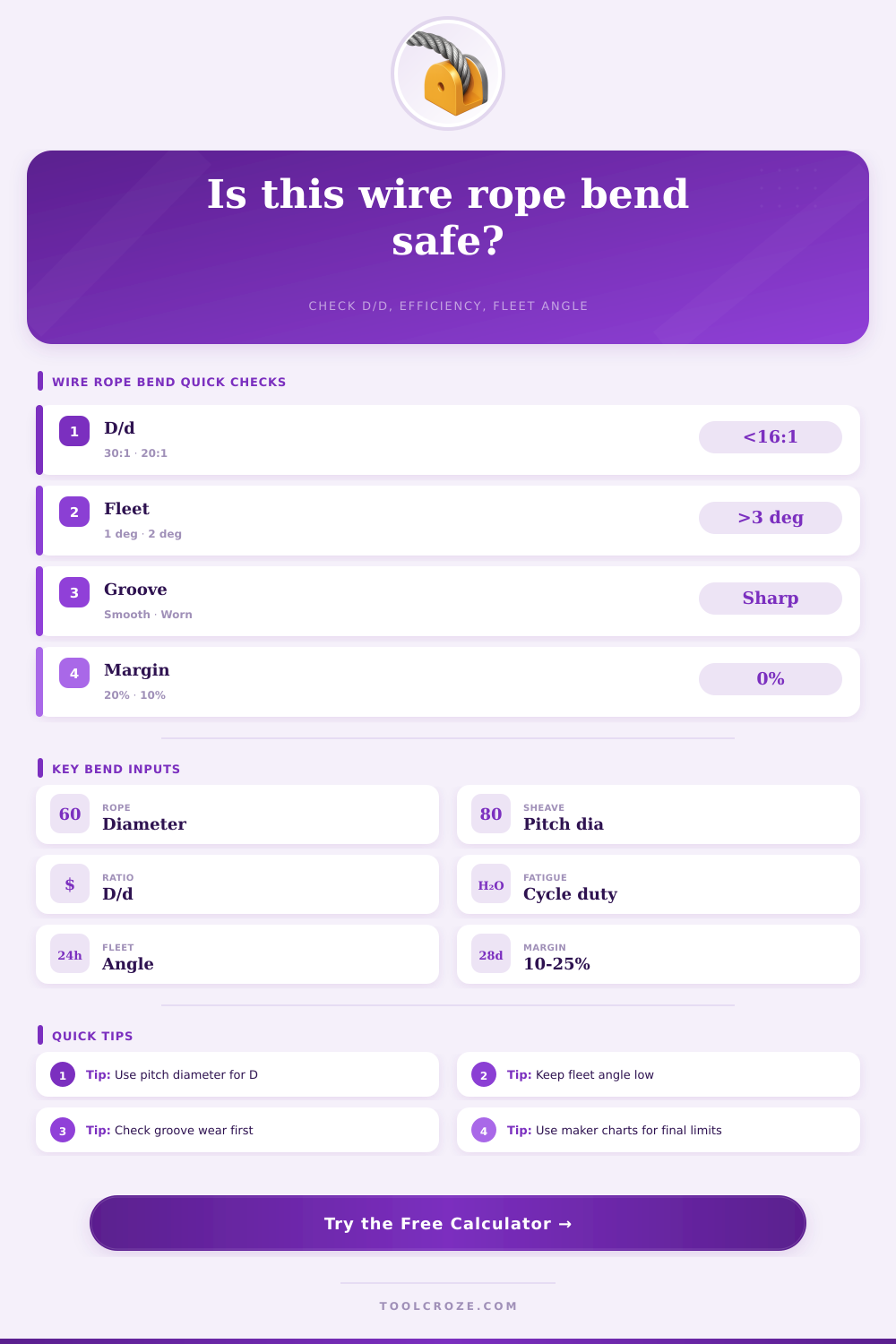
Therefore, it is important to make sure that the wire rope can handle the load that it will experience today, as well as after it is bent around the sheave for many weeks or months. The D/d ratio is an important number in determining what D/d ratio the wire rope system should have. The D in the D/d ratio is the pitch diameter of the sheave or drum…
How Bend Radius and D/d Ratio Affect Wire Rope Life
It is not the outside diameter of the sheave. Using the outside diameter of the sheave will hide the actual bend in the wire rope. The d is the measured diameter of the wire rope.
Using these two dimensions, a higher D/d ratio will provide for a greater lifespan of the wire rope than a lower D/d ratio. The construction type of the wire rope will also affect the D/d ratio that is established for the wire rope system. For instance, a 6×19 wire rope has thicker outer wires than a 6×36 wire rope.
The 6×36 wire rope will bend more easily due to the smaller diameter of the wires. Another example of wire rope with different D/d ratios is that 19×7 rotation-resistant ropes will experience more strain due to the internal strand of the rope working against the rope during bending. The fatigue category input in the calculator help to account for these types of differences in wire rope construction.
Another factor to consider when setting up a wire rope system is the fleet angle. The fleet angle can cause side loading of the wire rope, which is not accounted for in the D/d ratio calculation. If the wire rope is installed at an angle of more than one degree, the wire rope will rub against the flange of the sheave.
The calculator will account for this rubbing of the wire rope by applying a factor to the D/d ratio to account for wear of the wire rope. Therefore, it is often more important to have a clean reeving layout than to increase the diameter of the sheaves. The groove condition of the sheave will also impact the D/d ratio.
If the groove is worn, the wire rope will sit in a higher portion of the groove. The increased pressure on the outer wires of the rope will cause the wires to flatten. If the groove is undersized for the wire rope, the wire rope will experience increased pressure on the outer wires of the rope, leading to potential damage to the core of the wire rope.
Thus, any system that has worn grooves, a marginal fleet angle, or a tight D/d ratio is operating near its limit. The load percentage and the cycle count will determine the utilization screen for the wire rope system. The working load (%) can be entered as a percentage of the wire rope rating.
However, the wire rope manufacturer may use a different percentage to indicate the efficiency of the wire rope under the given load and conditions. Therefore, the calculation will adjust the load percentage to account for the bend in the wire rope, the fleet angle, the groove condition, the fatigue category and the speed of the wire rope. The adjusted load percentage will indicate if there is enough headroom for the working load.
A safety margin can be established in the system to provide more headroom for the wire rope system. For ordinary service, a margin of 15% is typically applied to the working load. For service with a high degree of risk of failure of insufficient headroom for the working load, a margin of 25% is established for the load.
Many of the variables for a wire rope system will not be the same as those that are calculated in the rope system acceptance calculator. For instance, the temperature in the area where the wire rope system is installed can change the lubrication of the rope. Dirt and salt in the area where the rope system is installed can contribute to wear of the outer wires of the wire rope.
The loads that is attached to the wire rope system are not necessarily steady loads, they can be shock loads. After operation of the system for many hours, the diameter of the wire rope can decrease due to wear. The decreasing diameter will affect the D/d ratio of the wire rope.
Finally, the broken wires and the damaged core of the wire rope will contribute to a decreasing strength of the wire rope. Because of these various variables, the acceptance calculator is just a planning tool to determine if the wire rope system can handle the load for the given conditions and life of the rope system. One way to protect a wire rope system is to incorporate the D/d ratio into an inspection process.
For instance, measuring the pitch diameter of the sheaves on the equipment will ensure that the diameter that is entered into the calculation is the actual diameter of the sheave. Furthermore, measuring the fleet angle at the extremes of the drums movement will ensure the fleet angle is correctly entered into the calculation. Finally, observing the wire rope during the first few dozen cycles will allow the operator to determine if the wire rope is rubbing against the flange of the sheave or if the outer wires of the rope are flattening.
Any of these issues indicate that the wire rope system needs to be corrected. While the acceptance calculator can help determine the variables for a wire rope system, it is also important to visually inspect the rope for these issues. Ensuring that there is enough headroom for the working load will prevent the need to replace the wire rope system unexpectedly.