⚡ Wire Gauge & Length Calculator
Calculate AWG wire size, resistance, voltage drop, and maximum safe current for any electrical run
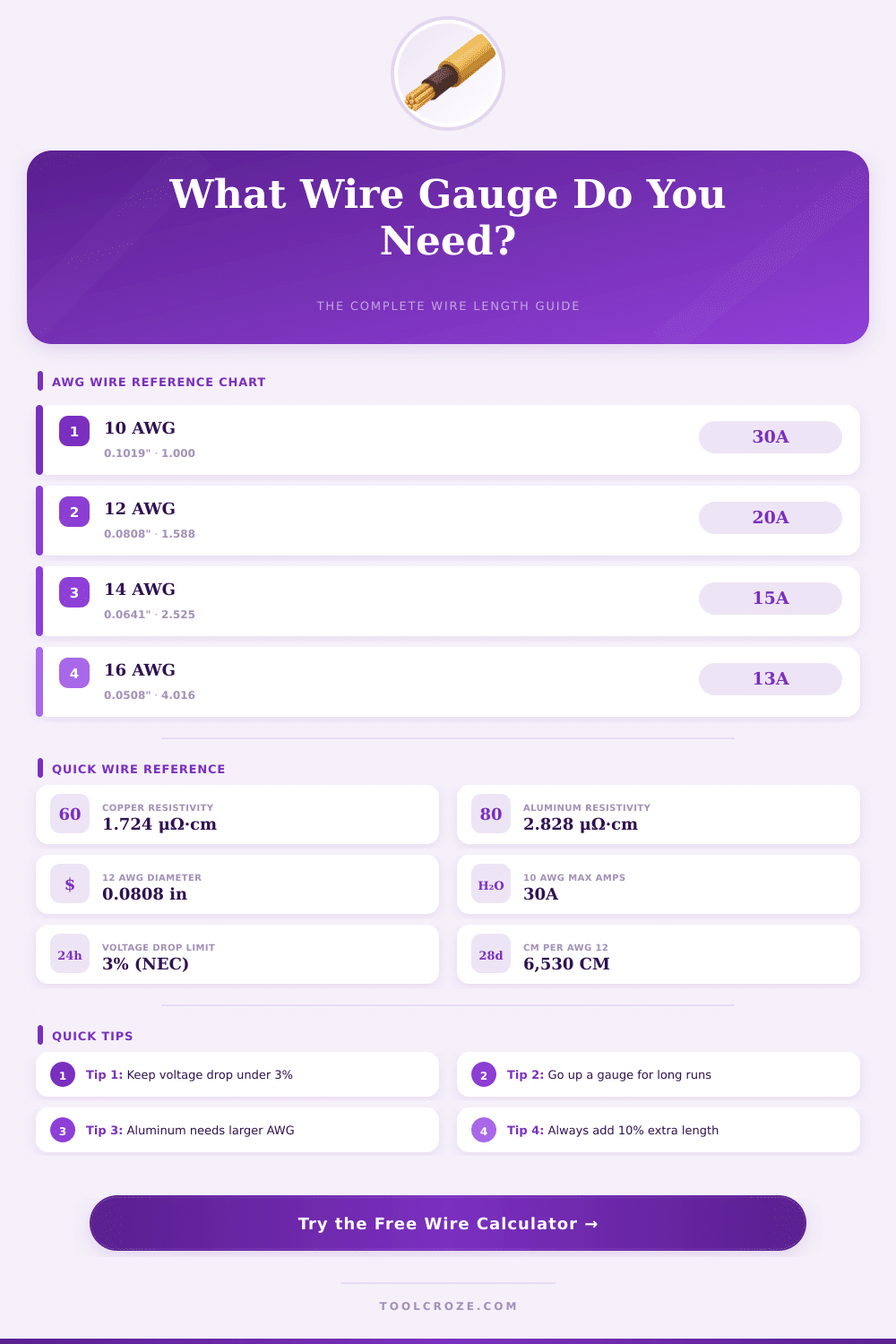
| AWG | Diameter (in) | Diameter (mm) | Area (CM) | Cu Resistance (Ω/1000ft) | Max Amps (Cu) | Max Amps (Al) | Typical Use |
|---|---|---|---|---|---|---|---|
| 4/0 (0000) | 0.4600" | 11.68mm | 211,600 | 0.049 | 230A | 180A | Service entrance |
| 3/0 (000) | 0.4096" | 10.40mm | 167,800 | 0.062 | 200A | 155A | Main panels |
| 2/0 (00) | 0.3648" | 9.27mm | 133,100 | 0.078 | 175A | 135A | Service, feeders |
| 1/0 (0) | 0.3249" | 8.25mm | 105,600 | 0.098 | 150A | 120A | Feeders |
| 1 | 0.2893" | 7.35mm | 83,690 | 0.124 | 130A | 100A | Feeders, service |
| 2 | 0.2576" | 6.54mm | 66,370 | 0.156 | 115A | 90A | Subpanels |
| 4 | 0.2043" | 5.19mm | 41,740 | 0.249 | 85A | 65A | EV charger, A/C |
| 6 | 0.1620" | 4.11mm | 26,250 | 0.395 | 65A | 50A | Ranges, A/C units |
| 8 | 0.1285" | 3.26mm | 16,510 | 0.628 | 50A | 40A | Dryer, range |
| 10 | 0.1019" | 2.59mm | 10,380 | 1.000 | 30A | 25A | A/C, workshop |
| 12 | 0.0808" | 2.05mm | 6,530 | 1.588 | 20A | 15A | General outlets |
| 14 | 0.0641" | 1.63mm | 4,107 | 2.525 | 15A | — | Lighting circuits |
| 16 | 0.0508" | 1.29mm | 2,583 | 4.016 | 13A | — | Extension cords |
| 18 | 0.0403" | 1.02mm | 1,624 | 6.385 | 10A | — | Appliance cords |
| 20 | 0.0320" | 0.81mm | 1,022 | 10.15 | 5A | — | Low voltage, signal |
| 22 | 0.0253" | 0.64mm | 640 | 16.14 | 3A | — | Thermostat, control |
| 24 | 0.0201" | 0.51mm | 404 | 25.67 | 2A | — | Speaker, data wire |
| AWG (Cu) | 25 ft @ 15A (120V) | 50 ft @ 15A (120V) | 100 ft @ 15A (120V) | 50 ft @ 20A (120V) | 100 ft @ 20A (120V) | 50 ft @ 30A (240V) |
|---|---|---|---|---|---|---|
| 10 AWG | 0.3% | 0.6% | 1.3% | 0.8% | 1.7% | 0.4% |
| 12 AWG | 0.5% | 1.0% | 2.0% | 1.3% | 2.6% | 0.7% |
| 14 AWG | 0.8% | 1.5% | 3.1% | 2.1% | 4.2% | 1.1% |
| 16 AWG | 1.2% | 2.5% | 5.0% | 3.3% | 6.6% | — |
| 18 AWG | 2.0% | 4.0% | 8.0% | 5.3% | 10.6% | — |
| Project | Typical Current | Voltage | Min AWG (Cu) | Recommended AWG | Typical Run Length |
|---|---|---|---|---|---|
| Household Outlet (15A) | 15A | 120V AC | 14 AWG | 14 AWG | 25–75 ft |
| Kitchen Circuit (20A) | 20A | 120V AC | 12 AWG | 12 AWG | 25–50 ft |
| Clothes Dryer | 30A | 240V AC | 10 AWG | 10 AWG | 20–40 ft |
| Electric Range | 50A | 240V AC | 6 AWG | 6 AWG | 20–40 ft |
| EV Charger (Level 2) | 50A | 240V AC | 6 AWG | 6 AWG | 30–100 ft |
| Workshop Sub-Panel 100A | 100A | 240V AC | 3 AWG | 2 AWG | 50–150 ft |
| Outdoor Lighting (12V) | 10A | 12V DC | 16 AWG | 14 AWG | 50–200 ft |
| Solar Panel to Charge Ctrl | 20A | 24V DC | 12 AWG | 10 AWG | 10–50 ft |
| LED Strip (5A) | 5A | 12V DC | 20 AWG | 18 AWG | 10–30 ft |
| Speaker Wire (Stereo) | 2A | — | 24 AWG | 16 AWG | 15–50 ft |
The wire rating is a method for estimating the size of wires. In United States one measures them by means of the American system of wire ratings, that also calls AWG. Many folks mistake that lower wire rating however points to thicker wires.
Like this 10 wire beats the size of 14 wire.
Wire Size (AWG) and Length: How to Pick the Right Wire
By definition, wire of 36 AWG has diameter of 0.005 inches, while 0000 AWG reaches 0.46 inches. Between those two values the ratio is 1:92, and there are 40 steps from 36 to 0000, what gives 39 gaps between them. Bundled wire always seems a bit broader than single of same AWG, because beetwen the threads stay little spaces.
Choosing the size of wire, one must think about the rating and the length. The skill to bare burden and the involved flow is key elements. Also the distance matters a lot.
The more long the wire, the higher is its resistance. That tie is straight. On the other hand, wire with broader slice less resists.
Here sample from the practice. Wire of 12 rating, that runs 40 feet, so 80 feet for both ways, with 1.6 amps only lost 0.2 volts. It works well.
If one uses less thick than 12 rating for same distance, the loss grows quickly. In 20-amp circuit in 100 degrees Fahrenheit, 12 wire long 53 feet cause 3-percent volt loss, what matches to 3.6 volts.
For solar or battery setups matter doubling the length of the wire in the math. One must place the seal of the positive cable within 7 inches of the battery, likewise close to the charger.
Measures by AWG relate only to the wire self, not to the coating or the cover around it. The surface of wire one counts by means of the square of radius multiplied by pi. Also one uses term “round thousand”, what is the area of round with diameter one thousandth of inch.
If label of wire mark something as 10/3, that points three separate 10 threads inside, together with basic wire.
For finding unknown size of wire, use of tools like calipers or gauges measure the diameter. Later one compares this value with table of wire ratings. There are also special rating devices, that aim to help workers estimate the size of usual electrical wires.
The right rating forthe right length ensures safe function of everything.