⚡ Wire Gauge Current & Length Calculator
Find the correct AWG or mm² wire size for any current load, run length, and voltage drop requirement
| AWG | Diameter (in) | Diameter (mm) | Area (mm²) | Resistance Ω/1000ft (Cu) | Ampacity 75°C (Cu) | Ampacity 75°C (Al) | Typical Use |
|---|---|---|---|---|---|---|---|
| 18 AWG | 0.0403" | 1.024 | 0.823 | 6.385 | — | — | Low voltage, signals |
| 16 AWG | 0.0508" | 1.291 | 1.310 | 4.016 | 13A | — | Lighting, extension cords |
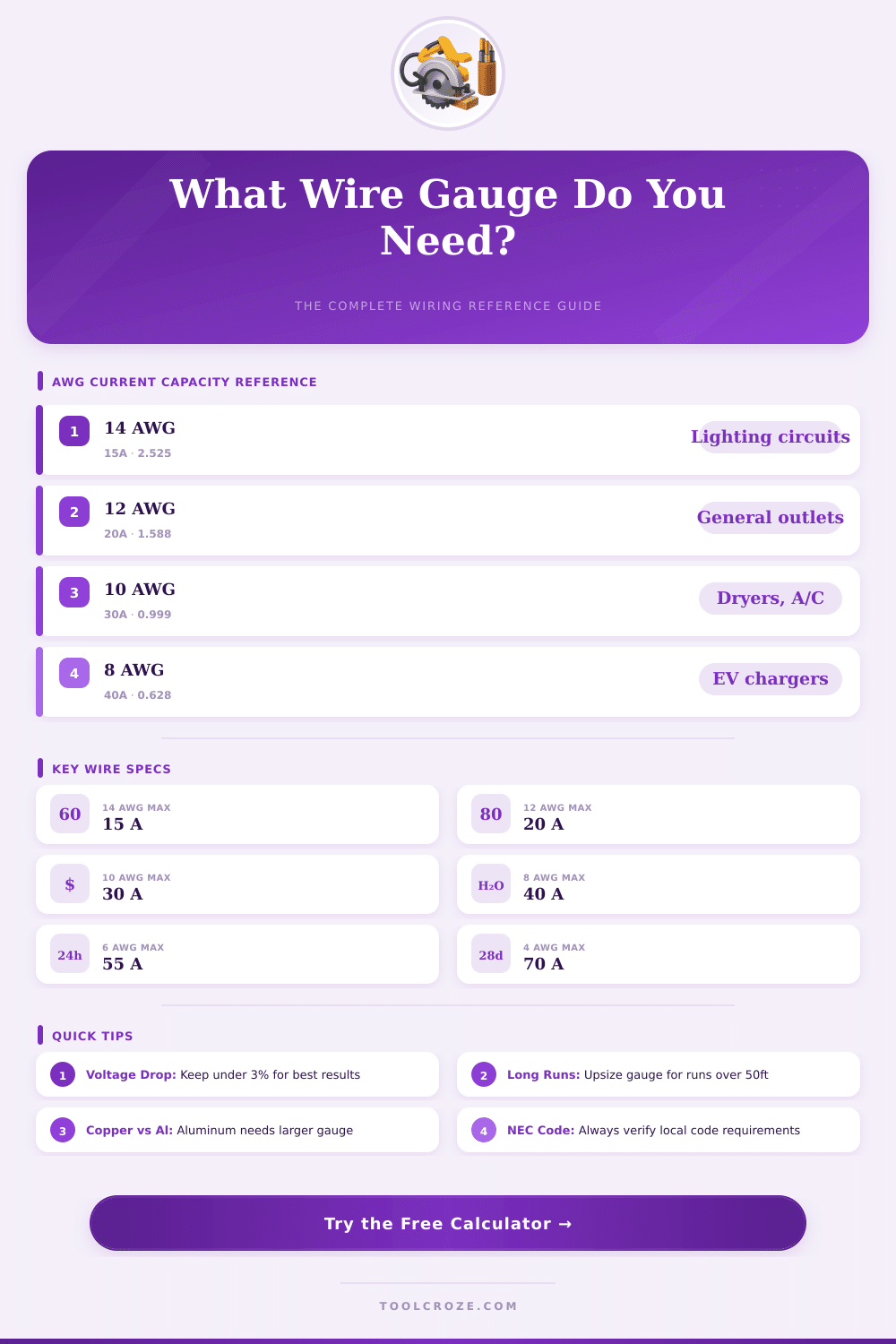
| 14 AWG | 0.0641" | 1.628 | 2.081 | 2.525 | 15A | — | 15A branch circuits |
| 12 AWG | 0.0808" | 2.053 | 3.310 | 1.588 | 20A | 15A | 20A branch circuits |
| 10 AWG | 0.1019" | 2.588 | 5.261 | 0.999 | 30A | 25A | Dryers, A/C, water heaters |
| 8 AWG | 0.1285" | 3.264 | 8.366 | 0.628 | 40A (50A) | 30A (40A) | EV chargers, ranges |
| 6 AWG | 0.1620" | 4.115 | 13.30 | 0.395 | 55A (65A) | 40A (50A) | Sub-panels, large A/C |
| 4 AWG | 0.2043" | 5.189 | 21.15 | 0.249 | 70A (85A) | 55A (65A) | Service entrance, feeders |
| 3 AWG | 0.2294" | 5.827 | 26.67 | 0.197 | 85A (100A) | 65A (75A) | Feeders |
| 2 AWG | 0.2576" | 6.544 | 33.63 | 0.156 | 95A (115A) | 75A (90A) | 200A service entrance |
| 1 AWG | 0.2893" | 7.348 | 42.41 | 0.124 | 110A (130A) | 85A (100A) | Service entrance |
| 1/0 AWG | 0.3249" | 8.252 | 53.49 | 0.0983 | 150A (170A) | 120A (135A) | 200A panels |
| 2/0 AWG | 0.3648" | 9.266 | 67.43 | 0.0779 | 175A (195A) | 135A (150A) | Large service entrance |
| 3/0 AWG | 0.4096" | 10.40 | 85.03 | 0.0618 | 200A (225A) | 155A (175A) | 400A panels |
| 4/0 AWG | 0.4600" | 11.68 | 107.2 | 0.0490 | 230A (260A) | 180A (205A) | Large feeders |
| Run Length (ft) | 14 AWG V-Drop | 12 AWG V-Drop | 10 AWG V-Drop | 8 AWG V-Drop | 3% Limit (120V) | Notes |
|---|---|---|---|---|---|---|
| 25 ft | 1.9V (1.6%) | 1.2V (1.0%) | 0.75V (0.6%) | 0.47V (0.4%) | 3.6V | All pass ✅ |
| 50 ft | 3.8V (3.2%) | 2.4V (2.0%) | 1.5V (1.2%) | 0.94V (0.8%) | 3.6V | 14 AWG borderline |
| 75 ft | 5.7V (4.7%) | 3.6V (3.0%) | 2.3V (1.9%) | 1.4V (1.2%) | 3.6V | Upsize to 12 AWG |
| 100 ft | 7.6V (6.3%) | 4.8V (4.0%) | 3.0V (2.5%) | 1.9V (1.6%) | 3.6V | Use 10 AWG min |
| 150 ft | 11.4V (9.5%) | 7.2V (6.0%) | 4.5V (3.7%) | 2.8V (2.4%) | 3.6V | Use 8 AWG min |
| 200 ft | 15.2V (12.7%) | 9.6V (8.0%) | 6.0V (5.0%) | 3.8V (3.2%) | 3.6V | Use 6 AWG min |
| Application | Typical Load | Min AWG (Cu) | Min AWG (Al) | Breaker Size | Voltage | Notes |
|---|---|---|---|---|---|---|
| Lighting Circuit | 7.5–12A | 14 AWG | N/A | 15A | 120V | Max 1440W load |
| General Outlet | 12–16A | 12 AWG | N/A | 20A | 120V | Kitchen, bathroom |
| Clothes Dryer | 24A | 10 AWG | 8 AWG | 30A | 240V | 4-wire circuit |
| Electric Range | 40–50A | 8 AWG | 6 AWG | 50A | 240V | 4-wire circuit |
| EV Charger (Level 2) | 32–40A | 8 AWG | 6 AWG | 50A | 240V | 125% continuous rule |
| A/C Unit 3-ton | 18–25A | 10 AWG | 8 AWG | 30A | 240V | Check nameplate |
| Water Heater | 18.8A | 10 AWG | 8 AWG | 30A | 240V | 4500W ÷ 240V |
| Sub-panel 60A | 48A | 6 AWG | 4 AWG | 60A | 240V | Garage, workshop |
| Sub-panel 100A | 80A | 3 AWG | 1 AWG | 100A | 240V | Large addition |
| Solar PCC Output | 20–40A | 10 AWG | 8 AWG | — | 240V | Verify array current |
| mm² | Nearest AWG | Diameter (mm) | Resistance (mΩ/m) Cu | Ampacity Cu | Ampacity Al | Typical Use |
|---|---|---|---|---|---|---|
| 0.75 mm² | 18 AWG | 0.98 | 24.4 | 6A | — | Control wiring, signals |
| 1.5 mm² | 15 AWG | 1.38 | 12.1 | 16A | — | Lighting, 13A outlets |
| 2.5 mm² | 13 AWG | 1.78 | 7.41 | 20A | 16A | Ring main, sockets |
| 4 mm² | 11 AWG | 2.26 | 4.61 | 25A | 20A | Cooker, shower |
| 6 mm² | 9 AWG | 2.76 | 3.08 | 32A | 25A | Electric shower 9kW |
| 10 mm² | 7 AWG | 3.57 | 1.83 | 43A | 34A | Sub-main, EV charger |
| 16 mm² | 5 AWG | 4.51 | 1.15 | 57A | 44A | Sub-panel feeders |
| 25 mm² | 3 AWG | 5.64 | 0.727 | 75A | 58A | Service entrance |
| 35 mm² | 2 AWG | 6.68 | 0.524 | 92A | 71A | Main service |
| 50 mm² | 1 AWG | 7.98 | 0.387 | 110A | 86A | Large feeder |
| 70 mm² | 2/0 AWG | 9.44 | 0.268 | 136A | 105A | Industrial feeder |
| 95 mm² | 3/0 AWG | 11.0 | 0.193 | 164A | 127A | Large service |
The wire gauge rating is basically the measuring method, that points to you, how thick wire genuinely is. Important is understand all causes about wire gauge ratings, because everything depends on that how many electrical flow wire can safely last without overheating. Actually exist some different systems for that, AWG, the more ancient British standard called SWG and the metric method, that uses square millimeters for the cross-section area.
In United States, each uses the AWG system (American Wire Gauge). It was standard already since 1857, so that we have reliable way to estimate diameters of round, solid wires from non-iron, well conducting metals. All details are described in the ASTM standard B 258.
What Is Wire Gauge and Why It Matters
Almost whole North America depends on AWG for electrical wire and cable production.
Here the part, where it becomes weird and hardly clear for many folks. In AWG, the confusing part is, that lower gauge number means actually thicker wires. Slim wires have high numbers, while thick receive low.
The more the gauge number gorws, the less thick the wire does. It does not follow linear pattern (rather), it bases on logarithmic scale, that causes big decreases in a set way instead of equal steps.
That confusing system has origin in the way, one manufactures wires initially. To make wire, one draws metal rod through plate many times, and every occasion it becomes a bit narrower. Basically, that is like cold pressure.
Practically, to check sizes of wires, one applies physical measures. Usually that is round or oval plates with cut teeth of different sizes around the edge. Every tooth bears label with number, and you simply slide the wire in the slot too find its rating.
Some prefer calipers to measure the diameter directly. When you measure AWG wires, use gauge for non-iron metals, copper, brass, aluminium, such causes.
In everyday talks about AWG, most commonly mention copper wires. Copper owns known resistance at 20 degrees Celsius, although this can range a bit according to cleaning of the metal and the used making process.
In real use cases, the chosen wire gauge does big difference. For instance, USB cables commonly store slimmer copper wires with high gauge numbers, so that they stay flexible and cheap. Most of such cables uses 28 AWG wires for energy and data.
Some producers replace them with steely wires to spare money, but this raises the electrical resistance per unit of length. For speakers the wires require something other, from 16 until 18 AWG answer for short, low-power lines, but long runs or strong systems require 12 AWG or thicker. Distance is the main factor at speakers.
Common home wire uses 12 wire gauge, that lasts everyday electrical loads without problems. If you go to 10 wire gauge, that weighs almost 31 pounds forthousand feet, while 12 wire gauge has around 20 pounds.