Winch Weight Calculator | Cable & Drum Load
Estimate a complete winch assembly from frame mass, drum geometry, rope or cable, motor, gearbox, mount plate allowance, accessories, and payload handling context.
⚙Preset Winch Builds
📏Calculator Inputs
📊Results
Full calculation breakdown
🧪Winch Material & Spec Comparison Grid
📚Reference Tables
| Rope / cable type | Density basis | Fill factor | Common use |
|---|---|---|---|
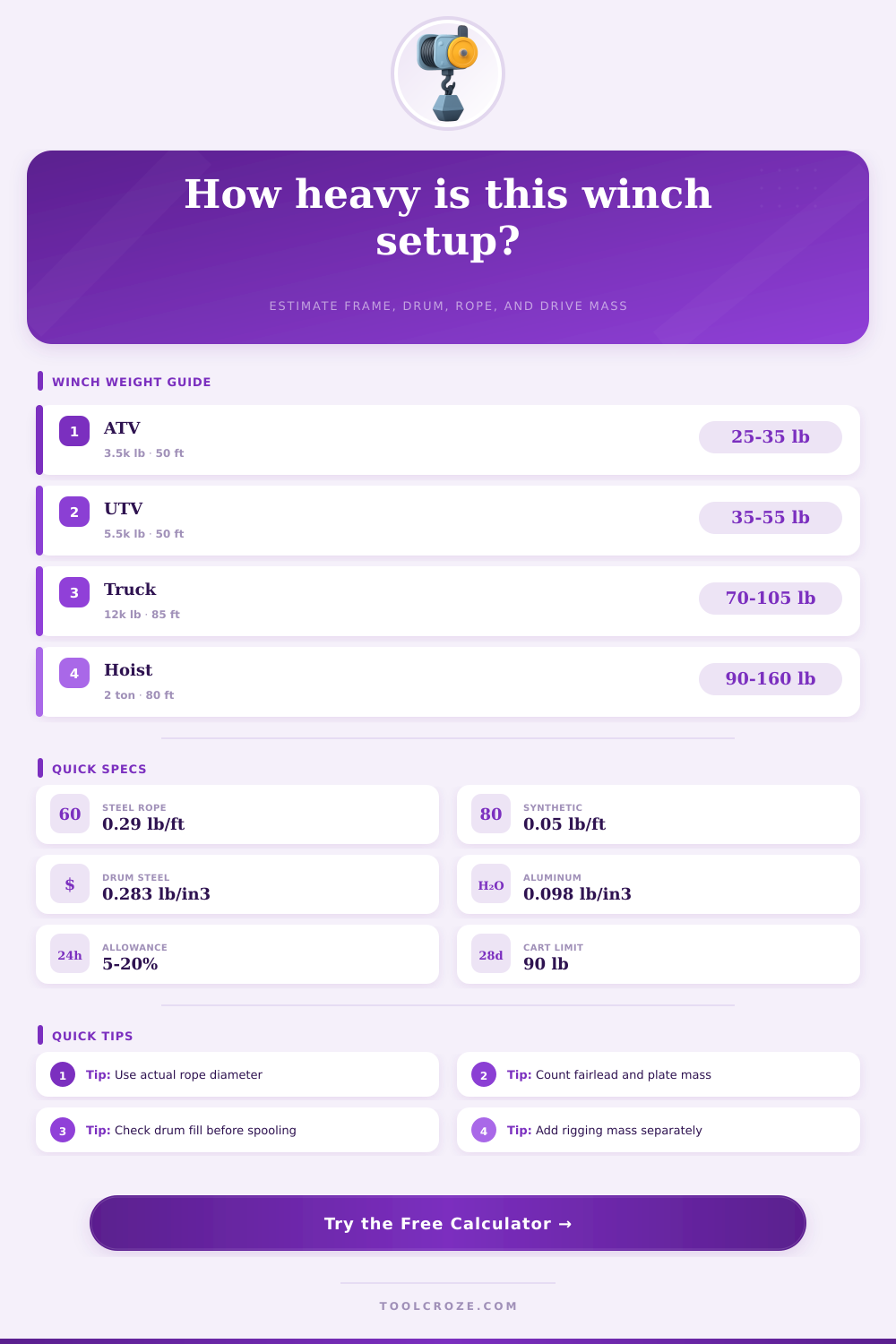
| 6x19 steel wire rope | 0.283 lb/in³ | 0.58 | Recovery and shop winches |
| Compacted steel cable | 0.283 lb/in³ | 0.64 | Dense industrial cable packs |
| Stainless wire rope | 0.289 lb/in³ | 0.56 | Marine and corrosion exposure |
| Fiber core wire rope | 0.250 lb/in³ | 0.48 | Flexible light duty cable |
| HMPE synthetic rope | 0.035 lb/in³ | 0.88 | Light recovery and portable rigs |
| Drum material | Density | Weight effect | Typical note |
|---|---|---|---|
| Carbon steel | 0.283 lb/in³ | Baseline | Most common welded drum |
| Stainless steel | 0.289 lb/in³ | Slightly heavier | Marine and washdown exposure |
| Aluminum | 0.098 lb/in³ | About one third | Portable builds and low corrosion |
| Ductile iron | 0.255 lb/in³ | Moderate | Cast drum and hub designs |
| Chromoly steel | 0.283 lb/in³ | Baseline | Strength focused compact drums |
| Payload context | Mass priority | Handling cue | Line pull note |
|---|---|---|---|
| Vehicle recovery | Medium | Mount before spooling | Often sized above vehicle weight |
| Trailer utility | High | One or two person install | Short cable keeps mass down |
| Marine davit | High | Watch corrosion and bracket load | Use working load references |
| Shop hoist | Low | Use trolley, beam, or bench lift | Do not treat pull rating as WLL |
| Forestry skidding | Low | Plan machine handling | Long cable dominates weight |
| Assembly range | Handling class | Suggested aid | Typical example |
|---|---|---|---|
| 0-45 lb | Portable carry | Bench or one person | ATV or small trailer winch |
| 45-90 lb | Two-person lift | Mounting stand | UTV or compact truck winch |
| 90-180 lb | Cart handling | Dolly or shop cart | Heavy truck or shop winch |
| 180-350 lb | Hoist handling | Engine crane or gantry | Hydraulic service winch |
| 350+ lb | Machine handling | Forklift or crane | Forestry and industrial drum |
💡Practical Tips
⚠Safety Note
When you are thinking about winning a winch project, you must think about the total mass of the winch. A winch isnt just the motor, the cable, or even the winch itself. A winch is a collection of steels, rope, and the fasteners that hold it all together.
The total mass of the winch will determine how many person will be necessary to move the winch, and how much equipment will be necessary to lift the winch. The mass of the winch frame will provide the baseline mass for the winch. The winch frame consist of the side plates, the tie bars, and the housing.
How to Calculate the Total Mass of a Winch
The housing can be made of aluminum to reduce the total mass of the winch. However, aluminum is less stiff than steel winch frames when subjected to side loads upon the winch. The motor and the gearbox will contribute to the total mass of the winch.
Motors and gearboxes that use hydraulic systems will have a higher mass then electric motors and gearboxes. However, the advantage of hydraulic components is that they do not require a battery to supply power to the winch. The mass of the winch drum is one of the major component of the total mass of the winch.
The winch drum consists of the barrel shell and the two flange ring. The material of the winch drum will impact the total mass of the winch. Carbon steel is a common material for winch drums.
Carbon steel is a strong material, and is easy to weld. Aluminum will reduce the mass of the winch drum by roughly two third of the mass of a carbon steel winch drum. Aluminum isnt as strong as steel.
Other materials for winch drums include stainless steel and chromoly, which are used to improve the corrosion resistance or the strength of the winch. The winch rope or cable will contribute to the total mass of the winch. Steel wire rope has a higher mass per foot of rope than synthetic rope.
The longer the rope, the more greater the difference in mass between steel rope and synthetic rope. A seventy-foot steel rope can have more mass than the winch drum. A seventy-foot synthetic rope will have very little mass.
To calculate the total mass of the winch, you can use a calculator that allows entry of the diameter of the winch core, the size of the flange of the winch, the thickness of the winch wall, and the diameter of the rope. The mass of the hardware that is used in the winch will contribute to the total mass of the winch. Rollers will have more mass than hawse plate, for instance.
Reinforced skid bracket can have more mass than the motor of the winch. Another factor in the total mass is the mass of any accessories. Control boxes, wiring, winch hooks, and guards are examples of accessories.
A ten percent factor for accessories is common among winch builders. However, if the winch has safety gears or remote controls, a higher factor must be use. The total mass of the winch will determine how the winch is handled.
If the total mass of the winch is under forty-five pound, then one person can move the winch. If the total mass is between forty-five and ninety pounds, two person must move the winch. If the total mass is above ninety pounds, a cart or hoist will be necessary to move the winch.
The purpose of the winch can help to indicate how the total mass of the winch should be viewed. For instance, a winch that is to be used in recovery operations of vehicles will have to balance the mass of the winch against its pull rating; the winch will have to be able to travel on the truck. In the case of a shop winch, the shop may be able to use a beam or trolley to lift the winch.
A marine winch will have to account for corrosion of the winch components, while a forestry winch will have to account for the total mass of the long cables that are used in that type of winch. It is important to note that the rated line pull of the winch should not be used to estimate the total mass. For example, a winch with a twelve-thousand-pound line pull can have less than seventy pounds if the winch has an aluminum drum and synthetic rope.
However, a winch with a small line pull can have a high mass if it has a cast-iron drum and a long steel rope. Related to the line pull is the diameter of the rope that is used with the winch. Using a winch with a larger diameter rope will require more layer of rope to fill the winch drum.
Thus, increasing the diameter of the winch rope will also increase the total mass of the winch. You should perform this calculation of the total mass of the winch before ordering winch parts. The total masses of the winch frame, motor, gearbox, and fairlead can be entered into a calculator.
Then, different materials for the winch drum and different type of rope can be tested in the calculator to determine their impact on the total mass. Finally, the total mass can be compared to the handling classes for the winch to ensure that the winch will be handled in a way that is appropriate for the total mass of the winch.