⚙️ Winch Line Pull Calculator
Calculate required winch pulling force based on load, grade, terrain, and line layers
| Drum Layer | Pull Factor | 1,000 lb Winch | 5,000 lb Winch | 8,000 lb Winch | 12,000 lb Winch |
|---|---|---|---|---|---|
| Layer 1 (innermost) | 100% | 1,000 lbs | 5,000 lbs | 8,000 lbs | 12,000 lbs |
| Layer 2 | 87% | 870 lbs | 4,350 lbs | 6,960 lbs | 10,440 lbs |
| Layer 3 | 74% | 740 lbs | 3,700 lbs | 5,920 lbs | 8,880 lbs |
| Layer 4 | 66% | 660 lbs | 3,300 lbs | 5,280 lbs | 7,920 lbs |
| Layer 5 (outermost) | 57% | 570 lbs | 2,850 lbs | 4,560 lbs | 6,840 lbs |
| Grade (%) | Angle (°) | Extra Force Factor | Added Pull (5,000 lbs) | Added Pull (8,000 lbs) |
|---|---|---|---|---|
| 0% (flat) | 0° | +0% | 0 lbs | 0 lbs |
| 10% | 5.7° | +9.95% | +498 lbs | +796 lbs |
| 20% | 11.3° | +19.6% | +980 lbs | +1,568 lbs |
| 30% | 16.7° | +28.7% | +1,435 lbs | +2,296 lbs |
| 45% | 24.2° | +41% | +2,050 lbs | +3,280 lbs |
| 60% | 31° | +51.5% | +2,575 lbs | +4,120 lbs |
| 100% | 45° | +70.7% | +3,535 lbs | +5,656 lbs |
| Vehicle Type | Typical GVW | Min. Winch Rating | Recommended Winch | With Snatch Block |
|---|---|---|---|---|
| Small ATV / UTV | 800–1,500 lbs | 1,200 lbs | 2,500 lbs | 1,250 lbs |
| Compact SUV | 3,500–4,500 lbs | 5,250 lbs | 8,000 lbs | 4,000 lbs |
| Mid-Size Truck / SUV | 4,500–5,500 lbs | 6,750 lbs | 9,500 lbs | 4,750 lbs |
| Full-Size Truck / SUV | 5,500–7,000 lbs | 8,250 lbs | 12,000 lbs | 6,000 lbs |
| Heavy-Duty Truck | 7,000–10,000 lbs | 10,500 lbs | 16,500 lbs | 8,250 lbs |
| Heavy Equipment / Commercial | 10,000–20,000 lbs | 15,000 lbs | 20,000+ lbs | 10,000 lbs |
Winches has to overcome several forces besides weight of the vehicle that they are recovering. A person must account for the weight of the vehicle that is to be recovered, the angle of the slope on which the vehicle is stranded, and the terrain that the vehicle are on. By not accounting for these different forces, it is possible for the winch to not have enough pulling power to successfully recover the vehicle.
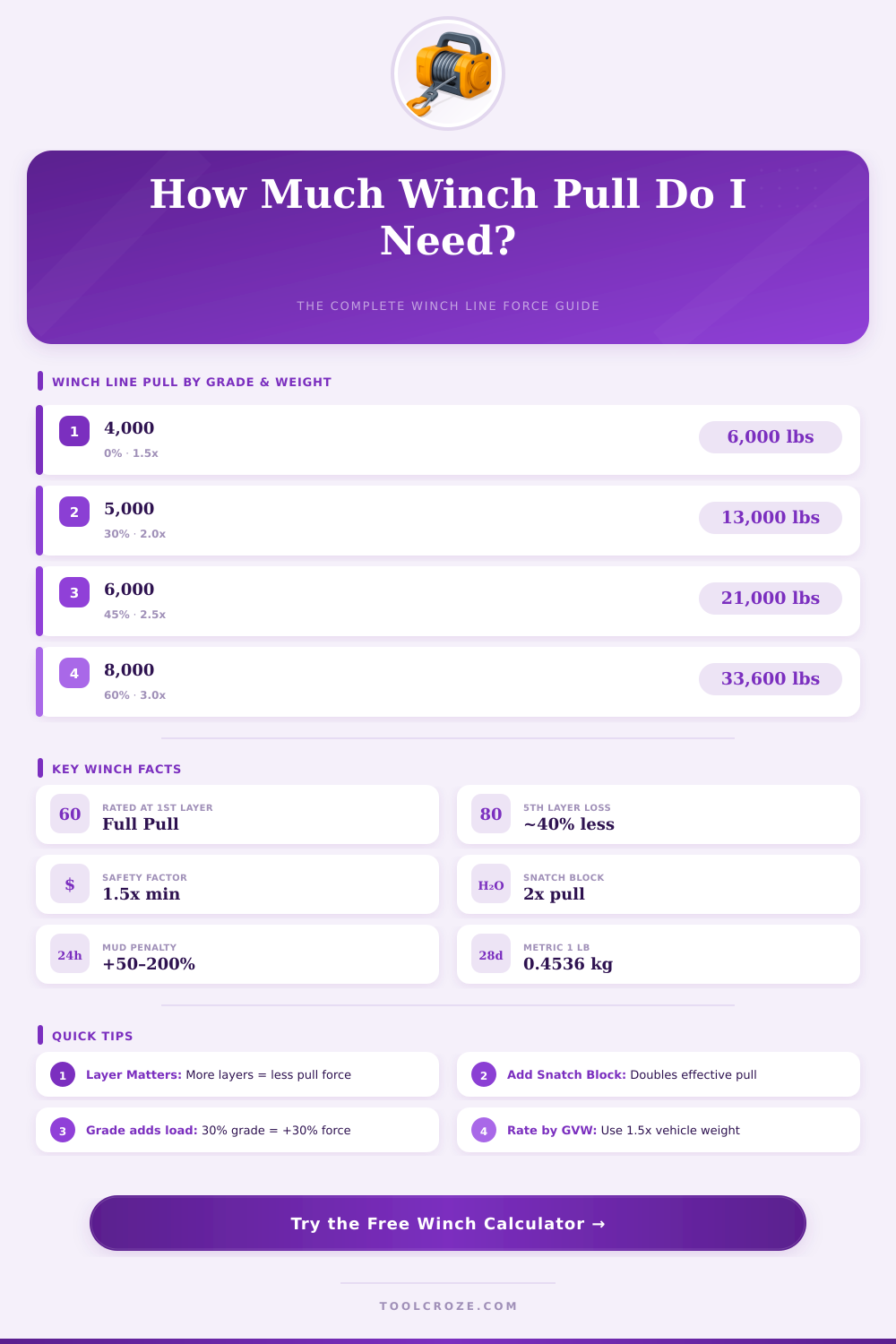
One of the forces that a winch must overcomes is the force of gravity. When a vehicle is on a slope, the force of gravity will pull the vehicle down the slope. On a 30% grade, for instance, the force of gravity will add 30% more force to the pull that the winch must performs.
Forces a Winch Must Overcome
Thus, the winch must be strong enough to overcome the weight of the vehicle that must be recovered times the grade of the slope on which the vehicle is stranded. Another of the forces that a winch must overcome is the force of the terrain upon which the vehicle is stranded. On even terrain, such as asphalt, the terrain presents little resistance for the winch to overcome.
However, on terrain like sand or mud, the resistance that the vehicle presents to the winch is much more higher. For instance, if a vehicle is stuck in mud, the mud presents a drag force on the tires of the vehicle that will double the force that the winch must apply to the vehicle. Furthermore, the more deeply the vehicle is embedded in the mud, the higher the resistance due to the suction that the mud presents to the tires; the more suction, the higher the resistance of that terrain to the winch.
Thus, the winch must overcome this force of the terrain which increases with the amount that the vehicle is embed in that terrain. Another of the forces that a winch must overcome are the layers of cable that are on the winch drum. The winch will exhibit its maximum pulling power when the cable is on the first layer of the winch drum; pulling power decreases with each additional layer of cable on the winch drum.
This is due to the fact that the larger diameter of the cable on the winch drum creates less leverage for the winch motor to effective apply force to the cable. Thus, if the winch cable is on many of the layers of the winch drum, there will be less pulling power from the winch than the winch’s rated pulling power. Therefore, those that recover vehicles with winchs must consider the number of layers that the winch cable will have.
The safety factor that those using the winch must consider is another of the forces that will be applied to the total force of the vehicle that is to be recovered. A safety factor is utilized to provide for unforeseen circumstance that may reduce the efficiency of the winch. A safety factor of 1.5 is commonly applied; utilizing a 1.5 factor allows for error in situations where the resistance of the terrain may make it difficult for the winch to recover the vehicle.
Furthermore, if a safety factor is not applied, the winch may not be able to overcome the resistance of the terrain, especially if the winch is performing under conditions that are not as perfect as those that were calculated for the winch. One of the tools that can be used to increase the effectiveness of the winch is a snatch block. A snatch block is a pulley that changes the angle at which the winch cable is applied to the winch.
By using a snatch block, the angle of the line can be doubled to halve the load on the winch. Thus, using a snatch block allows for a winch that is in the mid-range of the winch manufacturer to pull a load that otherwise would require a winch of a higher range. Therefore, snatch blocks are a useful tool when recovering vehicles.
When calculating the total force that will be applied to the vehicle that is to be recovered by a winch, it is necessary to use the gross weight of the vehicle rather than its curb weight. The curb weight of the vehicle is the weight of the vehicle when it is empty of any items that may be within the vehicle. The gross weight of the vehicle includes the weight of the fuel that is within the vehicle, the weight of the cargo that is within the vehicle, and any other gear that may be on the vehicle.
Thus, if the curb weight of the vehicle is used instead of the gross weight, the total force that is calculated will be less than that which must be applied to the vehicle to recover it; choosing a winch that is too weak may result. In addition to the considerations of the forces that must be overcome by the winch, there are some techniques that should be applied to even further ensure the safety of the winch during recovery operations. One such technique is to use a blanket to dampen the winch line.
If the winch line snaps during recovery of the vehicle, the blanket will muffle the force of the snapping line. Another technique is to use soft shackles rather than metal shackles. Soft shackles will absorb the energy of the winch line when the load of the vehicle is being pulled.
Additionally, another technique is to use tree savers when using trees as anchor points for the winch. Using tree savers will prevent the damage that may occur to those trees due to the recovery of the vehicle with the winch. Furthermore, another technique is to use rated straps rather than chains.
Rated straps contain more stretch than chains, which will absorb some of the energy of the vehicle when it is being recovered. Finally, another technique that should be utilized is to gradually build the tension of the winch line. By building the tension in the winch line slowly, the shock loads that may result from suddenly increasing the tension will be avoided.