Winch Gear Ratio Calculator
Compare motor RPM, drum RPM, spur tooth counts, worm reduction, line speed, load torque, gearbox efficiency, and safety factor for compact winch design checks.
Pick a starting point, then adjust the ratio, drum, and load fields to match the actual winch package.
Winch Ratio Results
| Winch duty | Typical motor RPM | Common total ratio | Usual loaded line speed |
|---|---|---|---|
| ATV recovery | 3000-4500 DC | 150:1 to 260:1 | 5-12 ft/min |
| Truck utility | 2800-5000 DC | 180:1 to 320:1 | 4-10 ft/min |
| Boat trailer puller | 1700-3500 AC/DC | 70:1 to 140:1 | 12-25 ft/min |
| Hoist drum | 1725 or 3450 AC | 100:1 to 220:1 | 6-18 ft/min |
| Anchor windlass | 1000-2500 DC | 60:1 to 160:1 | 20-45 ft/min |
| Gear stage | Example tooth pair | Stage ratio | Design note |
|---|---|---|---|
| Small spur reduction | 16T to 48T | 3.00:1 | Compact and efficient |
| Medium spur reduction | 14T to 70T | 5.00:1 | Common winch gearbox step |
| Large spur reduction | 12T to 84T | 7.00:1 | Check tooth strength |
| Worm reduction | 1-start to 30T | 30.00:1 | High reduction, lower efficiency |
| Drum layer | Diameter effect | Speed effect | Torque effect |
|---|---|---|---|
| Layer 1 | Bare drum | Slowest line speed | Highest line pull |
| Layer 2 | +2 cable diameters | Faster line speed | Lower line pull |
| Layer 4 | +6 cable diameters | Much faster line speed | Much lower line pull |
| Layer 6+ | Large effective drum | Speed can exceed target | Watch torque margin |
| Transmission type | Typical efficiency | Backdrive behavior | Calculator setting |
|---|---|---|---|
| Two spur stages | 88-95% | Usually backdrivable | 90% |
| Planetary winch set | 75-90% | Often backdrivable | 82% |
| Spur plus worm | 45-75% | May self-lock | 62% |
| Chain plus gearbox | 70-88% | Usually backdrivable | 78% |
A winch gearbox control the relationship between the motor and the drum speeds. Many peoples dont consider the winch gearbox until the winch do not work correctly. A winch can malfunction if the cable move too slowly or too quickly.
If the cable moves too quickly, the motor may stall because it does not has enough torque to move the cable. These issues are usualy the result of the reduction ratio between the motor and winch drum. Understanding this ratio can show how the gearbox can change the motors speed and torque.
Winch Gearbox Basics: Gears, Drum Size, Speed and Pulling Power
Winch gearboxes can use many type of gear reductions to achieve this. Two common types are spur gears and worm gears. Spur gears offer efficiency to provide step in the gear reduction.
Worm gears provide a jump in the gear reduction and have the ability to lock themselves in place. Using a calculator, you can enter the number of teeth of the spur gears and the worm gear. The calculator will multiply all the numbers to provide the total gear reduction ratio.
If the total gear reduction ratio is higher then you want, the winch drum will turn slower than wanted. If the total gear reduction ratio is lower than wanted, the cable will move faster than wanted and potentially make the motor stall with lack of torque. Another important element of the winch gearbox is the diameter of the winch drum and the number of cable layer on the winch drum.
The diameter of the drum will change as the number of layers of the cable change. The first layer of the cable will sit on the bare winch drum. The remaining layers will sit on the previous layer of the cable.
As the radius of the winch drum increase, the line speed will increase and the winches pulling strength will mathematically decrease. Using a calculator, you can select the layer of the cable you want to calculate. The calculator will show you the working diameter of the winch drum for that layer of cable.
It will also include the safety factor into the calculation of the winches torque. Efficiency is another important factor in gearboxes. Every component of the winch will reduce the torque from the motor.
Spur gears are efficient and only lose five to twelve percent of the motors torque. Worm gears are not as efficient in that they lose more of the motors torque. You should enter the efficiency into the winch torque calculator.
Any unrealistic value will produce incorrect result. A realistic efficiency for winches that contain both worm and spur gears is sixty percent. Using a too high value for efficiency will show that the motor has enough torque to perform the task, but the motor will not have enough when the winch is built.
The relationship between line speed and torque is always a trade-off. High gear reductions allow the winch to pull heavy load. High gear reductions will make the winch cable move slowly.
Low gear reductions will allow the cable to move quickly off the winch drum. However, the motor will have to supply the torque to move the cable at that high speed. The winch torque calculator will show the line speed and torque of the winch.
These two values are trade-offs of each other. Another important factor is the motor torque margin. The motor torque margin will allow you to see whether or not the motor can handle the load of the winch.
The tool will compare the motors torque to the torque the winch drum require. If the motor torque margin is negative, the motor will be overloaded when the cable is fully layered. A positive margin is desired so that there is extra torque for heat and voltage loss in the system.
You should not use the motors nameplate torque as the value for the motors torque. The nameplate value will be the peak torque the motor can produce. Winches may have more than one layer of cable and can have different loads.
Using the winch torque calculator, you can test the winch at the worst-case scenario of the cable layer and the safety factor. By testing the winch at multiple layers of cable, you can see if the line speed of the cable is within your desired range or if the winch will require more motor torque than the motor can provide. The type of winch can have different gear reduction pattern.
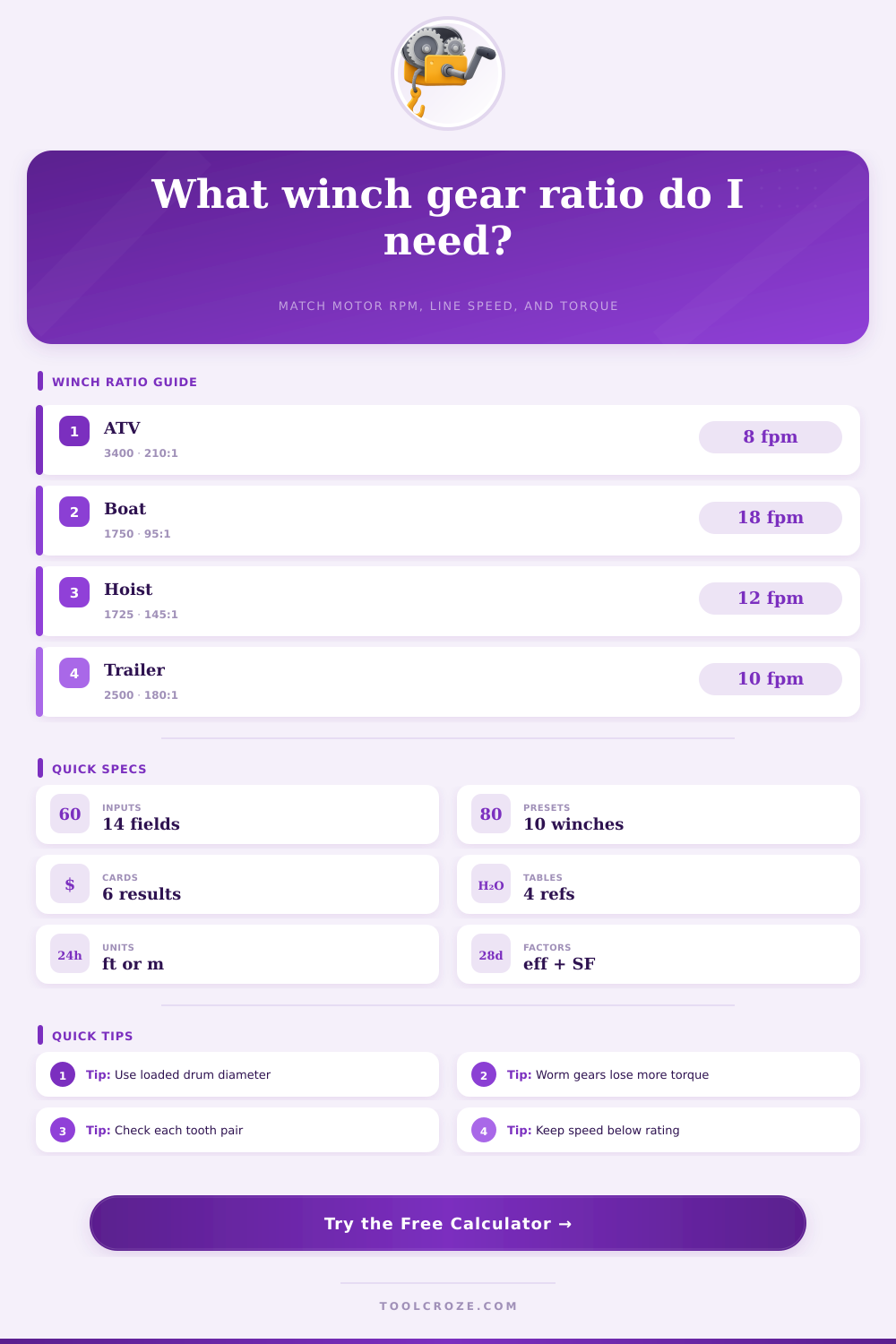
For instance, an ATV recovery winch will have a high gear reduction ratio because the ATV motor is small. A boat trailer winch can have a low gear reduction ratio since the boat trailer motor is large and the boat trailer require a higher line speed. Using the winch torque calculator, you can enter the specifications of your motor and your target line speed to see if your winch match these common patterns.
Finally, the thermal limits of the winch and the brake capacity are two more important factors. High-ratio worm gears will create heat during operation. The brake that is used to hold the load when the winch is not in operation may not be strong enough if the cable is on the outer layers of the winch drum.
The winch torque calculator will not calculate the heat or the brake capacity. However, it will provide the values that you can use to calculate each of these values. Using the information from the winch torque calculator will allow you to have a complete understanding of the winch design before the winch is built.