Welding Wire Weight Calculator
Estimate solid MIG wire, flux-cored wire, stainless filler, aluminum wire, and submerged arc wire weight from diameter, density, spool length, wire feed speed, deposition efficiency, and spool factor.
⚙Welding Wire Presets
📏Wire, Spool, And Feed Inputs
Welding Wire Weight Results
🧪Selected Wire Material Grid
📋Material And Filler Density Reference
| Filler Wire | Common Specification | Density | Typical Use |
|---|---|---|---|
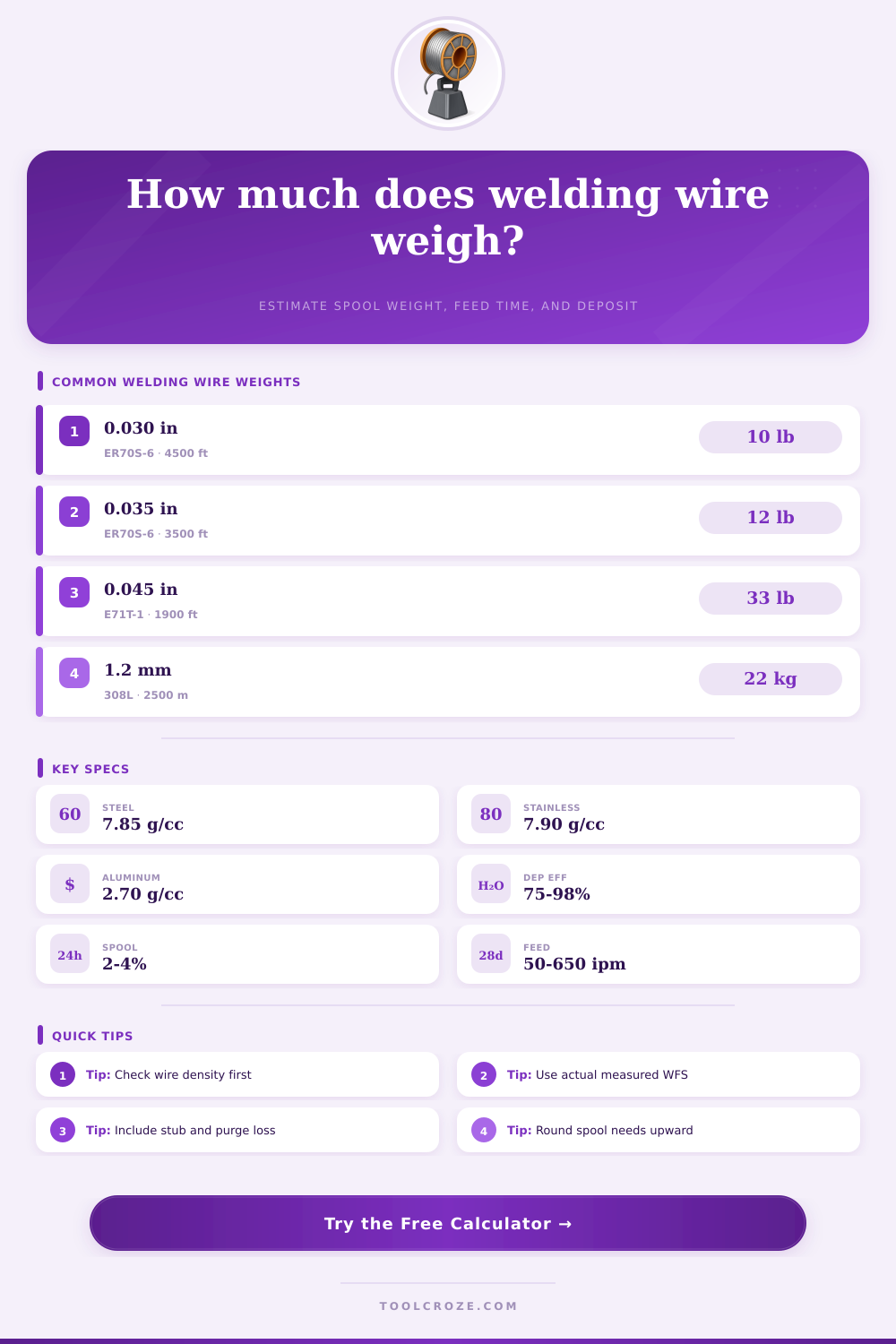
| ER70S-6 carbon steel | AWS A5.18 ER70S-6 | 7.85 g/cm³ or 0.284 lb/in³ | Solid MIG wire for mild steel fabrication |
| E71T-1 flux-cored | AWS A5.20 E71T-1C/M | 6.90 g/cm³ apparent density | Gas-shielded FCAW structural and shop welds |
| E71T-8 self-shielded | AWS A5.20 E71T-8 | 6.65 g/cm³ apparent density | Outdoor field welding without shielding gas |
| ER308L stainless | AWS A5.9 ER308L | 7.90 g/cm³ or 0.285 lb/in³ | 304 stainless steel weld metal and overlays |
| ER316L stainless | AWS A5.9 ER316L | 7.98 g/cm³ or 0.288 lb/in³ | 316 stainless process piping and corrosion service |
| ER4043 aluminum | AWS A5.10 ER4043 | 2.68 g/cm³ or 0.097 lb/in³ | Aluminum sheet, castings, and general GMAW |
| ER5356 aluminum | AWS A5.10 ER5356 | 2.66 g/cm³ or 0.096 lb/in³ | Marine aluminum and higher magnesium alloys |
| EM12K SAW wire | AWS A5.17 EM12K | 7.85 g/cm³ or 0.284 lb/in³ | Submerged arc welding coils and drums |
📐Diameter, Area, And Weight Reference
| Wire Diameter | Cross Section | Steel Weight | Planning Note |
|---|---|---|---|
| 0.023 in or 0.6 mm | 0.000415 in² | 0.00141 lb per 12 in | Light sheet metal and thin automotive panels |
| 0.030 in or 0.8 mm | 0.000707 in² | 0.00241 lb per 12 in | Small MIG machines and general light fabrication |
| 0.035 in or 0.9 mm | 0.000962 in² | 0.00328 lb per 12 in | Common shop wire for short-circuit and spray transfer |
| 0.045 in or 1.2 mm | 0.001590 in² | 0.00542 lb per 12 in | Production MIG and many flux-cored wires |
| 1/16 in or 1.6 mm | 0.003068 in² | 0.01046 lb per 12 in | Heavy FCAW, high deposition, and field welding |
| 5/32 in or 4.0 mm | 0.019175 in² | 0.06537 lb per 12 in | Large submerged arc welding wire packages |
📊Wire Feed And Deposition Reference
| Process | Typical Efficiency | Common WFS Range | Calculator Use |
|---|---|---|---|
| GMAW solid steel wire | 90% to 98% | 120 to 550 ipm | High transfer efficiency when settings and gas are stable |
| GMAW aluminum wire | 85% to 95% | 180 to 650 ipm | Use aluminum density and check liner or spool gun feed rate |
| FCAW gas-shielded wire | 82% to 90% | 120 to 500 ipm | Flux ingredients reduce deposited metal per wire weight |
| FCAW self-shielded wire | 72% to 86% | 80 to 420 ipm | More slag and fume loss than solid wire processes |
| Submerged arc wire | 95% to 99% | 40 to 220 ipm | Large wire and long runs usually give high recovery |
| GMAW brazing wire | 88% to 96% | 100 to 400 ipm | Use bronze density, not steel density, for spool weight |
📦Package Size And Spool Factor Reference
| Package Style | Typical Label Weight | Spool Factor | Planning Note |
|---|---|---|---|
| Small MIG spool | 2 lb to 10 lb or 1 kg to 5 kg | 3% to 8% | More tail loss and more changeovers on short spools |
| Shop basket spool | 11 lb to 44 lb or 5 kg to 20 kg | 2% to 4% | Good default for common fabrication workstations |
| FCAW coil or spool | 25 lb to 60 lb or 12 kg to 27 kg | 3% to 6% | Check apparent density for tubular wire calculations |
| Welding wire drum | 250 lb to 1000 lb or 100 kg to 450 kg | 1% to 3% | Best for automation and long production runs |
| SAW coil package | 60 lb to 1000 lb or 27 kg to 450 kg | 1% to 2% | Large diameter wire makes length errors heavier |
💡Welding Wire Calculation Tips
Welding wire consumption are a process that require planning to ensure that welders dont run out of welding wire during a job. A welder may believe they have enough welding wire from a spool to complete the welding job, but they may actualy run out of welding wire due to the amount lost to the tail end of the spool, welding stubs, and welding metal that does not enters the joint. To properly plan for welding wire consumption, you must account for the weight of the welding wire, the density of the welding wire, and the efficiency of the welding process.
The weight of the welding wire that is contained within each spool is not the same as the usable weight of that welding wire. The weight listed from the manufacturer include the weight of the spool itself, the plastic wrapping around the welding wire, and a small percentage of the welding wire that cannot be utilized due to casting issue or the position of the welding wire on the spool reel. Calculators can provide welders with an estimated usable weight of welding wire by entering the diameter of the welding wire, the density of the welding wire, and the usable length of the welding wire spool.
Planning How Much Welding Wire You Need
Additionally, each welding shop can adjust the spool factor to account for how much welding wire each shop typically utilizes. For instance, a welding shop that perform welding jobs continuously at their benches may only need to allow for three percent of welding wire loss, but a shop that performs welding jobs in the field may have to allow for eight or ten percent of wire loss due to the nature of the jobs they perform. Density is a factor in the calculation of the usable weight of welding wire because the density of the welding wire will determine the weight of the welding wire of a specified length.
For example, mild steel welding wire have a density of around 7.85 grams per cubic centimeter, but flux-cored welding wire has a lower density because the flux contained within the welding wire does not contribute to the weight of the welded metal. Aluminum welding wire has a density of around 2.7 grams per cubic centimeter, so the same length of aluminum welding wire will weigh less than a length of steel welding wire. If the type of welding wire alloy is change without changing the density input into the calculation, the calculation will produce an incorrect result.
Many welding wire calculators allow the user to select from a menu of common welding wire alloys or enter a custom welding wire alloy if they are using a welding wire with a different alloy than the common alloys. The feed speed and the arc-on time will also have an impact upon the length of welding wire that will be consumed during the welding process. A welder who moves the welding gun at a faster rate than another welder will consume welding wire at a faster rate.
However, a welder who sets their welding machine for a higher percentage of arc-on time will complete welding jobs in a shorterer period of time. Arc-on time refers to the percentage of time that the welder is welding as compared to the total amount of time required to complete the welding job. For example, if the welder sets the control on their welding torch to 50 percent arc-on time, then it will take the welder twice as long to complete the job as if they were welding continuous.
Since the welder must account for the time that will be required to complete the welding job, and since they must also account for the number of spools of welding wire that will be utilized during that time, the arc-on time is a factor to be considered in the calculations of the welding wire consumption rate. Deposition efficiency is a factor that indicates how much of the purchased welding wire will become metal that is welded into the joint. Welding wire with a deposition efficiency of 95 percent or higher includes solid welding wire; self-shielded flux-cored welding wire has a lower deposition efficiency because some of the welding wire becomes slag and weld spatter.
Additionally, another field within most welding wire calculators asks for the weld loss factor, which accounts for welding wire that is lost due to trim cuts, purge welds, or test welding coupons. These percentages will convert the gross weight of the welding wire spool into the net weight of the welding metal that will be deposited into the welding joint. This net weight is the measurement that will determine if the welded joint passes its inspection process.
By utilizing these factors, welders and welding shop managers can calculate the amount of welding wire that will be required to complete a specific job. By entering the length of the welding joint that will be welded and the travel speed of the welding gun into the welding wire consumption calculator, the welder can determine the number of spools of welding wire that will be required to complete that joint. The number of spools of welding wire that will be required to complete a joint will not necessarily be an even number.
Therefore, the welder and the welders manager must decide whether to round up to the nearest whole number to ensure that there is enough welding wire to complete the job, or to risk running out of welding wire while welding. Most welding shops will purchase an extra spool of welding wire in case the welder requires it; the cost of hiring additional welders and the cost of purchasing additional spools of welding wire is less costly than losing welding wire while in the middle of a welding job. External factors such as temperature changes can affect the welding wire spool and the way that the welding wire pays off the welding reel.
High humidity can impact flux-cored welding wire since the moisture in the flux core can lead to the formation of porosity in the welded metal. The condition of the liner of the welding wire spool and the pressure with which the drive-rolls of the welding wire spool turn can also affect the actual feed rate of the welding wire. These factors can change the total amount of welding wire that is consumed by several percentage point.
To find the proper spool factor for the welding wire that is utilized in the shop, the process of measuring several empty spool of welding wire can be used. Each empty welding wire spool can be weighed. The worker can subtract the weight of the empty welding wire spool from the total weight of the welding wire spool with the welding wire when it is full.
This operation will provide the weight of the welding wire in each spool. The weight of the welding wire in each spool can be compared to the output of the welding wire consumption calculator. By using these measurements for several spools of welding wire, an average factor for each spool can be determined.
By using the shop-specific spool factor in calculations for the consumption of welding wire, the calculations will provide an estimate of the amount of welding wire that will be consumed at the welding shop that is realistic to the actual welding that occur on the shops welding floor. Thus, by planning around the weight of the welding wire, a manager can determine how many welding wire spools will be required for a welding job of a specific size, and ensure that the appropriate amount of welding wire are stocked.