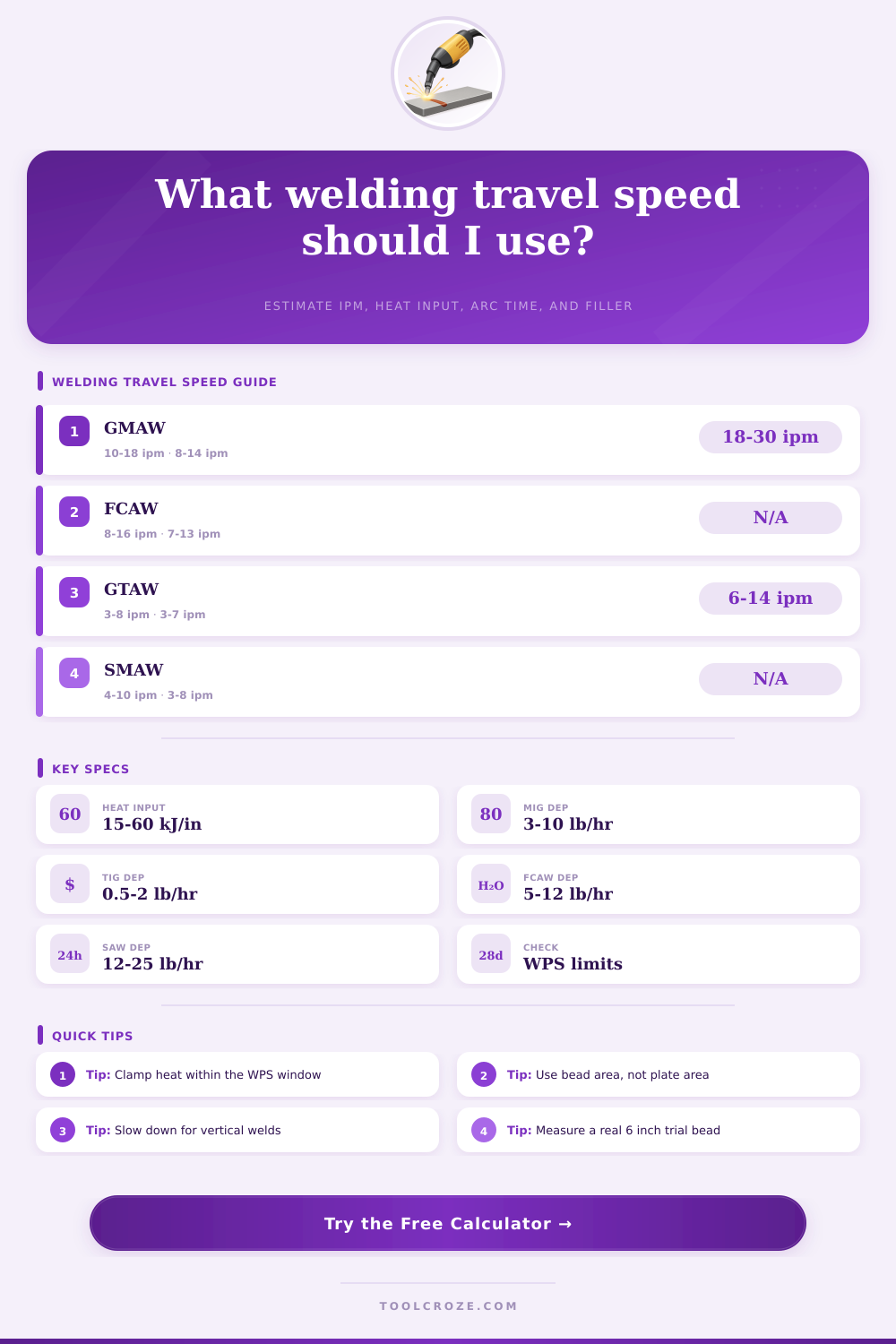
Welding Travel Speed Calculator
Estimate travel speed, heat input, bead volume, deposited metal, and arc-on time from process settings, weld geometry, material, and position.
Calculated Welding Settings
| Material | Typical heat input window | Watch point | Calculator density |
|---|---|---|---|
| Mild steel / A36 | 35-55 kJ/in | Good general fabrication range | 0.283 lb/in³ |
| HSLA steel | 25-45 kJ/in | Use qualified preheat and interpass limits | 0.283 lb/in³ |
| 304 / 316 stainless | 18-35 kJ/in | Limit dwell and distortion | 0.289 lb/in³ |
| 6061 aluminum | 10-22 kJ/in | Fast travel with good cleaning | 0.098 lb/in³ |
| Cast iron repair | 20-35 kJ/in | Short beads, peening, controlled cooling | 0.255 lb/in³ |
| Hardfacing / wear plate | 25-45 kJ/in | Follow filler dilution limits | 0.278 lb/in³ |
| Process | Typical deposition | Typical arc efficiency | Common travel-speed use |
|---|---|---|---|
| GMAW short-circuit MIG | 3-6 lb/hr | 75-85% | Sheet, tube, small fillets, short welds |
| GMAW spray or pulse MIG | 6-12 lb/hr | 80-90% | Aluminum, thick steel, long flat fillets |
| Gas-shielded FCAW | 5-12 lb/hr | 75-85% | Structural fillets and out-of-position work |
| SMAW stick electrode | 1.5-4 lb/hr | 65-80% | Repair, field welds, groove fill passes |
| GTAW TIG with filler | 0.4-2 lb/hr | 55-70% | Root passes, stainless tube, precision work |
| Submerged arc welding | 12-25 lb/hr | 85-95% | Long seams, heavy plate, mechanized welding |
| Geometry / position | How area is estimated | Why travel speed changes | Field check |
|---|---|---|---|
| Equal-leg fillet | 0.5 × leg² × bead factor | Bigger legs grow area rapidly | Gauge both leg length and throat |
| Open groove or bevel fill | Thickness × average groove width | Fill volume drives pass count | Measure actual root opening |
| Stringer bead | Width × estimated bead height | Small height changes affect deposition | Macroetch a test bead |
| Overlay / hardfacing | Bead width × layer height | Dilution limits may cap heat | Track overlap percentage |
| Vertical-up | Same area with slower position factor | Puddle control lowers speed | Confirm tie-in at toes |
| Overhead | Same area with lowest position factor | Gravity limits puddle size | Watch convexity and slag traps |
| Preset | Material and process | Starting size | Expected result range |
|---|---|---|---|
| 1/4 in MIG fillet | Mild steel GMAW short-circuit | 0.25 in fillet, 24 in weld | About 10-18 in/min |
| FCAW beam web | HSLA steel gas-shielded FCAW | 0.375 in fillet, 60 in weld | About 8-15 in/min |
| Stainless TIG tube | 304 stainless GTAW | 3 mm bead, 30 cm seam | About 3-8 in/min |
| Aluminum spray MIG | 6061 aluminum pulse or spray | 0.25 in fillet, 36 in weld | About 18-30 in/min |
| SAW long seam | Mild steel submerged arc | 0.5 in groove, 120 in weld | About 20-35 in/min |
Sometimes you’ll be so excited to get that long seam done and weld it real quick. Then your hands is sore. Other times, maybe you dragged too slow, so now you’ve got a porous weld. You realize after it cools that the weld are porous. That’s a common issue with this business.
Too fast, no penetration. Too slow, melting through and distorting your plate. All about traveling speed. This is one of those things most welders do by feel, what we call muscle memory. This lasts until you gets up from a position or change materials.
Why Welding Speed Matters
Taking away all the jargon, it’s just a matter of math. It is a little bit of geometry and energy. How fast does the arc move? What shape does the deposited metal take within the joint? How much metal are you putting down per hour? If you don’t put enough down (starving the puddle) you have problems. Put too much down (drowning the puddle) and you has issues as well.
Once you name the variables the calculator above figure out all that for you. You won’t have to guess while standing over a hot rig anymore. That’s where the rub is: What am I measuring? That’s not only your hand speed. It’s amount of metal it takes to fit into a certain space. That sounds like a small thing when we’re talking 1/4-inch fillet, but the cross-section area expand quickly when you add up a larger leg size. There is more geometry than most realize.
Width and thickness make a difference if you’re doing an open groove weld. That’s where the tool comes in, you tell it the type of joint. Is it a simple stringer bead or a complicated overlay? Then the tool matches that volume against the deposition rate and spits out the right number.
There’s also a problem with heat being put into these calculations. If you have too much heat, then you can still get your travel speed correct but burn away at base metal. Aluminum and stainless steel are especially bad about this. Metals conduct heat differently. What may be fine for mild steel could warp some stainless steels. Others may become susceptible to corrosion. These safe limits are clearly spelled out in the reference tables found on the page. They’ll tell you why you need to slow down going from one metal type to another (for example, from carbon steel to alloyed ones). That’s more than just an aesthetic issue; it’s an issue of structural integrity.
The type of welding process also significantly affects deposition rate. For instance, submerged arc welding deposits metal at a much higher rate then stick welding. Keep in mind that if you increase deposition rate (using a larger wire size or electrode), but don’t compensate for reduced arc efficiency, you’ll get the wrong answer. Arc efficiency refers to the percentage of energy from the arc that’s used to melt the filler metal. The rest is spatter, conduction, and radiation. To account for this, the calculator requests the efficiency as a percentage. This closes the gap between what theoreticaly should happen and what actualy does.
The position makes all the difference. Gravity affects the molten pool. When the puddle is supported (flat), you can move faster. If in overhead or vertical position, you need to slow down to keep it under control. Multipliers for position are part of the tool (no guessing required). It adjusts to prevent lack of fusion and sagging bead at the toes.
Novices often skip over start-stop allowances. When you stop and start your welder, it leaves a crater that needs to be filled in. And then there’s potential porosity to deal with too. Adding a percentage for stops and starts provides an accurate arc-on time estimate. It transforms theoretical speed into practical planning.
Now you have a good idea of how long the actual weld will take. You can confidently quote jobs based off real conditions, not perfect ones. It’s not about being fast but doing it right in the limits of the procedure. Go through some presets to understand what happens with various conditions. Adjust the parameters to fit your equipment.
Running a precise root pass on pipe is no different than hardfacing, except the principles applies. Respect the geometry and manage the heat. Listen to the data, let it control your hand. When the bead is consistent and the puddle flows freely, you’re at the right speed. Forcing or flowing too much would of compromise weld quality.