
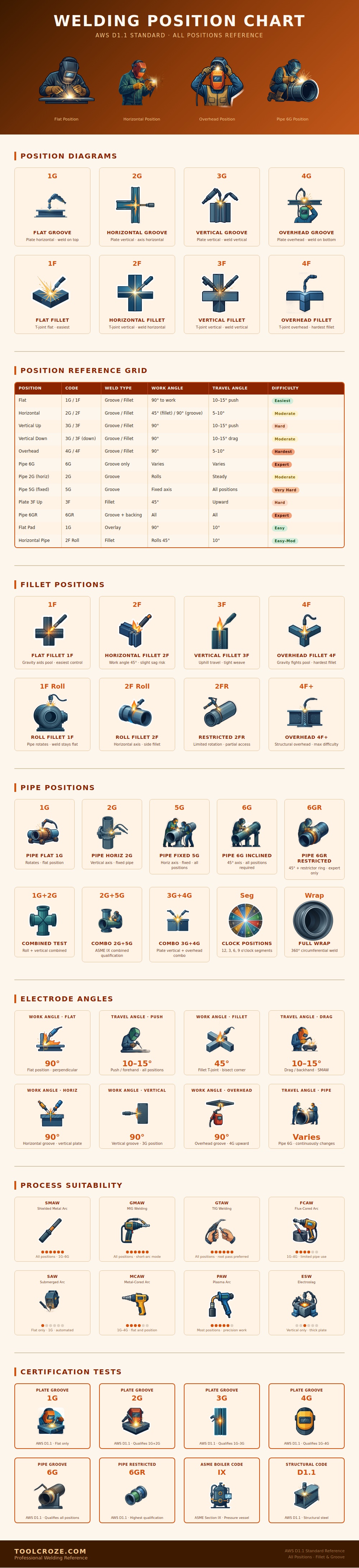
When thinking about your welding stance, keep in mind the geometry. Every bead you drop is subject to gravity, which either helps or hurts the weld. The welding position chart standardizes these gravity relationships for all fabricators. Once you understand this system, it will change the way you see work space.
Physics backs you up here. The molten pool sit exactly where you put it since you’re welding from above while the plate is laid down flat. There is no spilling over edges and no drips all over your shoes. Because you’re working with a flat surface, you can weld faster with larger bead. Electrode manipulation and heat input becomes the main focal points here. That’s why I’ve marked this category easy; there’s no fighting gravity like some other position. Learning how to weld flat will help build the hand-eye coordination skill needed to tackle the other positions.
How Gravity Affects Your Welding Position
Gravity adds resistance with vertical welding. Moving too fast means the arc runs ahead of the pool, leaving gaps. Too slow and it just melts down and gets all messed up. Some welders try to overcome this by dragging the torch down to force flow. However, this results in incomplete fusion at the root. Instead, weave deliberatly or push upwards slightly to keep puddle in position.
This is where the difficulty spike occurs; vertical up is harder then horizontal work as the chart shows. This is counter-intuitive. Because gravity is against you at each second of arc time, overhead welding requires strict adherence to perpendicular welding angles between electrode and the work piece. Use short arcs (not long ones like when welding flat). Pour molten metal on top of a ceiling with sparks flying down on your helmet. Hot drops from long arc will also get in your gloves. And one drop on a test coupon can mean a failed test. So, it’s the toughest fillet position, the infographic reminds us.
A second consideration is that rotating piece of work becomes impossible when you weld pipe. When you’re welding it in a 6G position, you are holding a pipe at a forty-five degree angle. Then you has to go horizontal to vertical to overhead all in one fluid movement while walking around the pipe. That means you need some flexibility and ability to adapt fast. That’s what gets you your certs on the chart. If you pass a 6G test then you can qualify to do just about anything else. Learning how to handle the slant makes everything else seem easy after.
But even more critical than understanding the angles is knowing which process to use. While stick welding can be used in all positions, it takes some experience removing slag. For horizontal and flat areas, MIG is quicker but you’ll need to tweak your settings to get good overhead welds. With TIG you have complete control no matter how tight the spot or what the angle, great for a root pass. Submerged arc will stay on the flat due to the inability of flux blanket to retain its form overhead. Knowing the limitations of each process will save you from getting frustrated trying to do a job that calls for an angle that’s out of bounds.
These 1G, 3F codes are standard ones that let you know how much physical toll welding take and which equipment to set up beforehand. An overhead pipe run is exhausting. A flat bead is easy on your back. The chart helps provide a quick visual reminder of such pros and cons before striking an arc.
Gravity is a silent partner in every single bead you lay, and it either helps you or fights you. Controlling liquid metal require control of your angle. Whether you’re just making a basic fillet or prepping for high-stress pipe joint, you know that where you stand determines what you do. Pay attention to the angle; slow down your travel, follow the geometry with your hand. Welding flat will teach you to weld. Welding hard angles will teach you how to think like a welder.
