
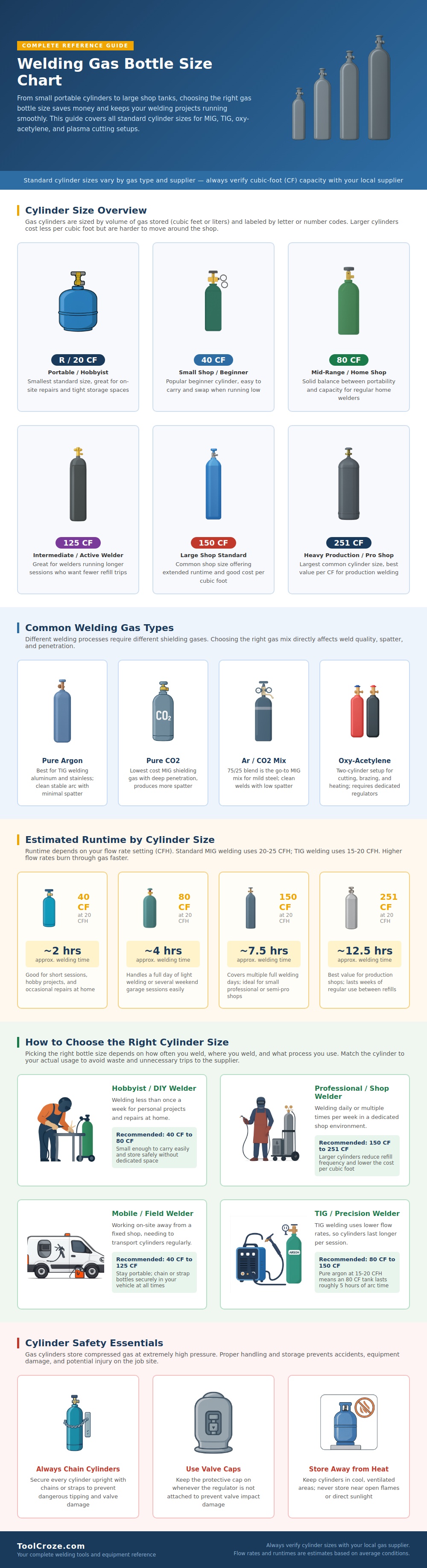
When you are selecting a gas cylinder to use for welding, you must balance the portability of the gas cylinder with the productivity of the gas cylinder. If the cylinder that contains the gas that you will use for welding is too small, it will run out of gas during the welding projects. Furthermore, if the cylinder is too small, you will have to visit the gas supplier for your weldery more frequent to refill the cylinder.
If you select a small gas cylinder, the small gas cylinder will be easy to move and it will fit in a vehicle. However, the small gas cylinder wont have enough gas to last for long welding session. If you select a large gas cylinder, it will contain more gas for your welding projects.
How to Choose a Welding Gas Cylinder
However, the large gas cylinder will be heavy and more difficultly to move. Depending upon the type of welding that you will be performing, you will need to use certain gases in your welding cylinder. For instance, if you are performing TIG welding on aluminum, you will want to use pure argon gas in your welding cylinder.
Argon gas forms a stable arc with the metal that you are welding. For MIG welding, welders often use argon and carbon dioxide gas mixtures. Argon and carbon dioxide mixtures allow for a good balance between the penetration and finish of the weld.
For instance, if you are welding steel, you may use pure carbon dioxide gas to save money on your welding costs. The downside of using pure carbon dioxide gas is that it creates more spatter on the metal than an argon and carbon dioxide mixture. Finally, if you are using an oxy acetylene welding torch, you will need two separate gas cylinders.
One cylinder will contain the fuel gas and the other will contain the oxidizer gas needed to ignite the fuel gas to create the welding flame. In order to extend the life of your gas cylinder, you should control the flow rate of the gas. Many welders increase the flow rate of the gas when performing welding tasks; however, high flow rates waste both the gas and the moneys spent on that gas.
Using a low and steady flow rate of gas is all that is needed to protect the weld pool from the atmosphere. By using a steady flow rate of gas, you will extend the life of the gas in your cylinder. Furthermore, by using a steady flow rate, the gas will allow you to weld for longer periods of time.
In professional welding environments, professionals often use large gas cylinders. This is due to the need to minimize the cost per cubic foot of gas in the professional welding environments. Large gas cylinders are not a portable welding solution.
However, they are a necessity for professional who weld for many hours each day. Using a small gas cylinder will result in the welder running out of gas very quick. A large gas cylinder will provide enough gas to allow welders to weld for weeks at a time.
Safety is one of the main requirements when using a gas cylinder. Gas cylinders is under high pressure. Furthermore, if the valve on the gas cylinder is damaged the gas cylinder can become dangerous.
You should never allow the gas cylinder to stand on it’s own. Therefore, you must chain the gas cylinder to a wall or chain it to a heavy cart. Finally, you should always ensure that the protective caps are in place on the gas cylinder when you are transporting it to where the welding will occur.
Furthermore, you should always keep the gas cylinder at a distance from any heat source. If a gas cylinder tips over, due to transportation for instance, it could cause a catastrophe in the welding area. The best way to select the correct gas cylinder is to evaluate your welding habit.
If you are a welder who only performs welding occasionally, a small cylinder will allow you to easy move the welding equipment. However, if you weld every day, you will need a gas cylinder that can provide more gas for your welding activities. Therefore, the best gas cylinder is the one that can provide enough gas to complete your welding project.
