Welding Duty Cycle Calculator
Estimate usable duty cycle from a welder rating, actual amperage, thermal exponent, cycle window, ambient temperature, airflow condition, planned arc time, and required cooling rest.
Duty Cycle Breakdown
| Rated duty | 10 minute window | 5 minute window | Typical use |
|---|---|---|---|
| 20% | 2 min weld, 8 min rest | 1 min weld, 4 min rest | Light repair and tack work |
| 40% | 4 min weld, 6 min rest | 2 min weld, 3 min rest | Garage fabrication and short beads |
| 60% | 6 min weld, 4 min rest | 3 min weld, 2 min rest | Shop welding with moderate pauses |
| 100% | Continuous within rating | Continuous within rating | Production or mechanized welding |
| Process | Common exponent | Heat pattern | Planning note |
|---|---|---|---|
| MIG short-circuit | 1.8 to 2.1 | Intermittent arc starts | Gun and liner limits can arrive before the power source. |
| Flux-core structural | 2.0 to 2.3 | High deposition heat | Long beads need strict rest and cable rating checks. |
| Stick welding | 1.7 to 2.1 | Natural rod-change pauses | Arc breaks help, but hot rods and leads still matter. |
| AC TIG aluminum | 2.1 to 2.5 | High torch heating | Water cooling can be the deciding duty limit. |
| Mechanized welding | 2.0 to 2.4 | Long continuous arcs | Use conservative duty unless the system is rated continuous. |
| Ambient condition | Suggested derate | Cooling factor | What to verify |
|---|---|---|---|
| Cool indoor bench | 0% per °C below rating | 1.00 to 1.06 | Vents clear and fan working. |
| Hot shop above rating | 0.5% to 1.5% per °C | 0.92 to 1.00 | Thermal light and duty chart in manual. |
| Dusty field work | 1.0% to 2.0% per °C | 0.90 to 0.96 | Air path, generator voltage, and cable size. |
| Water-cooled torch | Still derate power source | 1.06 to 1.12 | Coolant flow, torch rating, and return temperature. |
| Example machine rating | At rated amps | At lower amps | Practical reading |
|---|---|---|---|
| 90 A at 20% | 2 arc min per 10 | 60 A may approach 45% | Good for brackets, tacks, and short beads. |
| 200 A at 40% | 4 arc min per 10 | 160 A may approach 63% | Often enough for mixed shop fabrication. |
| 250 A at 60% | 6 arc min per 10 | 200 A may approach 94% | Check torch and leads before calling it continuous. |
| 400 A at 100% | 10 arc min per 10 | Lower amps remain continuous | Designed for long seams when accessories match. |
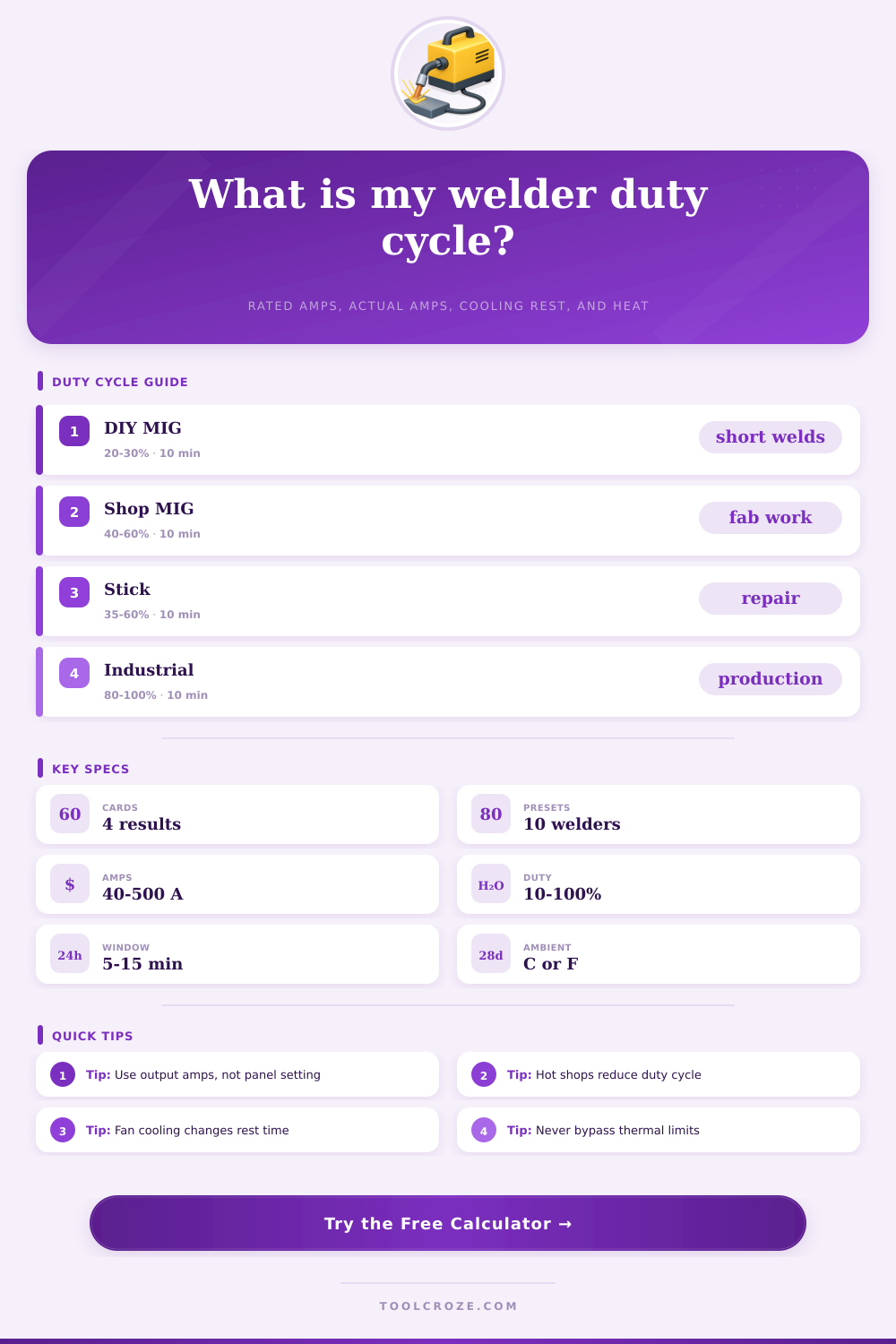
A welding duty cycle refer to the specification that determine how much time a welding machine can operate before it requires a rest period to cool down. Welding duty cycle is often represent as a percentage of a ten minute cycle. For example, if the welding duty cycle is 60%, the welding machine can operate for six minutes before it requires a four minute rest period.
The welding duty cycle printed on a welding machine, however, isnt a constant. The welding duty cycle can fluctuate based off the amperage the welding machine uses, the ambient temperatures of the welding environment, and the cooling condition of the welding machine itself. Many people selects a welding machine based only on the highest amperage or duty cycle that is printed on the welding machine’s nameplate.
What Is Welding Duty Cycle and How to Calculate It
Someone may select a welding machine that offer 250 amps and an 60% welding duty cycle. This welding machine, however, may not hold up under changes in the amperage settings or changes in the welding environments ambient temperature. Higher ambient temperature will reduce the welding duty cycle because the welding machine will reach it’s thermal limit more quickly.
Additionally, if the welding machine is in an area that is not well ventilated, the welding machine will overheat more quick because of the poor cooling conditions for the machine. By using the calculator include in this article, a person can calculate the welding duty cycle of their welding machine. To calculate the welding duty cycle of the welding machine, a person will need to enter the machines rated amperage, the actual amperage that the person will use, the ambient temperature of the welding shop, and the cooling condition of the welding machine.
By entering these values, the calculator will provide the allowed arc time and rest time for the welding machine. The ambient temperature of the welding shop is one of the variable that will impact the welding machine. Higher ambient temperatures will cause the welding machine to overheat more quick.
For example, if the welding machine is rated at a certain welding duty cycle at 40 degrees Celsius, increasing the ambient temperature will reduce that welding duty cycle. A welding machine in a very hot garage will overheat more quicker than one in a cool welding shop. Thus, the ambient temperature of the welding environment is another determining factor for the amount of welding that can be performed before the welding machine shut off.
The cooling conditions of the welding machine are another variable that will impact the welding machine. Machines with better cooling conditions will overheat less quickly than those with poor cooling conditions. For example, welding machines with well ventilated vents will have better cooling conditions than those with dusty vents or those that are place against a wall.
Poor cooling conditions will lead to a decrease in the welding duty cycle of the welding machine. The cooling factor field within the calculator allow for adjustments to the welding machine’s cooling conditions for more accurate projections of welding duty cycle. The outputs of the calculator will show the allowed arc time of the welding machine, the rest time that the welding machine should take, and the status of the welding machine based on its derated capacity.
These figures will allow welder to plan there welding jobs effectively. By taking into account the ambient temperature, cooling conditions, and amperage of the welding machine, the duty cycle calculator allow welders to have a more accurate estimation of the welding duty cycle of their welding machine than the nameplate on the welding machine itself. Many welders make a mistake when purchasing welding machines by ignoring the thermal limit of the welding machine.
If a person reduces the amperage that the welding machine operates at, the welding duty cycle of the welding machine will increase. For example, by decreasing the amperage the welding machine uses by 20%, that welding machine will be able to weld for a longer period of time before it need to take a rest break. Another factor to consider is the thermal limits of the welding accessory.
The torch, leads, and ground clamp can reach thermal limits that are lower then that of the welding machine. In these instances, the torch will be the limiting factor for the welding session. Effective workflow planning will allow welders to make the most of the required rest time for their welding machine.
During this time, other task can be completed in the welding job, such as changing welding rods or brushes, removing slag, or repositioning welding clamps. While it is common for welders to perform these tasks while the welding machine is running, it is more effective to perform these task while the welding machine is cooling down. By using the welding duty cycle calculator, welders can have an idea of how long their welding machine will need to rest before resuming welding operations.
Thus, the welder can complete their welding job without having to shut off their welding machine unexpectedly.