🔥 Welding Deposition Rate Calculator
Estimate melt-off, deposited weld metal, heat input, filler consumption, and arc time for GMAW, FCAW, SMAW, GTAW, and SAW production welds.
📌 Preset Welds
⚙ Weld Setup
🎯 Results
📊 Material and Specification Grid
📘 Reference Tables
| Process | Typical deposition efficiency | Arc efficiency | Production note |
|---|---|---|---|
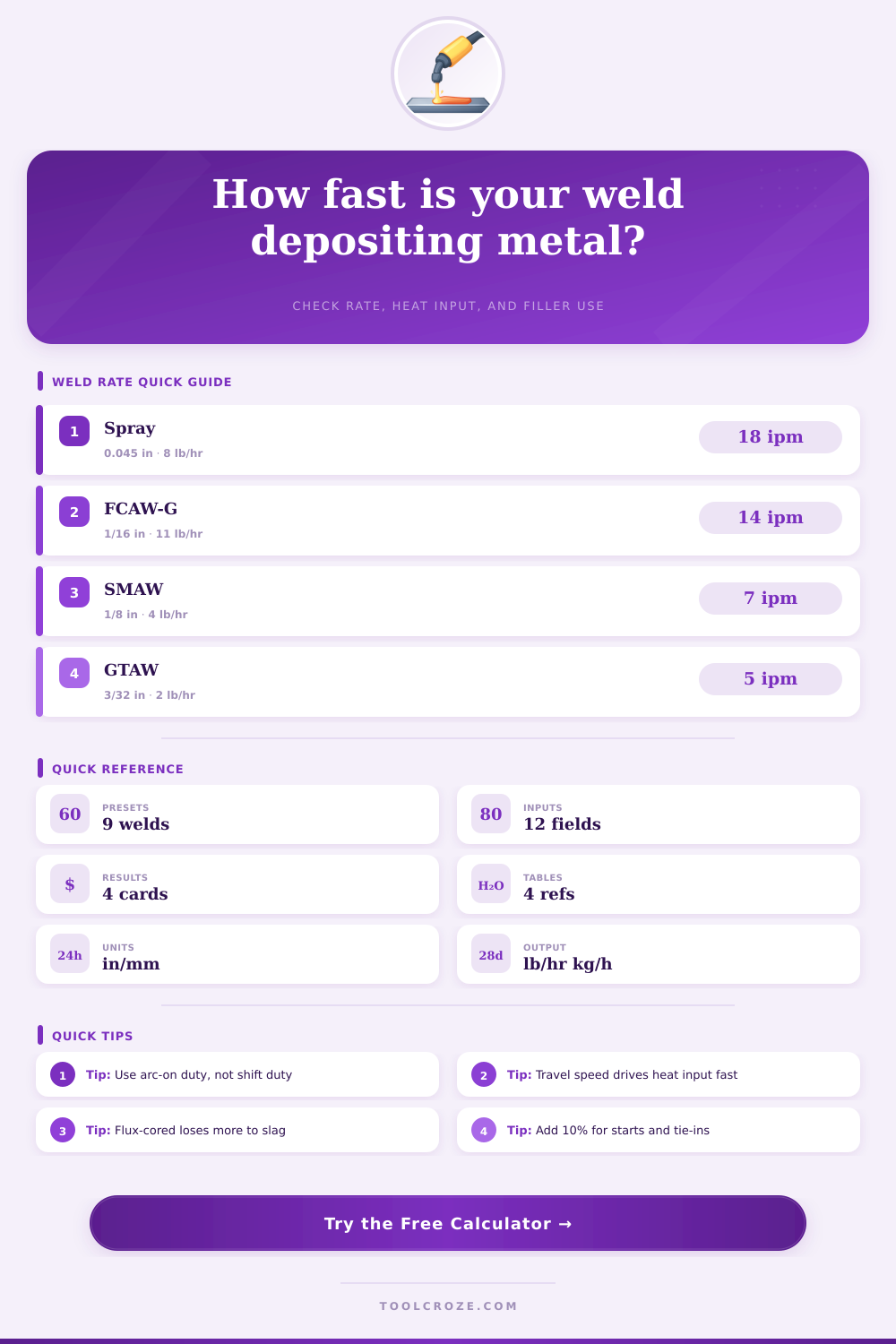
| GMAW spray | 95-98% | 0.80 | High melt-off with low spatter on flat fillet and groove work |
| GMAW short-circuit | 90-94% | 0.78 | Useful for thin gauge and out-of-position work with lower heat |
| FCAW gas-shielded | 84-90% | 0.80 | Excellent deposition but slag removal and slag islands reduce net yield |
| SMAW low-hydrogen | 62-70% | 0.75 | Stub ends and coating loss reduce deposited metal per pound of rod |
| GTAW manual feed | 93-97% | 0.60 | Very clean deposit, slower feed, and lower arc efficiency than wire processes |
| SAW single wire | 98-100% | 0.95 | Highest productivity for long seams with controlled flux recovery |
| Diameter | Common process | Typical feed window | Expected deposited rate |
|---|---|---|---|
| 0.035 in / 0.9 mm | GMAW short-circuit | 180-420 ipm | 2.5-5.5 lb/hr |
| 0.045 in / 1.2 mm | GMAW spray | 250-550 ipm | 5.5-10.5 lb/hr |
| 1/16 in / 1.6 mm | FCAW or GMAW | 180-420 ipm | 6.0-12.0 lb/hr |
| 3/32 in / 2.4 mm | GTAW or SMAW | 20-90 ipm | 1.0-3.0 lb/hr |
| 1/8 in / 3.2 mm | SMAW E7018 | 25-75 ipm | 2.5-5.0 lb/hr |
| 5/32 in / 4.0 mm | SAW single wire | 140-300 ipm | 10-22 lb/hr |
| Joint geometry | Area formula | Use case | Production caution |
|---|---|---|---|
| Equal-leg fillet | 0.5 x leg^2 | Structural fillets and bracket welds | Overwelding increases required weight sharply as leg size grows |
| Groove fill | width x depth x 0.95 | Single-V fill, seam fill, and joint buildup | Root opening, bevel angle, and cap profile can raise true volume |
| Overlay pass | width x layer x 0.85 | Wear pad, buttering, and corrosion overlays | Keep dilution low by controlling layer thickness and heat input |
| All geometries | volume = area x length | Converts weld section into deposited volume demand | Add starts factor for tie-ins, runoff tabs, and interruptions |
| Scenario | Travel speed | Heat input | Interpretation |
|---|---|---|---|
| Fast spray fillet | 18-24 ipm | 0.9-1.5 kJ/mm | Strong deposition with moderate distortion when fusion is stable |
| Thin sheet short arc | 22-32 ipm | 0.3-0.7 kJ/mm | Low heat protects the sheet but leaves little room for slowdown |
| FCAW structural groove | 10-16 ipm | 1.2-2.0 kJ/mm | High volume fill requires enough pause for slag release between passes |
| GTAW root or overlay | 4-8 ipm | 0.5-1.1 kJ/mm | Slow travel keeps control but can push heat input high very quickly |
💡 Shop Notes
Use this calculator to compare welding process settings, estimate net deposited metal, and plan weld time with practical allowances for tie-ins, slag loss, and real production duty cycles.
Deposition rate is the measurement of the amount of usable weld metal that is added to a weld joint during a specific period of time. Deposition rate are not the same as melt-off, which measures the total amount of welding wire that leaves the welding wire spool. The amount of metal that is added to the joint is the amount that is accounted for metal losses such as spatter and slag.
While many person may confuse the two measurements, deposition rate is the more important of the two measurements. In order to calculate the deposition rate for a welding job, there are several different factor that must be considered. Such factors include the wire feed speed, efficiency of the welding process, the duty cycle of the welding job, and even the travel speed of the welding machine.
Deposition Rate in Welding and How to Calculate It
Wire feed speed will determine how much metal is added to the weld, efficiency will account for metal loss, duty cycle will account for period where welding is not occurring, and travel speed will impact the amount of metal deposited per foot of weld. The higher the travel speed at which the welder travels the welding machine, the lesser metal will be deposited per foot of weld. Additionally, as the travel speed increases, the amount of heat input into the welding joint decrease.
The type of welding process that will be used also impact the deposition rate for the welding joint. Processes like spray transfer welding with solid wire rods has high deposition rates due to the little metal loss during the welding process. Flux-cored welding processes also have high deposition rates, yet have lower efficiency in the welding process due to the metal loss caused by the slag.
Stick welding processes have even lower deposition rates than flux-cored welding processes because of the metal loss caused by the stub ends and flux rods stick welding rods do not incorporate into the weld. Finally, submerged arc welding processes has the highest deposition rates because of the high efficiency of the welding process and the small amount of metal loss during welding. Finally, the geometry of the weld joint will change the amount of metal require to complete the weld.
Weld joints that are fillet welds will require more metal to complete welds with larger leg sizes. The volume of metal required for fillet welds increase as the square of the leg size. Groove welds require metal according to the width and depth of the groove to be welded, as well as the size of the root gap.
The volume of metal that must be deposited into a weld joint based off its shape will impact the deposition rate for that joint. One of the main use for calculating the deposition rate of weld metal is to accurately forecast the amount of welding wire that will be required for a specific welding job. By knowing the deposition rate, the welding machine can calculate the amount of time that it will take to complete the weld.
Additionally, by knowing the amount of metal that will be deposited per length of weld, the welder can calculate the total weight of the filler metal that is required. Finally, by knowing the weight of the filler metal that is required to complete the weld, the welding shop can also maintain the inventory of welding wire. Despite the ease with which deposition rate can be calculated, there are several mistakes that can be made when determining the deposition rate of metal for welding processes.
Some individuals may not take into account the efficiency in which the welding process will occur. If only the melt-off rate of welding wire is considered, the individual will underestimate the amount of time and metal that is required to complete the job. Additionally, some may increase the travel speed of the welding machine to increase the deposition rate of weld metal.
However, if the travel speed is too fast, the welding machine may experience a starving weld, causing the metal to not properly fuse. Finally, the welder should verify the calculations of the deposition rate against the Welding Procedure Specification (WPS) for the weld joint that is to be created. The WPS will contain information regarding the amperage, voltage, and heat input levels that the welder will use for that specific weld.
By adhering to the specifications within the WPS, the welder can ensure the deposition rate to remain within safe limits for the type of metal that will be welded. Thus, balancing the deposition rate, travel speed, and heat input together is essential for the successful completion of a welding job.