
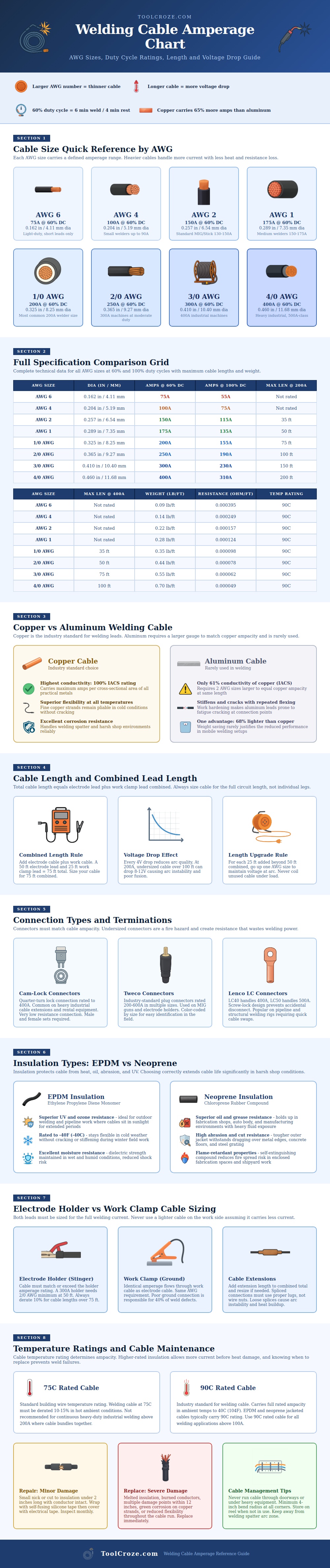
Welding cable are a critical component of a welding machine. The size of the welding cable will determine how much voltage that reaches the welding arc. If the welding cable is too thin or too long, the welding cable will cause a voltage drop at the welding arc site.
This voltage drop are due to the resistance of the welding cable if the welding cable is thin or long. If there is a voltage drop at the welding arc, this will cause instability in the welding arc and the weld quality will be poor. The size of the welding cable must be sized correct for the welding machine to deliver the proper voltage to the welding metal.
How to Choose the Right Welding Cable
The gauge of the welding cable is a measurement of the thickness of the welding cable. A larger gauge number mean a thinner welding cable. A smaller gauge number means a thicker welding cable.
The thickness of the welding cable will determine the amperage the welding cable can carry. A welding cable need to be selected according to the amperage of the welding machine and the duty cycle of the welding machine. The duty cycle of the welding machine is the amount of time the welding machine can operate before it requires a rest period to cool down.
If you will use the welding machine at 100 percent duty cycle, then the welding cable must be of a thick enough size to handle the necesary amount of current. The resistance created by the welding cable can create heat within the welding cable. If the welding cable overheats, it can damage the insulation of the welding cable.
A reference chart can be used to determine the correct size of the welding cable for the specified amperage requirements of the welding task. For 150-amp welding machines, the standard size of the welding cable is usually sufficient for short lengths of welding cables. However, if the welding task requires the use of longer welding cables, a larger diameter welding cable must be used to prevent the development of hot spots along the welding cable that could eventually lead to failure of the welding cable.
For welding to occur, electricity must travel through a complete circuit. This complete circuit is composed of both the electrode holder lead and the work clamp lead. The welding cable for the electrode holder and the work clamp lead must be of the same size.
The total length of the welding cable circuit is calculated by adding the length of the electrode holder lead and the work clamp lead. If the work clamp lead is thinner than the electrode holder lead, then the welding circuit will be imbalanced. This can cause weld defect in the metal being welded.
For instance, if the electrode holder lead is 50 feet in length and the work clamp lead is 25 feet in length, the welding circuit will be 75 feet in length. Voltage drop will occur with every four volts of resistance in the welding circuit. If the welding cable is thin or too long, voltage drop can reach between eight and twelve volts at higher amperages of welding machines.
In order to prevent voltage drop, the user should increase the size of the welding cable for every 25 feet of length of welding cable that is to be added beyond 50 feet. Another way to prevent voltage drop is to avoid coiling the welding cable if excess welding cable exist beyond the welding tasks to be performed. Welding cables are usualy made out of copper because copper has high electrical conductivity.
This allows for the welding cable to be thinner compared to aluminum welding cables of the same amperage. The advantage of using aluminum welding cable is that it is lighter than copper welding cable. However, the aluminum welding cable will need to be two gauges in size larger than the copper welding cable for both to carry the same amount of current.
Another advantage of copper welding cable is that the cable is more flexible than aluminum welding cable and it will not corrode if exposed to welding metal spatter. Copper welding cable is 65 percent more efficient in conducting electricity compared to aluminum welding cable. For these reasons, copper welding cable is of the preferred choice for welding tasks that require higher amounts of current.
The connector for the welding cable must match the rating of the welding cable. Using a connector that is undersized to the welding cable will create excess heat at the connector. Using excess heat at the welding cable will cause the welding cable to overheat and could start a fire.
The insulation for the welding cable must also be selected correctly according to the welding environment. If welding work will be performed outdoors in the sun, EPDM insulation will protect the welding cable from ultraviolet light and cold temperature. If welding work will be performed within the shop, neoprene insulation will protect the welding cable from oil and abrasion.
The insulation for welding cables is typically rated for 90C; however, this drop in relation to the ambient temperature of the welding environment. Welding cables should be inspected each month for damage. Minor nicks in the insulation can be repaired with self-fusing silicone tape.
If the welding cable has been melted or the copper strands have been corroded, the welding cable must be replaced. Welding cables should be kept out of doorways or areas where the welding cable may be exposed to sharp bend in the metal. Welding cables should be stored in a reeled position when not in use.
If welding cables are properly maintained and sized correctly according to the welding machine amperage and welding tasks, welding arcs will be stable and welds will be successful.
