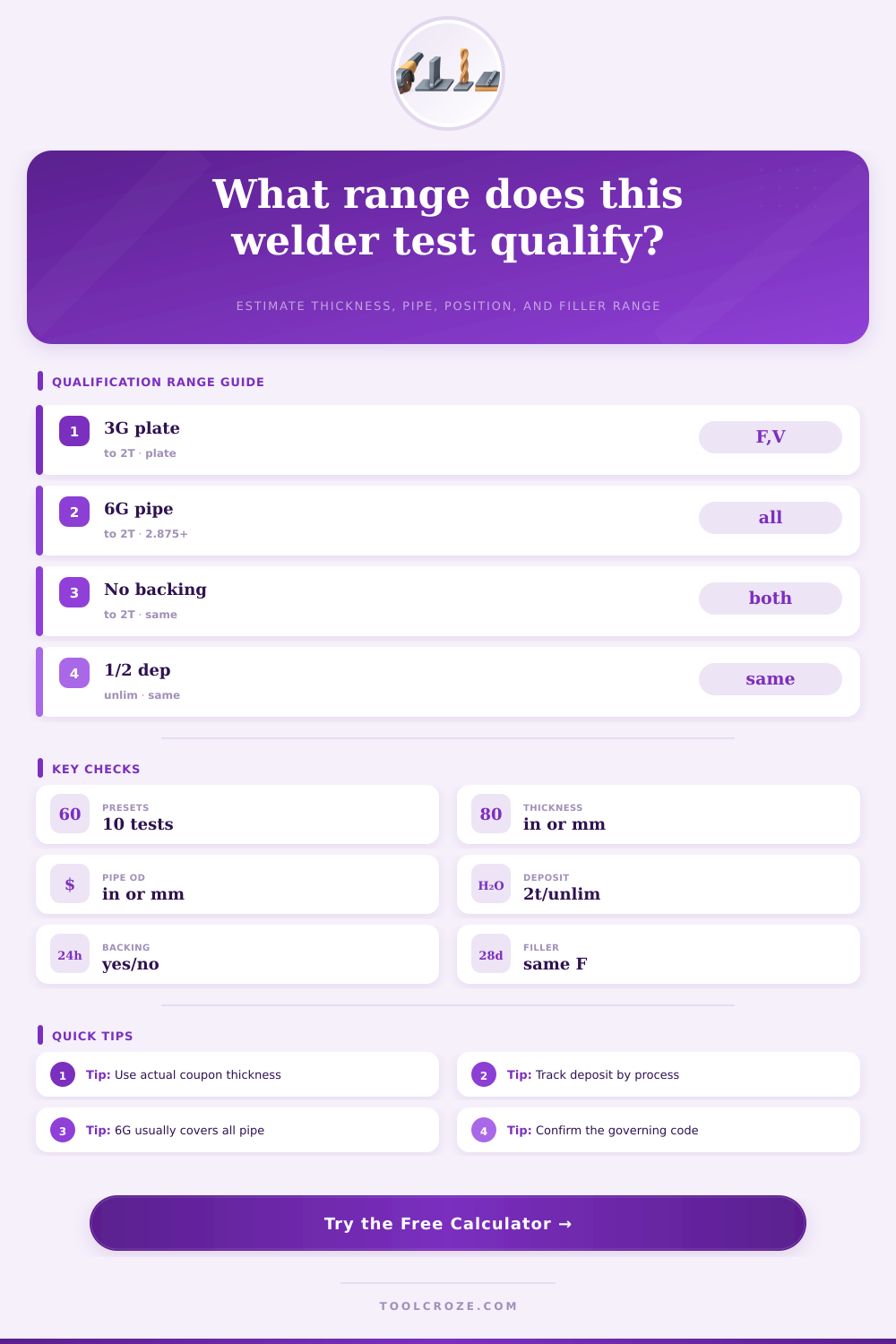
Welder Qualification Range Calculator
Estimate common AWS/ASME-style qualification ranges for coupon thickness, pipe diameter, welding process, position, backing, filler group, and deposited weld metal thickness.
These tables summarize widely used planning ranges. The governing code, edition, WPS, testing method, product form, and contract documents can narrow or expand them.
| Coupon thickness tested | Common base metal range | Deposit thickness range | Practical note |
|---|---|---|---|
| Less than 1/16 in (1.5 mm) | About T through 2T | Usually up to 2t | Thin sheet and tube often use product-specific limits. |
| 1/16 to under 3/8 in (1.5 to 10 mm) | About 1/16 in through 2T | 2t if deposited thickness is under 1/2 in | Most shop coupons fall in this working range. |
| 3/8 to under 3/4 in (10 to 19 mm) | About 3/16 in through 2T | 2t unless deposit meets unlimited rule | Confirm impact, P-number, and backing variables. |
| 3/4 in (19 mm) and over | About 3/16 in to unlimited when rules are met | Unlimited if at least 1/2 in deposited by process | Multi-layer welds are commonly required for unlimited range. |
| Test item | Common diameter range | Position range | Notes |
|---|---|---|---|
| Plate groove coupon | Plate; may qualify large pipe where permitted | Based on 1G, 2G, 3G, 4G combination | Many programs require 3G plus 4G for all plate positions. |
| Pipe under 1 in OD | Often limited around tested small diameter | Depends on 1G, 2G, 5G, 6G, or 6GR | Small tube tests are commonly the most restrictive. |
| Pipe 1 in to under 2-7/8 in OD | Commonly 1 in OD and larger | 5G covers vertical and overhead; 6G covers all | Some standards keep a minimum OD equal to test size. |
| Pipe 2-7/8 in OD and larger | Commonly 2-7/8 in OD and larger | 6G is the broadest ordinary pipe test | Restricted 6GR is often used for TKY or access limits. |
| Variable | Broadly qualifies | Usually does not qualify | What to document |
|---|---|---|---|
| Process | The process tested and deposited thickness by that process | Untested processes or transfer modes with separate essential variables | Process, mode, polarity, manual/semi-auto status. |
| Backing | No backing often covers both with and without backing | With backing usually does not cover open-root without backing | Backing ring, backing strip, back gouge, or open root. |
| Filler group | Same F-number or listed group in the code table | Special fillers, different usability groups, or unlisted classifications | F-number, A-number when required, filler class, lot traceability. |
| Vertical progression | The tested progression, or both if both are tested | Opposite progression when code makes it essential | Uphill, downhill, or both on the qualification record. |
Welder qualification ranges determines the types of welding work that a welder can legally perform on the job site. By not understanding the welder qualification ranges, you may find yourself wasting time performing retests on welds that isnt really necessary. You may also find that your welds is failing inspection, which will halt your production line.
In order to understand welder qualification ranges, one must understand the various variables that can impact the welder qualification ranges. Each of these variables have the potential to interact with each of the others to create either a weld qualification range that covers the projects that the welder will perform or create weld qualification ranges that does not cover those projects. One of the variables that can impact the welder qualification ranges is the thickness of the materials that the welder is to weld.
What Affects Welder Qualification Ranges
A welder who qualifies on a half-inch plate does not qualify automatically on a two-inch plate. The thickness of the material on which a welder performs their tests will dictate the range of thicknesses that the welder can qualify on. If the welder tests a coupon that is thinner than three-eighths of an inch, then the welder can qualify on double the thickness of the test coupon.
If the welder tests a coupon that is three-quarters of an inch or thicker and if the welder places enough weld metal onto the joint with multiple layer of weld metal, then the welder can qualify on any thickness of metal. Welders who test on thin metal all the time will find themselves not qualified for thick metal joints, even though the thick joints may appear similar to the thin metal joints that they are qualified to complete. Pipe diameter is another variable that impact the welder qualification ranges.
Similar to thickness, smaller diameter tubes will result in qualification ranges for those welders that is smaller than the qualification ranges for larger diameters of tubes. If the welder tests on a pipe that is smaller than two and seven-eighths inches in diameter, the welder will not qualify for any thicker pipes. However, if the welder qualifies on any pipe that is larger than two and seven-eighths inches in diameter, the welder will qualify for any thicker pipes in the same category.
This can greatly benefit those who work on large bore pipes, as qualifying on a six-inch pipe will allow the welder to perform on many other sizes of thick pipes. However, those who work on instrumentation and other small diameter tubing will require the welders to qualify on those small tubes to ensure that they are covered by the welder qualification ranges. The position that the welder performs their welds can also create variations in the qualification ranges of a welder.
Qualifying on a weld performed in the flat welding position will indicate to inspectors that the welder can control the weld puddle. However, qualifying on the flat welding position does not indicate that the welder can perform in positions where the force of gravity may work against the welder. A welder who has only qualified on welds performed in the flat welding position will not be legally allowed to perform welds in positions that is against the welder by gravity.
However, performing a 6G pipe test will allow a welder to qualify on all welding positions with that one weld test. If a shop does not perform the 6G pipe test, they may find that the welders qualified on only a few positions, and they will not be able to complete the projects. Other variables that impact the qualification ranges of welders are the type of backing on the metal that the welder is to weld and the type of filler metal rods that the welder is to use.
A welder who has performed tests on metal that has a backing plate will not necessarily be able to perform on metal joints that do not have a backing plate. Similarly, if the welder uses a low hydrogen welding electrode, that welder will not necessarily have qualified ranges on metal that require a cellulosic welding rod. Welders can also lose their qualification on the job site due to rules regarding the continuity of the welders skills.
A welder may have the best qualification ranges for the projects that they will perform, but if the welder does not use that specific welding process within a certain time range, such as six months, the welder can lose their qualification on the job site. This is established as a rule for welders so that welders do not lose their welding skills over time. If a welder has not performed a specific welding process in a while, they may pass a visual inspection of the weld, but they may fail another test, such as a bend or radiography inspection.
Each welding process must be tracked individually so that no welder is discovered as unqualified on the job site when the production line require the welder. In addition to the variables discussed above, there are also instances where a welder will have to qualify on a joint that requires additional complexity to the welding process. For instance, a joint may require uphill welding on one side of the metal joint and downhill welding on the other side.
Welders may also use two different welding processes for the same joint. For instance, the welder may use one welding process to perform the root of the joint and a second welding process to perform the fill of the joint. The welding code treats each of these separate welding processes as separate thicknesses of metal because the welding process only qualifies the welder for the metal that the welding process placed onto the joint.
If the welder attempted to mathematically combine each of these separate welding processes into a single number, there would be confusion regarding which welding process qualified which layer of the joint. The two tables on this page are reference tables for AWS and ASME welder qualification rules. These tables are planning tools for those who wish to qualify welders for metal joints.
However, the specifications for the projects may require welder qualifications that are more narrow in range. Additionally, some customers will require that the welds be tested for impact, which can impact the thickness of the metal that is qualified for that welder. While the qualification calculator will provide welders with a start to planning the qualification of their welders, it is the actual qualification and records for each welder that will dictate the projects that each welder will perform.
The issues that welders and welding fabricators may encounter are usualy due to incorrect assumptions rather than lacking welding skills. Use the welder qualification ranges as a map of the work that each welder is qualified to complete.