Weld Size Calculator
Estimate required weld leg size, effective throat, design capacity, utilization, and minimum-size checks for loaded welded joints.
Calculation breakdown
| Electrode or filler | Fexx used | Common base fit | Design note |
|---|---|---|---|
| E60 | 60 ksi | A36 light structural | Lower weld metal strength, often for light repair or legacy details. |
| E70 | 70 ksi | A36, A572, A992, A500 | Common matching-strength choice for many carbon steel joints. |
| E80/E90 | 80 to 90 ksi | Higher-strength steels | Check base metal, procedure, hydrogen control, and code limits. |
| E308L | 75 ksi | 304 stainless | Use stainless-specific procedure and corrosion requirements. |
| ER4043/ER5356 | 29 to 38 ksi | Aluminum alloys | Heat affected zone strength can govern aluminum welded joints. |
| Thicker part thickness | Typical minimum fillet | Thin-part maximum check | Length check |
|---|---|---|---|
| 1/4 in or less | 1/8 in | Not greater than thin part | Effective length at least 4 times weld size |
| Over 1/4 to 1/2 in | 3/16 in | Thin part minus 1/16 in when 1/4 in or thicker | Intermittent welds commonly need 1-1/2 in minimum segments |
| Over 1/2 to 3/4 in | 1/4 in | Confirm edge melt and access | Short welds lose capacity at starts and stops |
| Over 3/4 in | 5/16 in | Multi-pass procedures may be needed | Critical joints need engineered weld group checks |
| Weld geometry | Throat factor used | Best input use | Calculator interpretation |
|---|---|---|---|
| 90 degree equal-leg fillet | 0.707 times leg | Most lap, tee, corner welds | Entered weld size is leg size. |
| 60 degree acute fillet | 0.612 times leg | Acute included angle details | Smaller effective throat for same leg. |
| 120 degree obtuse fillet | 0.866 times leg | Open-angle fit-up | Geometry increases theoretical throat. |
| PJP or flare groove | 1.000 times entered size | Details with specified effective size | Entered size is already effective throat. |
| Plug or slot weld | 1.000 times thickness | Shear through fused area | Length input acts as total effective shear perimeter length. |
| Spec basis | Resistance used | Load angle treatment | Practical use |
|---|---|---|---|
| AISC LRFD style | 0.75 times nominal weld strength | Optional transverse angle increase capped at 1.50 | Factored structural steel load checks. |
| AISC ASD style | Nominal strength divided by 2.00 | Same angle model, then allowable stress reduction | Service-load steel checks. |
| AWS working-stress style | Nominal strength divided by 2.40 | Conservative angle treatment | Shop screening and nonbuilding details. |
| Eurocode-style check | Gamma-style reduction against ultimate strength | No added transverse bonus in this simplified mode | Comparison only unless project spec confirms it. |
| Service screening | Nominal weld strength shown without code factor | Angle factor visible in breakdown | Early concept sizing before formal design. |
| Preset scenario | Typical weld | Primary concern | Starting check |
|---|---|---|---|
| Bracket fillet | Two 3/16 in fillets | Direct shear plus small eccentricity | Utilization and short-weld length. |
| Tube base plate | Four-sided 1/4 in fillet | Load path around tube wall | Thin HSS wall and end-return assumptions. |
| Lifting lug | Double 5/16 in fillet | Tension, impact, fatigue sensitivity | Requires engineered lug and weld group design. |
| Aluminum fixture | 6 mm fillet or groove | Lower filler and HAZ strength | Use aluminum procedure-qualified data. |
Here you are facing a steel column and a bracket that needs to be bolted on. You see the load and your mind goes numb trying to figure out what size weld to use. There’s nothing tangible to go by, so most folks will grab for largest fillet they can fit.
Reason says bigger is stronger, but when put against real life, reason fails. Oversized welds produce huge amounts of heat which cause massive thermal distortion. That distortion push the joint out-of-tolerance before you ever pick up the torch. Never make biggest weld. Make the right weld.
Why You Should Use a Weld Calculator
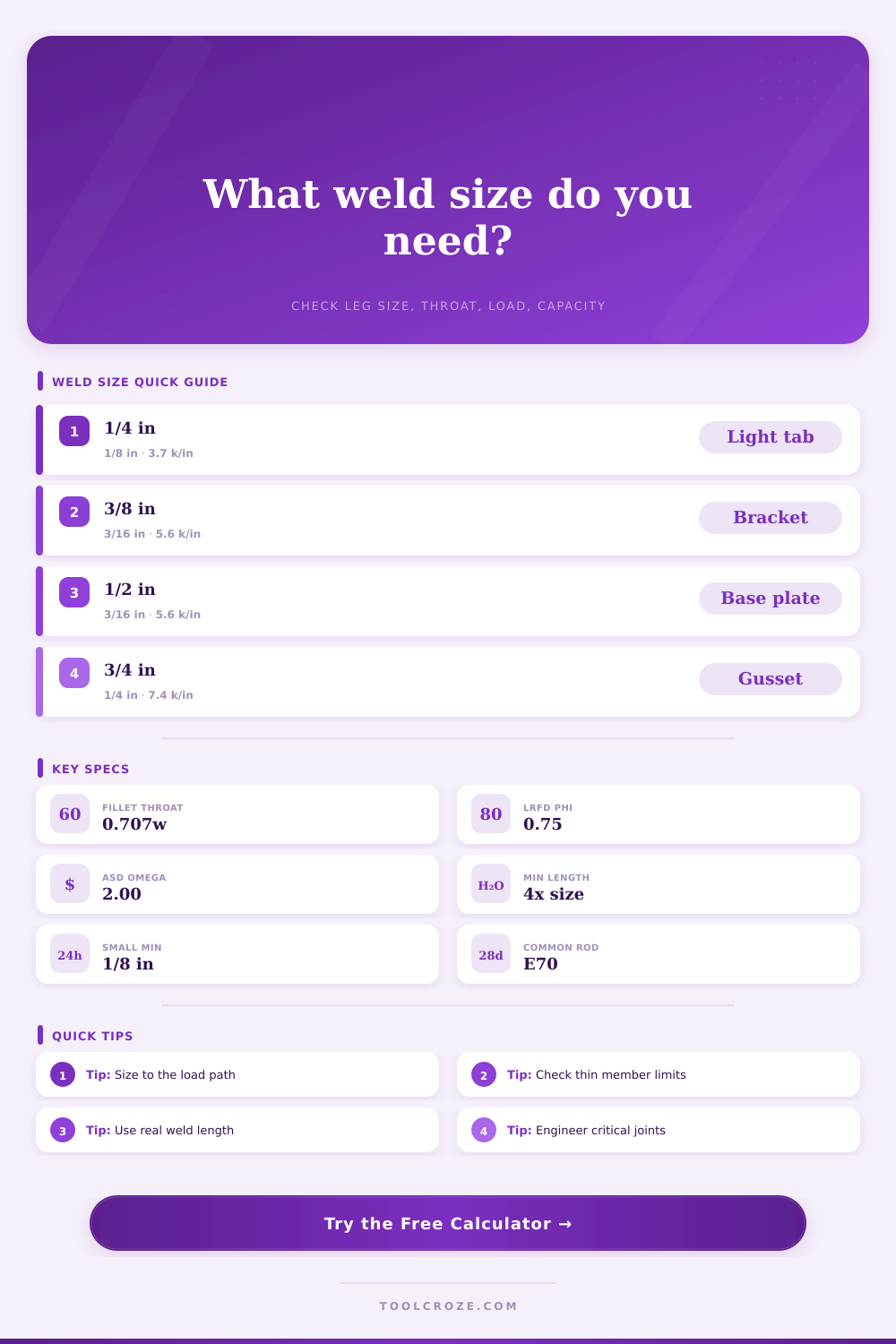
But the throat area matter most, and that is what the calculator above use to run the numbers. You gauge leg size. But it’s throat that carries stress load. On a typical 90 degree fillet, the throat will be about seventy percent of leg length. Doubling leg size without doubling leg length give you more capacity. It also adds more heat in smaller plates. And that heat can softens the surrounding base metal or burn its way along an edge.
Using the tool, you can check your trial size against maximums and minimums developed from plate thickness. And it help you find balance between those conflicting forces.
Electrode strength matter. Most hobbyists don’t understand why electrode strength selection is so important. The default workhorse for structural steel is E70 filler which provide a tensile strength of seventy thousand pounds per square inch. When welding, we’re tempted to go to higher strengths such as E80 and E90 because we believe it will make the weld “tougher”. However, when the base metal cannot support that concentration of stress, then it doesn’t really matter. This is where the chart below come into play. It shows how certain fillers match up with their respective grade of steel. High strength filler on mild steel isn’t always going to result in anything better other than cracking, no real safety margin.
The other thing is your load angle. In the world of math, changing the angle of your load makes all the difference. A weld parallel to its length experiences only shear stress. Pulling perpendicularly on that same weld results in much higher loads prior to failure. This geometric advantage is what the calculator takes into account based off your choice of design code. Different codes uses different safety factors for both situations. Service checks with no heavy code factors may work if you’re just running some ideas by yourself in the shop. When it comes to lifting people or holding up buildings, go by books.
Eccentricity is the silent killer of weld groups. If the force doesn’t run right through the middle of your weld pattern, there’s now torque. And that torque increase the stress on the outside of your weld way more then just the sheer force alone implies. There’s a simple off-center check built into the tool that warns you if the bending part begin to take over. One little off-center bracket design can transform an OK fillet into a critical fail in no time flat.
Codes have minimum sizes for a reason. When welds is made too small in comparison to the thickness of the plates, they will cool rapidly when deposited. The rapid cooling cause hard microstructures with trapped hydrogen, which will result in cracking from stresses. To combat the brittle nature, codes require minimum leg sizes based on the largest section involved in the joint. When the calculator tells you the size is too small, it’s not being overly cautious. It’s saving your behind from unseen flaws that can rear its ugly head months later.
It prevents melted edges When welding, don’t try forcing a big fillet on a small piece of metal (it’s going to burn a hole in the corner). The smaller piece limit how large the weld can be. This rule is checked for you by the tool, and you never need to look at the chart with gloved hands.
It will remind you when length matters too. It will also show that you need a long weld compared to the width to achieve full strength.
Welding is half geometry and half metallurgy. It’s building a bridge between two pieces of metal, and each bridge has its own load paths. Knowing how the parts will work together means you’ll be able to design a clean-looking joint that won’t let you down. You should of used tool more often. Let the calculator do the math so you can concentrate on getting the fit-up and execution correct. Once you get the size dialed-in correctly on the initial attempt, the rest of the fabrication process just falls into place. In the steel yard, precision always wins over brute force.