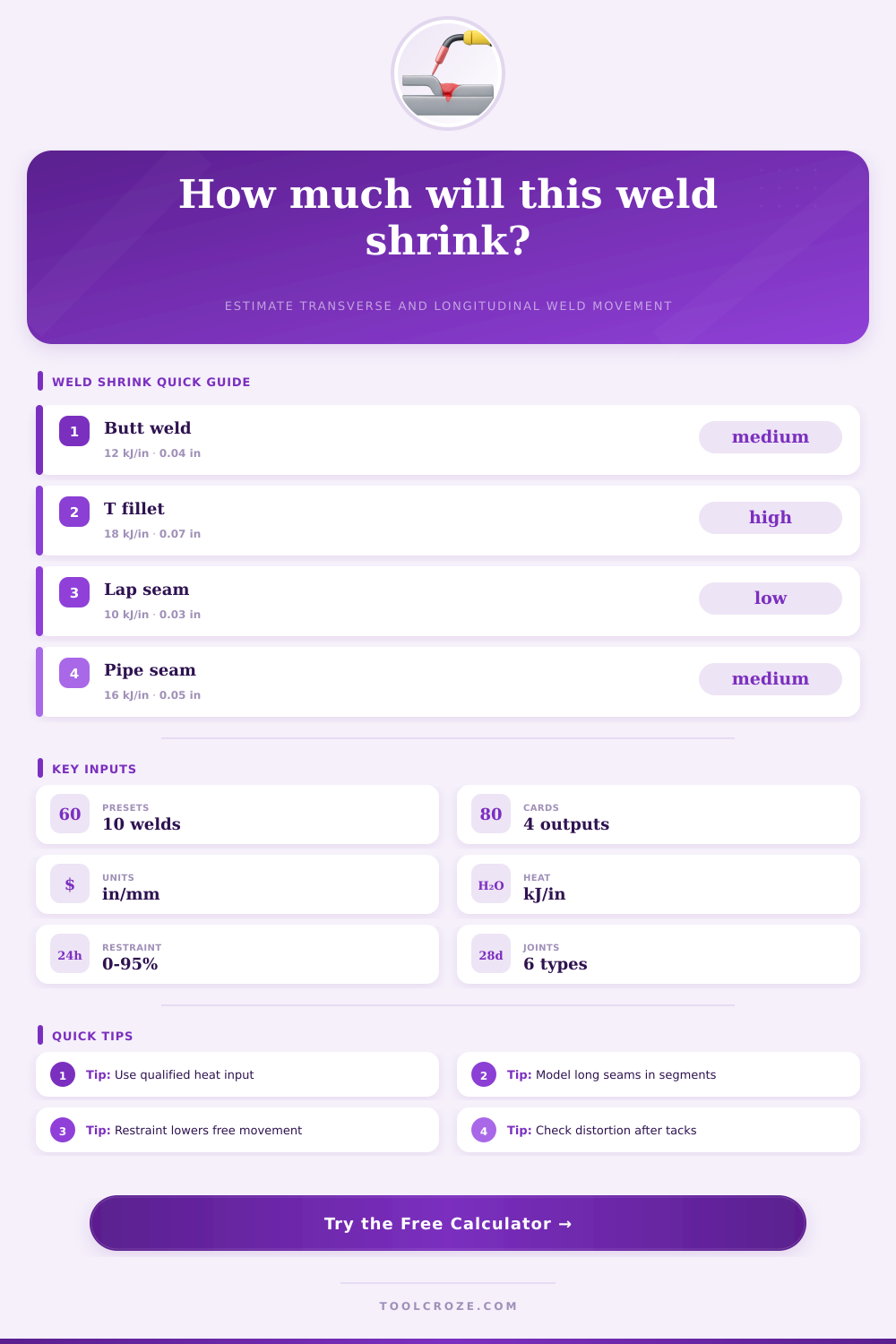
Weld Shrinkage Calculator
Estimate transverse shrink, longitudinal shortening, heat input, and restraint-adjusted movement from weld length, effective throat, deposit area, material, and joint type.
Choose a common fabrication scenario. Each preset fills the inputs and runs the shrinkage estimate.
| Material | Relative factor | Heat behavior | Planning note |
|---|---|---|---|
| Mild steel | 1.00 | Baseline | Good starting point for structural fabrication |
| HSLA steel | 0.95 | Slightly lower | Control heat input for properties and distortion |
| Stainless steel | 1.35 | High expansion | Use balanced sequencing and strong tack planning |
| Aluminum alloy | 1.55 | Very heat sensitive | High conductivity spreads heat but distortion can be large |
| Chrome-moly steel | 1.08 | Controlled heat | Preheat and postheat may affect movement timing |
| Nickel alloy | 1.20 | Slow cooling | Use low heat input and generous fit-up control |
| Joint type | Transverse factor | Longitudinal factor | Typical concern |
|---|---|---|---|
| Butt weld | 1.00 | 1.00 | Gap closure and angular distortion |
| V-groove weld | 1.22 | 1.08 | High deposit volume pulls plates together |
| T-joint fillet | 1.12 | 1.06 | Web tilt and flange bow |
| Lap seam | 0.82 | 0.92 | Edge curl near the overlap |
| Corner seam | 1.16 | 1.04 | Corner draw and opening angle change |
| Pipe seam | 0.96 | 1.15 | Ovality and axial shortening |
| Process or setup | Efficiency | Common heat range | Shrinkage cue |
|---|---|---|---|
| GMAW short arc | 75-85% | 5-18 kJ/in | Lower heat, useful for thin sections |
| GMAW spray transfer | 80-90% | 16-35 kJ/in | Higher deposition and more transverse pull |
| SMAW stick weld | 70-85% | 12-32 kJ/in | Pass count and weaving matter |
| GTAW root pass | 45-70% | 4-16 kJ/in | Slow travel can still create distortion |
| SAW seam weld | 85-95% | 25-70 kJ/in | Strong fixturing and camber planning needed |
| Preset | Length and size | Heat and restraint | Use case |
|---|---|---|---|
| Thin sheet butt | 18 in, 0.045 in throat | 7 kJ/in, 20% | Panel seam with tack sequence |
| Plate V-groove | 36 in, 0.25 in throat | 28 kJ/in, 55% | Multi-pass plate fabrication |
| T-joint fillet | 24 in, 0.177 in throat | 18 kJ/in, 45% | Frame or bracket fillet weld |
| Stainless corner | 14 in, 0.09 in throat | 11 kJ/in, 35% | Tray or enclosure seam |
| Metric gusset | 500 mm, 4.2 mm throat | 0.75 kJ/mm, 50% | Double fillet gusset plate |
Shrinkage in the welding process are caused by the contraction of metal as it cools. Weld shrinkage cause the parts to bow or develop gaps after the welding process is complete. The phenomenon of weld shrinkage occurs because hot metal takes up more space then cold metal.
Understanding weld shrinkage is important before beginning the welding process because once the welding process is complete, there are only options for correcting the distortion that weld shrinkage creates. Heat input is one of the factor that determines the amount of weld shrinkage. Heat input is the total amount of energy that is put into the weld.
What Makes Welds Shrink and How to Stop It
The higher the heat input, the more higher the amount of weld shrinkage. The factors that determine heat input are the travel speed, the amperage, and the number of weld pass. For instance, slow stringer beads will increase the heat input as compared to fast spray passes.
Similarly, increase the heat input will create weld shrinkage. A calculator can be used to calculate the heat input that will be used in the welding process and the resulting weld shrinkage. Another of the factors that will affect the amount of weld shrinkage are the materials that are used in the welding process.
Metals respond differently to heat, which impacts the amount of weld shrinkage. For instance, metals like stainless steel and aluminum will experience more shrinkage as compared to mild steel. High strength low alloy steels will experience less shrinkage than other metallic materials.
However, because these metals contract less when cooled, more precise heat control is required for welding. The choice of materials will determine how much the base metal will move during the welding process, which is the cause of weld shrinkage. Joint geometry is a factor in the shrinkage of weld metal.
Different types of weld joint will allow for different types of movement within the weld. For example, a square butt weld will allow for the two plates to pull together in one direction, but a fillet weld at a T-joint will allow for that web of metal to tilt. V-groove joints requires more weld metal to complete the weld than other types of joints.
Therefore, more metal will create more transverse pull on the joint due to weld shrinkage. Metal lap seams can cause the edges of the metal plate to curl, and pipe seams can cause other shrinkage complication. The type of joint can be a factor that is considered in the calculation of weld shrinkage.
Restraint is another of the factors that can impact the movement of weld shrinkage metal. A form of restraint, such as clamps, can be used to limit the movement of weld shrinkage metal. The metal will appear to be experiencing no movement with the metal in its hot state and the clamps in place.
However, once the clamps are removed, the metal may begin to move. Restraint will limit the movement of weld shrinkage metal. However, it will increase the amount of internal stress in the metal.
The high level of internal stress can cause cracking in the metal later on. Therefore, the welder must consider both the visible movement and the internal stress in the use of restraint in the welding process. The welding sequence and the quality of the metal fit-up will impact the amount of shrinkage of weld metal.
For instance, if the fit-up of the metal is poor, or if the root gap is oversized, there will be more weld metal. The increase in the amount of weld metal will increase the amount of weld shrinkage metal. A factor that can be included in the calculation of weld shrinkage is the welding sequence factor.
Using a calculation of shrinkage will allow for decisions to be made regarding the welding sequence to be used, and a comparison can be made between the two welding approaches that will be used. The number of variables in the welding process may preclude the use of a shrinkage calculator to determine the exact amount of shrinkage that will occur during the welding process. For instance, the effect of temperature change, the placement of tack welds, and the assembly of the metal can all impact the shrinkage of weld metal.
Additionally, no calculation tool will include every variable that may be used in a complex fabrication job. Therefore, many welders will use test coupon to determine the amount of weld shrinkage that will occur. The use of a shrinkage calculator will help the welder to understand the amount of movement that will occur during the welding process.
By understanding the amount of movement that will occur during welding, the welder will be able to determine the allowances for movement. Additionally, the welder can determine the welding sequence. Furthermore, the welder will be able to decide where to place extra restraint in the welding joint or where to use a preset joint.
By calculating the amount of shrinkage of weld metal, the welder will have a better understanding of the process. This will reduce the surprises and the amount of rework that will occur in the welding shop. By treating weld shrinkage as an essential part of the welding process, the welder will have better control over the welding process.
Shrinkage in the welding process are caused by the contraction of metal as it cools. Weld shrinkage cause the parts to bow or develop gaps after the welding process is complete. The phenomenon of weld shrinkage occurs because hot metal takes up more space then cold metal.
Understanding weld shrinkage is important before beginning the welding process because once the welding process is complete, there are only options for correcting the distortion that weld shrinkage creates. Heat input is one of the factor that determines the amount of weld shrinkage. Heat input is the total amount of energy that is put into the weld.
The higher the heat input, the more higher the amount of weld shrinkage. The factors that determine heat input are the travel speed, the amperage, and the number of weld pass. For instance, slow stringer beads will increase the heat input as compared to fast spray passes.
Similarly, increase the heat input will create weld shrinkage. A calculator can be used to calculate the heat input that will be used in the welding process and the resulting weld shrinkage. Another of the factors that will affect the amount of weld shrinkage are the materials that are used in the welding process.
Metals respond differently to heat, which impacts the amount of weld shrinkage. For instance, metals like stainless steel and aluminum will experience more shrinkage as compared to mild steel. High strength low alloy steels will experience less shrinkage than other metallic materials.
However, because these metals contract less when cooled, more precise heat control is required for welding. The choice of materials will determine how much the base metal will move during the welding process, which is the cause of weld shrinkage. Joint geometry is a factor in the shrinkage of weld metal.
Different types of weld joint will allow for different types of movement within the weld. For example, a square butt weld will allow for the two plates to pull together in one direction, but a fillet weld at a T-joint will allow for that web of metal to tilt. V-groove joints requires more weld metal to complete the weld than other types of joints.
Therefore, more metal will create more transverse pull on the joint due to weld shrinkage. Metal lap seams can cause the edges of the metal plate to curl, and pipe seams can cause other shrinkage complication. The type of joint can be a factor that is considered in the calculation of weld shrinkage.
Restraint is another of the factors that can impact the movement of weld shrinkage metal. A form of restraint, such as clamps, can be used to limit the movement of weld shrinkage metal. The metal will appear to be experiencing no movement with the metal in its hot state and the clamps in place.
However, once the clamps are removed, the metal may begin to move. Restraint will limit the movement of weld shrinkage metal. However, it will increase the amount of internal stress in the metal.
The high level of internal stress can cause cracking in the metal later on. Therefore, the welder must consider both the visible movement and the internal stress in the use of restraint in the welding process. The welding sequence and the quality of the metal fit-up will impact the amount of shrinkage of weld metal.
For instance, if the fit-up of the metal is poor, or if the root gap is oversized, there will be more weld metal. The increase in the amount of weld metal will increase the amount of weld shrinkage metal. A factor that can be included in the calculation of weld shrinkage is the welding sequence factor.
Using a calculation of shrinkage will allow for decisions to be made regarding the welding sequence to be used, and a comparison can be made between the two welding approaches that will be used. The number of variables in the welding process may preclude the use of a shrinkage calculator to determine the exact amount of shrinkage that will occur during the welding process. For instance, the effect of temperature change, the placement of tack welds, and the assembly of the metal can all impact the shrinkage of weld metal.
Additionally, no calculation tool will include every variable that may be used in a complex fabrication job. Therefore, many welders will use test coupon to determine the amount of weld shrinkage that will occur. The use of a shrinkage calculator will help the welder to understand the amount of movement that will occur during the welding process.
By understanding the amount of movement that will occur during welding, the welder will be able to determine the allowances for movement. Additionally, the welder can determine the welding sequence. Furthermore, the welder will be able to decide where to place extra restraint in the welding joint or where to use a preset joint.
By calculating the amount of shrinkage of weld metal, the welder will have a better understanding of the process. This will reduce the surprises and the amount of rework that will occur in the welding shop. By treating weld shrinkage as an essential part of the welding process, the welder will have better control over the welding process.
Shrinkage in the welding process are caused by the contraction of metal as it cools. Weld shrinkage cause the parts to bow or develop gaps after the welding process is complete. The phenomenon of weld shrinkage occurs because hot metal takes up more space then cold metal.
Understanding weld shrinkage is important before beginning the welding process because once the welding process is complete, there are only options for correcting the distortion that weld shrinkage creates. Heat input is one of the factor that determines the amount of weld shrinkage. Heat input is the total amount of energy that is put into the weld.
The higher the heat input, the more higher the amount of weld shrinkage. The factors that determine heat input are the travel speed, the amperage, and the number of weld pass. For instance, slow stringer beads will increase the heat input as compared to fast spray passes.
Similarly, increase the heat input will create weld shrinkage. A calculator can be used to calculate the heat input that will be used in the welding process and the resulting weld shrinkage. Another of the factors that will affect the amount of weld shrinkage are the materials that are used in the welding process.
Metals respond differently to heat, which impacts the amount of weld shrinkage. For instance, metals like stainless steel and aluminum will experience more shrinkage as compared to mild steel. High strength low alloy steels will experience less shrinkage than other metallic materials.
However, because these metals contract less when cooled, more precise heat control is required for welding. The choice of materials will determine how much the base metal will move during the welding process, which is the cause of weld shrinkage. Joint geometry is a factor in the shrinkage of weld metal.
Different types of weld joint will allow for different types of movement within the weld. For example, a square butt weld will allow for the two plates to pull together in one direction, but a fillet weld at a T-joint will allow for that web of metal to tilt. V-groove joints requires more weld metal to complete the weld than other types of joints.
Therefore, more metal will create more transverse pull on the joint due to weld shrinkage. Metal lap seams can cause the edges of the metal plate to curl, and pipe seams can cause other shrinkage complication. The type of joint can be a factor that is considered in the calculation of weld shrinkage.
Restraint is another of the factors that can impact the movement of weld shrinkage metal. A form of restraint, such as clamps, can be used to limit the movement of weld shrinkage metal. The metal will appear to be experiencing no movement with the metal in its hot state and the clamps in place.
However, once the clamps are removed, the metal may begin to move. Restraint will limit the movement of weld shrinkage metal. However, it will increase the amount of internal stress in the metal.
The high level of internal stress can cause cracking in the metal later on. Therefore, the welder must consider both the visible movement and the internal stress in the use of restraint in the welding process. The welding sequence and the quality of the metal fit-up will impact the amount of shrinkage of weld metal.
For instance, if the fit-up of the metal is poor, or if the root gap is oversized, there will be more weld metal. The increase in the amount of weld metal will increase the amount of weld shrinkage metal. A factor that can be included in the calculation of weld shrinkage is the welding sequence factor.
Using a calculation of shrinkage will allow for decisions to be made regarding the welding sequence to be used, and a comparison can be made between the two welding approaches that will be used. The number of variables in the welding process may preclude the use of a shrinkage calculator to determine the exact amount of shrinkage that will occur during the welding process. For instance, the effect of temperature change, the placement of tack welds, and the assembly of the metal can all impact the shrinkage of weld metal.
Additionally, no calculation tool will include every variable that may be used in a complex fabrication job. Therefore, many welders will use test coupon to determine the amount of weld shrinkage that will occur. The use of a shrinkage calculator will help the welder to understand the amount of movement that will occur during the welding process.
By understanding the amount of movement that will occur during welding, the welder will be able to determine the allowances for movement. Additionally, the welder can determine the welding sequence. Furthermore, the welder will be able to decide where to place extra restraint in the welding joint or where to use a preset joint.
By calculating the amount of shrinkage of weld metal, the welder will have a better understanding of the process. This will reduce the surprises and the amount of rework that will occur in the welding shop. By treating weld shrinkage as an essential part of the welding process, the welder will have better control over the welding process.
Shrinkage in the welding process are caused by the contraction of metal as it cools. Weld shrinkage cause the parts to bow or develop gaps after the welding process is complete. The phenomenon of weld shrinkage occurs because hot metal takes up more space then cold metal.
Understanding weld shrinkage is important before beginning the welding process because once the welding process is complete, there are only options for correcting the distortion that weld shrinkage creates. Heat input is one of the factor that determines the amount of weld shrinkage. Heat input is the total amount of energy that is put into the weld.
The higher the heat input, the more higher the amount of weld shrinkage. The factors that determine heat input are the travel speed, the amperage, and the number of weld pass. For instance, slow stringer beads will increase the heat input as compared to fast spray passes.
Similarly, increase the heat input will create weld shrinkage. A calculator can be used to calculate the heat input that will be used in the welding process and the resulting weld shrinkage. Another of the factors that will affect the amount of weld shrinkage are the materials that are used in the welding process.
Metals respond differently to heat, which impacts the amount of weld shrinkage. For instance, metals like stainless steel and aluminum will experience more shrinkage as compared to mild steel. High strength low alloy steels will experience less shrinkage than other metallic materials.
However, because these metals contract less when cooled, more precise heat control is required for welding. The choice of materials will determine how much the base metal will move during the welding process, which is the cause of weld shrinkage. Joint geometry is a factor in the shrinkage of weld metal.
Different types of weld joint will allow for different types of movement within the weld. For example, a square butt weld will allow for the two plates to pull together in one direction, but a fillet weld at a T-joint will allow for that web of metal to tilt. V-groove joints requires more weld metal to complete the weld than other types of joints.
Therefore, more metal will create more transverse pull on the joint due to weld shrinkage. Metal lap seams can cause the edges of the metal plate to curl, and pipe seams can cause other shrinkage complication. The type of joint can be a factor that is considered in the calculation of weld shrinkage.
Restraint is another of the factors that can impact the movement of weld shrinkage metal. A form of restraint, such as clamps, can be used to limit the movement of weld shrinkage metal. The metal will appear to be experiencing no movement with the metal in its hot state and the clamps in place.
However, once the clamps are removed, the metal may begin to move. Restraint will limit the movement of weld shrinkage metal. However, it will increase the amount of internal stress in the metal.
The high level of internal stress can cause cracking in the metal later on. Therefore, the welder must consider both the visible movement and the internal stress in the use of restraint in the welding process. The welding sequence and the quality of the metal fit-up will impact the amount of shrinkage of weld metal.
For instance, if the fit-up of the metal is poor, or if the root gap is oversized, there will be more weld metal. The increase in the amount of weld metal will increase the amount of weld shrinkage metal. A factor that can be included in the calculation of weld shrinkage is the welding sequence factor.
Using a calculation of shrinkage will allow for decisions to be made regarding the welding sequence to be used, and a comparison can be made between the two welding approaches that will be used. The number of variables in the welding process may preclude the use of a shrinkage calculator to determine the exact amount of shrinkage that will occur during the welding process. For instance, the effect of temperature change, the placement of tack welds, and the assembly of the metal can all impact the shrinkage of weld metal.
Additionally, no calculation tool will include every variable that may be used in a complex fabrication job. Therefore, many welders will use test coupon to determine the amount of weld shrinkage that will occur. The use of a shrinkage calculator will help the welder to understand the amount of movement that will occur during the welding process.
By understanding the amount of movement that will occur during welding, the welder will be able to determine the allowances for movement. Additionally, the welder can determine the welding sequence. Furthermore, the welder will be able to decide where to place extra restraint in the welding joint or where to use a preset joint.
By calculating the amount of shrinkage of weld metal, the welder will have a better understanding of the process. This will reduce the surprises and the amount of rework that will occur in the welding shop. By treating weld shrinkage as an essential part of the welding process, the welder will have better control over the welding process.
Shrinkage in the welding process are caused by the contraction of metal as it cools. Weld shrinkage cause the parts to bow or develop gaps after the welding process is complete. The phenomenon of weld shrinkage occurs because hot metal takes up more space then cold metal.
Understanding weld shrinkage is important before beginning the welding process because once the welding process is complete, there are only options for correcting the distortion that weld shrinkage creates. Heat input is one of the factor that determines the amount of weld shrinkage. Heat input is the total amount of energy that is put into the weld.
The higher the heat input, the more higher the amount of weld shrinkage. The factors that determine heat input are the travel speed, the amperage, and the number of weld pass. For instance, slow stringer beads will increase the heat input as compared to fast spray passes.
Similarly, increase the heat input will create weld shrinkage. A calculator can be used to calculate the heat input that will be used in the welding process and the resulting weld shrinkage. Another of the factors that will affect the amount of weld shrinkage are the materials that are used in the welding process.
Metals respond differently to heat, which impacts the amount of weld shrinkage. For instance, metals like stainless steel and aluminum will experience more shrinkage as compared to mild steel. High strength low alloy steels will experience less shrinkage than other metallic materials.
However, because these metals contract less when cooled, more precise heat control is required for welding. The choice of materials will determine how much the base metal will move during the welding process, which is the cause of weld shrinkage. Joint geometry is a factor in the shrinkage of weld metal.
Different types of weld joint will allow for different types of movement within the weld. For example, a square butt weld will allow for the two plates to pull together in one direction, but a fillet weld at a T-joint will allow for that web of metal to tilt. V-groove joints requires more weld metal to complete the weld than other types of joints.
Therefore, more metal will create more transverse pull on the joint due to weld shrinkage. Metal lap seams can cause the edges of the metal plate to curl, and pipe seams can cause other shrinkage complication. The type of joint can be a factor that is considered in the calculation of weld shrinkage.
Restraint is another of the factors that can impact the movement of weld shrinkage metal. A form of restraint, such as clamps, can be used to limit the movement of weld shrinkage metal. The metal will appear to be experiencing no movement with the metal in its hot state and the clamps in place.
However, once the clamps are removed, the metal may begin to move. Restraint will limit the movement of weld shrinkage metal. However, it will increase the amount of internal stress in the metal.
The high level of internal stress can cause cracking in the metal later on. Therefore, the welder must consider both the visible movement and the internal stress in the use of restraint in the welding process. The welding sequence and the quality of the metal fit-up will impact the amount of shrinkage of weld metal.
For instance, if the fit-up of the metal is poor, or if the root gap is oversized, there will be more weld metal. The increase in the amount of weld metal will increase the amount of weld shrinkage metal. A factor that can be included in the calculation of weld shrinkage is the welding sequence factor.
Using a calculation of shrinkage will allow for decisions to be made regarding the welding sequence to be used, and a comparison can be made between the two welding approaches that will be used. The number of variables in the welding process may preclude the use of a shrinkage calculator to determine the exact amount of shrinkage that will occur during the welding process. For instance, the effect of temperature change, the placement of tack welds, and the assembly of the metal can all impact the shrinkage of weld metal.
Additionally, no calculation tool will include every variable that may be used in a complex fabrication job. Therefore, many welders will use test coupon to determine the amount of weld shrinkage that will occur. The use of a shrinkage calculator will help the welder to understand the amount of movement that will occur during the welding process.
By understanding the amount of movement that will occur during welding, the welder will be able to determine the allowances for movement. Additionally, the welder can determine the welding sequence. Furthermore, the welder will be able to decide where to place extra restraint in the welding joint or where to use a preset joint.
By calculating the amount of shrinkage of weld metal, the welder will have a better understanding of the process. This will reduce the surprises and the amount of rework that will occur in the welding shop. By treating weld shrinkage as an essential part of the welding process, the welder will have better control over the welding process.
Shrinkage in the welding process are caused by the contraction of metal as it cools. Weld shrinkage cause the parts to bow or develop gaps after the welding process is complete. The phenomenon of weld shrinkage occurs because hot metal takes up more space then cold metal.
Understanding weld shrinkage is important before beginning the welding process because once the welding process is complete, there are only options for correcting the distortion that weld shrinkage creates. Heat input is one of the factor that determines the amount of weld shrinkage. Heat input is the total amount of energy that is put into the weld.
The higher the heat input, the more higher the amount of weld shrinkage. The factors that determine heat input are the travel speed, the amperage, and the number of weld pass. For instance, slow stringer beads will increase the heat input as compared to fast spray passes.
Similarly, increase the heat input will create weld shrinkage. A calculator can be used to calculate the heat input that will be used in the welding process and the resulting weld shrinkage. Another of the factors that will affect the amount of weld shrinkage are the materials that are used in the welding process.
Metals respond differently to heat, which impacts the amount of weld shrinkage. For instance, metals like stainless steel and aluminum will experience more shrinkage as compared to mild steel. High strength low alloy steels will experience less shrinkage than other metallic materials.
However, because these metals contract less when cooled, more precise heat control is required for welding. The choice of materials will determine how much the base metal will move during the welding process, which is the cause of weld shrinkage. Joint geometry is a factor in the shrinkage of weld metal.
Different types of weld joint will allow for different types of movement within the weld. For example, a square butt weld will allow for the two plates to pull together in one direction, but a fillet weld at a T-joint will allow for that web of metal to tilt. V-groove joints requires more weld metal to complete the weld than other types of joints.
Therefore, more metal will create more transverse pull on the joint due to weld shrinkage. Metal lap seams can cause the edges of the metal plate to curl, and pipe seams can cause other shrinkage complication. The type of joint can be a factor that is considered in the calculation of weld shrinkage.
Restraint is another of the factors that can impact the movement of weld shrinkage metal. A form of restraint, such as clamps, can be used to limit the movement of weld shrinkage metal. The metal will appear to be experiencing no movement with the metal in its hot state and the clamps in place.
However, once the clamps are removed, the metal may begin to move. Restraint will limit the movement of weld shrinkage metal. However, it will increase the amount of internal stress in the metal.
The high level of internal stress can cause cracking in the metal later on. Therefore, the welder must consider both the visible movement and the internal stress in the use of restraint in the welding process. The welding sequence and the quality of the metal fit-up will impact the amount of shrinkage of weld metal.
For instance, if the fit-up of the metal is poor, or if the root gap is oversized, there will be more weld metal. The increase in the amount of weld metal will increase the amount of weld shrinkage metal. A factor that can be included in the calculation of weld shrinkage is the welding sequence factor.
Using a calculation of shrinkage will allow for decisions to be made regarding the welding sequence to be used, and a comparison can be made between the two welding approaches that will be used. The number of variables in the welding process may preclude the use of a shrinkage calculator to determine the exact amount of shrinkage that will occur during the welding process. For instance, the effect of temperature change, the placement of tack welds, and the assembly of the metal can all impact the shrinkage of weld metal.
Additionally, no calculation tool will include every variable that may be used in a complex fabrication job. Therefore, many welders will use test coupon to determine the amount of weld shrinkage that will occur. The use of a shrinkage calculator will help the welder to understand the amount of movement that will occur during the welding process.
By understanding the amount of movement that will occur during welding, the welder will be able to determine the allowances for movement. Additionally, the welder can determine the welding sequence. Furthermore, the welder will be able to decide where to place extra restraint in the welding joint or where to use a preset joint.
By calculating the amount of shrinkage of weld metal, the welder will have a better understanding of the process. This will reduce the surprises and the amount of rework that will occur in the welding shop. By treating weld shrinkage as an essential part of the welding process, the welder will have better control over the welding process.
Shrinkage in the welding process are caused by the contraction of metal as it cools. Weld shrinkage cause the parts to bow or develop gaps after the welding process is complete. The phenomenon of weld shrinkage occurs because hot metal takes up more space then cold metal.
Understanding weld shrinkage is important before beginning the welding process because once the welding process is complete, there are only options for correcting the distortion that weld shrinkage creates. Heat input is one of the factor that determines the amount of weld shrinkage. Heat input is the total amount of energy that is put into the weld.
The higher the heat input, the more higher the amount of weld shrinkage. The factors that determine heat input are the travel speed, the amperage, and the number of weld pass. For instance, slow stringer beads will increase the heat input as compared to fast spray passes.
Similarly, increase the heat input will create weld shrinkage. A calculator can be used to calculate the heat input that will be used in the welding process and the resulting weld shrinkage. Another of the factors that will affect the amount of weld shrinkage are the materials that are used in the welding process.
Metals respond differently to heat, which impacts the amount of weld shrinkage. For instance, metals like stainless steel and aluminum will experience more shrinkage as compared to mild steel. High strength low alloy steels will experience less shrinkage than other metallic materials.
However, because these metals contract less when cooled, more precise heat control is required for welding. The choice of materials will determine how much the base metal will move during the welding process, which is the cause of weld shrinkage. Joint geometry is a factor in the shrinkage of weld metal.
Different types of weld joint will allow for different types of movement within the weld. For example, a square butt weld will allow for the two plates to pull together in one direction, but a fillet weld at a T-joint will allow for that web of metal to tilt. V-groove joints requires more weld metal to complete the weld than other types of joints.
Therefore, more metal will create more transverse pull on the joint due to weld shrinkage. Metal lap seams can cause the edges of the metal plate to curl, and pipe seams can cause other shrinkage complication. The type of joint can be a factor that is considered in the calculation of weld shrinkage.
Restraint is another of the factors that can impact the movement of weld shrinkage metal. A form of restraint, such as clamps, can be used to limit the movement of weld shrinkage metal. The metal will appear to be experiencing no movement with the metal in its hot state and the clamps in place.
However, once the clamps are removed, the metal may begin to move. Restraint will limit the movement of weld shrinkage metal. However, it will increase the amount of internal stress in the metal.
The high level of internal stress can cause cracking in the metal later on. Therefore, the welder must consider both the visible movement and the internal stress in the use of restraint in the welding process. The welding sequence and the quality of the metal fit-up will impact the amount of shrinkage of weld metal.
For instance, if the fit-up of the metal is poor, or if the root gap is oversized, there will be more weld metal. The increase in the amount of weld metal will increase the amount of weld shrinkage metal. A factor that can be included in the calculation of weld shrinkage is the welding sequence factor.
Using a calculation of shrinkage will allow for decisions to be made regarding the welding sequence to be used, and a comparison can be made between the two welding approaches that will be used. The number of variables in the welding process may preclude the use of a shrinkage calculator to determine the exact amount of shrinkage that will occur during the welding process. For instance, the effect of temperature change, the placement of tack welds, and the assembly of the metal can all impact the shrinkage of weld metal.
Additionally, no calculation tool will include every variable that may be used in a complex fabrication job. Therefore, many welders will use test coupon to determine the amount of weld shrinkage that will occur. The use of a shrinkage calculator will help the welder to understand the amount of movement that will occur during the welding process.
By understanding the amount of movement that will occur during welding, the welder will be able to determine the allowances for movement. Additionally, the welder can determine the welding sequence. Furthermore, the welder will be able to decide where to place extra restraint in the welding joint or where to use a preset joint.
By calculating the amount of shrinkage of weld metal, the welder will have a better understanding of the process. This will reduce the surprises and the amount of rework that will occur in the welding shop. By treating weld shrinkage as an essential part of the welding process, the welder will have better control over the welding process.
Shrinkage in the welding process are caused by the contraction of metal as it cools. Weld shrinkage cause the parts to bow or develop gaps after the welding process is complete. The phenomenon of weld shrinkage occurs because hot metal takes up more space then cold metal.
Understanding weld shrinkage is important before beginning the welding process because once the welding process is complete, there are only options for correcting the distortion that weld shrinkage creates. Heat input is one of the factor that determines the amount of weld shrinkage. Heat input is the total amount of energy that is put into the weld.
The higher the heat input, the more higher the amount of weld shrinkage. The factors that determine heat input are the travel speed, the amperage, and the number of weld pass. For instance, slow stringer beads will increase the heat input as compared to fast spray passes.
Similarly, increase the heat input will create weld shrinkage. A calculator can be used to calculate the heat input that will be used in the welding process and the resulting weld shrinkage. Another of the factors that will affect the amount of weld shrinkage are the materials that are used in the welding process.
Metals respond differently to heat, which impacts the amount of weld shrinkage. For instance, metals like stainless steel and aluminum will experience more shrinkage as compared to mild steel. High strength low alloy steels will experience less shrinkage than other metallic materials.
However, because these metals contract less when cooled, more precise heat control is required for welding. The choice of materials will determine how much the base metal will move during the welding process, which is the cause of weld shrinkage. Joint geometry is a factor in the shrinkage of weld metal.
Different types of weld joint will allow for different types of movement within the weld. For example, a square butt weld will allow for the two plates to pull together in one direction, but a fillet weld at a T-joint will allow for that web of metal to tilt. V-groove joints requires more weld metal to complete the weld than other types of joints.
Therefore, more metal will create more transverse pull on the joint due to weld shrinkage. Metal lap seams can cause the edges of the metal plate to curl, and pipe seams can cause other shrinkage complication. The type of joint can be a factor that is considered in the calculation of weld shrinkage.
Restraint is another of the factors that can impact the movement of weld shrinkage metal. A form of restraint, such as clamps, can be used to limit the movement of weld shrinkage metal. The metal will appear to be experiencing no movement with the metal in its hot state and the clamps in place.
However, once the clamps are removed, the metal may begin to move. Restraint will limit the movement of weld shrinkage metal. However, it will increase the amount of internal stress in the metal.
The high level of internal stress can cause cracking in the metal later on. Therefore, the welder must consider both the visible movement and the internal stress in the use of restraint in the welding process. The welding sequence and the quality of the metal fit-up will impact the amount of shrinkage of weld metal.
For instance, if the fit-up of the metal is poor, or if the root gap is oversized, there will be more weld metal. The increase in the amount of weld metal will increase the amount of weld shrinkage metal. A factor that can be included in the calculation of weld shrinkage is the welding sequence factor.
Using a calculation of shrinkage will allow for decisions to be made regarding the welding sequence to be used, and a comparison can be made between the two welding approaches that will be used. The number of variables in the welding process may preclude the use of a shrinkage calculator to determine the exact amount of shrinkage that will occur during the welding process. For instance, the effect of temperature change, the placement of tack welds, and the assembly of the metal can all impact the shrinkage of weld metal.
Additionally, no calculation tool will include every variable that may be used in a complex fabrication job. Therefore, many welders will use test coupon to determine the amount of weld shrinkage that will occur. The use of a shrinkage calculator will help the welder to understand the amount of movement that will occur during the welding process.
By understanding the amount of movement that will occur during welding, the welder will be able to determine the allowances for movement. Additionally, the welder can determine the welding sequence. Furthermore, the welder will be able to decide where to place extra restraint in the welding joint or where to use a preset joint.
By calculating the amount of shrinkage of weld metal, the welder will have a better understanding of the process. This will reduce the surprises and the amount of rework that will occur in the welding shop. By treating weld shrinkage as an essential part of the welding process, the welder will have better control over the welding process.
Shrinkage in the welding process are caused by the contraction of metal as it cools. Weld shrinkage cause the parts to bow or develop gaps after the welding process is complete. The phenomenon of weld shrinkage occurs because hot metal takes up more space then cold metal.
Understanding weld shrinkage is important before beginning the welding process because once the welding process is complete, there are only options for correcting the distortion that weld shrinkage creates. Heat input is one of the factor that determines the amount of weld shrinkage. Heat input is the total amount of energy that is put into the weld.
The higher the heat input, the more higher the amount of weld shrinkage. The factors that determine heat input are the travel speed, the amperage, and the number of weld pass. For instance, slow stringer beads will increase the heat input as compared to fast spray passes.
Similarly, increase the heat input will create weld shrinkage. A calculator can be used to calculate the heat input that will be used in the welding process and the resulting weld shrinkage. Another of the factors that will affect the amount of weld shrinkage are the materials that are used in the welding process.
Metals respond differently to heat, which impacts the amount of weld shrinkage. For instance, metals like stainless steel and aluminum will experience more shrinkage as compared to mild steel. High strength low alloy steels will experience less shrinkage than other metallic materials.
However, because these metals contract less when cooled, more precise heat control is required for welding. The choice of materials will determine how much the base metal will move during the welding process, which is the cause of weld shrinkage. Joint geometry is a factor in the shrinkage of weld metal.
Different types of weld joint will allow for different types of movement within the weld. For example, a square butt weld will allow for the two plates to pull together in one direction, but a fillet weld at a T-joint will allow for that web of metal to tilt. V-groove joints requires more weld metal to complete the weld than other types of joints.
Therefore, more metal will create more transverse pull on the joint due to weld shrinkage. Metal lap seams can cause the edges of the metal plate to curl, and pipe seams can cause other shrinkage complication. The type of joint can be a factor that is considered in the calculation of weld shrinkage.
Restraint is another of the factors that can impact the movement of weld shrinkage metal. A form of restraint, such as clamps, can be used to limit the movement of weld shrinkage metal. The metal will appear to be experiencing no movement with the metal in its hot state and the clamps in place.
However, once the clamps are removed, the metal may begin to move. Restraint will limit the movement of weld shrinkage metal. However, it will increase the amount of internal stress in the metal.
The high level of internal stress can cause cracking in the metal later on. Therefore, the welder must consider both the visible movement and the internal stress in the use of restraint in the welding process. The welding sequence and the quality of the metal fit-up will impact the amount of shrinkage of weld metal.
For instance, if the fit-up of the metal is poor, or if the root gap is oversized, there will be more weld metal. The increase in the amount of weld metal will increase the amount of weld shrinkage metal. A factor that can be included in the calculation of weld shrinkage is the welding sequence factor.
Using a calculation of shrinkage will allow for decisions to be made regarding the welding sequence to be used, and a comparison can be made between the two welding approaches that will be used. The number of variables in the welding process may preclude the use of a shrinkage calculator to determine the exact amount of shrinkage that will occur during the welding process. For instance, the effect of temperature change, the placement of tack welds, and the assembly of the metal can all impact the shrinkage of weld metal.
Additionally, no calculation tool will include every variable that may be used in a complex fabrication job. Therefore, many welders will use test coupon to determine the amount of weld shrinkage that will occur. The use of a shrinkage calculator will help the welder to understand the amount of movement that will occur during the welding process.
By understanding the amount of movement that will occur during welding, the welder will be able to determine the allowances for movement. Additionally, the welder can determine the welding sequence. Furthermore, the welder will be able to decide where to place extra restraint in the welding joint or where to use a preset joint.
By calculating the amount of shrinkage of weld metal, the welder will have a better understanding of the process. This will reduce the surprises and the amount of rework that will occur in the welding shop. By treating weld shrinkage as an essential part of the welding process, the welder will have better control over the welding process.
Shrinkage in the welding process are caused by the contraction of metal as it cools. Weld shrinkage cause the parts to bow or develop gaps after the welding process is complete. The phenomenon of weld shrinkage occurs because hot metal takes up more space then cold metal.
Understanding weld shrinkage is important before beginning the welding process because once the welding process is complete, there are only options for correcting the distortion that weld shrinkage creates. Heat input is one of the factor that determines the amount of weld shrinkage. Heat input is the total amount of energy that is put into the weld.
The higher the heat input, the more higher the amount of weld shrinkage. The factors that determine heat input are the travel speed, the amperage, and the number of weld pass. For instance, slow stringer beads will increase the heat input as compared to fast spray passes.
Similarly, increase the heat input will create weld shrinkage. A calculator can be used to calculate the heat input that will be used in the welding process and the resulting weld shrinkage. Another of the factors that will affect the amount of weld shrinkage are the materials that are used in the welding process.
Metals respond differently to heat, which impacts the amount of weld shrinkage. For instance, metals like stainless steel and aluminum will experience more shrinkage as compared to mild steel. High strength low alloy steels will experience less shrinkage than other metallic materials.
However, because these metals contract less when cooled, more precise heat control is required for welding. The choice of materials will determine how much the base metal will move during the welding process, which is the cause of weld shrinkage. Joint geometry is a factor in the shrinkage of weld metal.
Different types of weld joint will allow for different types of movement within the weld. For example, a square butt weld will allow for the two plates to pull together in one direction, but a fillet weld at a T-joint will allow for that web of metal to tilt. V-groove joints requires more weld metal to complete the weld than other types of joints.
Therefore, more metal will create more transverse pull on the joint due to weld shrinkage. Metal lap seams can cause the edges of the metal plate to curl, and pipe seams can cause other shrinkage complication. The type of joint can be a factor that is considered in the calculation of weld shrinkage.
Restraint is another of the factors that can impact the movement of weld shrinkage metal. A form of restraint, such as clamps, can be used to limit the movement of weld shrinkage metal. The metal will appear to be experiencing no movement with the metal in its hot state and the clamps in place.
However, once the clamps are removed, the metal may begin to move. Restraint will limit the movement of weld shrinkage metal. However, it will increase the amount of internal stress in the metal.
The high level of internal stress can cause cracking in the metal later on. Therefore, the welder must consider both the visible movement and the internal stress in the use of restraint in the welding process. The welding sequence and the quality of the metal fit-up will impact the amount of shrinkage of weld metal.
For instance, if the fit-up of the metal is poor, or if the root gap is oversized, there will be more weld metal. The increase in the amount of weld metal will increase the amount of weld shrinkage metal. A factor that can be included in the calculation of weld shrinkage is the welding sequence factor.
Using a calculation of shrinkage will allow for decisions to be made regarding the welding sequence to be used, and a comparison can be made between the two welding approaches that will be used. The number of variables in the welding process may preclude the use of a shrinkage calculator to determine the exact amount of shrinkage that will occur during the welding process. For instance, the effect of temperature change, the placement of tack welds, and the assembly of the metal can all impact the shrinkage of weld metal.
Additionally, no calculation tool will include every variable that may be used in a complex fabrication job. Therefore, many welders will use test coupon to determine the amount of weld shrinkage that will occur. The use of a shrinkage calculator will help the welder to understand the amount of movement that will occur during the welding process.
By understanding the amount of movement that will occur during welding, the welder will be able to determine the allowances for movement. Additionally, the welder can determine the welding sequence. Furthermore, the welder will be able to decide where to place extra restraint in the welding joint or where to use a preset joint.
By calculating the amount of shrinkage of weld metal, the welder will have a better understanding of the process. This will reduce the surprises and the amount of rework that will occur in the welding shop. By treating weld shrinkage as an essential part of the welding process, the welder will have better control over the welding process.
Shrinkage in the welding process are caused by the contraction of metal as it cools. Weld shrinkage cause the parts to bow or develop gaps after the welding process is complete. The phenomenon of weld shrinkage occurs because hot metal takes up more space then cold metal.
Understanding weld shrinkage is important before beginning the welding process because once the welding process is complete, there are only options for correcting the distortion that weld shrinkage creates. Heat input is one of the factor that determines the amount of weld shrinkage. Heat input is the total amount of energy that is put into the weld.
The higher the heat input, the more higher the amount of weld shrinkage. The factors that determine heat input are the travel speed, the amperage, and the number of weld pass. For instance, slow stringer beads will increase the heat input as compared to fast spray passes.
Similarly, increase the heat input will create weld shrinkage. A calculator can be used to calculate the heat input that will be used in the welding process and the resulting weld shrinkage. Another of the factors that will affect the amount of weld shrinkage are the materials that are used in the welding process.
Metals respond differently to heat, which impacts the amount of weld shrinkage. For instance, metals like stainless steel and aluminum will experience more shrinkage as compared to mild steel. High strength low alloy steels will experience less shrinkage than other metallic materials.
However, because these metals contract less when cooled, more precise heat control is required for welding. The choice of materials will determine how much the base metal will move during the welding process, which is the cause of weld shrinkage. Joint geometry is a factor in the shrinkage of weld metal.
Different types of weld joint will allow for different types of movement within the weld. For example, a square butt weld will allow for the two plates to pull together in one direction, but a fillet weld at a T-joint will allow for that web of metal to tilt. V-groove joints requires more weld metal to complete the weld than other types of joints.
Therefore, more metal will create more transverse pull on the joint due to weld shrinkage. Metal lap seams can cause the edges of the metal plate to curl, and pipe seams can cause other shrinkage complication. The type of joint can be a factor that is considered in the calculation of weld shrinkage.
Restraint is another of the factors that can impact the movement of weld shrinkage metal. A form of restraint, such as clamps, can be used to limit the movement of weld shrinkage metal. The metal will appear to be experiencing no movement with the metal in its hot state and the clamps in place.
However, once the clamps are removed, the metal may begin to move. Restraint will limit the movement of weld shrinkage metal. However, it will increase the amount of internal stress in the metal.
The high level of internal stress can cause cracking in the metal later on. Therefore, the welder must consider both the visible movement and the internal stress in the use of restraint in the welding process. The welding sequence and the quality of the metal fit-up will impact the amount of shrinkage of weld metal.
For instance, if the fit-up of the metal is poor, or if the root gap is oversized, there will be more weld metal. The increase in the amount of weld metal will increase the amount of weld shrinkage metal. A factor that can be included in the calculation of weld shrinkage is the welding sequence factor.
Using a calculation of shrinkage will allow for decisions to be made regarding the welding sequence to be used, and a comparison can be made between the two welding approaches that will be used. The number of variables in the welding process may preclude the use of a shrinkage calculator to determine the exact amount of shrinkage that will occur during the welding process. For instance, the effect of temperature change, the placement of tack welds, and the assembly of the metal can all impact the shrinkage of weld metal.
Additionally, no calculation tool will include every variable that may be used in a complex fabrication job. Therefore, many welders will use test coupon to determine the amount of weld shrinkage that will occur. The use of a shrinkage calculator will help the welder to understand the amount of movement that will occur during the welding process.
By understanding the amount of movement that will occur during welding, the welder will be able to determine the allowances for movement. Additionally, the welder can determine the welding sequence. Furthermore, the welder will be able to decide where to place extra restraint in the welding joint or where to use a preset joint.
By calculating the amount of shrinkage of weld metal, the welder will have a better understanding of the process. This will reduce the surprises and the amount of rework that will occur in the welding shop. By treating weld shrinkage as an essential part of the welding process, the welder will have better control over the welding process.
Shrinkage in the welding process are caused by the contraction of metal as it cools. Weld shrinkage cause the parts to bow or develop gaps after the welding process is complete. The phenomenon of weld shrinkage occurs because hot metal takes up more space then cold metal.
Understanding weld shrinkage is important before beginning the welding process because once the welding process is complete, there are only options for correcting the distortion that weld shrinkage creates. Heat input is one of the factor that determines the amount of weld shrinkage. Heat input is the total amount of energy that is put into the weld.
The higher the heat input, the more higher the amount of weld shrinkage. The factors that determine heat input are the travel speed, the amperage, and the number of weld pass. For instance, slow stringer beads will increase the heat input as compared to fast spray passes.
Similarly, increase the heat input will create weld shrinkage. A calculator can be used to calculate the heat input that will be used in the welding process and the resulting weld shrinkage. Another of the factors that will affect the amount of weld shrinkage are the materials that are used in the welding process.
Metals respond differently to heat, which impacts the amount of weld shrinkage. For instance, metals like stainless steel and aluminum will experience more shrinkage as compared to mild steel. High strength low alloy steels will experience less shrinkage than other metallic materials.
However, because these metals contract less when cooled, more precise heat control is required for welding. The choice of materials will determine how much the base metal will move during the welding process, which is the cause of weld shrinkage. Joint geometry is a factor in the shrinkage of weld metal.
Different types of weld joint will allow for different types of movement within the weld. For example, a square butt weld will allow for the two plates to pull together in one direction, but a fillet weld at a T-joint will allow for that web of metal to tilt. V-groove joints requires more weld metal to complete the weld than other types of joints.
Therefore, more metal will create more transverse pull on the joint due to weld shrinkage. Metal lap seams can cause the edges of the metal plate to curl, and pipe seams can cause other shrinkage complication. The type of joint can be a factor that is considered in the calculation of weld shrinkage.
Restraint is another of the factors that can impact the movement of weld shrinkage metal. A form of restraint, such as clamps, can be used to limit the movement of weld shrinkage metal. The metal will appear to be experiencing no movement with the metal in its hot state and the clamps in place.
However, once the clamps are removed, the metal may begin to move. Restraint will limit the movement of weld shrinkage metal. However, it will increase the amount of internal stress in the metal.
The high level of internal stress can cause cracking in the metal later on. Therefore, the welder must consider both the visible movement and the internal stress in the use of restraint in the welding process. The welding sequence and the quality of the metal fit-up will impact the amount of shrinkage of weld metal.
For instance, if the fit-up of the metal is poor, or if the root gap is oversized, there will be more weld metal. The increase in the amount of weld metal will increase the amount of weld shrinkage metal. A factor that can be included in the calculation of weld shrinkage is the welding sequence factor.
Using a calculation of shrinkage will allow for decisions to be made regarding the welding sequence to be used, and a comparison can be made between the two welding approaches that will be used. The number of variables in the welding process may preclude the use of a shrinkage calculator to determine the exact amount of shrinkage that will occur during the welding process. For instance, the effect of temperature change, the placement of tack welds, and the assembly of the metal can all impact the shrinkage of weld metal.
Additionally, no calculation tool will include every variable that may be used in a complex fabrication job. Therefore, many welders will use test coupon to determine the amount of weld shrinkage that will occur. The use of a shrinkage calculator will help the welder to understand the amount of movement that will occur during the welding process.
By understanding the amount of movement that will occur during welding, the welder will be able to determine the allowances for movement. Additionally, the welder can determine the welding sequence. Furthermore, the welder will be able to decide where to place extra restraint in the welding joint or where to use a preset joint.
By calculating the amount of shrinkage of weld metal, the welder will have a better understanding of the process. This will reduce the surprises and the amount of rework that will occur in the welding shop. By treating weld shrinkage as an essential part of the welding process, the welder will have better control over the welding process.
Shrinkage in the welding process are caused by the contraction of metal as it cools. Weld shrinkage cause the parts to bow or develop gaps after the welding process is complete. The phenomenon of weld shrinkage occurs because hot metal takes up more space then cold metal.
Understanding weld shrinkage is important before beginning the welding process because once the welding process is complete, there are only options for correcting the distortion that weld shrinkage creates. Heat input is one of the factor that determines the amount of weld shrinkage. Heat input is the total amount of energy that is put into the weld.
The higher the heat input, the more higher the amount of weld shrinkage. The factors that determine heat input are the travel speed, the amperage, and the number of weld pass. For instance, slow stringer beads will increase the heat input as compared to fast spray passes.
Similarly, increase the heat input will create weld shrinkage. A calculator can be used to calculate the heat input that will be used in the welding process and the resulting weld shrinkage. Another of the factors that will affect the amount of weld shrinkage are the materials that are used in the welding process.
Metals respond differently to heat, which impacts the amount of weld shrinkage. For instance, metals like stainless steel and aluminum will experience more shrinkage as compared to mild steel. High strength low alloy steels will experience less shrinkage than other metallic materials.
However, because these metals contract less when cooled, more precise heat control is required for welding. The choice of materials will determine how much the base metal will move during the welding process, which is the cause of weld shrinkage. Joint geometry is a factor in the shrinkage of weld metal.
Different types of weld joint will allow for different types of movement within the weld. For example, a square butt weld will allow for the two plates to pull together in one direction, but a fillet weld at a T-joint will allow for that web of metal to tilt. V-groove joints requires more weld metal to complete the weld than other types of joints.
Therefore, more metal will create more transverse pull on the joint due to weld shrinkage. Metal lap seams can cause the edges of the metal plate to curl, and pipe seams can cause other shrinkage complication. The type of joint can be a factor that is considered in the calculation of weld shrinkage.
Restraint is another of the factors that can impact the movement of weld shrinkage metal. A form of restraint, such as clamps, can be used to limit the movement of weld shrinkage metal. The metal will appear to be experiencing no movement with the metal in its hot state and the clamps in place.
However, once the clamps are removed, the metal may begin to move. Restraint will limit the movement of weld shrinkage metal. However, it will increase the amount of internal stress in the metal.
The high level of internal stress can cause cracking in the metal later on. Therefore, the welder must consider both the visible movement and the internal stress in the use of restraint in the welding process. The welding sequence and the quality of the metal fit-up will impact the amount of shrinkage of weld metal.
For instance, if the fit-up of the metal is poor, or if the root gap is oversized, there will be more weld metal. The increase in the amount of weld metal will increase the amount of weld shrinkage metal. A factor that can be included in the calculation of weld shrinkage is the welding sequence factor.
Using a calculation of shrinkage will allow for decisions to be made regarding the welding sequence to be used, and a comparison can be made between the two welding approaches that will be used. The number of variables in the welding process may preclude the use of a shrinkage calculator to determine the exact amount of shrinkage that will occur during the welding process. For instance, the effect of temperature change, the placement of tack welds, and the assembly of the metal can all impact the shrinkage of weld metal.
Additionally, no calculation tool will include every variable that may be used in a complex fabrication job. Therefore, many welders will use test coupon to determine the amount of weld shrinkage that will occur. The use of a shrinkage calculator will help the welder to understand the amount of movement that will occur during the welding process.
By understanding the amount of movement that will occur during welding, the welder will be able to determine the allowances for movement. Additionally, the welder can determine the welding sequence. Furthermore, the welder will be able to decide where to place extra restraint in the welding joint or where to use a preset joint.
By calculating the amount of shrinkage of weld metal, the welder will have a better understanding of the process. This will reduce the surprises and the amount of rework that will occur in the welding shop. By treating weld shrinkage as an essential part of the welding process, the welder will have better control over the welding process.
Shrinkage in the welding process are caused by the contraction of metal as it cools. Weld shrinkage cause the parts to bow or develop gaps after the welding process is complete. The phenomenon of weld shrinkage occurs because hot metal takes up more space then cold metal.
Understanding weld shrinkage is important before beginning the welding process because once the welding process is complete, there are only options for correcting the distortion that weld shrinkage creates. Heat input is one of the factor that determines the amount of weld shrinkage. Heat input is the total amount of energy that is put into the weld.
The higher the heat input, the more higher the amount of weld shrinkage. The factors that determine heat input are the travel speed, the amperage, and the number of weld pass. For instance, slow stringer beads will increase the heat input as compared to fast spray passes.
Similarly, increase the heat input will create weld shrinkage. A calculator can be used to calculate the heat input that will be used in the welding process and the resulting weld shrinkage. Another of the factors that will affect the amount of weld shrinkage are the materials that are used in the welding process.
Metals respond differently to heat, which impacts the amount of weld shrinkage. For instance, metals like stainless steel and aluminum will experience more shrinkage as compared to mild steel. High strength low alloy steels will experience less shrinkage than other metallic materials.
However, because these metals contract less when cooled, more precise heat control is required for welding. The choice of materials will determine how much the base metal will move during the welding process, which is the cause of weld shrinkage. Joint geometry is a factor in the shrinkage of weld metal.
Different types of weld joint will allow for different types of movement within the weld. For example, a square butt weld will allow for the two plates to pull together in one direction, but a fillet weld at a T-joint will allow for that web of metal to tilt. V-groove joints requires more weld metal to complete the weld than other types of joints.
Therefore, more metal will create more transverse pull on the joint due to weld shrinkage. Metal lap seams can cause the edges of the metal plate to curl, and pipe seams can cause other shrinkage complication. The type of joint can be a factor that is considered in the calculation of weld shrinkage.
Restraint is another of the factors that can impact the movement of weld shrinkage metal. A form of restraint, such as clamps, can be used to limit the movement of weld shrinkage metal. The metal will appear to be experiencing no movement with the metal in its hot state and the clamps in place.
However, once the clamps are removed, the metal may begin to move. Restraint will limit the movement of weld shrinkage metal. However, it will increase the amount of internal stress in the metal.
The high level of internal stress can cause cracking in the metal later on. Therefore, the welder must consider both the visible movement and the internal stress in the use of restraint in the welding process. The welding sequence and the quality of the metal fit-up will impact the amount of shrinkage of weld metal.
For instance, if the fit-up of the metal is poor, or if the root gap is oversized, there will be more weld metal. The increase in the amount of weld metal will increase the amount of weld shrinkage metal. A factor that can be included in the calculation of weld shrinkage is the welding sequence factor.
Using a calculation of shrinkage will allow for decisions to be made regarding the welding sequence to be used, and a comparison can be made between the two welding approaches that will be used. The number of variables in the welding process may preclude the use of a shrinkage calculator to determine the exact amount of shrinkage that will occur during the welding process. For instance, the effect of temperature change, the placement of tack welds, and the assembly of the metal can all impact the shrinkage of weld metal.
Additionally, no calculation tool will include every variable that may be used in a complex fabrication job. Therefore, many welders will use test coupon to determine the amount of weld shrinkage that will occur. The use of a shrinkage calculator will help the welder to understand the amount of movement that will occur during the welding process.
By understanding the amount of movement that will occur during welding, the welder will be able to determine the allowances for movement. Additionally, the welder can determine the welding sequence. Furthermore, the welder will be able to decide where to place extra restraint in the welding joint or where to use a preset joint.
By calculating the amount of shrinkage of weld metal, the welder will have a better understanding of the process. This will reduce the surprises and the amount of rework that will occur in the welding shop. By treating weld shrinkage as an essential part of the welding process, the welder will have better control over the welding process.
Shrinkage in the welding process are caused by the contraction of metal as it cools. Weld shrinkage cause the parts to bow or develop gaps after the welding process is complete. The phenomenon of weld shrinkage occurs because hot metal takes up more space then cold metal.
Understanding weld shrinkage is important before beginning the welding process because once the welding process is complete, there are only options for correcting the distortion that weld shrinkage creates. Heat input is one of the factor that determines the amount of weld shrinkage. Heat input is the total amount of energy that is put into the weld.
The higher the heat input, the more higher the amount of weld shrinkage. The factors that determine heat input are the travel speed, the amperage, and the number of weld pass. For instance, slow stringer beads will increase the heat input as compared to fast spray passes.
Similarly, increase the heat input will create weld shrinkage. A calculator can be used to calculate the heat input that will be used in the welding process and the resulting weld shrinkage. Another of the factors that will affect the amount of weld shrinkage are the materials that are used in the welding process.
Metals respond differently to heat, which impacts the amount of weld shrinkage. For instance, metals like stainless steel and aluminum will experience more shrinkage as compared to mild steel. High strength low alloy steels will experience less shrinkage than other metallic materials.
However, because these metals contract less when cooled, more precise heat control is required for welding. The choice of materials will determine how much the base metal will move during the welding process, which is the cause of weld shrinkage. Joint geometry is a factor in the shrinkage of weld metal.
Different types of weld joint will allow for different types of movement within the weld. For example, a square butt weld will allow for the two plates to pull together in one direction, but a fillet weld at a T-joint will allow for that web of metal to tilt. V-groove joints requires more weld metal to complete the weld than other types of joints.
Therefore, more metal will create more transverse pull on the joint due to weld shrinkage. Metal lap seams can cause the edges of the metal plate to curl, and pipe seams can cause other shrinkage complication. The type of joint can be a factor that is considered in the calculation of weld shrinkage.
Restraint is another of the factors that can impact the movement of weld shrinkage metal. A form of restraint, such as clamps, can be used to limit the movement of weld shrinkage metal. The metal will appear to be experiencing no movement with the metal in its hot state and the clamps in place.
However, once the clamps are removed, the metal may begin to move. Restraint will limit the movement of weld shrinkage metal. However, it will increase the amount of internal stress in the metal.
The high level of internal stress can cause cracking in the metal later on. Therefore, the welder must consider both the visible movement and the internal stress in the use of restraint in the welding process. The welding sequence and the quality of the metal fit-up will impact the amount of shrinkage of weld metal.
For instance, if the fit-up of the metal is poor, or if the root gap is oversized, there will be more weld metal. The increase in the amount of weld metal will increase the amount of weld shrinkage metal. A factor that can be included in the calculation of weld shrinkage is the welding sequence factor.
Using a calculation of shrinkage will allow for decisions to be made regarding the welding sequence to be used, and a comparison can be made between the two welding approaches that will be used. The number of variables in the welding process may preclude the use of a shrinkage calculator to determine the exact amount of shrinkage that will occur during the welding process. For instance, the effect of temperature change, the placement of tack welds, and the assembly of the metal can all impact the shrinkage of weld metal.
Additionally, no calculation tool will include every variable that may be used in a complex fabrication job. Therefore, many welders will use test coupon to determine the amount of weld shrinkage that will occur. The use of a shrinkage calculator will help the welder to understand the amount of movement that will occur during the welding process.
By understanding the amount of movement that will occur during welding, the welder will be able to determine the allowances for movement. Additionally, the welder can determine the welding sequence. Furthermore, the welder will be able to decide where to place extra restraint in the welding joint or where to use a preset joint.
By calculating the amount of shrinkage of weld metal, the welder will have a better understanding of the process. This will reduce the surprises and the amount of rework that will occur in the welding shop. By treating weld shrinkage as an essential part of the welding process, the welder will have better control over the welding process.
Shrinkage in the welding process are caused by the contraction of metal as it cools. Weld shrinkage cause the parts to bow or develop gaps after the welding process is complete. The phenomenon of weld shrinkage occurs because hot metal takes up more space then cold metal.
Understanding weld shrinkage is important before beginning the welding process because once the welding process is complete, there are only options for correcting the distortion that weld shrinkage creates. Heat input is one of the factor that determines the amount of weld shrinkage. Heat input is the total amount of energy that is put into the weld.
The higher the heat input, the more higher the amount of weld shrinkage. The factors that determine heat input are the travel speed, the amperage, and the number of weld pass. For instance, slow stringer beads will increase the heat input as compared to fast spray passes.
Similarly, increase the heat input will create weld shrinkage. A calculator can be used to calculate the heat input that will be used in the welding process and the resulting weld shrinkage. Another of the factors that will affect the amount of weld shrinkage are the materials that are used in the welding process.
Metals respond differently to heat, which impacts the amount of weld shrinkage. For instance, metals like stainless steel and aluminum will experience more shrinkage as compared to mild steel. High strength low alloy steels will experience less shrinkage than other metallic materials.
However, because these metals contract less when cooled, more precise heat control is required for welding. The choice of materials will determine how much the base metal will move during the welding process, which is the cause of weld shrinkage. Joint geometry is a factor in the shrinkage of weld metal.
Different types of weld joint will allow for different types of movement within the weld. For example, a square butt weld will allow for the two plates to pull together in one direction, but a fillet weld at a T-joint will allow for that web of metal to tilt. V-groove joints requires more weld metal to complete the weld than other types of joints.
Therefore, more metal will create more transverse pull on the joint due to weld shrinkage. Metal lap seams can cause the edges of the metal plate to curl, and pipe seams can cause other shrinkage complication. The type of joint can be a factor that is considered in the calculation of weld shrinkage.
Restraint is another of the factors that can impact the movement of weld shrinkage metal. A form of restraint, such as clamps, can be used to limit the movement of weld shrinkage metal. The metal will appear to be experiencing no movement with the metal in its hot state and the clamps in place.
However, once the clamps are removed, the metal may begin to move. Restraint will limit the movement of weld shrinkage metal. However, it will increase the amount of internal stress in the metal.
The high level of internal stress can cause cracking in the metal later on. Therefore, the welder must consider both the visible movement and the internal stress in the use of restraint in the welding process. The welding sequence and the quality of the metal fit-up will impact the amount of shrinkage of weld metal.
For instance, if the fit-up of the metal is poor, or if the root gap is oversized, there will be more weld metal. The increase in the amount of weld metal will increase the amount of weld shrinkage metal. A factor that can be included in the calculation of weld shrinkage is the welding sequence factor.
Using a calculation of shrinkage will allow for decisions to be made regarding the welding sequence to be used, and a comparison can be made between the two welding approaches that will be used. The number of variables in the welding process may preclude the use of a shrinkage calculator to determine the exact amount of shrinkage that will occur during the welding process. For instance, the effect of temperature change, the placement of tack welds, and the assembly of the metal can all impact the shrinkage of weld metal.
Additionally, no calculation tool will include every variable that may be used in a complex fabrication job. Therefore, many welders will use test coupon to determine the amount of weld shrinkage that will occur. The use of a shrinkage calculator will help the welder to understand the amount of movement that will occur during the welding process.
By understanding the amount of movement that will occur during welding, the welder will be able to determine the allowances for movement. Additionally, the welder can determine the welding sequence. Furthermore, the welder will be able to decide where to place extra restraint in the welding joint or where to use a preset joint.
By calculating the amount of shrinkage of weld metal, the welder will have a better understanding of the process. This will reduce the surprises and the amount of rework that will occur in the welding shop. By treating weld shrinkage as an essential part of the welding process, the welder will have better control over the welding process.
Shrinkage in the welding process are caused by the contraction of metal as it cools. Weld shrinkage cause the parts to bow or develop gaps after the welding process is complete. The phenomenon of weld shrinkage occurs because hot metal takes up more space then cold metal.
Understanding weld shrinkage is important before beginning the welding process because once the welding process is complete, there are only options for correcting the distortion that weld shrinkage creates. Heat input is one of the factor that determines the amount of weld shrinkage. Heat input is the total amount of energy that is put into the weld.
The higher the heat input, the more higher the amount of weld shrinkage. The factors that determine heat input are the travel speed, the amperage, and the number of weld pass. For instance, slow stringer beads will increase the heat input as compared to fast spray passes.
Similarly, increase the heat input will create weld shrinkage. A calculator can be used to calculate the heat input that will be used in the welding process and the resulting weld shrinkage. Another of the factors that will affect the amount of weld shrinkage are the materials that are used in the welding process.
Metals respond differently to heat, which impacts the amount of weld shrinkage. For instance, metals like stainless steel and aluminum will experience more shrinkage as compared to mild steel. High strength low alloy steels will experience less shrinkage than other metallic materials.
However, because these metals contract less when cooled, more precise heat control is required for welding. The choice of materials will determine how much the base metal will move during the welding process, which is the cause of weld shrinkage. Joint geometry is a factor in the shrinkage of weld metal.
Different types of weld joint will allow for different types of movement within the weld. For example, a square butt weld will allow for the two plates to pull together in one direction, but a fillet weld at a T-joint will allow for that web of metal to tilt. V-groove joints requires more weld metal to complete the weld than other types of joints.
Therefore, more metal will create more transverse pull on the joint due to weld shrinkage. Metal lap seams can cause the edges of the metal plate to curl, and pipe seams can cause other shrinkage complication. The type of joint can be a factor that is considered in the calculation of weld shrinkage.
Restraint is another of the factors that can impact the movement of weld shrinkage metal. A form of restraint, such as clamps, can be used to limit the movement of weld shrinkage metal. The metal will appear to be experiencing no movement with the metal in its hot state and the clamps in place.
However, once the clamps are removed, the metal may begin to move. Restraint will limit the movement of weld shrinkage metal. However, it will increase the amount of internal stress in the metal.
The high level of internal stress can cause cracking in the metal later on. Therefore, the welder must consider both the visible movement and the internal stress in the use of restraint in the welding process. The welding sequence and the quality of the metal fit-up will impact the amount of shrinkage of weld metal.
For instance, if the fit-up of the metal is poor, or if the root gap is oversized, there will be more weld metal. The increase in the amount of weld metal will increase the amount of weld shrinkage metal. A factor that can be included in the calculation of weld shrinkage is the welding sequence factor.
Using a calculation of shrinkage will allow for decisions to be made regarding the welding sequence to be used, and a comparison can be made between the two welding approaches that will be used. The number of variables in the welding process may preclude the use of a shrinkage calculator to determine the exact amount of shrinkage that will occur during the welding process. For instance, the effect of temperature change, the placement of tack welds, and the assembly of the metal can all impact the shrinkage of weld metal.
Additionally, no calculation tool will include every variable that may be used in a complex fabrication job. Therefore, many welders will use test coupon to determine the amount of weld shrinkage that will occur. The use of a shrinkage calculator will help the welder to understand the amount of movement that will occur during the welding process.
By understanding the amount of movement that will occur during welding, the welder will be able to determine the allowances for movement. Additionally, the welder can determine the welding sequence. Furthermore, the welder will be able to decide where to place extra restraint in the welding joint or where to use a preset joint.
By calculating the amount of shrinkage of weld metal, the welder will have a better understanding of the process. This will reduce the surprises and the amount of rework that will occur in the welding shop. By treating weld shrinkage as an essential part of the welding process, the welder will have better control over the welding process.
Shrinkage in the welding process are caused by the contraction of metal as it cools. Weld shrinkage cause the parts to bow or develop gaps after the welding process is complete. The phenomenon of weld shrinkage occurs because hot metal takes up more space then cold metal.
Understanding weld shrinkage is important before beginning the welding process because once the welding process is complete, there are only options for correcting the distortion that weld shrinkage creates. Heat input is one of the factor that determines the amount of weld shrinkage. Heat input is the total amount of energy that is put into the weld.
The higher the heat input, the more higher the amount of weld shrinkage. The factors that determine heat input are the travel speed, the amperage, and the number of weld pass. For instance, slow stringer beads will increase the heat input as compared to fast spray passes.
Similarly, increase the heat input will create weld shrinkage. A calculator can be used to calculate the heat input that will be used in the welding process and the resulting weld shrinkage. Another of the factors that will affect the amount of weld shrinkage are the materials that are used in the welding process.
Metals respond differently to heat, which impacts the amount of weld shrinkage. For instance, metals like stainless steel and aluminum will experience more shrinkage as compared to mild steel. High strength low alloy steels will experience less shrinkage than other metallic materials.
However, because these metals contract less when cooled, more precise heat control is required for welding. The choice of materials will determine how much the base metal will move during the welding process, which is the cause of weld shrinkage. Joint geometry is a factor in the shrinkage of weld metal.
Different types of weld joint will allow for different types of movement within the weld. For example, a square butt weld will allow for the two plates to pull together in one direction, but a fillet weld at a T-joint will allow for that web of metal to tilt. V-groove joints requires more weld metal to complete the weld than other types of joints.
Therefore, more metal will create more transverse pull on the joint due to weld shrinkage. Metal lap seams can cause the edges of the metal plate to curl, and pipe seams can cause other shrinkage complication. The type of joint can be a factor that is considered in the calculation of weld shrinkage.
Restraint is another of the factors that can impact the movement of weld shrinkage metal. A form of restraint, such as clamps, can be used to limit the movement of weld shrinkage metal. The metal will appear to be experiencing no movement with the metal in its hot state and the clamps in place.
However, once the clamps are removed, the metal may begin to move. Restraint will limit the movement of weld shrinkage metal. However, it will increase the amount of internal stress in the metal.
The high level of internal stress can cause cracking in the metal later on. Therefore, the welder must consider both the visible movement and the internal stress in the use of restraint in the welding process. The welding sequence and the quality of the metal fit-up will impact the amount of shrinkage of weld metal.
For instance, if the fit-up of the metal is poor, or if the root gap is oversized, there will be more weld metal. The increase in the amount of weld metal will increase the amount of weld shrinkage metal. A factor that can be included in the calculation of weld shrinkage is the welding sequence factor.
Using a calculation of shrinkage will allow for decisions to be made regarding the welding sequence to be used, and a comparison can be made between the two welding approaches that will be used. The number of variables in the welding process may preclude the use of a shrinkage calculator to determine the exact amount of shrinkage that will occur during the welding process. For instance, the effect of temperature change, the placement of tack welds, and the assembly of the metal can all impact the shrinkage of weld metal.
Additionally, no calculation tool will include every variable that may be used in a complex fabrication job. Therefore, many welders will use test coupon to determine the amount of weld shrinkage that will occur. The use of a shrinkage calculator will help the welder to understand the amount of movement that will occur during the welding process.
By understanding the amount of movement that will occur during welding, the welder will be able to determine the allowances for movement. Additionally, the welder can determine the welding sequence. Furthermore, the welder will be able to decide where to place extra restraint in the welding joint or where to use a preset joint.
By calculating the amount of shrinkage of weld metal, the welder will have a better understanding of the process. This will reduce the surprises and the amount of rework that will occur in the welding shop. By treating weld shrinkage as an essential part of the welding process, the welder will have better control over the welding process.
Shrinkage in the welding process are caused by the contraction of metal as it cools. Weld shrinkage cause the parts to bow or develop gaps after the welding process is complete. The phenomenon of weld shrinkage occurs because hot metal takes up more space then cold metal.
Understanding weld shrinkage is important before beginning the welding process because once the welding process is complete, there are only options for correcting the distortion that weld shrinkage creates. Heat input is one of the factor that determines the amount of weld shrinkage. Heat input is the total amount of energy that is put into the weld.
The higher the heat input, the more higher the amount of weld shrinkage. The factors that determine heat input are the travel speed, the amperage, and the number of weld pass. For instance, slow stringer beads will increase the heat input as compared to fast spray passes.
Similarly, increase the heat input will create weld shrinkage. A calculator can be used to calculate the heat input that will be used in the welding process and the resulting weld shrinkage. Another of the factors that will affect the amount of weld shrinkage are the materials that are used in the welding process.
Metals respond differently to heat, which impacts the amount of weld shrinkage. For instance, metals like stainless steel and aluminum will experience more shrinkage as compared to mild steel. High strength low alloy steels will experience less shrinkage than other metallic materials.
However, because these metals contract less when cooled, more precise heat control is required for welding. The choice of materials will determine how much the base metal will move during the welding process, which is the cause of weld shrinkage. Joint geometry is a factor in the shrinkage of weld metal.
Different types of weld joint will allow for different types of movement within the weld. For example, a square butt weld will allow for the two plates to pull together in one direction, but a fillet weld at a T-joint will allow for that web of metal to tilt. V-groove joints requires more weld metal to complete the weld than other types of joints.
Therefore, more metal will create more transverse pull on the joint due to weld shrinkage. Metal lap seams can cause the edges of the metal plate to curl, and pipe seams can cause other shrinkage complication. The type of joint can be a factor that is considered in the calculation of weld shrinkage.
Restraint is another of the factors that can impact the movement of weld shrinkage metal. A form of restraint, such as clamps, can be used to limit the movement of weld shrinkage metal. The metal will appear to be experiencing no movement with the metal in its hot state and the clamps in place.
However, once the clamps are removed, the metal may begin to move. Restraint will limit the movement of weld shrinkage metal. However, it will increase the amount of internal stress in the metal.
The high level of internal stress can cause cracking in the metal later on. Therefore, the welder must consider both the visible movement and the internal stress in the use of restraint in the welding process. The welding sequence and the quality of the metal fit-up will impact the amount of shrinkage of weld metal.
For instance, if the fit-up of the metal is poor, or if the root gap is oversized, there will be more weld metal. The increase in the amount of weld metal will increase the amount of weld shrinkage metal. A factor that can be included in the calculation of weld shrinkage is the welding sequence factor.
Using a calculation of shrinkage will allow for decisions to be made regarding the welding sequence to be used, and a comparison can be made between the two welding approaches that will be used. The number of variables in the welding process may preclude the use of a shrinkage calculator to determine the exact amount of shrinkage that will occur during the welding process. For instance, the effect of temperature change, the placement of tack welds, and the assembly of the metal can all impact the shrinkage of weld metal.
Additionally, no calculation tool will include every variable that may be used in a complex fabrication job. Therefore, many welders will use test coupon to determine the amount of weld shrinkage that will occur. The use of a shrinkage calculator will help the welder to understand the amount of movement that will occur during the welding process.
By understanding the amount of movement that will occur during welding, the welder will be able to determine the allowances for movement. Additionally, the welder can determine the welding sequence. Furthermore, the welder will be able to decide where to place extra restraint in the welding joint or where to use a preset joint.
By calculating the amount of shrinkage of weld metal, the welder will have a better understanding of the process. This will reduce the surprises and the amount of rework that will occur in the welding shop. By treating weld shrinkage as an essential part of the welding process, the welder will have better control over the welding process.
Shrinkage in the welding process are caused by the contraction of metal as it cools. Weld shrinkage cause the parts to bow or develop gaps after the welding process is complete. The phenomenon of weld shrinkage occurs because hot metal takes up more space then cold metal.
Understanding weld shrinkage is important before beginning the welding process because once the welding process is complete, there are only options for correcting the distortion that weld shrinkage creates. Heat input is one of the factor that determines the amount of weld shrinkage. Heat input is the total amount of energy that is put into the weld.
The higher the heat input, the more higher the amount of weld shrinkage. The factors that determine heat input are the travel speed, the amperage, and the number of weld pass. For instance, slow stringer beads will increase the heat input as compared to fast spray passes.
Similarly, increase the heat input will create weld shrinkage. A calculator can be used to calculate the heat input that will be used in the welding process and the resulting weld shrinkage. Another of the factors that will affect the amount of weld shrinkage are the materials that are used in the welding process.
Metals respond differently to heat, which impacts the amount of weld shrinkage. For instance, metals like stainless steel and aluminum will experience more shrinkage as compared to mild steel. High strength low alloy steels will experience less shrinkage than other metallic materials.
However, because these metals contract less when cooled, more precise heat control is required for welding. The choice of materials will determine how much the base metal will move during the welding process, which is the cause of weld shrinkage. Joint geometry is a factor in the shrinkage of weld metal.
Different types of weld joint will allow for different types of movement within the weld. For example, a square butt weld will allow for the two plates to pull together in one direction, but a fillet weld at a T-joint will allow for that web of metal to tilt. V-groove joints requires more weld metal to complete the weld than other types of joints.
Therefore, more metal will create more transverse pull on the joint due to weld shrinkage. Metal lap seams can cause the edges of the metal plate to curl, and pipe seams can cause other shrinkage complication. The type of joint can be a factor that is considered in the calculation of weld shrinkage.
Restraint is another of the factors that can impact the movement of weld shrinkage metal. A form of restraint, such as clamps, can be used to limit the movement of weld shrinkage metal. The metal will appear to be experiencing no movement with the metal in its hot state and the clamps in place.
However, once the clamps are removed, the metal may begin to move. Restraint will limit the movement of weld shrinkage metal. However, it will increase the amount of internal stress in the metal.
The high level of internal stress can cause cracking in the metal later on. Therefore, the welder must consider both the visible movement and the internal stress in the use of restraint in the welding process. The welding sequence and the quality of the metal fit-up will impact the amount of shrinkage of weld metal.
For instance, if the fit-up of the metal is poor, or if the root gap is oversized, there will be more weld metal. The increase in the amount of weld metal will increase the amount of weld shrinkage metal. A factor that can be included in the calculation of weld shrinkage is the welding sequence factor.
Using a calculation of shrinkage will allow for decisions to be made regarding the welding sequence to be used, and a comparison can be made between the two welding approaches that will be used. The number of variables in the welding process may preclude the use of a shrinkage calculator to determine the exact amount of shrinkage that will occur during the welding process. For instance, the effect of temperature change, the placement of tack welds, and the assembly of the metal can all impact the shrinkage of weld metal.
Additionally, no calculation tool will include every variable that may be used in a complex fabrication job. Therefore, many welders will use test coupon to determine the amount of weld shrinkage that will occur. The use of a shrinkage calculator will help the welder to understand the amount of movement that will occur during the welding process.
By understanding the amount of movement that will occur during welding, the welder will be able to determine the allowances for movement. Additionally, the welder can determine the welding sequence. Furthermore, the welder will be able to decide where to place extra restraint in the welding joint or where to use a preset joint.
By calculating the amount of shrinkage of weld metal, the welder will have a better understanding of the process. This will reduce the surprises and the amount of rework that will occur in the welding shop. By treating weld shrinkage as an essential part of the welding process, the welder will have better control over the welding process.
Shrinkage in the welding process are caused by the contraction of metal as it cools. Weld shrinkage cause the parts to bow or develop gaps after the welding process is complete. The phenomenon of weld shrinkage occurs because hot metal takes up more space then cold metal.
Understanding weld shrinkage is important before beginning the welding process because once the welding process is complete, there are only options for correcting the distortion that weld shrinkage creates. Heat input is one of the factor that determines the amount of weld shrinkage. Heat input is the total amount of energy that is put into the weld.
The higher the heat input, the more higher the amount of weld shrinkage. The factors that determine heat input are the travel speed, the amperage, and the number of weld pass. For instance, slow stringer beads will increase the heat input as compared to fast spray passes.
Similarly, increase the heat input will create weld shrinkage. A calculator can be used to calculate the heat input that will be used in the welding process and the resulting weld shrinkage. Another of the factors that will affect the amount of weld shrinkage are the materials that are used in the welding process.
Metals respond differently to heat, which impacts the amount of weld shrinkage. For instance, metals like stainless steel and aluminum will experience more shrinkage as compared to mild steel. High strength low alloy steels will experience less shrinkage than other metallic materials.
However, because these metals contract less when cooled, more precise heat control is required for welding. The choice of materials will determine how much the base metal will move during the welding process, which is the cause of weld shrinkage. Joint geometry is a factor in the shrinkage of weld metal.
Different types of weld joint will allow for different types of movement within the weld. For example, a square butt weld will allow for the two plates to pull together in one direction, but a fillet weld at a T-joint will allow for that web of metal to tilt. V-groove joints requires more weld metal to complete the weld than other types of joints.
Therefore, more metal will create more transverse pull on the joint due to weld shrinkage. Metal lap seams can cause the edges of the metal plate to curl, and pipe seams can cause other shrinkage complication. The type of joint can be a factor that is considered in the calculation of weld shrinkage.
Restraint is another of the factors that can impact the movement of weld shrinkage metal. A form of restraint, such as clamps, can be used to limit the movement of weld shrinkage metal. The metal will appear to be experiencing no movement with the metal in its hot state and the clamps in place.
However, once the clamps are removed, the metal may begin to move. Restraint will limit the movement of weld shrinkage metal. However, it will increase the amount of internal stress in the metal.
The high level of internal stress can cause cracking in the metal later on. Therefore, the welder must consider both the visible movement and the internal stress in the use of restraint in the welding process. The welding sequence and the quality of the metal fit-up will impact the amount of shrinkage of weld metal.
For instance, if the fit-up of the metal is poor, or if the root gap is oversized, there will be more weld metal. The increase in the amount of weld metal will increase the amount of weld shrinkage metal. A factor that can be included in the calculation of weld shrinkage is the welding sequence factor.
Using a calculation of shrinkage will allow for decisions to be made regarding the welding sequence to be used, and a comparison can be be made between the two welding approaches that will be used. The number of variables in the welding process may preclude the use of a shrinkage calculator to determine the exact amount of shrinkage that will occur during the welding process. For instance, the effect of temperature change, the placement of tack welds, and the assembly of the metal can all impact the shrinkage of weld metal.
Additionally, no calculation tool will include every variable that may be used in a complex fabrication job. Therefore, many welders will use test coupon to determine the amount of weld shrinkage that will occur. The use of a shrinkage calculator will help the welder to understand the amount of movement that will occur during the welding process.
By understanding the amount of movement that will occur during welding, the welder will be able to determine the allowances for movement. Additionally, the welder can determine the welding sequence. Furthermore, the welder will be able to decide where to place extra restraint in the welding joint or where to use a preset joint.
By calculating the amount of shrinkage of weld metal, the welder will have a better understanding of the process. This will reduce the surprises and the amount of rework that will occur in the welding shop. By treating weld shrinkage as an essential part of the welding process, the welder will have better control over the welding process.
Shrinkage in the welding process are caused by the contraction of metal as it cools. Weld shrinkage cause the parts to bow or develop gaps after the welding process is complete. The phenomenon of weld shrinkage occurs because hot metal takes up more space then cold metal.
Understanding weld shrinkage is important before beginning the welding process because once the welding process is complete, there are only options for correcting the distortion that weld shrinkage creates. Heat input is one of the factor that determines the amount of weld shrinkage. Heat input is the total amount of energy that is put into the weld.
The higher the heat input, the more higher the amount of weld shrinkage. The factors that determine heat input are the travel speed, the amperage, and the number of weld pass. For instance, slow stringer beads will increase the heat input as compared to fast spray passes.
Similarly, increase the heat input will create weld shrinkage. A calculator can be used to calculate the heat input that will be used in the welding process and the resulting weld shrinkage. Another of the factors that will affect the amount of weld shrinkage are the materials that are used in the welding process.
Metals respond differently to heat, which impacts the amount of weld shrinkage. For instance, metals like stainless steel and aluminum will experience more shrinkage as compared to mild steel. High strength low alloy steels will experience less shrinkage than other metallic materials.
However, because these metals contract less when cooled, more precise heat control is required for welding. The choice of materials will determine how much the base metal will move during the welding process, which is the cause of weld shrinkage. Joint geometry is a factor in the shrinkage of weld metal.
Different types of weld joint will allow for different types of movement within the weld. For example, a square butt weld will allow for the two plates to pull together in one direction, but a fillet weld at a T-joint will allow for that web of metal to tilt. V-groove joints requires more weld metal to complete the weld than other types of joints.
Therefore, more metal will create more transverse pull on the joint due to weld shrinkage. Metal lap seams can cause the edges of the metal plate to curl, and pipe seams can cause other shrinkage complication. The type of joint can be a factor that is considered in the calculation of weld shrinkage.
Restraint is another of the factors that can impact the movement of weld shrinkage metal. A form of restraint, such as clamps, can be used to limit the movement of weld shrinkage metal. The metal will appear to be experiencing no movement with the metal in its hot state and the clamps in place.
However, once the clamps are removed, the metal may begin to move. Restraint will limit the movement of weld shrinkage metal. However, it will increase the amount of internal stress in the metal.
The high level of internal stress can cause cracking in the metal later on. Therefore, the welder must consider both the visible movement and the internal stress in the use of restraint in the welding process. The welding sequence and the quality of the metal fit-up will impact the amount of shrinkage of weld metal.
For instance, if the fit-up of the metal is poor, or if the root gap is oversized, there will be more weld metal. The increase in the amount of weld metal will increase the amount of weld shrinkage metal. A factor that can be included in the calculation of weld shrinkage is the welding sequence factor.
Using a calculation of shrinkage will allow for decisions to be made regarding the welding sequence to be used, and a comparison can be made between the two welding approaches that will be used. The number of variables in the welding process may preclude the use of a shrinkage calculator to determine the exact amount of shrinkage that will occur during the welding process. For instance, the effect of temperature change, the placement of tack welds, and the assembly of the metal can all impact the shrinkage of weld metal.
Additionally, no calculation tool will include every variable that may be used in a complex fabrication job. Therefore, many welders will use test coupon to determine the amount of weld shrinkage that will occur. The use of a shrinkage calculator will help the welder to understand the amount of movement that will occur during the welding process.
By understanding the amount of movement that will occur during welding, the welder will be able to determine the allowances for movement. Additionally, the welder can determine the welding sequence. Furthermore, the welder will be able to decide where to place extra restraint in the welding joint or where to use a preset joint.
By calculating the amount of shrinkage of weld metal, the welder will have a better understanding of the process. This will reduce the surprises and the amount of rework that will occur in the welding shop. By treating weld shrinkage as an essential part of the welding process, the welder will have better control over the welding process.
Shrinkage in the welding process are caused by the contraction of metal as it cools. Weld shrinkage cause the parts to bow or develop gaps after the welding process is complete. The phenomenon of weld shrinkage occurs because hot metal takes up more space then cold metal.
Understanding weld shrinkage is important before beginning the welding process because once the welding process is complete, there are only options for correcting the distortion that weld shrinkage creates. Heat input is one of the factor that determines the amount of weld shrinkage. Heat input is the total amount of energy that is put into the weld.
The higher the heat input, the more higher the amount of weld shrinkage. The factors that determine heat input are the travel speed, the amperage, and the number of weld pass. For instance, slow stringer beads will increase the heat input as compared to fast spray passes.
Similarly, increase the heat input will create weld shrinkage. A calculator can be used to calculate the heat input that will be used in the welding process and the resulting weld shrinkage. Another of the factors that will affect the amount of weld shrinkage are the materials that are used in the welding process.
Metals respond differently to heat, which impacts the amount of weld shrinkage. For instance, metals like stainless steel and aluminum will experience more shrinkage as compared to mild steel. High strength low alloy steels will experience less shrinkage than other metallic materials.
However, because these metals contract less when cooled, more precise heat control is required for welding. The choice of materials will determine how much the base metal will move during the welding process, which is the cause of weld shrinkage. Joint geometry is a factor in the shrinkage of weld metal.
Different types of weld joint will allow for different types of movement within the weld. For example, a square butt weld will allow for the two plates to pull together in one direction, but a fillet weld at a T-joint will allow for that web of metal to tilt. V-groove joints requires more weld metal to complete the weld than other types of joints.
Therefore, more metal will create more transverse pull on the joint due to weld shrinkage. Metal lap seams can cause the edges of the metal plate to curl, and pipe seams can cause other shrinkage complication. The type of joint can be a factor that is considered in the calculation of weld shrinkage.
Restraint is another of the factors that can impact the movement of weld shrinkage metal. A form of restraint, such as clamps, can be used to limit the movement of weld shrinkage metal. The metal will appear to be experiencing no movement with the metal in its hot state and the clamps in place.
However, once the clamps are removed, the metal may begin to move. Restraint will limit the movement of weld shrinkage metal. However, it will increase the amount of internal stress in the metal.
The high level of internal stress can cause cracking in the metal later on. Therefore, the welder must consider both the visible movement and the internal stress in the use of restraint in the welding process. The welding sequence and the quality of the metal fit-up will impact the amount of shrinkage of weld metal.
For instance, if the fit-up of the metal is poor, or if the root gap is oversized, there will be more weld metal. The increase in the amount of weld metal will increase the amount of weld shrinkage metal. A factor that can be included in the calculation of weld shrinkage is the welding sequence factor.
Using a calculation of shrinkage will allow for decisions to be made regarding the welding sequence to be used, and a comparison can be made between the two welding approaches that will be used. The number of variables in the welding process may preclude the use of a shrinkage calculator to determine the exact amount of shrinkage that will occur during the welding process. For instance, the effect of temperature change, the placement of tack welds, and the assembly of the metal can all impact the shrinkage of weld metal.
Additionally, no calculation tool will include every variable that may be used in a complex fabrication job. Therefore, many welders will use test coupon to determine the amount of weld shrinkage that will occur. The use of a shrinkage calculator will help the welder to understand the amount of movement that will occur during the welding process.
By understanding the amount of movement that will occur during welding, the welder will be able to determine the allowances for movement. Additionally, the welder can determine the welding sequence. Furthermore, the welder will be able to decide where to place extra restraint in the welding joint or where to use a preset joint.
By calculating the amount of shrinkage of weld metal, the welder will have a better understanding of the process. This will reduce the surprises and the amount of rework that will occur in the welding shop. By treating weld shrinkage as an essential part of the welding process, the welder will have better control over the welding process.
Shrinkage in the welding process are caused by the contraction of metal as it cools. Weld shrinkage cause the parts to bow or develop gaps after the welding process is complete. The phenomenon of weld shrinkage occurs because hot metal takes up more space then cold metal.
Understanding weld shrinkage is important before beginning the welding process because once the welding process is complete, there are only options for correcting the distortion that weld shrinkage creates. Heat input is one of the factor that determines the amount of weld shrinkage. Heat input is the total amount of energy that is put into the weld.
The higher the heat input, the more higher the amount of weld shrinkage. The factors that determine heat input are the travel speed, the amperage, and the number of weld pass. For instance, slow stringer beads will increase the heat input as compared to fast spray passes.
Similarly, increase the heat input will create weld shrinkage. A calculator can be used to calculate the heat input that will be used in the welding process and the resulting weld shrinkage. Another of the factors that will affect the amount of weld shrinkage are the materials that are used in the welding process.
Metals respond differently to heat, which impacts the amount of weld shrinkage. For instance, metals like stainless steel and aluminum will experience more shrinkage as compared to mild steel. High strength low alloy steels will experience less shrinkage than other metallic materials.
However, because these metals contract less when cooled, more precise heat control is required for welding. The choice of materials will determine how much the base metal will move during the welding process, which is the cause of weld shrinkage. Joint geometry is a factor in the shrinkage of weld metal.
Different types of weld joint will allow for different types of movement within the weld. For example, a square butt weld will allow for the two plates to pull together in one direction, but a fillet weld at a T-joint will allow for that web of metal to tilt. V-groove joints requires more weld metal to complete the weld than other types of joints.
Therefore, more metal will create more transverse pull on the joint due to weld shrinkage. Metal lap seams can cause the edges of the metal plate to curl, and pipe seams can cause other shrinkage complication. The type of joint can be a factor that is considered in the calculation of weld shrinkage.
Restraint is another of the factors that can impact the movement of weld shrinkage metal. A form of restraint, such as clamps, can be used to limit the movement of weld shrinkage metal. The metal will appear to be experiencing no movement with the metal in its hot state and the clamps in place.
However, once the clamps are removed, the metal may begin to move. Restraint will limit the movement of weld shrinkage metal. However, it will increase the amount of internal stress in the metal.
The high level of internal stress can cause cracking in the metal later on. Therefore, the welder must consider both the visible movement and the internal stress in the use of restraint in the welding process. The welding sequence and the quality of the metal fit-up will impact the amount of shrinkage of weld metal.
For instance, if the fit-up of the metal is poor, or if the root gap is oversized, there will be more weld metal. The increase in the amount of weld metal will increase the amount of weld shrinkage metal. A factor that can be included in the calculation of weld shrinkage is the welding sequence factor.
Using a calculation of shrinkage will allow for decisions to be made regarding the welding sequence to be used, and a comparison can be made between the two welding approaches that will be used. The number of variables in the welding process may preclude the use of a shrinkage calculator to determine the exact amount of shrinkage that will occur during the welding process. For instance, the effect of temperature change, the placement of tack welds, and the assembly of the metal can all impact the shrinkage of weld metal.
Additionally, no calculation tool will include every variable that may be used in a complex fabrication job. Therefore, many welders will use test coupon to determine the amount of weld shrinkage that will occur. The use of a shrinkage calculator will help the welder to understand the amount of movement that will occur during the welding process.
By understanding the amount of movement that will occur during welding, the welder will be able to determine the allowances for movement. Additionally, the welder can determine the welding sequence. Furthermore, the welder will be able to decide where to place extra restraint in the welding joint or where to use a preset joint.
By calculating the amount of shrinkage of weld metal, the welder will have a better understanding of the process. This will reduce the surprises and the amount of rework that will occur in the welding shop. By treating weld shrinkage as an essential part of the welding process, the welder will have better control over the welding process.
Shrinkage in the welding process are caused by the contraction of metal as it cools. Weld shrinkage cause the parts to bow or develop gaps after the welding process is complete. The phenomenon of weld shrinkage occurs because hot metal takes up more space then cold metal.
Understanding weld shrinkage is important before beginning the welding process because once the welding process is complete, there are only options for correcting the distortion that weld shrinkage creates. Heat input is one of the factor that determines the amount of weld shrinkage. Heat input is the total amount of energy that is put into the weld.
The higher the heat input, the more higher the amount of weld shrinkage. The factors that determine heat input are the travel speed, the amperage, and the number of weld pass. For instance, slow stringer beads will increase the heat input as compared to fast spray passes.
Similarly, increase the heat input will create weld shrinkage. A calculator can be used to calculate the heat input that will be used in the welding process and the resulting weld shrinkage. Another of the factors that will affect the amount of weld shrinkage are the materials that are used in the welding process.
Metals respond differently to heat, which impacts the amount of weld shrinkage. For instance, metals like stainless steel and aluminum will experience more shrinkage as compared to mild steel. High strength low alloy steels will experience less shrinkage than other metallic materials.
However, because these metals contract less when cooled, more precise heat control is required for welding. The choice of materials will determine how much the base metal will move during the welding process, which is the cause of weld shrinkage. Joint geometry is a factor in the shrinkage of weld metal.
Different types of weld joint will allow for different types of movement within the weld. For example, a square butt weld will allow for the two plates to pull together in one direction, but a fillet weld at a T-joint will allow for that web of metal to tilt. V-groove joints requires more weld metal to complete the weld than other types of joints.
Therefore, more metal will create more transverse pull on the joint due to weld shrinkage. Metal lap seams can cause the edges of the metal plate to curl, and pipe seams can cause other shrinkage complication. The type of joint can be a factor that is considered in the calculation of weld shrinkage.
Restraint is another of the factors that can impact the movement of weld shrinkage metal. A form of restraint, such as clamps, can be used to limit the movement of weld shrinkage metal. The metal will appear to be experiencing no movement with the metal in its hot state and the clamps in place.
However, once the clamps are removed, the metal may begin to move. Restraint will limit the movement of weld shrinkage metal. However, it will increase the amount of internal stress in the metal.
The high level of internal stress can cause cracking in the metal later on. Therefore, the welder must consider both the visible movement and the internal stress in the use of restraint in the welding process. The welding sequence and the quality of the metal fit-up will impact the amount of shrinkage of weld metal.
For instance, if the fit-up of the metal is poor, or if the root gap is oversized, there will be more weld metal. The increase in the amount of weld metal will increase the amount of weld shrinkage metal. A factor that can be included in the calculation of weld shrinkage is the welding sequence factor.
Using a calculation of shrinkage will allow for decisions to be made regarding the welding sequence to be used, and a comparison can be made between the two welding approaches that will be used. The number of variables in the welding process may preclude the use of a shrinkage calculator to determine the exact amount of shrinkage that will occur during the welding process. For instance, the effect of temperature change, the placement of tack welds, and the assembly of the metal can all impact the shrinkage of weld metal.
Additionally, no calculation tool will include every variable that may be used in a complex fabrication job. Therefore, many welders will use test coupon to determine the amount of weld shrinkage that will occur. The use of a shrinkage calculator will help the welder to understand the amount of movement that will occur during the welding process.
By understanding the amount of movement that will occur during welding, the welder will be able to determine the allowances for movement. Additionally, the welder can determine the welding sequence. Furthermore, the welder will be able to decide where to place extra restraint in the welding joint or where to use a preset joint.
By calculating the amount of shrinkage of weld metal, the welder will have a better understanding of the process. This will reduce the surprises and the amount of rework that will occur in the welding shop. By treating weld shrinkage as an essential part of the welding process, the welder will have better control over the welding process.
Shrinkage in the welding process are caused by the contraction of metal as it cools. Weld shrinkage cause the parts to bow or develop gaps after the welding process is complete. The phenomenon of weld shrinkage occurs because hot metal takes up more space then cold metal.
Understanding weld shrinkage is important before beginning the welding process because once the welding process is complete, there are only options for correcting the distortion that weld shrinkage creates. Heat input is one of the factor that determines the amount of weld shrinkage. Heat input is the total amount of energy that is put into the weld.
The higher the heat input, the more higher the amount of weld shrinkage. The factors that determine heat input are the travel speed, the amperage, and the number of weld pass. For instance, slow stringer beads will increase the heat input as compared to fast spray passes.
Similarly, increase the heat input will create weld shrinkage. A calculator can be used to calculate the heat input that will be used in the welding process and the resulting weld shrinkage. Another of the factors that will affect the amount of weld shrinkage are the materials that are used in the welding process.
Metals respond differently to heat, which impacts the amount of weld shrinkage. For instance, metals like stainless steel and aluminum will experience more shrinkage as compared to mild steel. High strength low alloy steels will experience less shrinkage than other metallic materials.
However, because these metals contract less when cooled, more precise heat control is required for welding. The choice of materials will determine how much the base metal will move during the welding process, which is the cause of weld shrinkage. Joint geometry is a factor in the shrinkage of weld metal.
Different types of weld joint will allow for different types of movement within the weld. For example, a square butt weld will allow for the two plates to pull together in one direction, but a fillet weld at a T-joint will allow for that web of metal to tilt. V-groove joints requires more weld metal to complete the weld than other types of joints.
Therefore, more metal will create more transverse pull on the joint due to weld shrinkage. Metal lap seams can cause the edges of the metal plate to curl, and pipe seams can cause other shrinkage complication. The type of joint can be a factor that is considered in the calculation of weld shrinkage.
Restraint is another of the factors that can impact the movement of weld shrinkage metal. A form of restraint, such as clamps, can be used to limit the movement of weld shrinkage metal. The metal will appear to be experiencing no movement with the metal in its hot state and the clamps in place.
However, once the clamps are removed, the metal may begin to move. Restraint will limit the movement of weld shrinkage metal. However, it will increase the amount of internal stress in the metal.
The high level of internal stress can cause cracking in the metal later on. Therefore, the welder must consider both the visible movement and the internal stress in the use of restraint in the welding process. The welding sequence and the quality of the metal fit-up will impact the amount of shrinkage of weld metal.
For instance, if the fit-up of the metal is poor, or if the root gap is oversized, there will be more weld metal. The increase in the amount of weld metal will increase the amount of weld shrinkage metal. A factor that can be included in the calculation of weld shrinkage is the welding sequence factor.
Using a calculation of shrinkage will allow for decisions to be made regarding the welding sequence to be used, and a comparison can be made between the two welding approaches that will be used. The number of variables in the welding process may preclude the use of a shrinkage calculator to determine the exact amount of shrinkage that will occur during the welding process. For instance, the effect of temperature change, the placement of tack welds, and the assembly of the metal can all impact the shrinkage of weld metal.
Additionally, no calculation tool will include every variable that may be used in a complex fabrication job. Therefore, many welders will use test coupon to determine the amount of weld shrinkage that will occur. The use of a shrinkage calculator will help the welder to understand the amount of movement that will occur during the welding process.
By understanding the amount of movement that will occur during welding, the welder will be able to determine the allowances for movement. Additionally, the welder can determine the welding sequence. Furthermore, the welder will be able to decide where to place extra restraint in the welding joint or where to use a preset joint.
By calculating the amount of shrinkage of weld metal, the welder will have a better understanding of the process. This will reduce the surprises and the amount of rework that will occur in the welding shop. By treating weld shrinkage as an essential part of the welding process, the welder will have better control over the welding process.
Shrinkage in the welding process are caused by the contraction of metal as it cools. Weld shrinkage cause the parts to bow or develop gaps after the welding process is complete. The phenomenon of weld shrinkage occurs because hot metal takes up more space then cold metal.
Understanding weld shrinkage is important before beginning the welding process because once the welding process is complete, there are only options for correcting the distortion that weld shrinkage creates. Heat input is one of the factor that determines the amount of weld shrinkage. Heat input is the total amount of energy that is put into the weld.
The higher the heat input, the more higher the amount of weld shrinkage. The factors that determine heat input are the travel speed, the amperage, and the number of weld pass. For instance, slow stringer beads will increase the heat input as compared to fast spray passes.
Similarly, increase the heat input will create weld shrinkage. A calculator can be used to calculate the heat input that will be used in the welding process and the resulting weld shrinkage. Another of the factors that will affect the amount of weld shrinkage are the materials that are used in the welding process.
Metals respond differently to heat, which impacts the amount of weld shrinkage. For instance, metals like stainless steel and aluminum will experience more shrinkage as compared to mild steel. High strength low alloy steels will experience less shrinkage than other metallic materials.
However, because these metals contract less when cooled, more precise heat control is required for welding. The choice of materials will determine how much the base metal will move during the welding process, which is the cause of weld shrinkage. Joint geometry is a factor in the shrinkage of weld metal.
Different types of weld joint will allow for different types of movement within the weld. For example, a square butt weld will allow for the two plates to pull together in one direction, but a fillet weld at a T-joint will allow for that web of metal to tilt. V-groove joints requires more weld metal to complete the weld than other types of joints.
Therefore, more metal will create more transverse pull on the joint due to weld shrinkage. Metal lap seams can cause the edges of the metal plate to curl, and pipe seams can cause other shrinkage complication. The type of joint can be a factor that is considered in the calculation of weld shrinkage.
Restraint is another of the factors that can impact the movement of weld shrinkage metal. A form of restraint, such as clamps, can be used to limit the movement of weld shrinkage metal. The metal will appear to be experiencing no movement with the metal in its hot state and the clamps in place.
However, once the clamps are removed, the metal may begin to move. Restraint will limit the movement of weld shrinkage metal. However, it will increase the amount of internal stress in the metal.
The high level of internal stress can cause cracking in the metal later on. Therefore, the welder must consider both the visible movement and the internal stress in the use of restraint in the welding process. The welding sequence and the quality of the metal fit-up will impact the amount of shrinkage of weld metal.
For instance, if the fit-up of the metal is poor, or if the root gap is oversized, there will be more weld metal. The increase in the amount of weld metal will increase the amount of weld shrinkage metal. A factor that can be included in the calculation of weld shrinkage is the welding sequence factor.
Using a calculation of shrinkage will allow for decisions to be made regarding the welding sequence to be used, and a comparison can be made between the two welding approaches that will be used. The number of variables in the welding process may preclude the use of a shrinkage calculator to determine the exact amount of shrinkage that will occur during the welding process. For instance, the effect of temperature change, the placement of tack welds, and the assembly of the metal can all impact the shrinkage of weld metal.
Additionally, no calculation tool will include every variable that may be used in a complex fabrication job. Therefore, many welders will use test coupon to determine the amount of weld shrinkage that will occur. The use of a shrinkage calculator will help the welder to understand the amount of movement that will occur during the welding process.
By understanding the amount of movement that will occur during welding, the welder will be able to determine the allowances for movement. Additionally, the welder can determine the welding sequence. Furthermore, the welder will be able to decide where to place extra restraint in the welding joint or where to use a preset joint.
By calculating the amount of shrinkage of weld metal, the welder will have a better understanding of the process. This will reduce the surprises and the amount of rework that will occur in the welding shop. By treating weld shrinkage as an essential part of the welding process, the welder will have better control over the welding process.
Shrinkage in the welding process are caused by the contraction of metal as it cools. Weld shrinkage cause the parts to bow or develop gaps after the welding process is complete. The phenomenon of weld shrinkage occurs because hot metal takes up more space then cold metal.
Understanding weld shrinkage is important before beginning the welding process because once the welding process is complete, there are only options for correcting the distortion that weld shrinkage creates. Heat input is one of the factor that determines the amount of weld shrinkage. Heat input is the total amount of energy that is put into the weld.
The higher the heat input, the more higher the amount of weld shrinkage. The factors that determine heat input are the travel speed, the amperage, and the number of weld pass. For instance, slow stringer beads will increase the heat input as compared to fast spray passes.
Similarly, increase the heat input will create weld shrinkage. A calculator can be used to calculate the heat input that will be used in the welding process and the resulting weld shrinkage. Another of the factors that will affect the amount of weld shrinkage are the materials that are used in the welding process.
Metals respond differently to heat, which impacts the amount of weld shrinkage. For instance, metals like stainless steel and aluminum will experience more shrinkage as compared to mild steel. High strength low alloy steels will experience less shrinkage than other metallic materials.
However, because these metals contract less when cooled, more precise heat control is required for welding. The choice of materials will determine how much the base metal will move during the welding process, which is the cause of weld shrinkage. Joint geometry is a factor in the shrinkage of weld metal.
Different types of weld joint will allow for different types of movement within the weld. For example, a square butt weld will allow for the two plates to pull together in one direction, but a fillet weld at a T-joint will allow for that web of metal to tilt. V-groove joints requires more weld metal to complete the weld than other types of joints.
Therefore, more metal will create more transverse pull on the joint due to weld shrinkage. Metal lap seams can cause the edges of the metal plate to curl, and pipe seams can cause other shrinkage complication. The type of joint can be a factor that is considered in the calculation of weld shrinkage.
Restraint is another of the factors that can impact the movement of weld shrinkage metal. A form of restraint, such as clamps, can be used to limit the movement of weld shrinkage metal. The metal will appear to be experiencing no movement with the metal in its hot state and the clamps in place.
However, once the clamps are removed, the metal may begin to move. Restraint will limit the movement of weld shrinkage metal. However, it will increase the amount of internal stress in the metal.
The high level of internal stress can cause cracking in the metal later on. Therefore, the welder must consider both the visible movement and the internal stress in the use of restraint in the welding process. The welding sequence and the quality of the metal fit-up will impact the amount of shrinkage of weld metal.
For instance, if the fit-up of the metal is poor, or if the root gap is oversized, there will be more weld metal. The increase in the amount of weld metal will increase the amount of weld shrinkage metal. A factor that can be included in the calculation of weld shrinkage is the welding sequence factor.
Using a calculation of shrinkage will allow for decisions to be made regarding the welding sequence to be used, and a comparison can be made between the two welding approaches that will be used. The number of variables in the welding process may preclude the use of a shrinkage calculator to determine the exact amount of shrinkage that will occur during the welding process. For instance, the effect of temperature change, the placement of tack welds, and the assembly of the metal can all impact the shrinkage of weld metal.
Additionally, no calculation tool will include every variable that may be used in a complex fabrication job. Therefore, many welders will use test coupon to determine the amount of weld shrinkage that will occur. The use of a shrinkage calculator will help the welder to understand the amount of movement that will occur during the welding process.
By understanding the amount of movement that will occur during welding, the welder will be able to determine the allowances for movement. Additionally, the welder can determine the welding sequence. Furthermore, the welder will be able to decide where to place extra restraint in the welding joint or where to use a preset joint.
By calculating the amount of shrinkage of weld metal, the welder will have a better understanding of the process. This will reduce the surprises and the amount of rework that will occur in the welding shop. By treating weld shrinkage as an essential part of the welding process, the welder will have better control over the welding process.
Shrinkage in the welding process are caused by the contraction of metal as it cools. Weld shrinkage cause the parts to bow or develop gaps after the welding process is complete. The phenomenon of weld shrinkage occurs because hot metal takes up more space then cold metal.
Understanding weld shrinkage is important before beginning the welding process because once the welding process is complete, there are only options for correcting the distortion that weld shrinkage creates. Heat input is one of the factor that determines the amount of weld shrinkage. Heat input is the total amount of energy that is put into the weld.
The higher the heat input, the more higher the amount of weld shrinkage. The factors that determine heat input are the travel speed, the amperage, and the number of weld pass. For instance, slow stringer beads will increase the heat input as compared to fast spray passes.
Similarly, increase the heat input will create weld shrinkage. A calculator can be used to calculate the heat input that will be used in the welding process and the resulting weld shrinkage. Another of the factors that will affect the amount of weld shrinkage are the materials that are used in the welding process.
Metals respond differently to heat, which impacts the amount of weld shrinkage. For instance, metals like stainless steel and aluminum will experience more shrinkage as compared to mild steel. High strength low alloy steels will experience less shrinkage than other metallic materials.
However, because these metals contract less when cooled, more precise heat control is required for welding. The choice of materials will determine how much the base metal will move during the welding process, which is the cause of weld shrinkage. Joint geometry is a factor in the shrinkage of weld metal.
Different types of weld joint will allow for different types of movement within the weld. For example, a square butt weld will allow for the two plates to pull together in one direction, but a fillet weld at a T-joint will allow for that web of metal to tilt. V-groove joints requires more weld metal to complete the weld than other types of joints.
Therefore, more metal will create more transverse pull on the joint due to weld shrinkage. Metal lap seams can cause the edges of the metal plate to curl, and pipe seams can cause other shrinkage complication. The type of joint can be a factor that is considered in the calculation of weld shrinkage.
Restraint is another of the factors that can impact the movement of weld shrinkage metal. A form of restraint, such as clamps, can be used to limit the movement of weld shrinkage metal. The metal will appear to be experiencing no movement with the metal in its hot state and the clamps in place.
However, once the clamps are removed, the metal may begin to move. Restraint will limit the movement of weld shrinkage metal. However, it will increase the amount of internal stress in the metal.
The high level of internal stress can cause cracking in the metal later on. Therefore, the welder must consider both the visible movement and the internal stress in the use of restraint in the welding process. The welding sequence and the quality of the metal fit-up will impact the amount of shrinkage of weld metal.
For instance, if the fit-up of the metal is poor, or if the root gap is oversized, there will be more weld metal. The increase in the amount of weld metal will increase the amount of weld shrinkage metal. A factor that can be included in the calculation of weld shrinkage is the welding sequence factor.
Using a calculation of shrinkage will allow for decisions to be made regarding the welding sequence to be used, and a comparison can be made between the two welding approaches that will be used. The number of variables in the welding process may preclude the use of a shrinkage calculator to determine the exact amount of shrinkage that will occur during the welding process. For instance, the effect of temperature change, the placement of tack welds, and the assembly of the metal can all impact the shrinkage of weld metal.
Additionally, no calculation tool will include every variable that may be used in a complex fabrication job. Therefore, many welders will use test coupon to determine the amount of weld shrinkage that will occur. The use of a shrinkage calculator will help the welder to understand the amount of movement that will occur during the welding process.
By understanding the amount of movement that will occur during welding, the welder will be able to determine the allowances for movement. Additionally, the welder can determine the welding sequence. Furthermore, the welder will be able to decide where to place extra restraint in the welding joint or where to use a preset joint.
By calculating the amount of shrinkage of weld metal, the welder will have a better understanding of the process. This will reduce the surprises and the amount of rework that will occur in the welding shop. By treating weld shrinkage as an essential part of the welding process, the welder will have better control over the welding process.
Shrinkage in the welding process are caused by the contraction of metal as it cools. Weld shrinkage cause the parts to bow or develop gaps after the welding process is complete. The phenomenon of weld shrinkage occurs because hot metal takes up more space then cold metal.
Understanding weld shrinkage is important before beginning the welding process because once the welding process is complete, there are only options for correcting the distortion that weld shrinkage creates. Heat input is one of the factor that determines the amount of weld shrinkage. Heat input is the total amount of energy that is put into the weld.
The higher the heat input, the more higher the amount of weld shrinkage. The factors that determine heat input are the travel speed, the amperage, and the number of weld pass. For instance, slow stringer beads will increase the heat input as compared to fast spray passes.
Similarly, increase the heat input will create weld shrinkage. A calculator can be used to calculate the heat input that will be used in the welding process and the resulting weld shrinkage. Another of the factors that will affect the amount of weld shrinkage are the materials that are used in the welding process.
Metals respond differently to heat, which impacts the amount of weld shrinkage. For instance, metals like stainless steel and aluminum will experience more shrinkage as compared to mild steel. High strength low alloy steels will experience less shrinkage than other metallic materials.
However, because these metals contract less when cooled, more precise heat control is required for welding. The choice of materials will determine how much the base metal will move during the welding process, which is the cause of weld shrinkage. Joint geometry is a factor in the shrinkage of weld metal.
Different types of weld joint will allow for different types of movement within the weld. For example, a square butt weld will allow for the two plates to pull together in one direction, but a fillet weld at a T-joint will allow for that web of metal to tilt. V-groove joints requires more weld metal to complete the weld than other types of joints.
Therefore, more metal will create more transverse pull on the joint due to weld shrinkage. Metal lap seams can cause the edges of the metal plate to curl, and pipe seams can cause other shrinkage complication. The type of joint can be a factor that is considered in the calculation of weld shrinkage.
Restraint is another of the factors that can impact the movement of weld shrinkage metal. A form of restraint, such as clamps, can be used to limit the movement of weld shrinkage metal. The metal will appear to be experiencing no movement with the metal in its hot state and the clamps in place.
However, once the clamps are removed, the metal may begin to move. Restraint will limit the movement of weld shrinkage metal. However, it will increase the amount of internal stress in the metal.
The high level of internal stress can cause cracking in the metal later on. Therefore, the welder must consider both the visible movement and the internal stress in the use of restraint in the welding process. The welding sequence and the quality of the metal fit-up will impact the amount of shrinkage of weld metal.
For instance, if the fit-up of the metal is poor, or if the root gap is oversized, there will be more weld metal. The increase in the amount of weld metal will increase the amount of weld shrinkage metal. A factor that can be included in the calculation of weld shrinkage is the welding sequence factor.
Using a calculation of shrinkage will allow for decisions to be made regarding the welding sequence to be used, and a comparison can be made between the two welding approaches that will be used. The number of variables in the welding process may preclude the use of a shrinkage calculator to determine the exact amount of shrinkage that will occur during the welding process. For instance, the effect of temperature change, the placement of tack welds, and the assembly of the metal can all impact the shrinkage of weld metal.
Additionally, no calculation tool will include every variable that may be used in a complex fabrication job. Therefore, many welders will use test coupon to determine the amount of weld shrinkage that will occur. The use of a shrinkage calculator will help the welder to understand the amount of movement that will occur during the welding process.
By understanding the amount of movement that will occur during welding, the welder will be able to determine the allowances for movement. Additionally, the welder can determine the welding sequence. Furthermore, the welder will be able to decide where to place extra restraint in the welding joint or where to use a preset joint.
By calculating the amount of shrinkage of weld metal, the welder will have a better understanding of the process. This will reduce the surprises and the amount of rework that will occur in the welding shop. By treating weld shrinkage as an essential part of the welding process, the welder will have better control over the welding process.
Shrinkage in the welding process are caused by the contraction of metal as it cools. Weld shrinkage cause the parts to bow or develop gaps after the welding process is complete. The phenomenon of weld shrinkage occurs because hot metal takes up more space then cold metal.
Understanding weld shrinkage is important before beginning the welding process because once the welding process is complete, there are only options for correcting the distortion that weld shrinkage creates. Heat input is one of the factor that determines the amount of weld shrinkage. Heat input is the total amount of energy that is put into the weld.
The higher the heat input, the more higher the amount of weld shrinkage. The factors that determine heat input are the travel speed, the amperage, and the number of weld pass. For instance, slow stringer beads will increase the heat input as compared to fast spray passes.
Similarly, increase the heat input will create weld shrinkage. A calculator can be used to calculate the heat input that will be used in the welding process and the resulting weld shrinkage. Another of the factors that will affect the amount of weld shrinkage are the materials that are used in the welding process.
Metals respond differently to heat, which impacts the amount of weld shrinkage. For instance, metals like stainless steel and aluminum will experience more shrinkage as compared to mild steel. High strength low alloy steels will experience less shrinkage than other metallic materials.
However, because these metals contract less when cooled, more precise heat control is required for welding. The choice of materials will determine how much the base metal will move during the welding process, which is the cause of weld shrinkage. Joint geometry is a factor in the shrinkage of weld metal.
Different types of weld joint will allow for different types of movement within the weld. For example, a square butt weld will allow for the two plates to pull together in one direction, but a fillet weld at a T-joint will allow for that web of metal to tilt. V-groove joints requires more weld metal to complete the weld than other types of joints.
Therefore, more metal will create more transverse pull on the joint due to weld shrinkage. Metal lap seams can cause the edges of the metal plate to curl, and pipe seams can cause other shrinkage complication. The type of joint can be a factor that is considered in the calculation of weld shrinkage.
Restraint is another of the factors that can impact the movement of weld shrinkage metal. A form of restraint, such as clamps, can be used to limit the movement of weld shrinkage metal. The metal will appear to be experiencing no movement with the metal in its hot state and the clamps in place.
However, once the clamps are removed, the metal may begin to move. Restraint will limit the movement of weld shrinkage metal. However, it will increase the amount of internal stress in the metal.
The high level of internal stress can cause cracking in the metal later on. Therefore, the welder must consider both the visible movement and the internal stress in the use of restraint in the welding process. The welding sequence and the quality of the metal fit-up will impact the amount of shrinkage of weld metal.
For instance, if the fit-up of the metal is poor, or if the root gap is oversized, there will be more weld metal. The increase in the amount of weld metal will increase the amount of weld shrinkage metal. A factor that can be included in the calculation of weld shrinkage is the welding sequence factor.
Using a calculation of shrinkage will allow for decisions to be made regarding the welding sequence to be used, and a comparison can be made between the two welding approaches that will be used. The number of variables in the welding process may preclude the use of a shrinkage calculator to determine the exact amount of shrinkage that will occur during the welding process. For instance, the effect of temperature change, the placement of tack welds, and the assembly of the metal can all impact the shrinkage of weld metal.
Additionally, no calculation tool will include every variable that may be used in a complex fabrication job. Therefore, many welders will use test coupon to determine the amount of weld shrinkage that will occur. The use of a shrinkage calculator will help the welder to understand the amount of movement that will occur during the welding process.
By understanding the amount of movement that will occur during welding, the welder will be able to determine the allowances for movement. Additionally, the welder can determine the welding sequence. Furthermore, the welder will be able to decide where to place extra restraint in the welding joint or where to use a preset joint.
By calculating the amount of shrinkage of weld metal, the welder will have a better understanding of the process. This will reduce the surprises and the amount of rework that will occur in the welding shop. By treating weld shrinkage as an essential part of the welding process, the welder will have better control over the welding process.
Shrinkage in the welding process are caused by the contraction of metal as it cools. Weld shrinkage cause the parts to bow or develop gaps after the welding process is complete. The phenomenon of weld shrinkage occurs because hot metal takes up more space then cold metal.
Understanding weld shrinkage is important before beginning the welding process because once the welding process is complete, there are only options for correcting the distortion that weld shrinkage creates. Heat input is one of the factor that determines the amount of weld shrinkage. Heat input is the total amount of energy that is put into the weld.
The higher the heat input, the more higher the amount of weld shrinkage. The factors that determine heat input are the travel speed, the amperage, and the number of weld pass. For instance, slow stringer beads will increase the heat input as compared to fast spray passes.
Similarly, increase the heat input will create weld shrinkage. A calculator can be used to calculate the heat input that will be used in the welding process and the resulting weld shrinkage. Another of the factors that will affect the amount of weld shrinkage are the materials that are used in the welding process.
Metals respond differently to heat, which impacts the amount of weld shrinkage. For instance, metals like stainless steel and aluminum will experience more shrinkage as compared to mild steel. High strength low alloy steels will experience less shrinkage than other metallic materials.
However, because these metals contract less when cooled, more precise heat control is required for welding. The choice of materials will determine how much the base metal will move during the welding process, which is the cause of weld shrinkage. Joint geometry is a factor in the shrinkage of weld metal.
Different types of weld joint will allow for different types of movement within the weld. For example, a square butt weld will allow for the two plates to pull together in one direction, but a fillet weld at a T-joint will allow for that web of metal to tilt. V-groove joints requires more weld metal to complete the weld than other types of joints.
Therefore, more metal will create more transverse pull on the joint due to weld shrinkage. Metal lap seams can cause the edges of the metal plate to curl, and pipe seams can cause other shrinkage complication. The type of joint can be a factor that is considered in the calculation of weld shrinkage.
Restraint is another of the factors that can impact the movement of weld shrinkage metal. A form of restraint, such as clamps, can be used to limit the movement of weld shrinkage metal. The metal will appear to be experiencing no movement with the metal in its hot state and the clamps in place.
However, once the clamps are removed, the metal may begin to move. Restraint will limit the movement of weld shrinkage metal. However, it will increase the amount of internal stress in the metal.
The high level of internal stress can cause cracking in the metal later on. Therefore, the welder must consider both the visible movement and the internal stress in the use of restraint in the welding process. The welding sequence and the quality of the metal fit-up will impact the amount of shrinkage of weld metal.
For instance, if the fit-up of the metal is poor, or if the root gap is oversized, there will be more weld metal. The increase in the amount of weld metal will increase the amount of weld shrinkage metal. A factor that can be included in the calculation of weld shrinkage is the welding sequence factor.
Using a calculation of shrinkage will allow for decisions to be made regarding the welding sequence to be used, and a comparison can be made between the two welding approaches that will be used. The number of variables in the welding process may preclude the use of a shrinkage calculator to determine the exact amount of shrinkage that will occur during the welding process. For instance, the effect of temperature change, the placement of tack welds, and the assembly of the metal can all impact the shrinkage of weld metal.
Additionally, no calculation tool will include every variable that may be used in a complex fabrication job. Therefore, many welders will use test coupon to determine the amount of weld shrinkage that will occur. The use of a shrinkage calculator will help the welder to understand the amount of movement that will occur during the welding process.
By understanding the amount of movement that will occur during welding, the welder will be able to determine the allowances for movement. Additionally, the welder can determine the welding sequence. Furthermore, the welder will be able to decide where to place extra restraint in the welding joint or where to use a preset joint.
By calculating the amount of shrinkage of weld metal, the welder will have a better understanding of the process. This will reduce the surprises and the amount of rework that will occur in the welding shop. By treating weld shrinkage as an essential part of the welding process, the welder will have better control over the welding process.
Shrinkage in the welding process are caused by the contraction of metal as it cools. Weld shrinkage cause the parts to bow or develop gaps after the welding process is complete. The phenomenon of weld shrinkage occurs because hot metal takes up more space then cold metal.
Understanding weld shrinkage is important before beginning the welding process because once the welding process is complete, there are only options for correcting the distortion that weld shrinkage creates. Heat input is one of the factor that determines the amount of weld shrinkage. Heat input is the total amount of energy that is put into the weld.
The higher the heat input, the more higher the amount of weld shrinkage. The factors that determine heat input are the travel speed, the amperage, and the number of weld pass. For instance, slow stringer beads will increase the heat input as compared to fast spray passes.
Similarly, increase the heat input will create weld shrinkage. A calculator can be used to calculate the heat input that will be used in the welding process and the resulting weld shrinkage. Another of the factors that will affect the amount of weld shrinkage are the materials that are used in the welding process.
Metals respond differently to heat, which impacts the amount of weld shrinkage. For instance, metals like stainless steel and aluminum will experience more shrinkage as compared to mild steel. High strength low alloy steels will experience less shrinkage than other metallic materials.
However, because these metals contract less when cooled, more precise heat control is required for welding. The choice of materials will determine how much the base metal will move during the welding process, which is the cause of weld shrinkage. Joint geometry is a factor in the shrinkage of weld metal.
Different types of weld joint will allow for different types of movement within the weld. For example, a square butt weld will allow for the two plates to pull together in one direction, but a fillet weld at a T-joint will allow for that web of metal to tilt. V-groove joints requires more weld metal to complete the weld than other types of joints.
Therefore, more metal will create more transverse pull on the joint due to weld shrinkage. Metal lap seams can cause the edges of the metal plate to curl, and pipe seams can cause other shrinkage complication. The type of joint can be a factor that is considered in the calculation of weld shrinkage.
Restraint is another of the factors that can impact the movement of weld shrinkage metal. A form of restraint, such as clamps, can be used to limit the movement of weld shrinkage metal. The metal will appear to be experiencing no movement with the metal in its hot state and the clamps in place.
However, once the clamps are removed, the metal may begin to move. Restraint will limit the movement of weld shrinkage metal. However, it will increase the amount of internal stress in the metal.
The high level of internal stress can cause cracking in the metal later on. Therefore, the welder must consider both the visible movement and the internal stress in the use of restraint in the welding process. The welding sequence and the quality of the metal fit-up will impact the amount of shrinkage of weld metal.
For instance, if the fit-up of the metal is poor, or if the root gap is oversized, there will be more weld metal. The increase in the amount of weld metal will increase the amount of weld shrinkage metal. A factor that can be included in the calculation of weld shrinkage is the welding sequence factor.
Using a calculation of shrinkage will allow for decisions to be made regarding the welding sequence to be used, and a comparison can be made between the two welding approaches that will be used. The number of variables in the welding process may preclude the use of a shrinkage calculator to determine the exact amount of shrinkage that will occur during the welding process. For instance, the effect of temperature change, the placement of tack welds, and the assembly of the metal can all impact the shrinkage of weld metal.
Additionally, no calculation tool will include every variable that may be used in a complex fabrication job. Therefore, many welders will use test coupon to determine the amount of weld shrinkage that will occur. The use of a shrinkage calculator will help the welder to understand the amount of movement that will occur during the welding process.
By understanding the amount of movement that will occur during welding, the welder will be able to determine the allowances for movement. Additionally, the welder can determine the welding sequence. Furthermore, the welder will be able to decide where to place extra restraint in the welding joint or where to use a preset joint.
By calculating the amount of shrinkage of weld metal, the welder will have a better understanding of the process. This will reduce the surprises and the amount of rework that will occur in the welding shop. By treating weld shrinkage as an essential part of the welding process, the welder will have better control over the welding process.
Shrinkage in the welding process are caused by the contraction of metal as it cools. Weld shrinkage cause the parts to bow or develop gaps after the welding process is complete. The phenomenon of weld shrinkage occurs because hot metal takes up more space then cold metal.
Understanding weld shrinkage is important before beginning the welding process because once the welding process is complete, there are only options for correcting the distortion that weld shrinkage creates. Heat input is one of the factor that determines the amount of weld shrinkage. Heat input is the total amount of energy that is put into the weld.
The higher the heat input, the more higher the amount of weld shrinkage. The factors that determine heat input are the travel speed, the amperage, and the number of weld pass. For instance, slow stringer beads will increase the heat input as compared to fast spray passes.
Similarly, increase the heat input will create weld shrinkage. A calculator can be used to calculate the heat input that will be used in the welding process and the resulting weld shrinkage. Another of the factors that will affect the amount of weld shrinkage are the materials that are used in the welding process.
Metals respond differently to heat, which impacts the amount of weld shrinkage. For instance, metals like stainless steel and aluminum will experience more shrinkage as compared to mild steel. High strength low alloy steels will experience less shrinkage than other metallic materials.
However, because these metals contract less when cooled, more precise heat control is required for welding. The choice of materials will determine how much the base metal will move during the welding process, which is the cause of weld shrinkage. Joint geometry is a factor in the shrinkage of weld metal.
Different types of weld joint will allow for different types of movement within the weld. For example, a square butt weld will allow for the two plates to pull together in one direction, but a fillet weld at a T-joint will allow for that web of metal to tilt. V-groove joints requires more weld metal to complete the weld than other types of joints.
Therefore, more metal will create more transverse pull on the joint due to weld shrinkage. Metal lap seams can cause the edges of the metal plate to curl, and pipe seams can cause other shrinkage complication. The type of joint can be a factor that is considered in the calculation of weld shrinkage.
Restraint is another of the factors that can impact the movement of weld shrinkage metal. A form of restraint, such as clamps, can be used to limit the movement of weld shrinkage metal. The metal will appear to be experiencing no movement with the metal in its hot state and the clamps in place.
However, once the clamps are removed, the metal may begin to move. Restraint will limit the movement of weld shrinkage metal. However, it will increase the amount of internal stress in the metal.
The high level of internal stress can cause cracking in the metal later on. Therefore, the welder must consider both the visible movement and the internal stress in the use of restraint in the welding process. The welding sequence and the quality of the metal fit-up will impact the amount of shrinkage of weld metal.
For instance, if the fit-up of the metal is poor, or if the root gap is oversized, there will be more weld metal. The increase in the amount of weld metal will increase the amount of weld shrinkage metal. A factor that can be included in the calculation of weld shrinkage is the welding sequence factor.
Using a calculation of shrinkage will allow for decisions to be made regarding the welding sequence to be used, and a comparison can be made between the two welding approaches that will be used. The number of variables in the welding process may preclude the use of a shrinkage calculator to determine the exact amount of shrinkage that will occur during the welding process. For instance, the effect of temperature change, the placement of tack welds, and the assembly of the metal can all impact the shrinkage of weld metal.
Additionally, no calculation tool will include every variable that may be used in a complex fabrication job. Therefore, many welders will use test coupon to determine the amount of weld shrinkage that will occur. The use of a shrinkage calculator will help the welder to understand the amount of movement that will occur during the welding process.
By understanding the amount of movement that will occur during welding, the welder will be able to determine the allowances for movement. Additionally, the welder can determine the welding sequence. Furthermore, the welder will be able to decide where to place extra restraint in the welding joint or where to use a preset joint.
By calculating the amount of shrinkage of weld metal, the welder will have a better understanding of the process. This will reduce the surprises and the amount of rework that will occur in the welding shop. By treating weld shrinkage as an essential part of the welding process, the welder will have better control over the welding process.
Shrinkage in the welding process are caused by the contraction of metal as it cools. Weld shrinkage cause the parts to bow or develop gaps after the welding process is complete. The phenomenon of weld shrinkage occurs because hot metal takes up more space then cold metal.
Understanding weld shrinkage is important before beginning the welding process because once the welding process is complete, there are only options for correcting the distortion that weld shrinkage creates. Heat input is one of the factor that determines the amount of weld shrinkage. Heat input is the total amount of energy that is put into the weld.
The higher the heat input, the more higher the amount of weld shrinkage. The factors that determine heat input are the travel speed, the amperage, and the number of weld pass. For instance, slow stringer beads will increase the heat input as compared to fast spray passes.
Similarly, increase the heat input will create weld shrinkage. A calculator can be used to calculate the heat input that will be used in the welding process and the resulting weld shrinkage. Another of the factors that will affect the amount of weld shrinkage are the materials that are used in the welding process.
Metals respond differently to heat, which impacts the amount of weld shrinkage. For instance, metals like stainless steel and aluminum will experience more shrinkage as compared to mild steel. High strength low alloy steels will experience less shrinkage than other metallic materials.
However, because these metals contract less when cooled, more precise heat control is required for welding. The choice of materials will determine how much the base metal will move during the welding process, which is the cause of weld shrinkage. Joint geometry is a factor in the shrinkage of weld metal.
Different types of weld joint will allow for different types of movement within the weld. For example, a square butt weld will allow for the two plates to pull together in one direction, but a fillet weld at a T-joint will allow for that web of metal to tilt. V-groove joints requires more weld metal to complete the weld than other types of joints.
Therefore, more metal will create more transverse pull on the joint due to weld shrinkage. Metal lap seams can cause the edges of the metal plate to curl, and pipe seams can cause other shrinkage complication. The type of joint can be a factor that is considered in the calculation of weld shrinkage.
Restraint is another of the factors that can impact the movement of weld shrinkage metal. A form of restraint, such as clamps, can be used to limit the movement of weld shrinkage metal. The metal will appear to be experiencing no movement with the metal in its hot state and the clamps in place.
However, once the clamps are removed, the metal may begin to move. Restraint will limit the movement of weld shrinkage metal. However, it will increase the amount of internal stress in the metal.
The high level of internal stress can cause cracking in the metal later on. Therefore, the welder must consider both the visible movement and the internal stress in the use of restraint in the welding process. The welding sequence and the quality of the metal fit-up will impact the amount of shrinkage of weld metal.
For instance, if the fit-up of the metal is poor, or if the root gap is oversized, there will be more weld metal. The increase in the amount of weld metal will increase the amount of weld shrinkage metal. A factor that can be included in the calculation of weld shrinkage is the welding sequence factor.
Using a calculation of shrinkage will allow for decisions to be made regarding the welding sequence to be used, and a comparison can be made between the two welding approaches that will be used. The number of variables in the welding process may preclude the use of a shrinkage calculator to determine the exact amount of shrinkage that will occur during the welding process. For instance, the effect of temperature change, the placement of tack welds, and the assembly of the metal can all impact the shrinkage of weld metal.
Additionally, no calculation tool will include every variable that may be used in a complex fabrication job. Therefore, many welders will use test coupon to determine the amount of weld shrinkage that will occur. The use of a shrinkage calculator will help the welder to understand the amount of movement that will occur during the welding process.
By understanding the amount of movement that will occur during welding, the welder will be able to determine the allowances for movement. Additionally, the welder can determine the welding sequence. Furthermore, the welder will be able to decide where to place extra restraint in the welding joint or where to use a preset joint.
By calculating the amount of shrinkage of weld metal, the welder will have a better understanding of the process. This will reduce the surprises and the amount of rework that will occur in the welding shop. By treating weld shrinkage as an essential part of the welding process, the welder will have better control over the welding process.
Shrinkage in the welding process are caused by the contraction of metal as it cools. Weld shrinkage cause the parts to bow or develop gaps after the welding process is complete. The phenomenon of weld shrinkage occurs because hot metal takes up more space then cold metal.
Understanding weld shrinkage is important before beginning the welding process because once the welding process is complete, there are only options for correcting the distortion that weld shrinkage creates. Heat input is one of the factor that determines the amount of weld shrinkage. Heat input is the total amount of energy that is put into the weld.
The higher the heat input, the more higher the amount of weld shrinkage. The factors that determine heat input are the travel speed, the amperage, and the number of weld pass. For instance, slow stringer beads will increase the heat input as compared to fast spray passes.
Similarly, increase the heat input will create weld shrinkage. A calculator can be used to calculate the heat input that will be used in the welding process and the resulting weld shrinkage. Another of the factors that will affect the amount of weld shrinkage are the materials that are used in the welding process.
Metals respond differently to heat, which impacts the amount of weld shrinkage. For instance, metals like stainless steel and aluminum will experience more shrinkage as compared to mild steel. High strength low alloy steels will experience less shrinkage than other metallic materials.
However, because these metals contract less when cooled, more precise heat control is required for welding. The choice of materials will determine how much the base metal will move during the welding process, which is the cause of weld shrinkage. Joint geometry is a factor in the shrinkage of weld metal.
Different types of weld joint will allow for different types of movement within the weld. For example, a square butt weld will allow for the two plates to pull together in one direction, but a fillet weld at a T-joint will allow for that web of metal to tilt. V-groove joints requires more weld metal to complete the weld than other types of joints.
Therefore, more metal will create more transverse pull on the joint due to weld shrinkage. Metal lap seams can cause the edges of the metal plate to curl, and pipe seams can cause other shrinkage complication. The type of joint can be a factor that is considered in the calculation of weld shrinkage.
Restraint is another of the factors that can impact the movement of weld shrinkage metal. A form of restraint, such as clamps, can be used to limit the movement of weld shrinkage metal. The metal will appear to be experiencing no movement with the metal in its hot state and the clamps in place.
However, once the clamps are removed, the metal may begin to move. Restraint will limit the movement of weld shrinkage metal. However, it will increase the amount of internal stress in the metal.
The high level of internal stress can cause cracking in the metal later on. Therefore, the welder must consider both the visible movement and the internal stress in the use of restraint in the welding process. The welding sequence and the quality of the metal fit-up will impact the amount of shrinkage of weld metal.
For instance, if the fit-up of the metal is poor, or if the root gap is oversized, there will be more weld metal. The increase in the amount of weld metal will increase the amount of weld shrinkage metal. A factor that can be included in the calculation of weld shrinkage is the welding sequence factor.
Using a calculation of shrinkage will allow for decisions to be made regarding the welding sequence to be used, and a comparison can be made between the two welding approaches that will be used. The number of variables in the welding process may preclude the use of a shrinkage calculator to determine the exact amount of shrinkage that will occur during the welding process. For instance, the effect of temperature change, the placement of tack welds, and the assembly of the metal can all impact the shrinkage of weld metal.
Additionally, no calculation tool will include every variable that may be used in a complex fabrication job. Therefore, many welders will use test coupon to determine the amount of weld shrinkage that will occur. The use of a shrinkage calculator will help the welder to understand the amount of movement that will occur during the welding process.
By understanding the amount of movement that will occur during welding, the welder will be able to determine the allowances for movement. Additionally, the welder can determine the welding sequence. Furthermore, the welder will be able to decide where to place extra restraint in the welding joint or where to use a preset joint.
By calculating the amount of shrinkage of weld metal, the welder will have a better understanding of the process. This will reduce the surprises and the amount of rework that will occur in the welding shop. By treating weld shrinkage as an essential part of the welding process, the welder will have better control over the welding process.
Shrinkage in the welding process are caused by the contraction of metal as it cools. Weld shrinkage cause the parts to bow or develop gaps after the welding process is complete. The phenomenon of weld shrinkage occurs because hot metal takes up more space then cold metal.
Understanding weld shrinkage is important before beginning the welding process because once the welding process is complete, there are only options for correcting the distortion that weld shrinkage creates. Heat input is one of the factor that determines the amount of weld shrinkage. Heat input is the total amount of energy that is put into the weld.
The higher the heat input, the more higher the amount of weld shrinkage. The factors that determine heat input are the travel speed, the amperage, and the number of weld pass. For instance, slow stringer beads will increase the heat input as compared to fast spray passes.
Similarly, increase the heat input will create weld shrinkage. A calculator can be used to calculate the heat input that will be used in the welding process and the resulting weld shrinkage. Another of the factors that will affect the amount of weld shrinkage are the materials that are used in the welding process.
Metals respond differently to heat, which impacts the amount of weld shrinkage. For instance, metals like stainless steel and aluminum will experience more shrinkage as compared to mild steel. High strength low alloy steels will experience less shrinkage than other metallic materials.
However, because these metals contract less when cooled, more precise heat control is required for welding. The choice of materials will determine how much the base metal will move during the welding process, which is the cause of weld shrinkage. Joint geometry is a factor in the shrinkage of weld metal.
Different types of weld joint will allow for different types of movement within the weld. For example, a square butt weld will allow for the two plates to pull together in one direction, but a fillet weld at a T-joint will allow for that web of metal to tilt. V-groove joints requires more weld metal to complete the weld than other types of joints.
Therefore, more metal will create more transverse pull on the joint due to weld shrinkage. Metal lap seams can cause the edges of the metal plate to curl, and pipe seams can cause other shrinkage complication. The type of joint can be a factor that is considered in the calculation of weld shrinkage.
Restraint is another of the factors that can impact the movement of weld shrinkage metal. A form of restraint, such as clamps, can be used to limit the movement of weld shrinkage metal. The metal will appear to be experiencing no movement with the metal in its hot state and the clamps in place.
However, once the clamps are removed, the metal may begin to move. Restraint will limit the movement of weld shrinkage metal. However, it will increase the amount of internal stress in the metal.
The high level of internal stress can cause cracking in the metal later on. Therefore, the welder must consider both the visible movement and the internal stress in the use of restraint in the welding process. The welding sequence and the quality of the metal fit-up will impact the amount of shrinkage of weld metal.
For instance, if the fit-up of the metal is poor, or if the root gap is oversized, there will be more weld metal. The increase in the amount of weld metal will increase the amount of weld shrinkage metal. A factor that can be included in the calculation of weld shrinkage is the welding sequence factor.
Using a calculation of shrinkage will allow for decisions to be made regarding the welding sequence to be used, and a comparison can be made between the two welding approaches that will be used. The number of variables in the welding process may preclude the use of a shrinkage calculator to determine the exact amount of shrinkage that will occur during the welding process. For instance, the effect of temperature change, the placement of tack welds, and the assembly of the metal can all impact the shrinkage of weld metal.
Additionally, no calculation tool will include every variable that may be used in a complex fabrication job. Therefore, many welders will use test coupon to determine the amount of weld shrinkage that will occur. The use of a shrinkage calculator will help the welder to understand the amount of movement that will occur during the welding process.
By understanding the amount of movement that will occur during welding, the welder will be able to determine the allowances for movement. Additionally, the welder can determine the welding sequence. Furthermore, the welder will be able to decide where to place extra restraint in the welding joint or where to use a preset joint.
By calculating the amount of shrinkage of weld metal, the welder will have a better understanding of the process. This will reduce the surprises and the amount of rework that will occur in the welding shop. By treating weld shrinkage as an essential part of the welding process, the welder will have better control over the welding process.
Shrinkage in the welding process are caused by the contraction of metal as it cools. Weld shrinkage cause the parts to bow or develop gaps after the welding process is complete. The phenomenon of weld shrinkage occurs because hot metal takes up more space then cold metal.
Understanding weld shrinkage is important before beginning the welding process because once the welding process is complete, there are only options for correcting the distortion that weld shrinkage creates. Heat input is one of the factor that determines the amount of weld shrinkage. Heat input is the total amount of energy that is put into the weld.
The higher the heat input, the more higher the amount of weld shrinkage. The factors that determine heat input are the travel speed, the amperage, and the number of weld pass. For instance, slow stringer beads will increase the heat input as compared to fast spray passes.
Similarly, increase the heat input will create weld shrinkage. A calculator can be used to calculate the heat input that will be used in the welding process and the resulting weld shrinkage. Another of the factors that will affect the amount of weld shrinkage are the materials that are used in the welding process.
Metals respond differently to heat, which impacts the amount of weld shrinkage. For instance, metals like stainless steel and aluminum will experience more shrinkage as compared to mild steel. High strength low alloy steels will experience less shrinkage than other metallic materials.
However, because these metals contract less when cooled, more precise heat control is required for welding. The choice of materials will determine how much the base metal will move during the welding process, which is the cause of weld shrinkage. Joint geometry is a factor in the shrinkage of weld metal.
Different types of weld joint will allow for different types of movement within the weld. For example, a square butt weld will allow for the two plates to pull together in one direction, but a fillet weld at a T-joint will allow for that web of metal to tilt. V-groove joints requires more weld metal to complete the weld than other types of joints.
Therefore, more metal will create more transverse pull on the joint due to weld shrinkage. Metal lap seams can cause the edges of the metal plate to curl, and pipe seams can cause other shrinkage complication. The type of joint can be a factor that is considered in the calculation of weld shrinkage.
Restraint is another of the factors that can impact the movement of weld shrinkage metal. A form of restraint, such as clamps, can be used to limit the movement of weld shrinkage metal. The metal will appear to be experiencing no movement with the metal in its hot state and the clamps in place.
However, once the clamps are removed, the metal may begin to move. Restraint will limit the movement of weld shrinkage metal. However, it will increase the amount of internal stress in the metal.
The high level of internal stress can cause cracking in the metal later on. Therefore, the welder must consider both the visible movement and the internal stress in the use of restraint in the welding process. The welding sequence and the quality of the metal fit-up will impact the amount of shrinkage of weld metal.
For instance, if the fit-up of the metal is poor, or if the root gap is oversized, there will be more weld metal. The increase in the amount of weld metal will increase the amount of weld shrinkage metal. A factor that can be included in the calculation of weld shrinkage is the welding sequence factor.
Using a calculation of shrinkage will allow for decisions to be made regarding the welding sequence to be used, and a comparison can be made between the two welding approaches that will be used. The number of variables in the welding process may preclude the use of a shrinkage calculator to determine the exact amount of shrinkage that will occur during the welding process. For instance, the effect of temperature change, the placement of tack welds, and the assembly of the metal can all impact the shrinkage of weld metal.
Additionally, no calculation tool will include every variable that may be used in a complex fabrication job. Therefore, many welders will use test coupon to determine the amount of weld shrinkage that will occur. The use of a shrinkage calculator will help the welder to understand the amount of movement that will occur during the welding process.
By understanding the amount of movement that will occur during welding, the welder will be able to determine the allowances for movement. Additionally, the welder can determine the welding sequence. Furthermore, the welder will be able to decide where to place extra restraint in the welding joint or where to use a preset joint.
By calculating the amount of shrinkage of weld metal, the welder will have a better understanding of the process. This will reduce the surprises and the amount of rework that will occur in the welding shop. By treating weld shrinkage as an essential part of the welding process, the welder will have better control over the welding process.
Shrinkage in the welding process are caused by the contraction of metal as it cools. Weld shrinkage cause the parts to bow or develop gaps after the welding process is complete. The phenomenon of weld shrinkage occurs because hot metal takes up more space then cold metal.
Understanding weld shrinkage is important before beginning the welding process because once the welding process is complete, there are only options for correcting the distortion that weld shrinkage creates. Heat input is one of the factor that determines the amount of weld shrinkage. Heat input is the total amount of energy that is put into the weld.
The higher the heat input, the more higher the amount of weld shrinkage. The factors that determine heat input are the travel speed, the amperage, and the number of weld pass. For instance, slow stringer beads will increase the heat input as compared to fast spray passes.
Similarly, increase the heat input will create weld shrinkage. A calculator can be used to calculate the heat input that will be used in the welding process and the resulting weld shrinkage. Another of the factors that will affect the amount of weld shrinkage are the materials that are used in the welding process.
Metals respond differently to heat, which impacts the amount of weld shrinkage. For instance, metals like stainless steel and aluminum will experience more shrinkage as compared to mild steel. High strength low alloy steels will experience less shrinkage than other metallic materials.
However, because these metals contract less when cooled, more precise heat control is required for welding. The choice of materials will determine how much the base metal will move during the welding process, which is the cause of weld shrinkage. Joint geometry is a factor in the shrinkage of weld metal.
Different types of weld joint will allow for different types of movement within the weld. For example, a square butt weld will allow for the two plates to pull together in one direction, but a fillet weld at a T-joint will allow for that web of metal to tilt. V-groove joints requires more weld metal to complete the weld than other types of joints.
Therefore, more metal will create more transverse pull on the joint due to weld shrinkage. Metal lap seams can cause the edges of the metal plate to curl, and pipe seams can cause other shrinkage complication. The type of joint can be a factor that is considered in the calculation of weld shrinkage.
Restraint is another of the factors that can impact the movement of weld shrinkage metal. A form of restraint, such as clamps, can be used to limit the movement of weld shrinkage metal. The metal will appear to be experiencing no movement with the metal in its hot state and the clamps in place.
However, once the clamps are removed, the metal may begin to move. Restraint will limit the movement of weld shrinkage metal. However, it will increase the amount of internal stress in the metal.
The high level of internal stress can cause cracking in the metal later on. Therefore, the welder must consider both the visible movement and the internal stress in the use of restraint in the welding process. The welding sequence and the quality of the metal fit-up will impact the amount of shrinkage of weld metal.
For instance, if the fit-up of the metal is poor, or if the root gap is oversized, there will be more weld metal. The increase in the amount of weld metal will increase the amount of weld shrinkage metal. A factor that can be included in the calculation of weld shrinkage is the welding sequence factor.
Using a calculation of shrinkage will allow for decisions to be made regarding the welding sequence to be used, and a comparison can be made between the two welding approaches that will be used. The number of variables in the welding process may preclude the use of a shrinkage calculator to determine the exact amount of shrinkage that will occur during the welding process. For instance, the effect of temperature change, the placement of tack welds, and the assembly of the metal can all impact the shrinkage of weld metal.
Additionally, no calculation tool will include every variable that may be used in a complex fabrication job. Therefore, many welders will use test coupon to determine the amount of weld shrinkage that will occur. The use of a shrinkage calculator will help the welder to understand the amount of movement that will occur during the welding process.
By understanding the amount of movement that will occur during welding, the welder will be able to determine the allowances for movement. Additionally, the welder can determine the welding sequence. Furthermore, the welder will be able to decide where to place extra restraint in the welding joint or where to use a preset joint.
By calculating the amount of shrinkage of weld metal, the welder will have a better understanding of the process. This will reduce the surprises and the amount of rework that will occur in the welding shop. By treating weld shrinkage as an essential part of the welding process, the welder will have better control over the welding process.
Shrinkage in the welding process are caused by the contraction of metal as it cools. Weld shrinkage cause the parts to bow or develop gaps after the welding process is complete. The phenomenon of weld shrinkage occurs because hot metal takes up more space then cold metal.
Understanding weld shrinkage is important before beginning the welding process because once the welding process is complete, there are only options for correcting the distortion that weld shrinkage creates. Heat input is one of the factor that determines the amount of weld shrinkage. Heat input is the total amount of energy that is put into the weld.
The higher the heat input, the more higher the amount of weld shrinkage. The factors that determine heat input are the travel speed, the amperage, and the number of weld pass. For instance, slow stringer beads will increase the heat input as compared to fast spray passes.
Similarly, increase the heat input will create weld shrinkage. A calculator can be used to calculate the heat input that will be used in the welding process and the resulting weld shrinkage. Another of the factors that will affect the amount of weld shrinkage are the materials that are used in the welding process.
Metals respond differently to heat, which impacts the amount of weld shrinkage. For instance, metals like stainless steel and aluminum will experience more shrinkage as compared to mild steel. High strength low alloy steels will experience less shrinkage than other metallic materials.
However, because these metals contract less when cooled, more precise heat control is required for welding. The choice of materials will determine how much the base metal will move during the welding process, which is the cause of weld shrinkage. Joint geometry is a factor in the shrinkage of weld metal.
Different types of weld joint will allow for different types of movement within the weld. For example, a square butt weld will allow for the two plates to pull together in one direction, but a fillet weld at a T-joint will allow for that web of metal to tilt. V-groove joints requires more weld metal to complete the weld than other types of joints.
Therefore, more metal will create more transverse pull on the joint due to weld shrinkage. Metal lap seams can cause the edges of the metal plate to curl, and pipe seams can cause other shrinkage complication. The type of joint can be a factor that is considered in the calculation of weld shrinkage.
Restraint is another of the factors that can impact the movement of weld shrinkage metal. A form of restraint, such as clamps, can be used to limit the movement of weld shrinkage metal. The metal will appear to be experiencing no movement with the metal in its hot state and the clamps in place.
However, once the clamps are removed, the metal may begin to move. Restraint will limit the movement of weld shrinkage metal. However, it will increase the amount of internal stress in the metal.
The high level of internal stress can cause cracking in the metal later on. Therefore, the welder must consider both the visible movement and the internal stress in the use of restraint in the welding process. The welding sequence and the quality of the metal fit-up will impact the amount of shrinkage of weld metal.
For instance, if the fit-up of the metal is poor, or if the root gap is oversized, there will be more weld metal. The increase in the amount of weld metal will increase the amount of weld shrinkage metal. A factor that can be included in the calculation of weld shrinkage is the welding sequence factor.
Using a calculation of shrinkage will allow for decisions to be made regarding the welding sequence to be used, and a comparison can be made between the two welding approaches that will be used. The number of variables in the welding process may preclude the use of a shrinkage calculator to determine the exact amount of shrinkage that will occur during the welding process. For instance, the effect of temperature change, the placement of tack welds, and the assembly of the metal can all impact the shrinkage of weld metal.
Additionally, no calculation tool will include every variable that may be used in a complex fabrication job. Therefore, many welders will use test coupon to determine the amount of weld shrinkage that will occur. The use of a shrinkage calculator will help the welder to understand the amount of movement that will occur during the welding process.
By understanding the amount of movement that will occur during welding, the welder will be able to determine the allowances for movement. Additionally, the welder can determine the welding sequence. Furthermore, the welder will be able to decide where to place extra restraint in the welding joint or where to use a preset joint.
By calculating the amount of shrinkage of weld metal, the welder will have a better understanding of the process. This will reduce the surprises and the amount of rework that will occur in the welding shop. By treating weld shrinkage as an essential part of the welding process, the welder will have better control over the welding process.
Shrinkage in the welding process are caused by the contraction of metal as it cools. Weld shrinkage cause the parts to bow or develop gaps after the welding process is complete. The phenomenon of weld shrinkage occurs because hot metal takes up more space then cold metal.
Understanding weld shrinkage is important before beginning the welding process because once the welding process is complete, there are only options for correcting the distortion that weld shrinkage creates. Heat input is one of the factor that determines the amount of weld shrinkage. Heat input is the total amount of energy that is put into the weld.
The higher the heat input, the more higher the amount of weld shrinkage. The factors that determine heat input are the travel speed, the amperage, and the number of weld pass. For instance, slow stringer beads will increase the heat input as compared to fast spray passes.
Similarly, increase the heat input will create weld shrinkage. A calculator can be used to calculate the heat input that will be used in the welding process and the resulting weld shrinkage. Another of the factors that will affect the amount of weld shrinkage are the materials that are used in the welding process.
Metals respond differently to heat, which impacts the amount of weld shrinkage. For instance, metals like stainless steel and aluminum will experience more shrinkage as compared to mild steel. High strength low alloy steels will experience less shrinkage than other metallic materials.
However, because these metals contract less when cooled, more precise heat control is required for welding. The choice of materials will determine how much the base metal will move during the welding process, which is the cause of weld shrinkage. Joint geometry is a factor in the shrinkage of weld metal.
Different types of weld joint will allow for different types of movement within the weld. For example, a square butt weld will allow for the two plates to pull together in one direction, but a fillet weld at a T-joint will allow for that web of metal to tilt. V-groove joints requires more weld metal to complete the weld than other types of joints.
Therefore, more metal will create more transverse pull on the joint due to weld shrinkage. Metal lap seams can cause the edges of the metal plate to curl, and pipe seams can cause other shrinkage complication. The type of joint can be a factor that is considered in the calculation of weld shrinkage.
Restraint is another of the factors that can impact the movement of weld shrinkage metal. A form of restraint, such as clamps, can be used to limit the movement of weld shrinkage metal. The metal will appear to be experiencing no movement with the metal in its hot state and the clamps in place.
However, once the clamps are removed, the metal may begin to move. Restraint will limit the movement of weld shrinkage metal. However, it will increase the amount of internal stress in the metal.
The high level of internal stress can cause cracking in the metal later on. Therefore, the welder must consider both the visible movement and the internal stress in the use of restraint in the welding process. The welding sequence and the quality of the metal fit-up will impact the amount of shrinkage of weld metal.
For instance, if the fit-up of the metal is poor, or if the root gap is oversized, there will be more weld metal. The increase in the amount of weld metal will increase the amount of weld shrinkage metal. A factor that can be included in the calculation of weld shrinkage is the welding sequence factor.
Using a calculation of shrinkage will allow for decisions to be made regarding the welding sequence to be used, and a comparison can be made between the two welding approaches that will be used. The number of variables in the welding process may preclude the use of a shrinkage calculator to determine the exact amount of shrinkage that will occur during the welding process. For instance, the effect of temperature change, the placement of tack welds, and the assembly of the metal can all impact the shrinkage of weld metal.
Additionally, no calculation tool will include every variable that may be used in a complex fabrication job. Therefore, many welders will use test coupon to determine the amount of weld shrinkage that will occur. The use of a shrinkage calculator will help the welder to understand the amount of movement that will occur during the welding process.
By understanding the amount of movement that will occur during welding, the welder will be able to determine the allowances for movement. Additionally, the welder can determine the welding sequence. Furthermore, the welder will be able to decide where to place extra restraint in the welding joint or where to use a preset joint.
By calculating the amount of shrinkage of weld metal, the welder will have a better understanding of the process. This will reduce the surprises and the amount of rework that will occur in the welding shop. By treating weld shrinkage as an essential part of the welding process, the welder will have better control over the welding process.
Shrinkage in the welding process are caused by the contraction of metal as it cools. Weld shrinkage cause the parts to bow or develop gaps after the welding process is complete. The phenomenon of weld shrinkage occurs because hot metal takes up more space then cold metal.
Understanding weld shrinkage is important before beginning the welding process because once the welding process is complete, there are only options for correcting the distortion that weld shrinkage creates. Heat input is one of the factor that determines the amount of weld shrinkage. Heat input is the total amount of energy that is put into the weld.
The higher the heat input, the more higher the amount of weld shrinkage. The factors that determine heat input are the travel speed, the amperage, and the number of weld pass. For instance, slow stringer beads will increase the heat input as compared to fast spray passes.
Similarly, increase the heat input will create weld shrinkage. A calculator can be used to calculate the heat input that will be used in the welding process and the resulting weld shrinkage. Another of the factors that will affect the amount of weld shrinkage are the materials that are used in the welding process.
Metals respond differently to heat, which impacts the amount of weld shrinkage. For instance, metals like stainless steel and aluminum will experience more shrinkage as compared to mild steel. High strength low alloy steels will experience less shrinkage than other metallic materials.
However, because these metals contract less when cooled, more precise heat control is required for welding. The choice of materials will determine how much the base metal will move during the welding process, which is the cause of weld shrinkage. Joint geometry is a factor in the shrinkage of weld metal.
Different types of weld joint will allow for different types of movement within the weld. For example, a square butt weld will allow for the two plates to pull together in one direction, but a fillet weld at a T-joint will allow for that web of metal to tilt. V-groove joints requires more weld metal to complete the weld than other types of joints.
Therefore, more metal will create more transverse pull on the joint due to weld shrinkage. Metal lap seams can cause the edges of the metal plate to curl, and pipe seams can cause other shrinkage complication. The type of joint can be a factor that is considered in the calculation of weld shrinkage.
Restraint is another of the factors that can impact the movement of weld shrinkage metal. A form of restraint, such as clamps, can be used to limit the movement of weld shrinkage metal. The metal will appear to be experiencing no movement with the metal in its hot state and the clamps in place.
However, once the clamps are removed, the metal may begin to move. Restraint will limit the movement of weld shrinkage metal. However, it will increase the amount of internal stress in the metal.
The high level of internal stress can cause cracking in the metal later on. Therefore, the welder must consider both the visible movement and the internal stress in the use of restraint in the welding process. The welding sequence and the quality of the metal fit-up will impact the amount of shrinkage of weld metal.
For instance, if the fit-up of the metal is poor, or if the root gap is oversized, there will be more weld metal. The increase in the amount of weld metal will increase the amount of weld shrinkage metal. A factor that can be included in the calculation of weld shrinkage is the welding sequence factor.
Using a calculation of shrinkage will allow for decisions to be made regarding the welding sequence to be used, and a comparison can be made between the two welding approaches that will be used. The number of variables in the welding process may preclude the use of a shrinkage calculator to determine the exact amount of shrinkage that will occur during the welding process. For instance, the effect of temperature change, the placement of tack welds, and the assembly of the metal can all impact the shrinkage of weld metal.
Additionally, no calculation tool will include every variable that may be used in a complex fabrication job. Therefore, many welders will use test coupon to determine the amount of weld shrinkage that will occur. The use of a shrinkage calculator will help the welder to understand the amount of movement that will occur during the welding process.
By understanding the amount of movement that will occur during welding, the welder will be able to determine the allowances for movement. Additionally, the welder can determine the welding sequence. Furthermore, the welder will be able to decide where to place extra restraint in the welding joint or where to use a preset joint.
By calculating the amount of shrinkage of weld metal, the welder will have a better understanding of the process. This will reduce the surprises and the amount of rework that will occur in the welding shop. By treating weld shrinkage as an essential part of the welding process, the welder will have better control over the welding process.
Shrinkage in the welding process are caused by the contraction of metal as it cools. Weld shrinkage cause the parts to bow or develop gaps after the welding process is complete. The phenomenon of weld shrinkage occurs because hot metal takes up more space then cold metal.
Understanding weld shrinkage is important before beginning the welding process because once the welding process is complete, there are only options for correcting the distortion that weld shrinkage creates. Heat input is one of the factor that determines the amount of weld shrinkage. Heat input is the total amount of energy that is put into the weld.
The higher the heat input, the more higher the amount of weld shrinkage. The factors that determine heat input are the travel speed, the amperage, and the number of weld pass. For instance, slow stringer beads will increase the heat input as compared to fast spray passes.
Similarly, increase the heat input will create weld shrinkage. A calculator can be used to calculate the heat input that will be used in the welding process and the resulting weld shrinkage. Another of the factors that will affect the amount of weld shrinkage are the materials that are used in the welding process.
Metals respond differently to heat, which impacts the amount of weld shrinkage. For instance, metals like stainless steel and aluminum will experience more shrinkage as compared to mild steel. High strength low alloy steels will experience less shrinkage than other metallic materials.
However, because these metals contract less when cooled, more precise heat control is required for welding. The choice of materials will determine how much the base metal will move during the welding process, which is the cause of weld shrinkage. Joint geometry is a factor in the shrinkage of weld metal.
Different types of weld joint will allow for different types of movement within the weld. For example, a square butt weld will allow for the two plates to pull together in one direction, but a fillet weld at a T-joint will allow for that web of metal to tilt. V-groove joints requires more weld metal to complete the weld than other types of joints.
Therefore, more metal will create more transverse pull on the joint due to weld shrinkage. Metal lap seams can cause the edges of the metal plate to curl, and pipe seams can cause other shrinkage complication. The type of joint can be a factor that is considered in the calculation of weld shrinkage.
Restraint is another of the factors that can impact the movement of weld shrinkage metal. A form of restraint, such as clamps, can be used to limit the movement of weld shrinkage metal. The metal will appear to be experiencing no movement with the metal in its hot state and the clamps in place.
However, once the clamps are removed, the metal may begin to move. Restraint will limit the movement of weld shrinkage metal. However, it will increase the amount of internal stress in the metal.
The high level of internal stress can cause cracking in the metal later on. Therefore, the welder must consider both the visible movement and the internal stress in the use of restraint in the welding process. The welding sequence and the quality of the metal fit-up will impact the amount of shrinkage of weld metal.
For instance, if the fit-up of the metal is poor, or if the root gap is oversized, there will be more weld metal. The increase in the amount of weld metal will increase the amount of weld shrinkage metal. A factor that can be included in the calculation of weld shrinkage is the welding sequence factor.
Using a calculation of shrinkage will allow for decisions to be made regarding the welding sequence to be used, and a comparison can be made between the two welding approaches that will be used. The number of variables in the welding process may preclude the use of a shrinkage calculator to determine the exact amount of shrinkage that will occur during the welding process. For instance, the effect of temperature change, the placement of tack welds, and the assembly of the metal can all impact the shrinkage of weld metal.
Additionally, no calculation tool will include every variable that may be used in a complex fabrication job. Therefore, many welders will use test coupon to determine the amount of weld shrinkage that will occur. The use of a shrinkage calculator will help the welder to understand the amount of movement that will occur during the welding process.
By understanding the amount of movement that will occur during welding, the welder will be able to determine the allowances for movement. Additionally, the welder can determine the welding sequence. Furthermore, the welder will be able to decide where to place extra restraint in the welding joint or where to use a preset joint.
By calculating the amount of shrinkage of weld metal, the welder will have a better understanding of the process. This will reduce the surprises and the amount of rework that will occur in the welding shop. By treating weld shrinkage as an essential part of the welding process, the welder will have better control over the welding process.
Shrinkage in the welding process are caused by the contraction of metal as it cools. Weld shrinkage cause the parts to bow or develop gaps after the welding process is complete. The phenomenon of weld shrinkage occurs because hot metal takes up more space then cold metal.
Understanding weld shrinkage is important before beginning the welding process because once the welding process is complete, there are only options for correcting the distortion that weld shrinkage creates. Heat input is one of the factor that determines the amount of weld shrinkage. Heat input is the total amount of energy that is put into the weld.
The higher the heat input, the more higher the amount of weld shrinkage. The factors that determine heat input are the travel speed, the amperage, and the number of weld pass. For instance, slow stringer beads will increase the heat input as compared to fast spray passes.
Similarly, increase the heat input will create weld shrinkage. A calculator can be used to calculate the heat input that will be used in the welding process and the resulting weld shrinkage. Another of the factors that will affect the amount of weld shrinkage are the materials that are used in the welding process.
Metals respond differently to heat, which impacts the amount of weld shrinkage. For instance, metals like stainless steel and aluminum will experience more shrinkage as compared to mild steel. High strength low alloy steels will experience less shrinkage than other metallic materials.
However, because these metals contract less when cooled, more precise heat control is required for welding. The choice of materials will determine how much the base metal will move during the welding process, which is the cause of weld shrinkage. Joint geometry is a factor in the shrinkage of weld metal.
Different types of weld joint will allow for different types of movement within the weld. For example, a square butt weld will allow for the two plates to pull together in one direction, but a fillet weld at a T-joint will allow for that web of metal to tilt. V-groove joints requires more weld metal to complete the weld than other types of joints.
Therefore, more metal will create more transverse pull on the joint due to weld shrinkage. Metal lap seams can cause the edges of the metal plate to curl, and pipe seams can cause other shrinkage complication. The type of joint can be a factor that is considered in the calculation of weld shrinkage.
Restraint is another of the factors that can impact the movement of weld shrinkage metal. A form of restraint, such as clamps, can be used to limit the movement of weld shrinkage metal. The metal will appear to be experiencing no movement with the metal in its hot state and the clamps in place.
However, once the clamps are removed, the metal may begin to move. Restraint will limit the movement of weld shrinkage metal. However, it will increase the amount of internal stress in the metal.
The high level of internal stress can cause cracking in the metal later on. Therefore, the welder must consider both the visible movement and the internal stress in the use of restraint in the welding process. The welding sequence and the quality of the metal fit-up will impact the amount of shrinkage of weld metal.
For instance, if the fit-up of the metal is poor, or if the root gap is oversized, there will be more weld metal. The increase in the amount of weld metal will increase the amount of weld shrinkage metal. A factor that can be included in the calculation of weld shrinkage is the welding sequence factor.
Using a calculation of shrinkage will allow for decisions to be made regarding the welding sequence to be used, and a comparison can be made between the two welding approaches that will be used. The number of variables in the welding process may preclude the use of a shrinkage calculator to determine the exact amount of shrinkage that will occur during the welding process. For instance, the effect of temperature change, the placement of tack welds, and the assembly of the metal can all impact the shrinkage of weld metal.
Additionally, no calculation tool will include every variable that may be used in a complex fabrication job. Therefore, many welders will use test coupon to determine the amount of weld shrinkage that will occur. The use of a shrinkage calculator will help the welder to understand the amount of movement that will occur during the welding process.
By understanding the amount of movement that will occur during welding, the welder will be able to determine the allowances for movement. Additionally, the welder can determine the welding sequence. Furthermore, the welder will be able to decide where to place extra restraint in the welding joint or where to use a preset joint.
By calculating the amount of shrinkage of weld metal, the welder will have a better understanding of the process. This will reduce the surprises and the amount of rework that will occur in the welding shop. By treating weld shrinkage as an essential part of the welding process, the welder will have better control over the welding process.
Shrinkage in the welding process are caused by the contraction of metal as it cools. Weld shrinkage cause the parts to bow or develop gaps after the welding process is complete. The phenomenon of weld shrinkage occurs because hot metal takes up more space then cold metal.
Understanding weld shrinkage is important before beginning the welding process because once the welding process is complete, there are only options for correcting the distortion that weld shrinkage creates. Heat input is one of the factor that determines the amount of weld shrinkage. Heat input is the total amount of energy that is put into the weld.
The higher the heat input, the more higher the amount of weld shrinkage. The factors that determine heat input are the travel speed, the amperage, and the number of weld pass. For instance, slow stringer beads will increase the heat input as compared to fast spray passes.
Similarly, increase the heat input will create weld shrinkage. A calculator can be used to calculate the heat input that will be used in the welding process and the resulting weld shrinkage. Another of the factors that will affect the amount of weld shrinkage are the materials that are used in the welding process.
Metals respond differently to heat, which impacts the amount of weld shrinkage. For instance, metals like stainless steel and aluminum will experience more shrinkage as compared to mild steel. High strength low alloy steels will experience less shrinkage than other metallic materials.
However, because these metals contract less when cooled, more precise heat control is required for welding. The choice of materials will determine how much the base metal will move during the welding process, which is the cause of weld shrinkage. Joint geometry is a factor in the shrinkage of weld metal.
Different types of weld joint will allow for different types of movement within the weld. For example, a square butt weld will allow for the two plates to pull together in one direction, but a fillet weld at a T-joint will allow for that web of metal to tilt. V-groove joints requires more weld metal to complete the weld than other types of joints.
Therefore, more metal will create more transverse pull on the joint due to weld shrinkage. Metal lap seams can cause the edges of the metal plate to curl, and pipe seams can cause other shrinkage complication. The type of joint can be a factor that is considered in the calculation of weld shrinkage.
Restraint is another of the factors that can impact the movement of weld shrinkage metal. A form of restraint, such as clamps, can be used to limit the movement of weld shrinkage metal. The metal will appear to be experiencing no movement with the metal in its hot state and the clamps in place.
However, once the clamps are removed, the metal may begin to move. Restraint will limit the movement of weld shrinkage metal. However, it will increase the amount of internal stress in the metal.
The high level of internal stress can cause cracking in the metal later on. Therefore, the welder must consider both the visible movement and the internal stress in the use of restraint in the welding process. The welding sequence and the quality of the metal fit-up will impact the amount of shrinkage of weld metal.
For instance, if the fit-up of the metal is poor, or if the root gap is oversized, there will be more weld metal. The increase in the amount of weld metal will increase the amount of weld shrinkage metal. A factor that can be included in the calculation of weld shrinkage is the welding sequence factor.
Using a calculation of shrinkage will allow for decisions to be made regarding the welding sequence to be used, and a comparison can be made between the two welding approaches that will be used. The number of variables in the welding process may preclude the use of a shrinkage calculator to determine the exact amount of shrinkage that will occur during the welding process. For instance, the effect of temperature change, the placement of tack welds, and the assembly of the metal can all impact the shrinkage of weld metal.
Additionally, no calculation tool will include every variable that may be used in a complex fabrication job. Therefore, many welders will use test coupon to determine the amount of weld shrinkage that will occur. The use of a shrinkage calculator will help the welder to understand the amount of movement that will occur during the welding process.
By understanding the amount of movement that will occur during welding, the welder will be able to determine the allowances for movement. Additionally, the welder can determine the welding sequence. Furthermore, the welder will be able to decide where to place extra restraint in the welding joint or where to use a preset joint.
By calculating the amount of shrinkage of weld metal, the welder will have a better understanding of the process. This will reduce the surprises and the amount of rework that will occur in the welding shop. By treating weld shrinkage as an essential part of the welding process, the welder will have better control over the welding process.
Shrinkage in the welding process are caused by the contraction of metal as it cools. Weld shrinkage cause the parts to bow or develop gaps after the welding process is complete. The phenomenon of weld shrinkage occurs because hot metal takes up more space then cold metal.
Understanding weld shrinkage is important before beginning the welding process because once the welding process is complete, there are only options for correcting the distortion that weld shrinkage creates. Heat input is one of the factor that determines the amount of weld shrinkage. Heat input is the total amount of energy that is put into the weld.
The higher the heat input, the more higher the amount of weld shrinkage. The factors that determine heat input are the travel speed, the amperage, and the number of weld pass. For instance, slow stringer beads will increase the heat input as compared to fast spray passes.
Similarly, increase the heat input will create weld shrinkage. A calculator can be used to calculate the heat input that will be used in the welding process and the resulting weld shrinkage. Another of the factors that will affect the amount of weld shrinkage are the materials that are used in the welding process.
Metals respond differently to heat, which impacts the amount of weld shrinkage. For instance, metals like stainless steel and aluminum will experience more shrinkage as compared to mild steel. High strength low alloy steels will experience less shrinkage than other metallic materials.
However, because these metals contract less when cooled, more precise heat control is required for welding. The choice of materials will determine how much the base metal will move during the welding process, which is the cause of weld shrinkage. Joint geometry is a factor in the shrinkage of weld metal.
Different types of weld joint will allow for different types of movement within the weld. For example, a square butt weld will allow for the two plates to pull together in one direction, but a fillet weld at a T-joint will allow for that web of metal to tilt. V-groove joints requires more weld metal to complete the weld than other types of joints.
Therefore, more metal will create more transverse pull on the joint due to weld shrinkage. Metal lap seams can cause the edges of the metal plate to curl, and pipe seams can cause other shrinkage complication. The type of joint can be a factor that is considered in the calculation of weld shrinkage.
Restraint is another of the factors that can impact the movement of weld shrinkage metal. A form of restraint, such as clamps, can be used to limit the movement of weld shrinkage metal. The metal will appear to be experiencing no movement with the metal in its hot state and the clamps in place.
However, once the clamps are removed, the metal may begin to move. Restraint will limit the movement of weld shrinkage metal. However, it will increase the amount of internal stress in the metal.
The high level of internal stress can cause cracking in the metal later on. Therefore, the welder must consider both the visible movement and the internal stress in the use of restraint in the welding process. The welding sequence and the quality of the metal fit-up will impact the amount of shrinkage of weld metal.
For instance, if the fit-up of the metal is poor, or if the root gap is oversized, there will be more weld metal. The increase in the amount of weld metal will increase the amount of weld shrinkage metal. A factor that can be included in the calculation of weld shrinkage is the welding sequence factor.
Using a calculation of shrinkage will allow for decisions to be made regarding the welding sequence to be used, and a comparison can be made between the two welding approaches that will be used. The number of variables in the welding process may preclude the use of a shrinkage calculator to determine the exact amount of shrinkage that will occur during the welding process. For instance, the effect of temperature change, the placement of tack welds, and the assembly of the metal can all impact the shrinkage of weld metal.
Additionally, no calculation tool will include every variable that may be used in a complex fabrication job. Therefore, many welders will use test coupon to determine the amount of weld shrinkage that will occur. The use of a shrinkage calculator will help the welder to understand the amount of movement that will occur during the welding process.
By understanding the amount of movement that will occur during welding, the welder will be able to determine the allowances for movement. Additionally, the welder can determine the welding sequence. Furthermore, the welder will be able to decide where to place extra restraint in the welding joint or where to use a preset joint.
By calculating the amount of shrinkage of weld metal, the welder will have a better understanding of the process. This will reduce the surprises and the amount of rework that will occur in the welding shop. By treating weld shrinkage as an essential part of the welding process, the welder will have better control over the welding process.
Shrinkage in the welding process are caused by the contraction of metal as it cools. Weld shrinkage cause the parts to bow or develop gaps after the welding process is complete. The phenomenon of weld shrinkage occurs because hot metal takes up more space then cold metal.
Understanding weld shrinkage is important before beginning the welding process because once the welding process is complete, there are only options for correcting the distortion that weld shrinkage creates. Heat input is one of the factor that determines the amount of weld shrinkage. Heat input is the total amount of energy that is put into the weld.
The higher the heat input, the more higher the amount of weld shrinkage. The factors that determine heat input are the travel speed, the amperage, and the number of weld pass. For instance, slow stringer beads will increase the heat input as compared to fast spray passes.
Similarly, increase the heat input will create weld shrinkage. A calculator can be used to calculate the heat input that will be used in the welding process and the resulting weld shrinkage. Another of the factors that will affect the amount of weld shrinkage are the materials that are used in the welding process.
Metals respond differently to heat, which impacts the amount of weld shrinkage. For instance, metals like stainless steel and aluminum will experience more shrinkage as compared to mild steel. High strength low alloy steels will experience less shrinkage than other metallic materials.
However, because these metals contract less when cooled, more precise heat control is required for welding. The choice of materials will determine how much the base metal will move during the welding process, which is the cause of weld shrinkage. Joint geometry is a factor in the shrinkage of weld metal.
Different types of weld joint will allow for different types of movement within the weld. For example, a square butt weld will allow for the two plates to pull together in one direction, but a fillet weld at a T-joint will allow for that web of metal to tilt. V-groove joints requires more weld metal to complete the weld than other types of joints.
Therefore, more metal will create more transverse pull on the joint due to weld shrinkage. Metal lap seams can cause the edges of the metal plate to curl, and pipe seams can cause other shrinkage complication. The type of joint can be a factor that is considered in the calculation of weld shrinkage.
Restraint is another of the factors that can impact the movement of weld shrinkage metal. A form of restraint, such as clamps, can be used to limit the movement of weld shrinkage metal. The metal will appear to be experiencing no movement with the metal in its hot state and the clamps in place.
However, once the clamps are removed, the metal may begin to move. Restraint will limit the movement of weld shrinkage metal. However, it will increase the amount of internal stress in the metal.
The high level of internal stress can cause cracking in the metal later on. Therefore, the welder must consider both the visible movement and the internal stress in the use of restraint in the welding process. The welding sequence and the quality of the metal fit-up will impact the amount of shrinkage of weld metal.
For instance, if the fit-up of the metal is poor, or if the root gap is oversized, there will be more weld metal. The increase in the amount of weld metal will increase the amount of weld shrinkage metal. A factor that can be included in the calculation of weld shrinkage is the welding sequence factor.
Using a calculation of shrinkage will allow for decisions to be made regarding the welding sequence to be used, and a comparison can be made between the two welding approaches that will be used. The number of variables in the welding process may preclude the use of a shrinkage calculator to determine the exact amount of shrinkage that will occur during the welding process. For instance, the effect of temperature change, the placement of tack welds, and the assembly of the metal can all impact the shrinkage of weld metal.
Additionally, no calculation tool will include every variable that may be used in a complex fabrication job. Therefore, many welders will use test coupon to determine the amount of weld shrinkage that will occur. The use of a shrinkage calculator will help the welder to understand the amount of movement that will occur during the welding process.
By understanding the amount of movement that will occur during welding, the welder will be able to determine the allowances for movement. Additionally, the welder can determine the welding sequence. Furthermore, the welder will be able to decide where to place extra restraint in the welding joint or where to use a preset joint.
By calculating the amount of shrinkage of weld metal, the welder will have a better understanding of the process. This will reduce the surprises and the amount of rework that will occur in the welding shop. By treating weld shrinkage as an essential part of the welding process, the welder will have better control over the welding process.
Shrinkage in the welding process are caused by the contraction of metal as it cools. Weld shrinkage cause the parts to bow or develop gaps after the welding process is complete. The phenomenon of weld shrinkage occurs because hot metal takes up more space then cold metal.
Understanding weld shrinkage is important before beginning the welding process because once the welding process is complete, there are only options for correcting the distortion that weld shrinkage creates. Heat input is one of the factor that determines the amount of weld shrinkage. Heat input is the total amount of energy that is put into the weld.
The higher the heat input, the more higher the amount of weld shrinkage. The factors that determine heat input are the travel speed, the amperage, and the number of weld pass. For instance, slow stringer beads will increase the heat input as compared to fast spray passes.
Similarly, increase the heat input will create weld shrinkage. A calculator can be used to calculate the heat input that will be used in the welding process and the resulting weld shrinkage. Another of the factors that will affect the amount of weld shrinkage are the materials that are used in the welding process.
Metals respond differently to heat, which impacts the amount of weld shrinkage. For instance, metals like stainless steel and aluminum will experience more shrinkage as compared to mild steel. High strength low alloy steels will experience less shrinkage than other metallic materials.
However, because these metals contract less when cooled, more precise heat control is required for welding. The choice of materials will determine how much the base metal will move during the welding process, which is the cause of weld shrinkage. Joint geometry is a factor in the shrinkage of weld metal.
Different types of weld joint will allow for different types of movement within the weld. For example, a square butt weld will allow for the two plates to pull together in one direction, but a fillet weld at a T-joint will allow for that web of metal to tilt. V-groove joints requires more weld metal to complete the weld than other types of joints.
Therefore, more metal will create more transverse pull on the joint due to weld shrinkage. Metal lap seams can cause the edges of the metal plate to curl, and pipe seams can cause other shrinkage complication. The type of joint can be a factor that is considered in the calculation of weld shrinkage.
Restraint is another of the factors that can impact the movement of weld shrinkage metal. A form of restraint, such as clamps, can be used to limit the movement of weld shrinkage metal. The metal will appear to be experiencing no movement with the metal in its hot state and the clamps in place.
However, once the clamps are removed, the metal may begin to move. Restraint will limit the movement of weld shrinkage metal. However, it will increase the amount of internal stress in the metal.
The high level of internal stress can cause cracking in the metal later on. Therefore, the welder must consider both the visible movement and the internal stress in the use of restraint in the welding process. The welding sequence and the quality of the metal fit-up will impact the amount of shrinkage of weld metal.
For instance, if the fit-up of the metal is poor, or if the root gap is oversized, there will be more weld metal. The increase in the amount of weld metal will increase the amount of weld shrinkage metal. A factor that can be included in the calculation of weld shrinkage is the welding sequence factor.
Using a calculation of shrinkage will allow for decisions to be made regarding the welding sequence to be used, and a comparison can be made between the two welding approaches that will be used. The number of variables in the welding process may preclude the use of a shrinkage calculator to determine the exact amount of shrinkage that will occur during the welding process. For instance, the effect of temperature change, the placement of tack welds, and the assembly of the metal can all impact the shrinkage of weld metal.
Additionally, no calculation tool will include every variable that may be used in a complex fabrication job. Therefore, many welders will use test coupon to determine the amount of weld shrinkage that will occur. The use of a shrinkage calculator will help the welder to understand the amount of movement that will occur during the welding process.
By understanding the amount of movement that will occur during welding, the welder will be able to determine the allowances for movement. Additionally, the welder can determine the welding sequence. Furthermore, the welder will be able to decide where to place extra restraint in the welding joint or where to use a preset joint.
By calculating the amount of shrinkage of weld metal, the welder will have a better understanding of the process. This will reduce the surprises and the amount of rework that will occur in the welding shop. By treating weld shrinkage as an essential part of the welding process, the welder will have better control over the welding process.
Shrinkage in the welding process are caused by the contraction of metal as it cools. Weld shrinkage cause the parts to bow or develop gaps after the welding process is complete. The phenomenon of weld shrinkage occurs because hot metal takes up more space then cold metal.
Understanding weld shrinkage is important before beginning the welding process because once the welding process is complete, there are only options for correcting the distortion that weld shrinkage creates. Heat input is one of the factor that determines the amount of weld shrinkage. Heat input is the total amount of energy that is put into the weld.
The higher the heat input, the more higher the amount of weld shrinkage. The factors that determine heat input are the travel speed, the amperage, and the number of weld pass. For instance, slow stringer beads will increase the heat input as compared to fast spray passes.
Similarly, increase the heat input will create weld shrinkage. A calculator can be used to calculate the heat input that will be used in the welding process and the resulting weld shrinkage. Another of the factors that will affect the amount of weld shrinkage are the materials that are used in the welding process.
Metals respond differently to heat, which impacts the amount of weld shrinkage. For instance, metals like stainless steel and aluminum will experience more shrinkage as compared to mild steel. High strength low alloy steels will experience less shrinkage than other metallic materials.
However, because these metals contract less when cooled, more precise heat control is required for welding. The choice of materials will determine how much the base metal will move during the welding process, which is the cause of weld shrinkage. Joint geometry is a factor in the shrinkage of weld metal.
Different types of weld joint will allow for different types of movement within the weld. For example, a square butt weld will allow for the two plates to pull together in one direction, but a fillet weld at a T-joint will allow for that web of metal to tilt. V-groove joints requires more weld metal to complete the weld than other types of joints.
Therefore, more metal will create more transverse pull on the joint due to weld shrinkage. Metal lap seams can cause the edges of the metal plate to curl, and pipe seams can cause other shrinkage complication. The type of joint can be a factor that is considered in the calculation of weld shrinkage.
Restraint is another of the factors that can impact the movement of weld shrinkage metal. A form of restraint, such as clamps, can be used to limit the movement of weld shrinkage metal. The metal will appear to be experiencing no movement with the metal in its hot state and the clamps in place.
However, once the clamps are removed, the metal may begin to move. Restraint will limit the movement of weld shrinkage metal. However, it will increase the amount of internal stress in the metal.
The high level of internal stress can cause cracking in the metal later on. Therefore, the welder must consider both the visible movement and the internal stress in the use of restraint in the welding process. The welding sequence and the quality of the metal fit-up will impact the amount of shrinkage of weld metal.
For instance, if the fit-up of the metal is poor, or if the root gap is oversized, there will be more weld metal. The increase in the amount of weld metal will increase the amount of weld shrinkage metal. A factor that can be included in the calculation of weld shrinkage is the welding sequence factor.
Using a calculation of shrinkage will allow for decisions to be made regarding the welding sequence to be used, and a comparison can be made between the two welding approaches that will be used. The number of variables in the welding process may preclude the use of a shrinkage calculator to determine the exact amount of shrinkage that will occur during the welding process. For instance, the effect of temperature change, the placement of tack welds, and the assembly of the metal can all impact the shrinkage of weld metal.
Additionally, no calculation tool will include every variable that may be used in a complex fabrication job. Therefore, many welders will use test coupon to determine the amount of weld shrinkage that will occur. The use of a shrinkage calculator will help the welder to understand the amount of movement that will occur during the welding process.
By understanding the amount of movement that will occur during welding, the welder will be able to determine the allowances for movement. Additionally, the welder can determine the welding sequence. Furthermore, the welder will be able to decide where to place extra restraint in the welding joint or where to use a preset joint.
By calculating the amount of shrinkage of weld metal, the welder will have a better understanding of the process. This will reduce the surprises and the amount of rework that will occur in the welding shop. By treating weld shrinkage as an essential part of the welding process, the welder will have better control over the welding process.
Shrinkage in the welding process are caused by the contraction of metal as it cools. Weld shrinkage cause the parts to bow or develop gaps after the welding process is complete. The phenomenon of weld shrinkage occurs because hot metal takes up more space then cold metal.
Understanding weld shrinkage is important before beginning the welding process because once the welding process is complete, there are only options for correcting the distortion that weld shrinkage creates. Heat input is one of the factor that determines the amount of weld shrinkage. Heat input is the total amount of energy that is put into the weld.
The higher the heat input, the more higher the amount of weld shrinkage. The factors that determine heat input are the travel speed, the amperage, and the number of weld pass. For instance, slow stringer beads will increase the heat input as compared to fast spray passes.
Similarly, increase the heat input will create weld shrinkage. A calculator can be used to calculate the heat input that will be used in the welding process and the resulting weld shrinkage. Another of the factors that will affect the amount of weld shrinkage are the materials that are used in the welding process.
Metals respond differently to heat, which impacts the amount of weld shrinkage. For instance, metals like stainless steel and aluminum will experience more shrinkage as compared to mild steel. High strength low alloy steels will experience less shrinkage than other metallic materials.
However, because these metals contract less when cooled, more precise heat control is required for welding. The choice of materials will determine how much the base metal will move during the welding process, which is the cause of weld shrinkage. Joint geometry is a factor in the shrinkage of weld metal.
Different types of weld joint will allow for different types of movement within the weld. For example, a square butt weld will allow for the two plates to pull together in one direction, but a fillet weld at a T-joint will allow for that web of metal to tilt. V-groove joints requires more weld metal to complete the weld than other types of joints.
Therefore, more metal will create more transverse pull on the joint due to weld shrinkage. Metal lap seams can cause the edges of the metal plate to curl, and pipe seams can cause other shrinkage complication. The type of joint can be a factor that is considered in the calculation of weld shrinkage.
Restraint is another of the factors that can impact the movement of weld shrinkage metal. A form of restraint, such as clamps, can be used to limit the movement of weld shrinkage metal. The metal will appear to be experiencing no movement with the metal in its hot state and the clamps in place.
However, once the clamps are removed, the metal may begin to move. Restraint will limit the movement of weld shrinkage metal. However, it will increase the amount of internal stress in the metal.
The high level of internal stress can cause cracking in the metal later on. Therefore, the welder must consider both the visible movement and the internal stress in the use of restraint in the welding process. The welding sequence and the quality of the metal fit-up will impact the amount of shrinkage of weld metal.
For instance, if the fit-up of the metal is poor, or if the root gap is oversized, there will be more weld metal. The increase in the amount of weld metal will increase the amount of weld shrinkage metal. A factor that can be included in the calculation of weld shrinkage is the welding sequence factor.
Using a calculation of shrinkage will allow for decisions to be made regarding the welding sequence to be used, and a comparison can be made between the two welding approaches that will be used. The number of variables in the welding process may preclude the use of a shrinkage calculator to determine the exact amount of shrinkage that will occur during the welding process. For instance, the effect of temperature change, the placement of tack welds, and the assembly of the metal can all impact the shrinkage of weld metal.
Additionally, no calculation tool will include every variable that may be used in a complex fabrication job. Therefore, many welders will use test coupon to determine the amount of weld shrinkage that will occur. The use of a shrinkage calculator will help the welder to understand the amount of movement that will occur during the welding process.
By understanding the amount of movement that will occur during welding, the welder will be able to determine the allowances for movement. Additionally, the welder can determine the welding sequence. Furthermore, the welder will be able to decide where to place extra restraint in the welding joint or where to use a preset joint.
By calculating the amount of shrinkage of weld metal, the welder will have a better understanding of the process. This will reduce the surprises and the amount of rework that will occur in the welding shop. By treating weld shrinkage as an essential part of the welding process, the welder will have better control over the welding process.
Shrinkage in the welding process are caused by the contraction of metal as it cools. Weld shrinkage cause the parts to bow or develop gaps after the welding process is complete. The phenomenon of weld shrinkage occurs because hot metal takes up more space then cold metal.
Understanding weld shrinkage is important before beginning the welding process because once the welding process is complete, there are only options for correcting the distortion that weld shrinkage creates. Heat input is one of the factor that determines the amount of weld shrinkage. Heat input is the total amount of energy that is put into the weld.
The higher the heat input, the more higher the amount of weld shrinkage. The factors that determine heat input are the travel speed, the amperage, and the number of weld pass. For instance, slow stringer beads will increase the heat input as compared to fast spray passes.
Similarly, increase the heat input will create weld shrinkage. A calculator can be used to calculate the heat input that will be used in the welding process and the resulting weld shrinkage. Another of the factors that will affect the amount of weld shrinkage are the materials that are used in the welding process.
Metals respond differently to heat, which impacts the amount of weld shrinkage. For instance, metals like stainless steel and aluminum will experience more shrinkage as compared to mild steel. High strength low alloy steels will experience less shrinkage than other metallic materials.
However, because these metals contract less when cooled, more precise heat control is required for welding. The choice of materials will determine how much the base metal will move during the welding process, which is the cause of weld shrinkage. Joint geometry is a factor in the shrinkage of weld metal.
Different types of weld joint will allow for different types of movement within the weld. For example, a square butt weld will allow for the two plates to pull together in one direction, but a fillet weld at a T-joint will allow for that web of metal to tilt. V-groove joints requires more weld metal to complete the weld than other types of joints.
Therefore, more metal will create more transverse pull on the joint due to weld shrinkage. Metal lap seams can cause the edges of the metal plate to curl, and pipe seams can cause other shrinkage complication. The type of joint can be a factor that is considered in the calculation of weld shrinkage.
Restraint is another of the factors that can impact the movement of weld shrinkage metal. A form of restraint, such as clamps, can be used to limit the movement of weld shrinkage metal. The metal will appear to be experiencing no movement with the metal in its hot state and the clamps in place.
However, once the clamps are removed, the metal may begin to move. Restraint will limit the movement of weld shrinkage metal. However, it will increase the amount of internal stress in the metal.
The high level of internal stress can cause cracking in the metal later on. Therefore, the welder must consider both the visible movement and the internal stress in the use of restraint in the welding process. The welding sequence and the quality of the metal fit-up will impact the amount of shrinkage of weld metal.
For instance, if the fit-up of the metal is poor, or if the root gap is oversized, there will be more weld metal. The increase in the amount of weld metal will increase the amount of weld shrinkage metal. A factor that can be included in the calculation of weld shrinkage is the welding sequence factor.
Using a calculation of shrinkage will allow for decisions to be made regarding the welding sequence to be used, and a comparison can be made between the two welding approaches that will be used. The number of variables in the welding process may preclude the use of a shrinkage calculator to determine the exact amount of shrinkage that will occur during the welding process. For instance, the effect of temperature change, the placement of tack welds, and the assembly of the metal can all impact the shrinkage of weld metal.
Additionally, no calculation tool will include every variable that may be used in a complex fabrication job. Therefore, many welders will use test coupon to determine the amount of weld shrinkage that will occur. The use of a shrinkage calculator will help the welder to understand the amount of movement that will occur during the welding process.
By understanding the amount of movement that will occur during welding, the welder will be able to determine the allowances for movement. Additionally, the welder can determine the welding sequence. Furthermore, the welder will be able to decide where to place extra restraint in the welding joint or where to use a preset joint.
By calculating the amount of shrinkage of weld metal, the welder will have a better understanding of the process. This will reduce the surprises and the amount of rework that will occur in the welding shop. By treating weld shrinkage as an essential part of the welding process, the welder will have better control over the welding process.
Shrinkage in the welding process are caused by the contraction of metal as it cools. Weld shrinkage cause the parts to bow or develop gaps after the welding process is complete. The phenomenon of weld shrinkage occurs because hot metal takes up more space then cold metal.
Understanding weld shrinkage is important before beginning the welding process because once the welding process is complete, there are only options for correcting the distortion that weld shrinkage creates. Heat input is one of the factor that determines the amount of weld shrinkage. Heat input is the total amount of energy that is put into the weld.
The higher the heat input, the more higher the amount of weld shrinkage. The factors that determine heat input are the travel speed, the amperage, and the number of weld pass. For instance, slow stringer beads will increase the heat input as compared to fast spray passes.
Similarly, increase the heat input will create weld shrinkage. A calculator can be used to calculate the heat input that will be used in the welding process and the resulting weld shrinkage. Another of the factors that will affect the amount of weld shrinkage are the materials that are used in the welding process.
Metals respond differently to heat, which impacts the amount of weld shrinkage. For instance, metals like stainless steel and aluminum will experience more shrinkage as compared to mild steel. High strength low alloy steels will experience less shrinkage than other metallic materials.
However, because these metals contract less when cooled, more precise heat control is required for welding. The choice of materials will determine how much the base metal will move during the welding process, which is the cause of weld shrinkage. Joint geometry is a factor in the shrinkage of weld metal.
Different types of weld joint will allow for different types of movement within the weld. For example, a square butt weld will allow for the two plates to pull together in one direction, but a fillet weld at a T-joint will allow for that web of metal to tilt. V-groove joints requires more weld metal to complete the weld than other types of joints.
Therefore, more metal will create more transverse pull on the joint due to weld shrinkage. Metal lap seams can cause the edges of the metal plate to curl, and pipe seams can cause other shrinkage complication. The type of joint can be a factor that is considered in the calculation of weld shrinkage.
Restraint is another of the factors that can impact the movement of weld shrinkage metal. A form of restraint, such as clamps, can be used to limit the movement of weld shrinkage metal. The metal will appear to be experiencing no movement with the metal in its hot state and the clamps in place.
However, once the clamps are removed, the metal may begin to move. Restraint will limit the movement of weld shrinkage metal. However, it will increase the amount of internal stress in the metal.
The high level of internal stress can cause cracking in the metal later on. Therefore, the welder must consider both the visible movement and the internal stress in the use of restraint in the welding process. The welding sequence and the quality of the metal fit-up will impact the amount of shrinkage of weld metal.
For instance, if the fit-up of the metal is poor, or if the root gap is oversized, there will be more weld metal. The increase in the amount of weld metal will increase the amount of weld shrinkage metal. A factor that can be included in the calculation of weld shrinkage is the welding sequence factor.
Using a calculation of shrinkage will allow for decisions to be made regarding the welding sequence to be used, and a comparison can be made between the two welding approaches that will be used. The number of variables in the welding process may preclude the use of a shrinkage calculator to determine the exact amount of shrinkage that will occur during the welding process. For instance, the effect of temperature change, the placement of tack welds, and the assembly of the metal can all impact the shrinkage of weld metal.
Additionally, no calculation tool will include every variable that may be used in a complex fabrication job. Therefore, many welders will use test coupon to determine the amount of weld shrinkage that will occur. The use of a shrinkage calculator will help the welder to understand the amount of movement that will occur during the welding process.
By understanding the amount of movement that will occur during welding, the welder will be able to determine the allowances for movement. Additionally, the welder can determine the welding sequence. Furthermore, the welder will be able to decide where to place extra restraint in the welding joint or where to use a preset joint.
By calculating the amount of shrinkage of weld metal, the welder will have a better understanding of the process. This will reduce the surprises and the amount of rework that will occur in the welding shop. By treating weld shrinkage as an essential part of the welding process, the welder will have better control over the welding process.
Shrinkage in the welding process are caused by the contraction of metal as it cools. Weld shrinkage cause the parts to bow or develop gaps after the welding process is complete. The phenomenon of weld shrinkage occurs because hot metal takes up more space then cold metal.
Understanding weld shrinkage is important before beginning the welding process because once the welding process is complete, there are only options for correcting the distortion that weld shrinkage creates. Heat input is one of the factor that determines the amount of weld shrinkage. Heat input is the total amount of energy that is put into the weld.
The higher the heat input, the more higher the amount of weld shrinkage. The factors that determine heat input are the travel speed, the amperage, and the number of weld pass. For instance, slow stringer beads will increase the heat input as compared to fast spray passes.
Similarly, increase the heat input will create weld shrinkage. A calculator can be used to calculate the heat input that will be used in the welding process and the resulting weld shrinkage. Another of the factors that will affect the amount of weld shrinkage are the materials that are used in the welding process.
Metals respond differently to heat, which impacts the amount of weld shrinkage. For instance, metals like stainless steel and aluminum will experience more shrinkage as compared to mild steel. High strength low alloy steels will experience less shrinkage than other metallic materials.
However, because these metals contract less when cooled, more precise heat control is required for welding. The choice of materials will determine how much the base metal will move during the welding process, which is the cause of weld shrinkage. Joint geometry is a factor in the shrinkage of weld metal.
Different types of weld joint will allow for different types of movement within the weld. For example, a square butt weld will allow for the two plates to pull together in one direction, but a fillet weld at a T-joint will allow for that web of metal to tilt. V-groove joints requires more weld metal to complete the weld than other types of joints.
Therefore, more metal will create more transverse pull on the joint due to weld shrinkage. Metal lap seams can cause the edges of the metal plate to curl, and pipe seams can cause other shrinkage complication. The type of joint can be a factor that is considered in the calculation of weld shrinkage.
Restraint is another of the factors that can impact the movement of weld shrinkage metal. A form of restraint, such as clamps, can be used to limit the movement of weld shrinkage metal. The metal will appear to be experiencing no movement with the metal in its hot state and the clamps in place.
However, once the clamps are removed, the metal may begin to move. Restraint will limit the movement of weld shrinkage metal. However, it will increase the amount of internal stress in the metal.
The high level of internal stress can cause cracking in the metal later on. Therefore, the welder must consider both the visible movement and the internal stress in the use of restraint in the welding process. The welding sequence and the quality of the metal fit-up will impact the amount of shrinkage of weld metal.
For instance, if the fit-up of the metal is poor, or if the root gap is oversized, there will be more weld metal. The increase in the amount of weld metal will increase the amount of weld shrinkage metal. A factor that can be included in the calculation of weld shrinkage is the welding sequence factor.
Using a calculation of shrinkage will allow for decisions to be made regarding the welding sequence to be used, and a comparison can be made between the two welding approaches that will be used. The number of variables in the welding process may preclude the use of a shrinkage calculator to determine the exact amount of shrinkage that will occur during the welding process. For instance, the effect of temperature change, the placement of tack welds, and the assembly of the metal can all impact the shrinkage of weld metal.
Additionally, no calculation tool will include every variable that may be used in a complex fabrication job. Therefore, many welders will use test coupon to determine the amount of weld shrinkage that will occur. The use of a shrinkage calculator will help the welder to understand the amount of movement that will occur during the welding process.
By understanding the amount of movement that will occur during welding, the welder will be able to determine the allowances for movement. Additionally, the welder can determine the welding sequence. Furthermore, the welder will be able to decide where to place extra restraint in the welding joint or where to use a preset joint.
By calculating the amount of shrinkage of weld metal, the welder will have a better understanding of the process. This will reduce the surprises and the amount of rework that will occur in the welding shop. By treating weld shrinkage as an essential part of the welding process, the welder will have better control over the welding process.
Shrinkage in the welding process are caused by the contraction of metal as it cools. Weld shrinkage cause the parts to bow or develop gaps after the welding process is complete. The phenomenon of weld shrinkage occurs because hot metal takes up more space then cold metal.
Understanding weld shrinkage is important before beginning the welding process because once the welding process is complete, there are only options for correcting the distortion that weld shrinkage creates. Heat input is one of the factor that determines the amount of weld shrinkage. Heat input is the total amount of energy that is put into the weld.
The higher the heat input, the more higher the amount of weld shrinkage. The factors that determine heat input are the travel speed, the amperage, and the number of weld pass. For instance, slow stringer beads will increase the heat input as compared to fast spray passes.
Similarly, increase the heat input will create weld shrinkage. A calculator can be used to calculate the heat input that will be used in the welding process and the resulting weld shrinkage. Another of the factors that will affect the amount of weld shrinkage are the materials that are used in the welding process.
Metals respond differently to heat, which impacts the amount of weld shrinkage. For instance, metals like stainless steel and aluminum will experience more shrinkage as compared to mild steel. High strength low alloy steels will experience less shrinkage than other metallic materials.
However, because these metals contract less when cooled, more precise heat control is required for welding. The choice of materials will determine how much the base metal will move during the welding process, which is the cause of weld shrinkage. Joint geometry is a factor in the shrinkage of weld metal.
Different types of weld joint will allow for different types of movement within the weld. For example, a square butt weld will allow for the two plates to pull together in one direction, but a fillet weld at a T-joint will allow for that web of metal to tilt. V-groove joints requires more weld metal to complete the weld than other types of joints.
Therefore, more metal will create more transverse pull on the joint due to weld shrinkage. Metal lap seams can cause the edges of the metal plate to curl, and pipe seams can cause other shrinkage complication. The type of joint can be a factor that is considered in the calculation of weld shrinkage.
Restraint is another of the factors that can impact the movement of weld shrinkage metal. A form of restraint, such as clamps, can be used to limit the movement of weld shrinkage metal. The metal will appear to be experiencing no movement with the metal in its hot state and the clamps in place.
However, once the clamps are removed, the metal may begin to move. Restraint will limit the movement of weld shrinkage metal. However, it will increase the amount of internal stress in the metal.
The high level of internal stress can cause cracking in the metal later on. Therefore, the welder must consider both the visible movement and the internal stress in the use of restraint in the welding process. The welding sequence and the quality of the metal fit-up will impact the amount of shrinkage of weld metal.
For instance, if the fit-up of the metal is poor, or if the root gap is oversized, there will be more weld metal. The increase in the amount of weld metal will increase the amount of weld shrinkage metal. A factor that can be included in the calculation of weld shrinkage is the welding sequence factor.
Using a calculation of shrinkage will allow for decisions to be made regarding the welding sequence to be used, and a comparison can be made between the two welding approaches that will be used. The number of variables in the welding process may preclude the use of a shrinkage calculator to determine the exact amount of shrinkage that will occur during the welding process. For instance, the effect of temperature change, the placement of tack welds, and the assembly of the metal can all impact the shrinkage of weld metal.
Additionally, no calculation tool will include every variable that may be used in a complex fabrication job. Therefore, many welders will use test coupon to determine the amount of weld shrinkage that will occur. The use of a shrinkage calculator will help the welder to understand the amount of movement that will occur during the welding process.
By understanding the amount of movement that will occur during welding, the welder will be able to determine the allowances for movement. Additionally, the welder can determine the welding sequence. Furthermore, the welder will be able to decide where to place extra restraint in the welding joint or where to use a preset joint.
By calculating the amount of shrinkage of weld metal, the welder will have a better understanding of the process. This will reduce the surprises and the amount of rework that will occur in the welding shop. By treating weld shrinkage as an essential part of the welding process, the welder will have better control over the welding process.
Shrinkage in the welding process are caused by the contraction of metal as it cools. Weld shrinkage cause the parts to bow or develop gaps after the welding process is complete. The phenomenon of weld shrinkage occurs because hot metal takes up more space then cold metal.
Understanding weld shrinkage is important before beginning the welding process because once the welding process is complete, there are only options for correcting the distortion that weld shrinkage creates. Heat input is one of the factor that determines the amount of weld shrinkage. Heat input is the total amount of energy that is put into the weld.
The higher the heat input, the more higher the amount of weld shrinkage. The factors that determine heat input are the travel speed, the amperage, and the number of weld pass. For instance, slow stringer beads will increase the heat input as compared to fast spray passes.
Similarly, increase the heat input will create weld shrinkage. A calculator can be used to calculate the heat input that will be used in the welding process and the resulting weld shrinkage. Another of the factors that will affect the amount of weld shrinkage are the materials that are used in the welding process.
Metals respond differently to heat, which impacts the amount of weld shrinkage. For instance, metals like stainless steel and aluminum will experience more shrinkage as compared to mild steel. High strength low alloy steels will experience less shrinkage than other metallic materials.
However, because these metals contract less when cooled, more precise heat control is required for welding. The choice of materials will determine how much the base metal will move during the welding process, which is the cause of weld shrinkage. Joint geometry is a factor in the shrinkage of weld metal.
Different types of weld joint will allow for different types of movement within the weld. For example, a square butt weld will allow for the two plates to pull together in one direction, but a fillet weld at a T-joint will allow for that web of metal to tilt. V-groove joints requires more weld metal to complete the weld than other types of joints.
Therefore, more metal will create more transverse pull on the joint due to weld shrinkage. Metal lap seams can cause the edges of the metal plate to curl, and pipe seams can cause other shrinkage complication. The type of joint can be a factor that is considered in the calculation of weld shrinkage.
Restraint is another of the factors that can impact the movement of weld shrinkage metal. A form of restraint, such as clamps, can be used to limit the movement of weld shrinkage metal. The metal will appear to be experiencing no movement with the metal in its hot state and the clamps in place.
However, once the clamps are removed, the metal may begin to move. Restraint will limit the movement of weld shrinkage metal. However, it will increase the amount of internal stress in the metal.
The high level of internal stress can cause cracking in the metal later on. Therefore, the welder must consider both the visible movement and the internal stress in the use of restraint in the welding process. The welding sequence and the quality of the metal fit-up will impact the amount of shrinkage of weld metal.
For instance, if the fit-up of the metal is poor, or if the root gap is oversized, there will be more weld metal. The increase in the amount of weld metal will increase the amount of weld shrinkage metal. A factor that can be included in the calculation of weld shrinkage is the welding sequence factor.
Using a calculation of shrinkage will allow for decisions to be made regarding the welding sequence to be used, and a comparison can be made between the two welding approaches that will be used. The number of variables in the welding process may preclude the use of a shrinkage calculator to determine the exact amount of shrinkage that will occur during the welding process. For instance, the effect of temperature change, the placement of tack welds, and the assembly of the metal can all impact the shrinkage of weld metal.
Additionally, no calculation tool will include every variable that may be used in a complex fabrication job. Therefore, many welders will use test coupon to determine the amount of weld shrinkage that will occur. The use of a shrinkage calculator will help the welder to understand the amount of movement that will occur during the welding process.
By understanding the amount of movement that will occur during welding, the welder will be able to determine the allowances for movement. Additionally, the welder can determine the welding sequence. Furthermore, the welder will be able to decide where to place extra restraint in the welding joint or where to use a preset joint.
By calculating the amount of shrinkage of weld metal, the welder will have a better understanding of the process. This will reduce the surprises and the amount of rework that will occur in the welding shop. By treating weld shrinkage as an essential part of the welding process, the welder will have better control over the welding process.
Shrinkage in the welding process are caused by the contraction of metal as it cools. Weld shrinkage cause the parts to bow or develop gaps after the welding process is complete. The phenomenon of weld shrinkage occurs because hot metal takes up more space then cold metal.
Understanding weld shrinkage is important before beginning the welding process because once the welding process is complete, there are only options for correcting the distortion that weld shrinkage creates. Heat input is one of the factor that determines the amount of weld shrinkage. Heat input is the total amount of energy that is put into the weld.
The higher the heat input, the more higher the amount of weld shrinkage. The factors that determine heat input are the travel speed, the amperage, and the number of weld pass. For instance, slow stringer beads will increase the heat input as compared to fast spray passes.
Similarly, increase the heat input will create weld shrinkage. A calculator can be used to calculate the heat input that will be used in the welding process and the resulting weld shrinkage. Another of the factors that will affect the amount of weld shrinkage are the materials that are used in the welding process.
Metals respond differently to heat, which impacts the amount of weld shrinkage. For instance, metals like stainless steel and aluminum will experience more shrinkage as compared to mild steel. High strength low alloy steels will experience less shrinkage than other metallic materials.
However, because these metals contract less when cooled, more precise heat control is required for welding. The choice of materials will determine how much the base metal will move during the welding process, which is the cause of weld shrinkage. Joint geometry is a factor in the shrinkage of weld metal.
Different types of weld joint will allow for different types of movement within the weld. For example, a square butt weld will allow for the two plates to pull together in one direction, but a fillet weld at a T-joint will allow for that web of metal to tilt. V-groove joints requires more weld metal to complete the weld than other types of joints.
Therefore, more metal will create more transverse pull on the joint due to weld shrinkage. Metal lap seams can cause the edges of the metal plate to curl, and pipe seams can cause other shrinkage complication. The type of joint can be a factor that is considered in the calculation of weld shrinkage.
Restraint is another of the factors that can impact the movement of weld shrinkage metal. A form of restraint, such as as clamps, can be used to limit the movement of weld shrinkage metal. The metal will appear to be experiencing no movement with the metal in its hot state and the clamps in place.
However, once the clamps are removed, the metal may begin to move. Restraint will limit the movement of weld shrinkage metal. However, it will increase the amount of internal stress in the metal.
The high level of internal stress can cause cracking in the metal later on. Therefore, the welder must consider both the visible movement and the internal stress in the use of restraint in the welding process. The welding sequence and the quality of the metal fit-up will impact the amount of shrinkage of weld metal.
For instance, if the fit-up of the metal is poor, or if the root gap is oversized, there will be more weld metal. The increase in the amount of weld metal will increase the amount of weld shrinkage metal. A factor that can be included in the calculation of weld shrinkage is the welding sequence factor.
Using a calculation of shrinkage will allow for decisions to be made regarding the welding sequence to be used, and a comparison can be made between the two welding approaches that will be used. The number of variables in the welding process may preclude the use of a shrinkage calculator to determine the exact amount of shrinkage that will occur during the welding process. For instance, the effect of temperature change, the placement of tack welds, and the assembly of the metal can all impact the shrinkage of weld metal.
Additionally, no calculation tool will include every variable that may be used in a complex fabrication job. Therefore, many welders will use test coupon to determine the amount of weld shrinkage that will occur. The use of a shrinkage calculator will help the welder to understand the amount of movement that will occur during the welding process.
By understanding the amount of movement that will occur during welding, the welder will be able to determine the allowances for movement. Additionally, the welder can determine the welding sequence. Furthermore, the welder will be able to decide where to place extra restraint in the welding joint or where to use a preset joint.
By calculating the amount of shrinkage of weld metal, the welder will have a better understanding of the process. This will reduce the surprises and the amount of rework that will occur in the welding shop. By treating weld shrinkage as an essential part of the welding process, the welder will have better control over the welding process.
Shrinkage in the welding process are caused by the contraction of metal as it cools. Weld shrinkage cause the parts to bow or develop gaps after the welding process is complete. The phenomenon of weld shrinkage occurs because hot metal takes up more space then cold metal.
Understanding weld shrinkage is important before beginning the welding process because once the welding process is complete, there are only options for correcting the distortion that weld shrinkage creates. Heat input is one of the factor that determines the amount of weld shrinkage. Heat input is the total amount of energy that is put into the weld.
The higher the heat input, the more higher the amount of weld shrinkage. The factors that determine heat input are the travel speed, the amperage, and the number of weld pass. For instance, slow stringer beads will increase the heat input as compared to fast spray passes.
Similarly, increase the heat input will create weld shrinkage. A calculator can be used to calculate the heat input that will be used in the welding process and the resulting weld shrinkage. Another of the factors that will affect the amount of weld shrinkage are the materials that are used in the welding process.
Metals respond differently to heat, which impacts the amount of weld shrinkage. For instance, metals like stainless steel and aluminum will experience more shrinkage as compared to mild steel. High strength low alloy steels will experience less shrinkage than other metallic materials.
However, because these metals contract less when cooled, more precise heat control is required for welding. The choice of materials will determine how much the base metal will move during the welding process, which is the cause of weld shrinkage. Joint geometry is a factor in the shrinkage of weld metal.
Different types of weld joint will allow for different types of movement within the weld. For example, a square butt weld will allow for the two plates to pull together in one direction, but a fillet weld at a T-joint will allow for that web of metal to tilt. V-groove joints requires more weld metal to complete the weld than other types of joints.
Therefore, more metal will create more transverse pull on the joint due to weld shrinkage. Metal lap seams can cause the edges of the metal plate to curl, and pipe seams can cause other shrinkage complication. The type of joint can be a factor that is considered in the calculation of weld shrinkage.
Restraint is another of the factors that can impact the movement of weld shrinkage metal. A form of restraint, such as as clamps, can be used to limit the movement of weld shrinkage metal. The metal will appear to be experiencing no movement with the metal in its hot state and the clamps in place.
However, once the clamps are removed, the metal may begin to move. Restraint will limit the movement of weld shrinkage metal. However, it will increase the amount of internal stress in the metal.
The high level of internal stress can cause cracking in the metal later on. Therefore, the welder must consider both the visible movement and the internal stress in the use of restraint in the welding process. The welding sequence and the quality of the metal fit-up will impact the amount of shrinkage of weld metal.
For instance, if the fit-up of the metal is poor, or if the root gap is oversized, there will be more weld metal. The increase in the amount of weld metal will increase the amount of weld shrinkage metal. A factor that can be included in the calculation of weld shrinkage is the welding sequence factor.
Using a calculation of shrinkage will allow for decisions to be made regarding the welding sequence to be used, and a comparison can be made between the two welding approaches that will be used. The number of variables in the welding process may preclude the use of a shrinkage calculator to determine the exact amount of shrinkage that will occur during the welding process. For instance, the effect of temperature change, the placement of tack welds, and the assembly of the metal can all impact the shrinkage of weld metal.
Additionally, no calculation tool will include every variable that may be used in a complex fabrication job. Therefore, many welders will use test coupon to determine the amount of weld shrinkage that will occur. The use of a shrinkage calculator will help the welder to understand the amount of movement that will occur during the welding process.
By understanding the amount of movement that will occur during welding, the welder will be able to determine the allowances for movement. Additionally, the welder can determine the welding sequence. Furthermore, the welder will be able to decide where to place extra restraint in the welding joint or where to use a preset joint.
By calculating the amount of shrinkage of weld metal, the welder will have a better understanding of the process. This will reduce the surprises and the amount of rework that will occur in the welding shop. By treating weld shrinkage as an essential part of the welding process, the welder will have better control over the welding process.
Shrinkage in the welding process are caused by the contraction of metal as it cools. Weld shrinkage cause the parts to bow or develop gaps after the welding process is complete. The phenomenon of weld shrinkage occurs because hot metal takes up more space then cold metal.
Understanding weld shrinkage is important before beginning the welding process because once the welding process is complete, there are only options for correcting the distortion that weld shrinkage creates. Heat input is one of the factor that determines the amount of weld shrinkage. Heat input is the total amount of energy that is put into the weld.
The higher the heat input, the more higher the amount of weld shrinkage. The factors that determine heat input are the travel speed, the amperage, and the number of weld pass. For instance, slow stringer beads will increase the heat input as compared to fast spray passes.
Similarly, increase the heat input will create weld shrinkage. A calculator can be used to calculate the heat input that will be used in the welding process and the resulting weld shrinkage. Another of the factors that will affect the amount of weld shrinkage are the materials that are used in the welding process.
Metals respond differently to heat, which impacts the amount of weld shrinkage. For instance, metals like stainless steel and aluminum will experience more shrinkage as compared to mild steel. High strength low alloy steels will experience less shrinkage than other metallic materials.
However, because these metals contract less when cooled, more precise heat control is required for welding. The choice of materials will determine how much the base metal will move during the welding process, which is the cause of weld shrinkage. Joint geometry is a factor in the shrinkage of weld metal.
Different types of weld joint will allow for different types of movement within the weld. For example, a square butt weld will allow for the two plates to pull together in one direction, but a fillet weld at a T-joint will allow for that web of metal to tilt. V-groove joints requires more weld metal to complete the weld than other types of joints.
Therefore, more metal will create more transverse pull on the joint due to weld shrinkage. Metal lap seams can cause the edges of the metal plate to curl, and pipe seams can cause other shrinkage complication. The type of joint can be a factor that is considered in the calculation of weld shrinkage.
Restraint is another of the factors that can impact the movement of weld shrinkage metal. A form of restraint, such as as clamps, can be used to limit the movement of weld shrinkage metal. The metal will appear to be experiencing no movement with the metal in its hot state and the clamps in place.
However, once the clamps are removed, the metal may begin to move. Restraint will limit the movement of weld shrinkage metal. However, it will increase the amount of internal stress in the metal.
The high level of internal stress can cause cracking in the metal later on. Therefore, the welder must consider both the visible movement and the internal stress in the use of restraint in the welding process. The welding sequence and the quality of the metal fit-up will impact the amount of shrinkage of weld metal.
For instance, if the fit-up of the metal is poor, or if the root gap is oversized, there will be more weld metal. The increase in the amount of weld metal will increase the amount of weld shrinkage metal. A factor that can be included in the calculation of weld shrinkage is the welding sequence factor.
Using a calculation of shrinkage will allow for decisions to be made regarding the welding sequence to be used, and a comparison can be made between the two welding approaches that will be used. The number of variables in the welding process may preclude the use of a shrinkage calculator to determine the exact amount of shrinkage that will occur during the welding process. For instance, the effect of temperature change, the placement of tack welds, and the assembly of the metal can all impact the shrinkage of weld metal.
Additionally, no calculation tool will include every variable that may be used in a complex fabrication job. Therefore, many welders will use test coupon to determine the amount of weld shrinkage that will occur. The use of a shrinkage calculator will help the welder to understand the amount of movement that will occur during the welding process.
By understanding the amount of movement that will occur during welding, the welder will be able to determine the allowances for movement. Additionally, the welder can determine the welding sequence. Furthermore, the welder will be able to decide where to place extra restraint in the welding joint or where to use a preset joint.
By calculating the amount of shrinkage of weld metal, the welder will have a better understanding of the process. This will reduce the surprises and the amount of rework that will occur in the welding shop. By treating weld shrinkage as an essential part of the welding process, the welder will have better control over the welding process.
Shrinkage in the welding process are caused by the contraction of metal as it cools. Weld shrinkage cause the parts to bow or develop gaps after the welding process is complete. The phenomenon of weld shrinkage occurs because hot metal takes up more space then cold metal.
Understanding weld shrinkage is important before beginning the welding process because once the welding process is complete, there are only options for correcting the distortion that weld shrinkage creates. Heat input is one of the factor that determines the amount of weld shrinkage. Heat input is the total amount of energy that is put into the weld.
The higher the heat input, the more higher the amount of weld shrinkage. The factors that determine heat input are the travel speed, the amperage, and the number of weld pass. For instance, slow stringer beads will increase the heat input as compared to fast spray passes.
Similarly, increase the heat input will create weld shrinkage. A calculator can be used to calculate the heat input that will be used in the welding process and the resulting weld shrinkage. Another of the factors that will affect the amount of weld shrinkage are the materials that are used in the welding process.
Metals respond differently to heat, which impacts the amount of weld shrinkage. For instance, metals like stainless steel and aluminum will experience more shrinkage as compared to mild steel. High strength low alloy steels will experience less shrinkage than other metallic materials.
However, because these metals contract less when cooled, more precise heat control is required for welding. The choice of materials will determine how much the base metal will move during the welding process, which is the cause of weld shrinkage. Joint geometry is a factor in the shrinkage of weld metal.
Different types of weld joint will allow for different types of movement within the weld. For example, a square butt weld will allow for the two plates to pull together in one direction, but a fillet weld at a T-joint will allow for that web of metal to tilt. V-groove joints requires more weld metal to complete the weld than other types of joints.
Therefore, more metal will create more transverse pull on the joint due to weld shrinkage. Metal lap seams can cause the edges of the metal plate to curl, and pipe seams can cause other shrinkage complication. The type of joint can be a factor that is considered in the calculation of weld shrinkage.
Restraint is another of the factors that can impact the movement of weld shrinkage metal. A form of restraint, such as as clamps, can be used to limit the movement of weld shrinkage metal. The metal will appear to be experiencing no movement with the metal in its hot state and the clamps in place.
However, once the clamps are removed, the metal may begin to move. Restraint will limit the movement of weld shrinkage metal. However, it will increase the amount of internal stress in the metal.
The high level of internal stress can cause cracking in the metal later on. Therefore, the welder must consider both the visible movement and the internal stress in the use of restraint in the welding process. The welding sequence and the quality of the metal fit-up will impact the amount of shrinkage of weld metal.
For instance, if the fit-up of the metal is poor, or if the root gap is oversized, there will be more weld metal. The increase in the amount of weld metal will increase the amount of weld shrinkage metal. A factor that can be included in the calculation of weld shrinkage is the welding sequence factor.
Using a calculation of shrinkage will allow for decisions to be made regarding the welding sequence to be used, and a comparison can be made between the two welding approaches that will be used. The number of variables in the welding process may preclude the use of a shrinkage calculator to determine the exact amount of shrinkage that will occur during the welding process. For instance, the effect of temperature change, the placement of tack welds, and the assembly of the metal can all impact the shrinkage of weld metal.
Additionally, no calculation tool will include every variable that may be used in a complex fabrication job. Therefore, many welders will use test coupon to determine the amount of weld shrinkage that will occur. The use of a shrinkage calculator will help the welder to understand the amount of movement that will occur during the welding process.
By understanding the amount of movement that will occur during welding, the welder will be able to determine the allowances for movement. Additionally, the welder can determine the welding sequence. Furthermore, the welder will be able to decide where to place extra restraint in the welding joint or where to use a preset joint.
By calculating the amount of shrinkage of weld metal, the welder will have a better understanding of the process. This will reduce the surprises and the amount of rework that will occur in the welding shop. By treating weld shrinkage as an essential part of the welding process, the welder will have better control over the welding process.
Shrinkage in the welding process are caused by the contraction of metal as it cools. Weld shrinkage cause the parts to bow or develop gaps after the welding process is complete. The phenomenon of weld shrinkage occurs because hot metal takes up more space then cold metal.
Understanding weld shrinkage is important before beginning the welding process because once the welding process is complete, there are only options for correcting the distortion that weld shrinkage creates. Heat input is one of the factor that determines the amount of weld shrinkage. Heat input is the total amount of energy that is put into the weld.
The higher the heat input, the more higher the amount of weld shrinkage. The factors that determine heat input are the travel speed, the amperage, and the number of weld pass. For instance, slow stringer beads will increase the heat input as compared to fast spray passes.
Similarly, increase the heat input will create weld shrinkage. A calculator can be used to calculate the heat input that will be used in the welding process and the resulting weld shrinkage. Another of the factors that will affect the amount of weld shrinkage are the materials that are used in the welding process.
Metals respond differently to heat, which impacts the amount of weld shrinkage. For instance, metals like stainless steel and aluminum will experience more shrinkage as compared to mild steel. High strength low alloy steels will experience less shrinkage than other metallic materials.
However, because these metals contract less when cooled, more precise heat control is required for welding. The choice of materials will determine how much the base metal will move during the welding process, which is the cause of weld shrinkage. Joint geometry is a factor in the shrinkage of weld metal.
Different types of weld joint will allow for different types of movement within the weld. For example, a square butt weld will allow for the two plates to pull together in one direction, but a fillet weld at a T-joint will allow for that web of metal to tilt. V-groove joints requires more weld metal to complete the weld than other types of joints.
Therefore, more metal will create more transverse pull on the joint due to weld shrinkage. Metal lap seams can cause the edges of the metal plate to curl, and pipe seams can cause other shrinkage complication. The type of joint can be a factor that is considered in the calculation of weld shrinkage.
Restraint is another of the factors that can impact the movement of weld shrinkage metal. A form of restraint, such as as clamps, can be used to limit the movement of weld shrinkage metal. The metal will appear to be experiencing no movement with the metal in its hot state and the clamps in place.
However, once the clamps are removed, the metal may begin to move. Restraint will limit the movement of weld shrinkage metal. However, it will increase the amount of internal stress in the metal.
The high level of internal stress can cause cracking in the metal later on. Therefore, the welder must consider both the visible movement and the internal stress in the use of restraint in the welding process. The welding sequence and the quality of the metal fit-up will impact the amount of shrinkage of weld metal.
For instance, if the fit-up of the metal is poor, or if the root gap is oversized, there will be more weld metal. The increase in the amount of weld metal will increase the amount of weld shrinkage metal. A factor that can be included in the calculation of weld shrinkage is the welding sequence factor.
Using a calculation of shrinkage will allow for decisions to be made regarding the welding sequence to be used, and a comparison can be made between the two welding approaches that will be used. The number of variables in the welding process may preclude the use of a shrinkage calculator to determine the exact amount of shrinkage that will occur during the welding process. For instance, the effect of temperature change, the placement of tack welds, and the assembly of the metal can all impact the shrinkage of weld metal.
Additionally, no calculation tool will include every variable that may be used in a complex fabrication job. Therefore, many welders will use test coupon to determine the amount of weld shrinkage that will occur. The use of a shrinkage calculator will help the welder to understand the amount of movement that will occur during the welding process.
By understanding the amount of movement that will occur during welding, the welder will be able to determine the allowances for movement. Additionally, the welder can determine the welding sequence. Furthermore, the welder will be able to decide where to place extra restraint in the welding joint or where to use a preset joint.
By calculating the amount of shrinkage of weld metal, the welder will have a better understanding of the process. This will reduce the surprises and the amount of rework that will occur in the welding shop. By treating weld shrinkage as an essential part of the welding process, the welder will have better control over the welding process.
Shrinkage in the welding process are caused by the contraction of metal as it cools. Weld shrinkage cause the parts to bow or develop gaps after the welding process is complete. The phenomenon of weld shrinkage occurs because hot metal takes up more space then cold metal.
Understanding weld shrinkage is important before beginning the welding process because once the welding process is complete, there are only options for correcting the distortion that weld shrinkage creates. Heat input is one of the factor that determines the amount of weld shrinkage. Heat input is the total amount of energy that is put into the weld.
The higher the heat input, the more higher the amount of weld shrinkage. The factors that determine heat input are the travel speed, the amperage, and the number of weld pass. For instance, slow stringer beads will increase the heat input as compared to fast spray passes.
Similarly, increase the heat input will create weld shrinkage. A calculator can be used to calculate the heat input that will be used in the welding process and the resulting weld shrinkage. Another of the factors that will affect the amount of weld shrinkage are the materials that are used in the welding process.
Metals respond differently to heat, which impacts the amount of weld shrinkage. For instance, metals like stainless steel and aluminum will experience more shrinkage as compared to mild steel. High strength low alloy steels will experience less shrinkage than other metallic materials.
However, because these metals contract less when cooled, more precise heat control is required for welding. The choice of materials will determine how much the base metal will move during the welding process, which is the cause of weld shrinkage. Joint geometry is a factor in the shrinkage of weld metal.
Different types of weld joint will allow for different types of movement within the weld. For example, a square butt weld will allow for the two plates to pull together in one direction, but a fillet weld at a T-joint will allow for that web of metal to tilt. V-groove joints requires more weld metal to complete the weld than other types of joints.
Therefore, more metal will create more transverse pull on the joint due to weld shrinkage. Metal lap seams can cause the edges of the metal plate to curl, and pipe seams can cause other shrinkage complication. The type of joint can be a factor that is considered in the calculation of weld shrinkage.
Restraint is another of the factors that can impact the movement of weld shrinkage metal. A form of restraint, such as as clamps, can be used to limit the movement of weld shrinkage metal. The metal will appear to be experiencing no movement with the metal in its hot state and the clamps in place.
However, once the clamps are removed, the metal may begin to move. Restraint will limit the movement of weld shrinkage metal. However, it will increase the amount of internal stress in the metal.
The high level of internal stress can cause cracking in the metal later on. Therefore, the welder must consider both the visible movement and the internal stress in the use of restraint in the welding process. The welding sequence and the quality of the metal fit-up will impact the amount of shrinkage of weld metal.
For instance, if the fit-up of the metal is poor, or if the root gap is oversized, there will be more weld metal. The increase in the amount of weld metal will increase the amount of weld shrinkage metal. A factor that can be included in the calculation of weld shrinkage is the welding sequence factor.
Using a calculation of shrinkage will allow for decisions to be made regarding the welding sequence to be used, and a comparison can be made between the two welding approaches that will be used. The number of variables in the welding process may preclude the use of a shrinkage calculator to determine the exact amount of shrinkage that will occur during the welding process. For instance, the effect of temperature change, the placement of tack welds, and the assembly of the metal can all impact the shrinkage of weld metal.
Additionally, no calculation tool will include every variable that may be used in a complex fabrication job. Therefore, many welders will use test coupon to determine the amount of weld shrinkage that will occur. The use of a shrinkage calculator will help the welder to understand the amount of movement that will occur during the welding process.
By understanding the amount of movement that will occur during welding, the welder will be able to determine the allowances for movement. Additionally, the welder can determine the welding sequence. Furthermore, the welder will be able to decide where to place extra restraint in the welding joint or where to use a preset joint.
By calculating the amount of shrinkage of weld metal, the welder will have a better understanding of the process. This will reduce the surprises and the amount of rework that will occur in the welding shop. By treating weld shrinkage as an essential part of the welding process, the welder will have better control over the welding process.
Shrinkage in the welding process are caused by the contraction of metal as it cools. Weld shrinkage cause the parts to bow or develop gaps after the welding process is complete. The phenomenon of weld shrinkage occurs because hot metal takes up more space then cold metal.
Understanding weld shrinkage is important before beginning the welding process because once the welding process is complete, there are only options for correcting the distortion that weld shrinkage creates. Heat input is one of the factor that determines the amount of weld shrinkage. Heat input is the total amount of energy that is put into the weld.
The higher the heat input, the more higher the amount of weld shrinkage. The factors that determine heat input are the travel speed, the amperage, and the number of weld pass. For instance, slow stringer beads will increase the heat input as compared to fast spray passes.
Similarly, increase the heat input will create weld shrinkage. A calculator can be used to calculate the heat input that will be used in the welding process and the resulting weld shrinkage. Another of the factors that will affect the amount of weld shrinkage are the materials that are used in the welding process.
Metals respond differently to heat, which impacts the amount of weld shrinkage. For instance, metals like stainless steel and aluminum will experience more shrinkage as compared to mild steel. High strength low alloy steels will experience less shrinkage than other metallic materials.
However, because these metals contract less when cooled, more precise heat control is required for welding. The choice of materials will determine how much the base metal will move during the welding process, which is the cause of weld shrinkage. Joint geometry is a factor in the shrinkage of weld metal.
Different types of weld joint will allow for different types of movement within the weld. For example, a square butt weld will allow for the two plates to pull together in one direction, but a fillet weld at a T-joint will allow for that web of metal to tilt. V-groove joints requires more weld metal to complete the weld than other types of joints.
Therefore, more metal will create more transverse pull on the joint due to weld shrinkage. Metal lap seams can cause the edges of the metal plate to curl, and pipe seams can cause other shrinkage complication. The type of joint can be a factor that is considered in the calculation of weld shrinkage.
Restraint is another of the factors that can impact the movement of weld shrinkage metal. A form of restraint, such as as clamps, can be used to limit the movement of weld shrinkage metal. The metal will appear to be experiencing no movement with the metal in its hot state and the clamps in place.
However, once the clamps are removed, the metal may begin to move. Restraint will limit the movement of weld shrinkage metal. However, it will increase the amount of internal stress in the metal.
The high level of internal stress can cause cracking in the metal later on. Therefore, the welder must consider both the visible movement and the internal stress in the use of restraint in the welding process. The welding sequence and the quality of the metal fit-up will impact the amount of shrinkage of weld metal.
For instance, if the fit-up of the metal is poor, or if the root gap is oversized, there will be more weld metal. The increase in the amount of weld metal will increase the amount of weld shrinkage metal. A factor that can be included in the calculation of weld shrinkage is the welding sequence factor.
Using a calculation of shrinkage will allow for decisions to be made regarding the welding sequence to be used, and a comparison can be made between the two welding approaches that will be used. The number of variables in the welding process may preclude the use of a shrinkage calculator to determine the exact amount of shrinkage that will occur during the welding process. For instance, the effect of temperature change, the placement of tack welds, and the assembly of the metal can all impact the shrinkage of weld metal.
Additionally, no calculation tool will include every variable that may be used in a complex fabrication job. Therefore, many welders will use test coupon to determine the amount of weld shrinkage that will occur. The use of a shrinkage calculator will help the welder to understand the amount of movement that will occur during the welding process.
By understanding the amount of movement that will occur during welding, the welder will be able to determine the allowances for movement. Additionally, the welder can determine the welding sequence. Furthermore, the welder will be able to decide where to place extra restraint in the welding joint or where to use a preset joint.
By calculating the amount of shrinkage of weld metal, the welder will have a better understanding of the process. This will reduce the surprises and the amount of rework that will occur in the welding shop. By treating weld shrinkage as an essential part of the welding process, the welder will have better control over the welding process.
Shrinkage in the welding process are caused by the contraction of metal as it cools. Weld shrinkage cause the parts to bow or develop gaps after the welding process is complete. The phenomenon of weld shrinkage occurs because hot metal takes up more space then cold metal.
Understanding weld shrinkage is important before beginning the welding process because once the welding process is complete, there are only options for correcting the distortion that weld shrinkage creates. Heat input is one of the factor that determines the amount of weld shrinkage. Heat input is the total amount of energy that is put into the weld.
The higher the heat input, the more higher the amount of weld shrinkage. The factors that determine heat input are the travel speed, the amperage, and the number of weld pass. For instance, slow stringer beads will increase the heat input as compared to fast spray passes.
Similarly, increase the heat input will create weld shrinkage. A calculator can be used to calculate the heat input that will be used in the welding process and the resulting weld shrinkage. Another of the factors that will affect the amount of weld shrinkage are the materials that are used in the welding process.
Metals respond differently to heat, which impacts the amount of weld shrinkage. For instance, metals like stainless steel and aluminum will experience more shrinkage as compared to mild steel. High strength low alloy steels will experience less shrinkage than other metallic materials.
However, because these metals contract less when cooled, more precise heat control is required for welding. The choice of materials will determine how much the base metal will move during the welding process, which is the cause of weld shrinkage. Joint geometry is a factor in the shrinkage of weld metal.
Different types of weld joint will allow for different types of movement within the weld. For example, a square butt weld will allow for the two plates to pull together in one direction, but a fillet weld at a T-joint will allow for that web of metal to tilt. V-groove joints requires more weld metal to complete the weld than other types of joints.
Therefore, more metal will create more transverse pull on the joint due to weld shrinkage. Metal lap seams can cause the edges of the metal plate to curl, and pipe seams can cause other shrinkage complication. The type of joint can be a factor that is considered in the calculation of weld shrinkage.
Restraint is another of the factors that can impact the movement of weld shrinkage metal. A form of restraint, such as as clamps, can be used to limit the movement of weld shrinkage metal. The metal will appear to be experiencing no movement with the metal in its hot state and the clamps in place.
However, once the clamps are removed, the metal may begin to move. Restraint will limit the movement of weld shrinkage metal. However, it will increase the amount of internal stress in the metal.
The high level of internal stress can cause cracking in the metal later on. Therefore, the welder must consider both the visible movement and the internal stress in the use of restraint in the welding process. The welding sequence and the quality of the metal fit-up will impact the amount of shrinkage of weld metal.
For instance, if the fit-up of the metal is poor, or if the root gap is oversized, there will be more weld metal. The increase in the amount of weld metal will increase the amount of weld shrinkage metal. A factor that can be included in the calculation of weld shrinkage is the welding sequence factor.
Using a calculation of shrinkage will allow for decisions to be made regarding the welding sequence to be used, and a comparison can be made between the two welding approaches that will be used. The number of variables in the welding process may preclude the use of a shrinkage calculator to determine the exact amount of shrinkage that will occur during the welding process. For instance, the effect of temperature change, the placement of tack welds, and the assembly of the metal can all impact the shrinkage of weld metal.
Additionally, no calculation tool will include every variable that may be used in a complex fabrication job. Therefore, many welders will use test coupon to determine the amount of weld shrinkage that will occur. The use of a shrinkage calculator will help the welder to understand the amount of movement that will occur during the welding process.
By understanding the amount of movement that will occur during welding, the welder will be able to determine the allowances for movement. Additionally, the welder can determine the welding sequence. Furthermore, the welder will be able to decide where to place extra restraint in the welding joint or where to use a preset joint.
By calculating the amount of shrinkage of weld metal, the welder will have a better understanding of the process. This will reduce the surprises and the amount of rework that will occur in the welding shop. By treating weld shrinkage as an essential part of the welding process, the welder will have better control over the welding process.
Shrinkage in the welding process are caused by the contraction of metal as it cools. Weld shrinkage cause the parts to bow or develop gaps after the welding process is complete. The phenomenon of weld shrinkage occurs because hot metal takes up more space then cold metal.
Understanding weld shrinkage is important before beginning the welding process because once the welding process is complete, there are only options for correcting the distortion that weld shrinkage creates. Heat input is one of the factor that determines the amount of weld shrinkage. Heat input is the total amount of energy that is put into the weld.
The higher the heat input, the more higher the amount of weld shrinkage. The factors that determine heat input are the travel speed, the amperage, and the number of weld pass. For instance, slow stringer beads will increase the heat input as compared to fast spray passes.
Similarly, increase the heat input will create weld shrinkage. A calculator can be used to calculate the heat input that will be used in the welding process and the resulting weld shrinkage. Another of the factors that will affect the amount of weld shrinkage are the materials that are used in the welding process.
Metals respond differently to heat, which impacts the amount of weld shrinkage. For instance, metals like stainless steel and aluminum will experience more shrinkage as compared to mild steel. High strength low alloy steels will experience less shrinkage than other metallic materials.
However, because these metals contract less when cooled, more precise heat control is required for welding. The choice of materials will determine how much the base metal will move during the welding process, which is the cause of weld shrinkage. Joint geometry is a factor in the shrinkage of weld metal.
Different types of weld joint will allow for different types of movement within the weld. For example, a square butt weld will allow for the two plates to pull together in one direction, but a fillet weld at a T-joint will allow for that web of metal to tilt. V-groove joints requires more weld metal to complete the weld than other types of joints.
Therefore, more metal will create more transverse pull on the joint due to weld shrinkage. Metal lap seams can cause the edges of the metal plate to curl, and pipe seams can cause other shrinkage complication. The type of joint can be a factor that is considered in the calculation of weld shrinkage.
Restraint is another of the factors that can impact the movement of weld shrinkage metal. A form of restraint, such as as clamps, can be used to limit the movement of weld shrinkage metal. The metal will appear to be experiencing no movement with the metal in its hot state and the clamps in place.
However, once the clamps are removed, the metal may begin to move. Restraint will limit the movement of weld shrinkage metal. However, it will increase the amount of internal stress in the metal.
The high level of internal stress can cause cracking in the metal later on. Therefore, the welder must consider both the visible movement and the internal stress in the use of restraint in the welding process. The welding sequence and the quality of the metal fit-up will impact the amount of shrinkage of weld metal.
For instance, if the fit-up of the metal is poor, or if the root gap is oversized, there will be more weld metal. The increase in the amount of weld metal will increase the amount of weld shrinkage metal. A factor that can be included in the calculation of weld shrinkage is the welding sequence factor.
Using a calculation of shrinkage will allow for decisions to be made regarding the welding sequence to be used, and a comparison can be made between the two welding approaches that will be used. The number of variables in the welding process may preclude the use of a shrinkage calculator to determine the exact amount of shrinkage that will occur during the welding process. For instance, the effect of temperature change, the placement of tack welds, and the assembly of the metal can all impact the shrinkage of weld metal.
Additionally, no calculation tool will include every variable that may be used in a complex fabrication job. Therefore, many welders will use test coupon to determine the amount of weld shrinkage that will occur. The use of a shrinkage calculator will help the welder to understand the amount of movement that will occur during the welding process.
By understanding the amount of movement that will occur during welding, the welder will be able to determine the allowances for movement. Additionally, the welder can determine the welding sequence. Furthermore, the welder will be able to decide where to place extra restraint in the welding joint or where to use a preset joint.
By calculating the amount of shrinkage of weld metal, the welder will have a better understanding of the process. This will reduce the surprises and the amount of rework that will occur in the welding shop. By treating weld shrinkage as an essential part of the welding process, the welder will have better control over the welding process.
Shrinkage in the welding process are caused by the contraction of metal as it cools. Weld shrinkage cause the parts to bow or develop gaps after the welding process is complete. The phenomenon of weld shrinkage occurs because hot metal takes up more space then cold metal.
Understanding weld shrinkage is important before beginning the welding process because once the welding process is complete, there are only options for correcting the distortion that weld shrinkage creates. Heat input is one of the factor that determines the amount of weld shrinkage. Heat input is the total amount of energy that is put into the weld.
The higher the heat input, the more higher the amount of weld shrinkage. The factors that determine heat input are the travel speed, the amperage, and the number of weld pass. For instance, slow stringer beads will increase the heat input as compared to fast spray passes.
Similarly, increase the heat input will create weld shrinkage. A calculator can be used to calculate the heat input that will be used in the welding process and the resulting weld shrinkage. Another of the factors that will affect the amount of weld shrinkage are the materials that are used in the welding process.
Metals respond differently to heat, which impacts the amount of weld shrinkage. For instance, metals like stainless steel and aluminum will experience more shrinkage as compared to mild steel. High strength low alloy steels will experience less shrinkage than other metallic materials.
However, because these metals contract less when cooled, more precise heat control is required for welding. The choice of materials will determine how much the base metal will move during the welding process, which is the cause of weld shrinkage. Joint geometry is a factor in the shrinkage of weld metal.
Different types of weld joint will allow for different types of movement within the weld. For example, a square butt weld will allow for the two plates to pull together in one direction, but a fillet weld at a T-joint will allow for that web of metal to tilt. V-groove joints requires more weld metal to complete the weld than other types of joints.
Therefore, more metal will create more transverse pull on the joint due to weld shrinkage. Metal lap seams can cause the edges of the metal plate to curl, and pipe seams can cause other shrinkage complication. The type of joint can be a factor that is considered in the calculation of weld shrinkage.
Restraint is another of the factors that can impact the movement of weld shrinkage metal. A form of restraint, such as as clamps, can be used to limit the movement of weld shrinkage metal. The metal will appear to be experiencing no movement with the metal in its hot state and the clamps in place.
However, once the clamps are removed, the metal may begin to move. Restraint will limit the movement of weld shrinkage metal. However, it will increase the amount of internal stress in the metal.
The high level of internal stress can cause cracking in the metal later on. Therefore, the welder must consider both the visible movement and the internal stress in the use of restraint in the welding process. The welding sequence and the quality of the metal fit-up will impact the amount of shrinkage of weld metal.
For instance, if the fit-up of the metal is poor, or if the root gap is oversized, there will be more weld metal. The increase in the amount of weld metal will increase the amount of weld shrinkage metal. A factor that can be included in the calculation of weld shrinkage is the welding sequence factor.
Using a calculation of shrinkage will allow for decisions to be made regarding the welding sequence to be used, and a comparison can be made between the two welding approaches that will be used. The number of variables in the welding process may preclude the use of a shrinkage calculator to determine the exact amount of shrinkage that will occur during the welding process. For instance, the effect of temperature change, the placement of tack welds, and the assembly of the metal can all impact the shrinkage of weld metal.
Additionally, no calculation tool will include every variable that may be used in a complex fabrication job. Therefore, many welders will use test coupon to determine the amount of weld shrinkage that will occur. The use of a shrinkage calculator will help the welder to understand the amount of movement that will occur during the welding process.
By understanding the amount of movement that will occur during welding, the welder will be able to determine the allowances for movement. Additionally, the welder can determine the welding sequence. Furthermore, the welder will be able to decide where to place extra restraint in the welding joint or where to use a preset joint.
By calculating the amount of shrinkage of weld metal, the welder will have a better understanding of the process. This will reduce the surprises and the amount of rework that will occur in the welding shop. By treating weld shrinkage as an essential part of the welding process, the welder will have better control over the welding process.
Shrinkage in the welding process are caused by the contraction of metal as it cools. Weld shrinkage cause the parts to bow or develop gaps after the welding process is complete. The phenomenon of weld shrinkage occurs because hot metal takes up more space then cold metal.
Understanding weld shrinkage is important before beginning the welding process because once the welding process is complete, there are only options for correcting the distortion that weld shrinkage creates. Heat input is one of the factor that determines the amount of weld shrinkage. Heat input is the total amount of energy that is put into the weld.
The higher the heat input, the more higher the amount of weld shrinkage. The factors that determine heat input are the travel speed, the amperage, and the number of weld pass. For instance, slow stringer beads will increase the heat input as compared to fast spray passes.
Similarly, increase the heat input will create weld shrinkage. A calculator can be used to calculate the heat input that will be used in the welding process and the resulting weld shrinkage. Another of the factors that will affect the amount of weld shrinkage are the materials that are used in the welding process.
Metals respond differently to heat, which impacts the amount of weld shrinkage. For instance, metals like stainless steel and aluminum will experience more shrinkage as compared to mild steel. High strength low alloy steels will experience less shrinkage than other metallic materials.
However, because these metals contract less when cooled, more precise heat control is required for welding. The choice of materials will determine how much the base metal will move during the welding process, which is the cause of weld shrinkage. Joint geometry is a factor in the shrinkage of weld metal.
Different types of weld joint will allow for different types of movement within the weld. For example, a square butt weld will allow for the two plates to pull together in one direction, but a fillet weld at a T-joint will allow for that web of metal to tilt. V-groove joints requires more weld metal to complete the weld than other types of joints.
Therefore, more metal will create more transverse pull on the joint due to weld shrinkage. Metal lap seams can cause the edges of the metal plate to curl, and pipe seams can cause other shrinkage complication. The type of joint can be a factor that is considered in the calculation of weld shrinkage.
Restraint is another of the factors that can impact the movement of weld shrinkage metal. A form of restraint, such as as clamps, can be used to limit the movement of weld shrinkage metal. The metal will appear to be experiencing no movement with the metal in its hot state and the clamps in place.
However, once the clamps are removed, the metal may begin to move. Restraint will limit the movement of weld shrinkage metal. However, it will increase the amount of internal stress in the metal.
The high level of internal stress can cause cracking in the metal later on. Therefore, the welder must consider both the visible movement and the internal stress in the use of restraint in the welding process. The welding sequence and the quality of the metal fit-up will impact the amount of shrinkage of weld metal.
For instance, if the fit-up of the metal is poor, or if the root gap is oversized, there will be more weld metal. The increase in the amount of weld metal will increase the amount of weld shrinkage metal. A factor that can be included in the calculation of weld shrinkage is the welding sequence factor.
Using a calculation of shrinkage will allow for decisions to be made regarding the welding sequence to be used, and a comparison can be made between the two welding approaches that will be used. The number of variables in the welding process may preclude the use of a shrinkage calculator to determine the exact amount of shrinkage that will occur during the welding process. For instance, the effect of temperature change, the placement of tack welds, and the assembly of the metal can all impact the shrinkage of weld metal.
Additionally, no calculation tool will include every variable that may be used in a complex fabrication job. Therefore, many welders will use test coupon to determine the amount of weld shrinkage that will occur. The use of a shrinkage calculator will help the welder to understand the amount of movement that will occur during the welding process.
By understanding the amount of movement that will occur during welding, the welder will be able to determine the allowances for movement. Additionally, the welder can determine the welding sequence. Furthermore, the welder will be able to decide where to place extra restraint in the welding joint or where to use a preset joint.
By calculating the amount of shrinkage of weld metal, the welder will have a better understanding of the process. This will reduce the surprises and the amount of rework that will occur in the welding shop. By treating weld shrinkage as an essential part of the welding process, the welder will have better control over the welding process.
Shrinkage in the welding process are caused by the contraction of metal as it cools. Weld shrinkage cause the parts to bow or develop gaps after the welding process is complete. The phenomenon of weld shrinkage occurs because hot metal takes up more space then cold metal.
Understanding weld shrinkage is important before beginning the welding process because once the welding process is complete, there are only options for correcting the distortion that weld shrinkage creates. Heat input is one of the factor that determines the amount of weld shrinkage. Heat input is the total amount of energy that is put into the weld.
The higher the heat input, the more higher the amount of weld shrinkage. The factors that determine heat input are the travel speed, the amperage, and the number of weld pass. For instance, slow stringer beads will increase the heat input as compared to fast spray passes.
Similarly, increase the heat input will create weld shrinkage. A calculator can be used to calculate the heat input that will be used in the welding process and the resulting weld shrinkage. Another of the factors that will affect the amount of weld shrinkage are the materials that are used in the welding process.
Metals respond differently to heat, which impacts the amount of weld shrinkage. For instance, metals like stainless steel and aluminum will experience more shrinkage as compared to mild steel. High strength low alloy steels will experience less shrinkage than other metallic materials.
However, because these metals contract less when cooled, more precise heat control is required for welding. The choice of materials will determine how much the base metal will move during the welding process, which is the cause of weld shrinkage. Joint geometry is a factor in the shrinkage of weld metal.
Different types of weld joint will allow for different types of movement within the weld. For example, a square butt weld will allow for the two plates to pull together in one direction, but a fillet weld at a T-joint will allow for that web of metal to tilt. V-groove joints requires more weld metal to complete the weld than other types of joints.
Therefore, more metal will create more transverse pull on the joint due to weld shrinkage. Metal lap seams can cause the edges of the metal plate to curl, and pipe seams can cause other shrinkage complication. The type of joint can be a factor that is considered in the calculation of weld shrinkage.
Restraint is another of the factors that can impact the movement of weld shrinkage metal. A form of restraint, such as as clamps, can be used to limit the movement of weld shrinkage metal. The metal will appear to be experiencing no movement with the metal in its hot state and the clamps in place.
However, once the clamps are removed, the metal may begin to move. Restraint will limit the movement of weld shrinkage metal. However, it will increase the amount of internal stress in the metal.
The high level of internal stress can cause cracking in the metal later on. Therefore, the welder must consider both the visible movement and the internal stress in the use of restraint in the welding process. The welding sequence and the quality of the metal fit-up will impact the amount of shrinkage of weld metal.
For instance, if the fit-up of the metal is poor, or if the root gap is oversized, there will be more weld metal. The increase in the amount of weld metal will increase the amount of weld shrinkage metal. A factor that can be included in the calculation of weld shrinkage is the welding sequence factor.
Using a calculation of shrinkage will allow for decisions to be made regarding the welding sequence to be used, and a comparison can be made between the two welding approaches that will be used. The number of variables in the welding process may preclude the use of a shrinkage calculator to determine the exact amount of shrinkage that will occur during the welding process. For instance, the effect of temperature change, the placement of tack welds, and the assembly of the metal can all impact the shrinkage of weld metal.
Additionally, no calculation tool will include every variable that may be used in a complex fabrication job. Therefore, many welders will use test coupon to determine the amount of weld shrinkage that will occur. The use of a shrinkage calculator will help the welder to understand the amount of movement that will occur during the welding process.
By understanding the amount of movement that will occur during welding, the welder will be able to determine the allowances for movement. Additionally, the welder can determine the welding sequence. Furthermore, the welder will be able to decide where to place extra restraint in the welding joint or where to use a preset joint.
By calculating the amount of shrinkage of weld metal, the welder will have a better understanding of the process. This will reduce the surprises and the amount of rework that will occur in the welding shop. By treating weld shrinkage as an essential part of the welding process, the welder will have better control over the welding