🔥 Weld Preheat Calculator
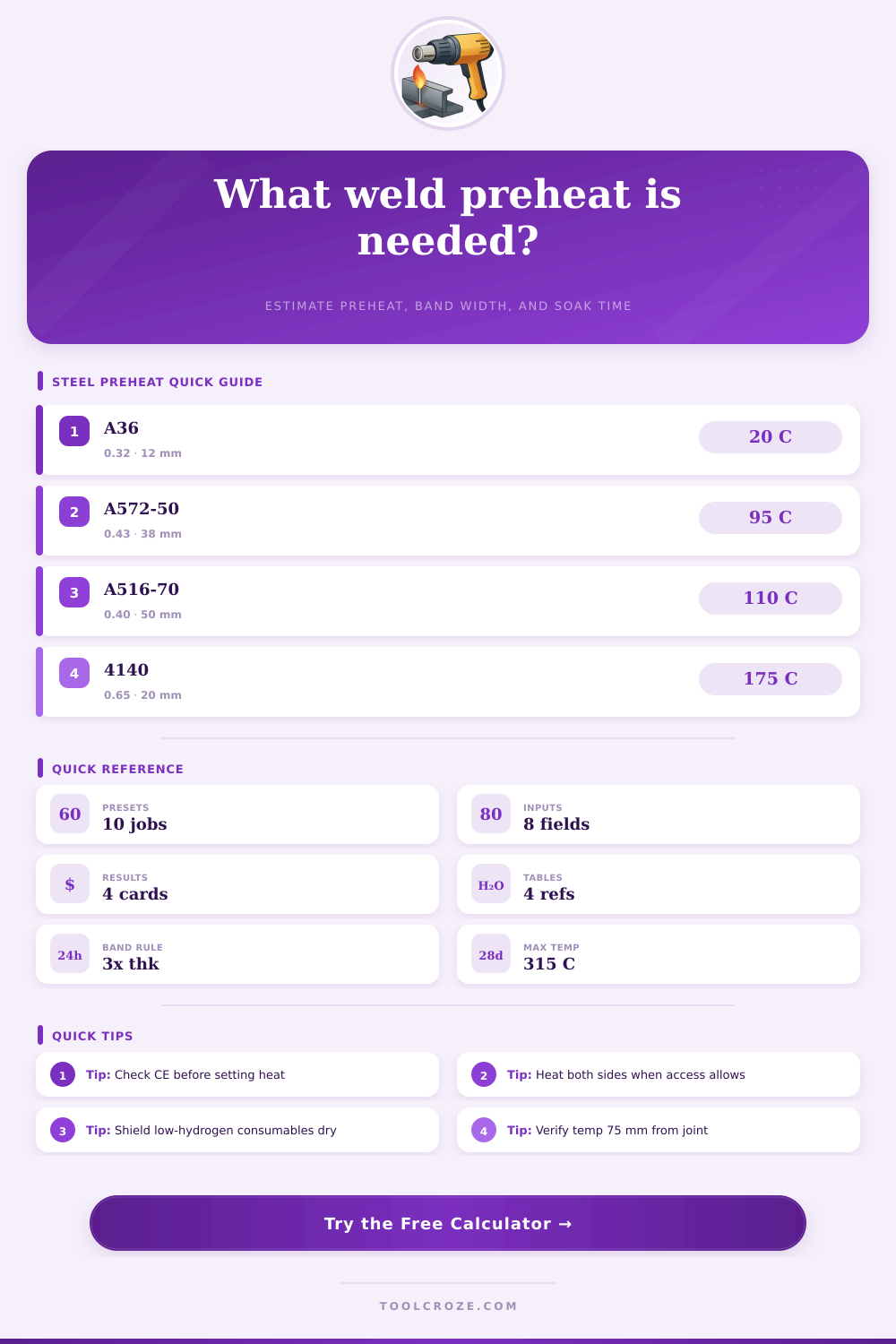
Estimate minimum preheat, interpass band, heated zone width, and soak time for carbon and alloy steel welds using carbon equivalent, thickness, restraint, process, and ambient conditions.
📌 Preset Weld Scenarios
⚙ Weld Data Entry
🎯 Preheat Results
🗂 Material and Spec Comparison Grid
Yield 250 MPa
Typical start 20-75 C
Yield 345 MPa
Typical start 75-125 C
Yield 260 MPa
Typical start 95-150 C
Yield 450 MPa
Typical start 65-120 C
Yield 355 MPa
Typical start 50-110 C
Yield 310 MPa
Typical start 125-175 C
Yield 655 MPa
Typical start 175-260 C
Yield 745 MPa
Typical start 230-315 C
📊 Reference Tables
| CE range | Below 20 mm | 20-40 mm | Above 40 mm |
|---|---|---|---|
| 0.30-0.35 | 20 C | 40 C | 65 C |
| 0.36-0.45 | 50 C | 80 C | 110 C |
| 0.46-0.60 | 95 C | 135 C | 175 C |
| Above 0.60 | 150 C | 205 C | 260 C |
| Hydrogen class | Typical process fit | Adder | Use note |
|---|---|---|---|
| H16 | SMAW cellulosic | 45 C | Fast root, highest crack risk |
| H8 | FCAW or basic SMAW | 25 C | Common field structural work |
| H4 | Dry low-hydrogen wire | 10 C | Balanced shop and site choice |
| H2 | Baked premium consumables | 0 C | Lowest hydrogen burden |
| Joint geometry | Factor | Heating band rule | Typical concern |
|---|---|---|---|
| Single-V butt | 1.00 | max(75 mm, 3x thk) | Root restraint and start-stop zones |
| Double-V groove | 0.92 | max(65 mm, 2.5x thk) | Lower distortion through balance |
| Tee or fillet | 1.10 | max(75 mm, 3x thk) | Stiffer shrinkage path |
| Repair excavation | 1.22 | max(100 mm, 4x thk) | High hardness and trapped hydrogen |
| Project case | Typical thickness | Common preheat band | Soak note |
|---|---|---|---|
| Bridge flange splice | 25-40 mm | 75-125 C | Hold longer near cope details |
| Pressure shell seam | 40-60 mm | 100-160 C | Check inside and outside surfaces |
| Pipe girth weld | 12-25 mm | 65-120 C | Wrap blankets between passes |
| 4140 repair groove | 15-30 mm | 175-260 C | Slow cool after final pass |
💡 Practical Tips
This weld preheat calculator turns CE, thickness, restraint, hydrogen level, and heat input into a practical preheat plan so you can compare steel grades and control cracking risk before welding.
Preheat are a process used in welding to heat the metal to a higher temperature prior to beginning the welding process. The purpose of preheat is to allow the metal to having a slower cooling rate after the welding process is complete. If the cooling rate is too rapidely, the metal can develop crack.
These cracks is typically caused either by hydrogen in the metal or by high hardness of the metal. If the preheat isnt high enough, the hydrogen in the metal can cause cracking at a root of the weld. If the preheat is too high, however, the metal may distort or the heat-affected zone can soften.
Why We Preheat Metal Before Welding
The amount of preheat that is required to heat the metal before welding can depend on several differance factors. One of the main factors are the carbon equivalent of the metal. Metals that has high amounts of carbon in their structure will commonly form martensite if cooled too quickly.
Thus, metals that contain high levels of carbon will require more preheat to allow for prevention of the formation of martensite. Additionally, the thickness of the metal can also have an impact on the amount of preheat that is required. Metals of high thickness will naturaly act as a heat sink and will naturaly remove heat from the welded area at a faster rate than thinner metals.
Another of the factors that will impact the amount of preheat that is required is the amount of hydrogen that is contained in the metal. Hydrogen typicaly enter the weld in the welding consumables. If the welding consumables contain a high amount of cellulosic material, then those materials will add to the hydrogen that is introduced into the weld.
Thus, higher amounts of preheat will be required when using cellulosic welding consumables. Conversely, if low-hydrogen welding consumables are used, then preheat will not be necessary to the same extent. The welding process will also impact the rate at which the metal cools.
For instance, processes like submerged arc welding will add high amounts of heat to the metal. High heat will slow the cooling rate of the metal after welding is complete. Thus, less preheat will be required if submerged arc welding is used.
Gas tungsten arc welding processes, in contrast, will add less heat to the metal. Thus, more preheat is required before using gas tungsten arc welding processes. Additionally, the ambient temperature will impact the rate of cooling of the metal.
If the ambient temperature is low, the metal will cool at a rapid rate. Thus, higher preheat is required in environment with low ambient temperatures. The temperature of the metal must be measured correctly prior to welding.
You should measure the temperature at a distance of 75 mm from the joint. The temperature should not be measured with an infrared thermometer if possible, as infrared thermometers may measure the temperature of the glow of the metals surface rather than the bulk temperature of the metal. Additionally, the interpass temperature of the metal should be maintained between passes of welding.
The amount of restraint that the metal has will also impact the requirements of preheat. Metals that have high amounts of restraint will have a decreased ability of the metal to naturally cool. High amounts of restraint will increase the potential of the metal to crack.
Thus, preheat should of been increased in metals with high amounts of restraint. Overall, factors such as carbon equivalent of metal, thickness of metal, amount of hydrogen in welding consumables, welding process, ambient temperature, and amount of restraint should be considered prior to welding. Each of these factors will have an impact on the amount of preheat that is required for the metal prior to welding.
By considering these factors, you can properly apply preheat to metal to prevent cracking and ensure that the weld is sound.