Weld Metal Calculator
Estimate weld cross-section, throat or groove area, deposited volume, filler mass, deposition efficiency losses, overfill allowance, and pass loading for common weld joints.
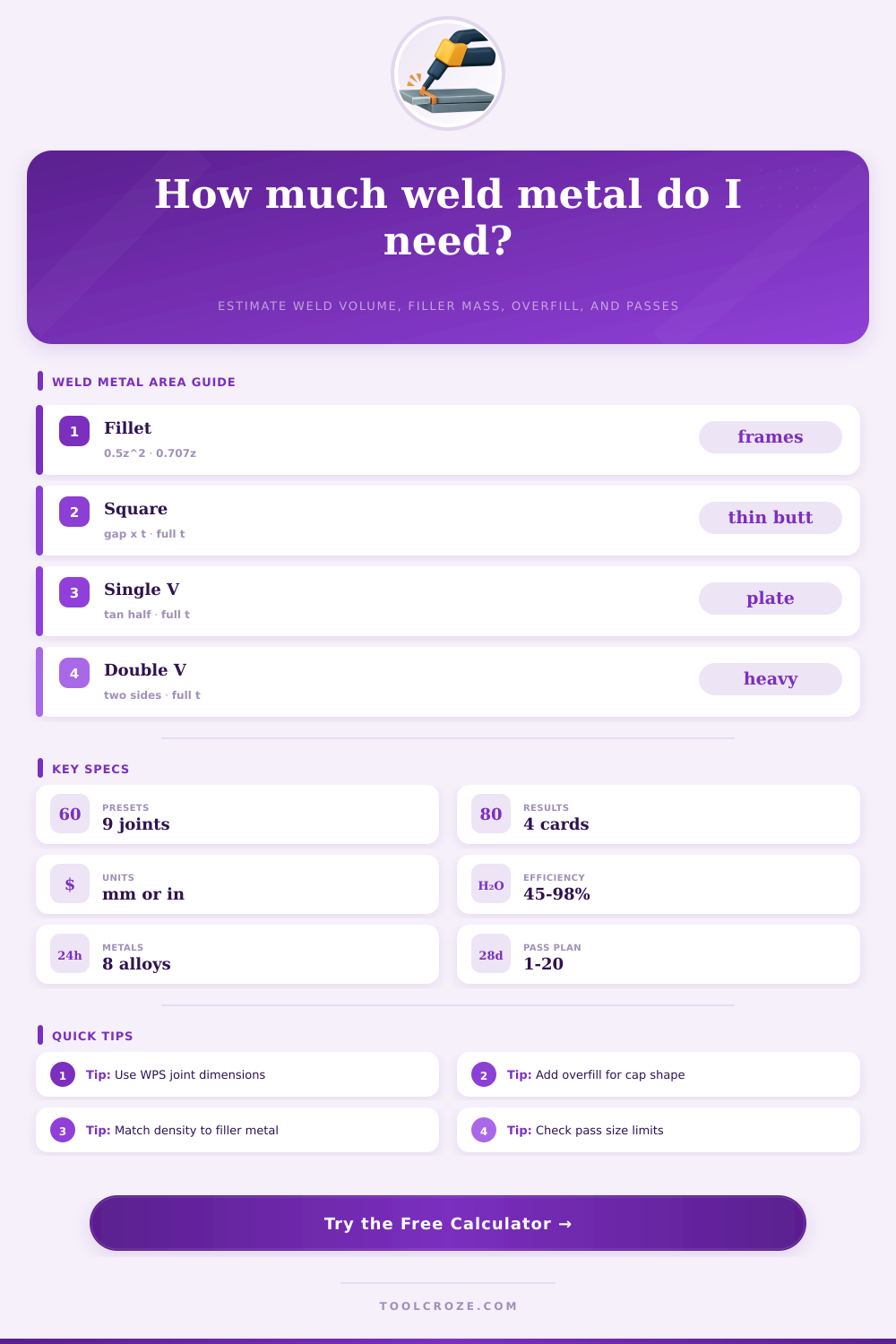
Fillet area uses 0.5 x leg size squared before overfill.
GMAW wire is often high; SMAW stick is lower because of stubs and slag.
Weld Metal Estimate
Throat / Groove Area
0
in²
Deposited Weld Volume
0
in³
Filler Metal Required
0
lb incl. efficiency
Pass Plan
0
in² per pass
7.85
Carbon steel g/cm³
ER70S-6
Common GMAW wire
90-98%
Typical solid wire efficiency
0.707z
Equal fillet effective throat
| Joint type | Calculator area basis | Key dimensions | Best check before use |
|---|---|---|---|
| Equal-leg fillet, lap fillet, T fillet | 0.5 x leg size² | Leg size z and total length | Confirm specified leg or throat on drawing |
| Square groove butt weld | Root gap x plate thickness | Root opening, thickness, length | Use only for open square grooves or root gaps |
| Single V groove | Gap x thickness plus V triangle | Thickness, land, gap, included angle | Match bevel prep to the WPS joint sketch |
| Double V groove | Gap x thickness plus two half-depth V faces | Thickness, angle, root face, length | Check side split if the joint is asymmetric |
| Plug or round slot weld | Circle area x fill depth | Hole diameter, fill depth, plug count | Deduct unmelted center if the spec requires it |
| Process | Typical efficiency | Where losses come from | Calculator setting |
|---|---|---|---|
| GMAW solid wire | 90-98% | Spatter, nozzle cleanup, trim loss | 95% for clean spray transfer |
| FCAW gas shielded | 82-92% | Slag system, spatter, wire trim | 88% for shop fabrication |
| SMAW stick electrode | 55-70% | Stub loss, slag, spatter, restarts | 65% for low-hydrogen electrodes |
| GTAW manual filler | 85-95% | Rod end loss and starts | 90% for controlled bench work |
| SAW submerged arc | 95-99% | Minimal spatter, flux handling | 98% for mechanized seams |
| Filler family | Density g/cm³ | Density lb/in³ | Common specification examples |
|---|---|---|---|
| Carbon steel | 7.85 | 0.284 | AWS ER70S-6, E7018 |
| Low-alloy steel | 7.83 | 0.283 | AWS ER80S-D2, E8018 |
| Austenitic stainless | 7.90 | 0.285 | AWS ER308L, ER316L, E308L |
| Duplex stainless | 7.80 | 0.282 | AWS ER2209, E2209 |
| Aluminum | 2.70 | 0.098 | AWS ER4043, ER5356 |
| Nickel alloy | 8.44 | 0.305 | AWS ERNiCrMo-3, ENiCrMo-3 |
| Pass type | Typical area per pass | Common use | Shop note |
|---|---|---|---|
| Small stringer | 10-25 mm² / 0.016-0.039 in² | Root passes, thin fillets, pipe work | Good control and lower heat per pass |
| Medium stringer | 25-55 mm² / 0.039-0.085 in² | General structural fillets and groove fill | Common planning range for manual work |
| Large weave or high deposition | 55-100 mm² / 0.085-0.155 in² | Cap passes, FCAW, SAW, heavy fillets | Verify heat input and bead shape limits |
| Hardfacing layer | Width x layer thickness | Wear pads, overlays, build-up passes | Use overlay mode for rectangular beads |
Weld metal quantity is a critical measurement for a welder to determine because weld metal quantity impact the cost of the project and the amount of time a welder can spend on the job. Many welders make mistake when calculating weld metal quantity because they use mental estimate for weld metal quantity rather than the mathematical calculation required to determine the correct quantity of weld metal needed for a project. If a welder makes an estimate of the amount of weld metal that is required for a project, the welder may find that they runs out of weld metal prior to completing the weld.
This will result in the welder losing time adding more weld metal to the project. Therefore, a welder must calculate weld metal quantity so that a welder knows that they have enough filler metal for the project. The shape of the joint will play a primary role in determining the amount of weld metal that is required to complete the joint.
How to Calculate How Much Weld Metal You Need
Different shapes of joints will require different amount of weld metal because each of the different shapes have different internal area. The amount of weld metal required for a joint will depend on the size of the legs of the weld, the root opening of the joint, the groove angle of the joint, and the thickness of the metal plate. The dimensions of the joint must be entered into a metal weld calculator.
A weld metal calculator will calculate the volume of weld metal required for the joint by applying an overfill allowance to the calculation. An overfill allowance is used in the calculation to account for the shape of the weld cap of the joint and the amount of weld metal that exists outside of the theoretical joint groove. Another factor that determines the amount of metal filler that is required for a project is the deposition efficiency of the welding process.
Deposition efficiency is a ratio that determines the amount of filler metal that is consume by the welder and the amount of that metal that remains within the weld. The amount of filler metal that the welder consumes will never be the same as the amount of metal that is contained within the weld. Some of the metal gets lost as spatter, slag, and electrode stub.
For instance, GMAW welding processes have high rates of deposition efficiency while stick welding processes has a low rate of deposition efficiency for these same reasons. Deposition efficiency must be accounted for when calculating the amount of filler metal that will be consumed during the welding process. The density of the metal that is to be welded also plays a role in the total mass of weld metal.
The density of metal varies for each type of metal. Each metal will have a different density meaning that the same volume of metal will weigh different. For example, the density of carbon steel is higher than the density of aluminum meaning that a volume of carbon steel will weigh more than the same volume of aluminum.
Since the weight of the metal filler will change according to metal density, the welder must select the type of metal filler metal when using a metal weld calculator to ensure that the density of the metal is accurately calculate for the project. Pass planning is another necessary step in the welding process that utilizes the estimate of weld metal quantity. Weld metal quantity can help to determine if multiple passes will be used for the weld relative to the size of the joint.
A welder may determine that multiple passes will be required to ensure that the heat input into the metal is within the limit for that specific metal. By dividing the total area of the weld by the number of passes that the welder is to use, the welder can determine the area that each pass will cover. Knowing the area of each pass will allow the welder to make a determination of whether or not additional layer of weld metal will be required for the weld.
The theoretical drawings of the weld joint may not be replicated in the real world. Root gap may be different than depicted in the drawing as may the bevel angle of the metal. The actual metal that is being welded may not allow for the amount of weld metal that may be calculated from the theoretical drawing.
In this case, weld metal quantity should be increased to account for the fact that the fit-up of the metal parts may not be perfect. In these instances, the welder can refer to reference tables to ensure the accuracy of the calculations of weld metal quantity. Weld metal quantity should be recalculated whenever there are change to the joint or welding procedure.
Weld joint drawings may be changed so that the thickness of the metal plate or the root gap may be different from the original drawing. In this case, the welder will have to recalculate weld metal quantity to determine the new amount of weld metal that is required for the weld. Recalculating weld metal quantity may save time for the welder because it would take the welder less time to recalculate the amount of weld metal required than it would to stop the welding process to obtain more weld metal.
Another reason to recalculate the weld metal quantity is to monitor the overfill allowance and the number of passes of the weld metal. If the overfill allowance is increased but the number of passes of the weld metal is not increased, then each pass will be larger. Passes that are too large to control may be difficult to control when performing welding manual.
The overall purpose of calculating the weld metal quantity is to enable the welder to understand the relationship between the joint, the welding process, and the welding metal. With an understanding of these relationships, the welder will be able to make better decisions regarding metal orders. Weld metal calculators will eliminate the need for the welder to perform the mathematical calculations of metal quantity.
By calculating weld metal quantity, welders will be able to avoid running out of metal filler for their welding project.