Weld Mesh Calculator
Estimate welded wire mesh coverage, line wire count, cross wire count, total wire length, mesh weight, lap allowance, opening deductions, and stock panel count for slab, fence, guard, and fabrication layouts.
⚙Named weld mesh presets
📏Sheet dimensions, wire, spacing, lap, and openings
Weld mesh takeoff result
📊Live mesh planning cards
📋Weld mesh reference tables
| Common mesh name | Typical wire | Typical spacing | Planning use |
|---|---|---|---|
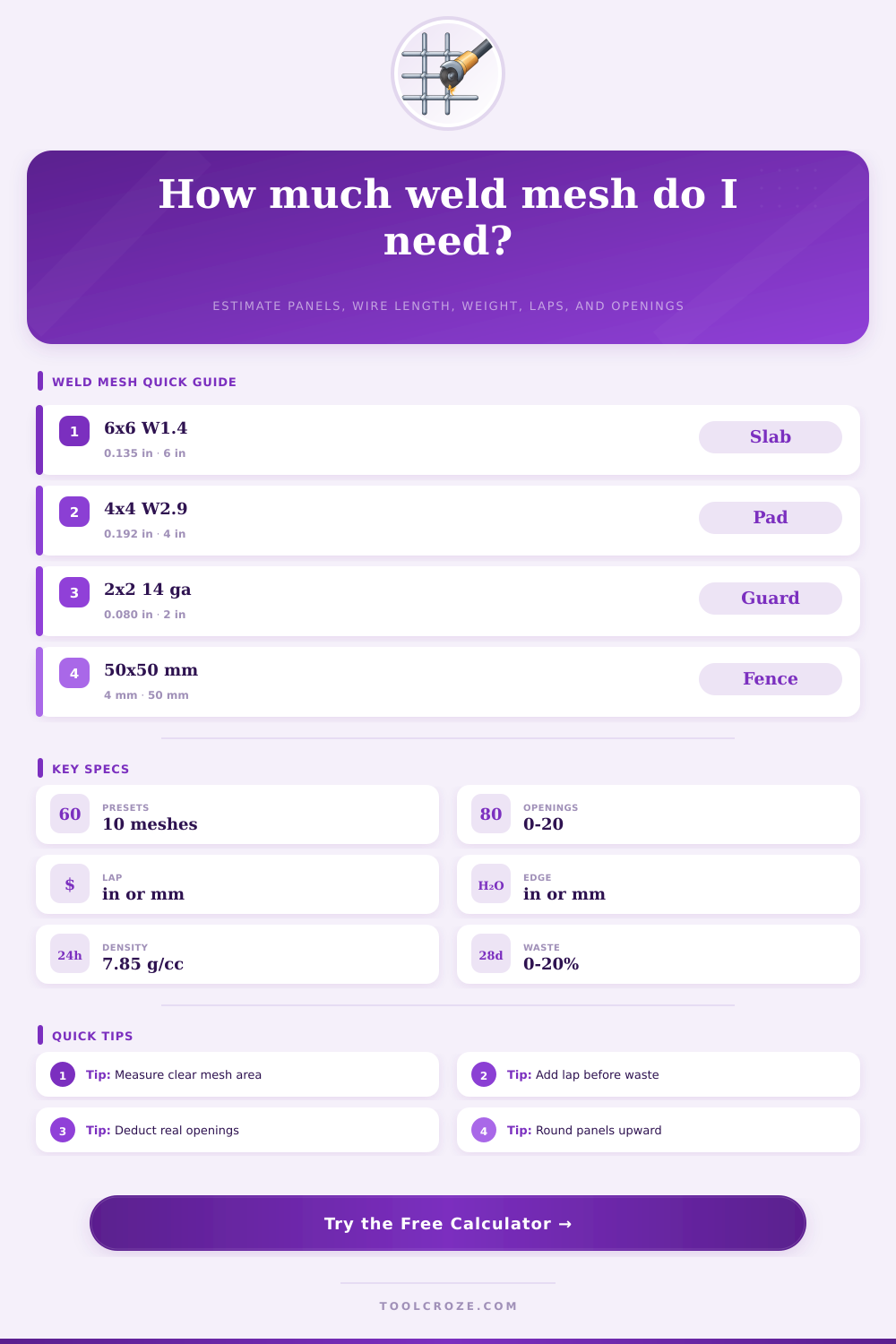
| 6x6 W1.4/W1.4 | 0.135 in steel wire | 6 in by 6 in | Light slab reinforcement and flatwork layout estimates. |
| 6x6 W2.9/W2.9 | 0.192 in steel wire | 6 in by 6 in | Heavier slab, driveway, and equipment pad planning. |
| 4x4 W2.9/W2.9 | 0.192 in steel wire | 4 in by 4 in | Closer reinforcement spacing or high crack-control layouts. |
| 2x2 14 gauge | 0.080 in wire | 2 in by 2 in | Guards, screens, cages, cabinet panels, and light fabrication. |
| 50x50 mm mesh | 3 mm to 5 mm wire | 50 mm by 50 mm | Metric fence, grate, infill panel, and shop welded mesh layouts. |
| Wire diameter | Steel weight per 100 ft | Metric equivalent | Takeoff note |
|---|---|---|---|
| 0.080 in, about 14 ga | 1.71 lb | 2.03 mm | Light guards and mesh inserts; easy to trim and bend. |
| 0.105 in, about 12 ga | 2.94 lb | 2.67 mm | Common shop mesh wire for cages and partition panels. |
| 0.135 in, W1.4 | 4.86 lb | 3.43 mm | Light reinforcing mesh; verify W-number on project documents. |
| 0.192 in, W2.9 | 9.84 lb | 4.88 mm | Heavier welded wire reinforcement and pad mesh. |
| 0.250 in, W5.0 | 16.68 lb | 6.35 mm | Heavy panels; weight and handling become major layout factors. |
| Layout item | Common allowance | Calculator field | Practical check |
|---|---|---|---|
| Concrete cover or edge setback | 1.5 in to 3 in | Edge allowance | Deducts usable mesh dimensions before counting wires. |
| Mesh lap at seams | One to two grid spaces | Lap allowance | Increases material over panel seams before waste is applied. |
| Small penetrations | Measure actual clear size | Opening count and size | Deducts area and an approximate cut wire length. |
| Field trimming | 5% to 12% | Trim allowance | Adds practical margin for cuts, tie-ins, and damaged edges. |
When you are considering the purchase of weld mesh for your project, you must consider the total amount of weld mesh that you require. You may look at weld mesh on the shelves in the store and consider how strong the weld mesh is, but the strength of the weld mesh is not as important as the total amount of weld mesh needed for the project. If you purchase too much weld mesh, you will spend too much moneys on your project.
If you purchase too little weld mesh, you will having cause delays on the job site. Weld mesh is rarely purchased in the form of a single sheet. Holes is required in the weld mesh to allow for posts or pipes to pass through the weld mesh.
How to Work Out How Much Weld Mesh You Need
Additionally, you must overlap the panels of weld mesh at the edges to permit for the weld mesh to meet building code. Therefore, the amount of wire in a sheet of weld mesh is not the same as the area of the sheet itself. You must calculate for the difference between the gross area of the sheet and the actual area of the weld mesh that can be used in your project.
The spacing and the diameter of the wire that is used in the weld mesh will impact the weight and strength of the weld mesh. For instance, projects that require more crack control will use weld mesh with closer wire spacing then projects that require less crack control. Similarly, 4-inch grids is often used for projects like machine pads, whereas 6-inch grids are often used for flatwork projects that require less strength from the weld mesh.
The thickness of the wire will also impact the weight of the weld mesh. If the weld mesh has thicker wire, the total weight of the weld mesh will be greater. A difference in the mass of 0.135-inch wire to 0.192-inch wire is large when the difference is multiplied across the entire panel of weld mesh.
Additionally, the spacing and the diameter of the wires will also impact the amount of concretesthat can pass through the weld mesh during the pouring of the foundation or concrete slab. The edge allowance and the lap allowance for weld mesh are two different measurements that are applied to the weld mesh at the same time. The edge allowance involves cutting a strip of weld mesh that will not be covered by the poured concrete.
The lap allowance is the amount of weld mesh that is overlapped when two sheets of weld mesh are but together. These two allowances are performed at the same time because the edge allowance removes weld mesh but the lap allowance add weld mesh to the project. Therefore, you must first measure the total area of the project, and then the lap allowance can be added to the measurements where the sheets of weld mesh will overlap.
The openings within the project will impact the amount of weld mesh that is required. Any rectangle that is cut out of the weld mesh for the purpose of allowing for a pipe or drain will remove some of the weld mesh from the project. Additionally, any cut will also remove some of the lengths of wire that is contained within the weld mesh panels.
A weld mesh calculator can account for the length of wire that these cuts to the weld mesh remove, and that total length of wire will be the actual length of wire that is needed for the project. The size of the clear opening must be entered into the calculation for the weld mesh required for the project. The type of material that is used in the weld mesh will impact the weight of the weld mesh.
Weld mesh that is made of mild steel and galvanized wire will have the same density for the steel. However, the amount of galvanized wire can impact the total weight of the weld mesh. Additionally, the density of stainless steel and aluminum is not the same as steel, so the difference in density will impact the cost of the weld mesh and the amount of effort that is required to handle the weld mesh.
When you are ready to purchase the weld mesh, you must transition from calculating the length of wire to calculating the amount of stock panels of weld mesh that are required for your project. Because weld mesh panels do not always perfectly fit the area that is to be covered with weld mesh, you must count the number of panels that is required to cover the entire area of the project. You can round this number up to the nearest panel to ensure that you do not run short of weld mesh panels for the job site.
Additionally, rounding the number of panels that are required will tell you if the orientation of the weld mesh panels will impact the number of panels required. There are many variables of the project that cannot be accounted for in the calculations. For example, you may have to add laps around an obstruction on the job site.
The number of panels of weld mesh that is delivered to a job site is often in whole bundles. Therefore, you may have to purchase more weld mesh than the calculations indicate. For these reasons, you must add a waste factor to your calculations to account for the complexities of the project that you are creating.
It is easy to make a mistake when purchasing weld mesh. For example, a weld mesh calculator will provide you with a total weight and the number of panels of weld mesh that are required for your project. In addition to these calculations, you must also consider the lap distance for the project.
The calculations must also verify the number of openings in the project. Additionally, you must ensure that the percentage of waste in the project is accurate to the number of panels that will be ordered. By verifying these details, you will avoid the problems that can occur if you find yourself in need of weld mesh after you have poured the concrete for your project.
The value of calculating the amount of weld mesh that is needed for a project is in the fact that the calculations will allow the weld mesh to match the work that is to be performed on the project. If you use the dimensions, spacing, and allowances for the weld mesh to calculate the amount of weld mesh that will be purchased, you will ensure that the weld mesh that is delivered to the job site will match the work that is required of the weld mesh.