Weld Inches Calculator
Total continuous or intermittent weld inches from joint segments, pitch, return welds, sides, pass count, bead size, and planning allowance.
★Named shop presets
Pick a starting layout, then adjust the segment length, pitch, returns, and pass count to match the drawing or weld map.
⚙Weld layout inputs
Weld Inches Breakdown
▣Current layout snapshot
ℹWeld inch reference tables
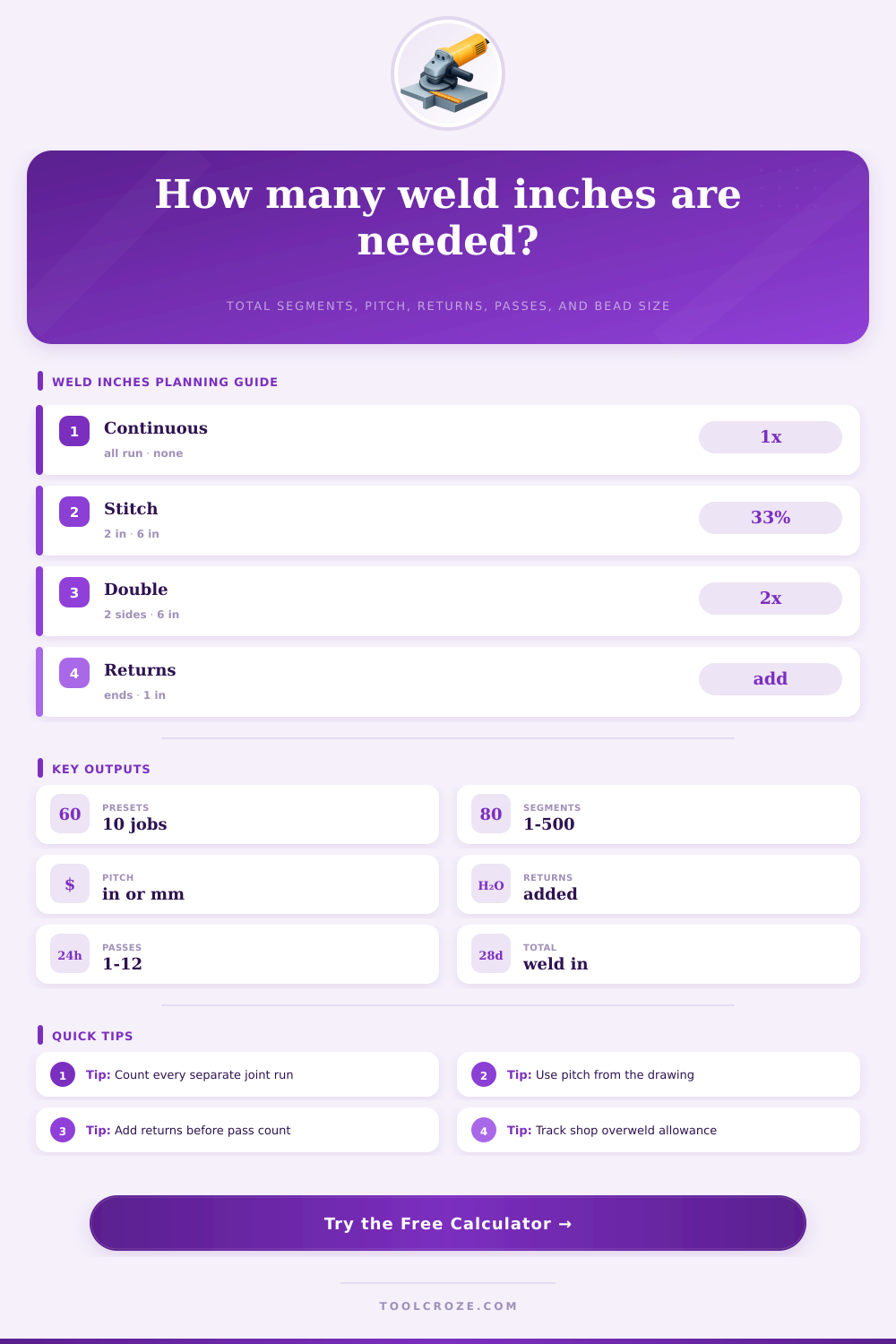
| Pattern | How length is counted | Use when | Common check |
|---|---|---|---|
| Continuous | Full segment length × sides | Seams, frames, sealed joints | Confirm start and stop locations |
| Intermittent | Stitch count × stitch length | Stiffeners, clips, sheet welds | Pitch is center-to-center |
| Double side intermittent | Intermittent length × two sides | Balanced welds and alternating stitch layouts | Keep both sides on the weld map |
| Returns | Added before pass multiplier | Boxed ends, corners, seal returns | Do not double-count corner overlap |
| Intermittent callout | Meaning | Approx coverage | Example on 48 in run |
|---|---|---|---|
| 1 in at 4 in | One inch stitch every four inches | 25% | 12 stitches, 12 weld in |
| 2 in at 6 in | Two inch stitch every six inches | 33% | 8 stitches, 16 weld in |
| 3 in at 12 in | Three inch stitch every twelve inches | 25% | 4 stitches, 12 weld in |
| 4 in at 8 in | Four inch stitch every eight inches | 50% | 6 stitches, 24 weld in |
| Pass planning item | Input used | Effect on total | Shop note |
|---|---|---|---|
| Root pass | Pass count 1 | Base weld inches | Use actual root continuity |
| Fill passes | Pass count 2 to 8 | Linear multiplier | Split by side when needed |
| Cap pass | Final pass | Extra cumulative inches | Include weave only as allowance |
| Bead size | Leg or bead width | Volume estimate only | Confirm WPS size limits |
✓Practical weld inch checks
When you begin a welding job, you must determine the total number of inches of weld that are required for the project. The total inches of weld that are required for a project will determine the amount of electrodes that will be used, the time that will be required to complete the project, and the budget for that project. Each of the field on the calculator allow for welding jobs to input the information necessary to calculate the total inches of weld that will be necessary for the project.
By using the calculator, welders can remove the guesswork from the estimating processes. Continuous welds are the easiest to calculate because all that must be determined is the length of each individual sides of the weld. Intermittent welds, however, are more difficult to calculate than continuous welds.
How to Calculate Total Inches of Weld
For intermittent welds, welders must take note of the stitch length of the weld and the pitch of the weld. The pitch is measured from the center of each weld to the center of the following weld. If the weld would extend past the end of one of the metal members, then that weld should not be counted.
Only intermittent welds that are completely within one metal member should be counted. Returns are short welds that are utilized along the end of a bracket or an metal stiffener to which the weld is too be made. Returns must be accounted for prior to applying the pass count for the welds.
If returns are not accounted for in calculating the total inches of weld, the total inches will be too low for the project. Pass counts can often have a large impact upon the total inches of weld that must be made. For single pass welds, the total length of the weld will be the length of the weld.
For four pass welds, for instance, the length of the weld will be multiplied by four. The pass count is applied after the returns are accounted for in the calculation of the total inches of weld. This allows welders to accurately account for all welds that will be made with the metal members, just as the weld maps indicate.
The bead size does not impact the total length of the weld. Instead, the bead size can help to determine the total volume of welds. Knowing the total volume of welds will help the welder to determine the pounds of welding wire or rods that will be needed.
Allowances for starts and stops in the welding process must be made for each job. Even the most detailed welding drawings will require welds to start and stop during the welding process. An allowance of 10% is typically used for most jobs.
However, for jobs that will occur in the field, or for welds whose metals have experienced heavy distortion, a 15% or 20% allowance may be made. An allowance can be set into the weld calculator to ensure that the total length of weld that must be made for the project is provided with an allowance for starts and stops in the welding process. The type of weld that is to be created will impact the parameters that must be input into the weld calculator.
For instance, the length of a lap weld will be different than the length of a pipe saddle weld. If a double-side intermittent weld is selected, the side multiplier will be automatically applied to the calculation of the total inches of weld. The joint type field is used as of reference to ensure that the welders remember which welding procedure specification will be used for that type of weld.
The tables included at the bottom of the weld calculator are used to assist welders in reading the intermittent weld callouts on the engineering drawings. For instance, if a weld design calls for 1-inch stitches at 4-inch pitches, the weld will cover 25% of the metal members. If the weld design calls for 2-inch stitches at 6-inch pitches, the weld will cover roughly 33% of the metal members.
These percentages are not rules that welders should memorize. However, the percentages will help welders to ensure that the weld drawings are not requesting excessive welding of the metal members. The weld calculator will provide the exact percentage of weld that will be created in the project.
Welding layouts in the field may be more complex than those that are depicted in welding textbooks. For instance, while the drawings may show welds along a metal tube, a metal bracket may extend into one of those metal segments. The weld calculator can be used to calculate different scenarios that may exist within the job.
The weld calculator will allow welders to easily compare scenarios without having to recompute the parameters of the job. The bead size and pass count for a weld will impact each other. For instance, increasing the bead size for the first pass will impact the number of passes that will need to be made for the remaining welds.
However, increasing the bead size will also impact the total volume of weld that will be made. The volume of weld that is calculated with the weld calculator is approximate. The approximate volume of weld will be helpful in estimating the pounds of welding wire that will be required for the job.
In addition to the parameters that are accounted for in the weld calculator, there are some checks that should be made prior to finalizing any calculations for the project. One check is to ensure that any members that are repeated in a weld should be accounted for separately in the calculation of the total inches of weld. Additionally, returns should be accounted for prior to multiplying the total length of weld by the pass count.
Finally, an allowance should be made for the welding starts and stops. If these steps are skipped, the welder may not have enough welding rod for the project, or may not be able to meet the schedule for completing the weld. Knowing the total inches of weld that are to be made is useful in discussing the project with others.
If the total inches is determined to be higher then that which was estimated for the project, the welder may be able to suggest altering the specifications for the intermittent welds, or the type of joint that is used. If the total inches of weld that is to be made is less than that which was estimated, the welder can investigate if the drawings have missed any returns, or if an allowance should be made for the metal members. The weld calculator will produce several important figures.
These figures will include the effective length of the welds to be made, the total inches of weld that will be made, the allowed total length of welds to be made, and the approximate volume of weld that will be created. After the parameters are entered into the weld calculator, each of these figure will be provided to the welder. The welder must then make certain that these figures are within the schedule, crew, and metal materials that are available for the project.
When you begin a welding job, you must determine the total number of inches of weld that are required for the project. The total inches of weld that are required for a project will determine the amount of electrodes that will be used for the project, the time that will be required to complete the project, and the budget for that project. Each of the field on the calculator allow for welding jobs to input the information necessary to calculate the total inches of weld that will be necessary for the project.
By using the calculator, welders can remove the guesswork from the estimating processes. Continuous welds are the easiest to calculate because all that must be determined is the length of each individual sides of the weld. Intermittent welds, however, are more difficult to calculate than continuous welds.
For intermittent welds, welders must take note of the stitch length of the weld and the pitch of the weld. The pitch is measured from the center of each weld to the center of the following weld. If the weld would extend past the end of one of the metal members, then that weld should not be counted.
Only intermittent welds that are completely within one metal member should be counted. Returns are short welds that are utilized along the end of a bracket or an metal stiffener to which the weld is too be made. Returns must be accounted for prior to applying the pass count for the welds.
If returns are not accounted for in calculating the total inches of weld, the total inches will be too low for the project. Pass counts can often have a large impact upon the total inches of weld that must be made. For single pass welds, the total length of the weld will be the length of the weld.
For four pass welds, for instance, the length of the weld will be multiplied by four. The pass count is applied after the returns are accounted for in the calculation of the total inches of weld. This allows welders to accurately account for all welds that will be made with the metal members, just as the weld maps indicate.
The bead size does not impact the total length of the weld. Instead, the bead size can help to determine the total volume of welds. Knowing the total volume of welds will help the welder to determine the pounds of welding wire or rods that will be needed.
Allowances for starts and stops in the welding process must be made for each job. Even the most detailed welding drawings will require welds to start and stop during the welding process. An allowance of 10% is typically used for most jobs.
However, for jobs that will occur in the field, or for welds whose metals have experienced heavy distortion, a 15% or 20% allowance may be made. An allowance can be set into the weld calculator to ensure that the total length of weld that must be made for the project is provided with an allowance for starts and stops in the welding process. The type of weld that is to be created will impact the parameters that must be input into the weld calculator.
For instance, the length of a lap weld will be different than the length of a pipe saddle weld. If a double-side intermittent weld is selected, the side multiplier will be automatically applied to the calculation of the total inches of weld. The joint type field is used as of reference to ensure that the welders remember which welding procedure specification will be used for that type of weld.
The tables included at the bottom of the weld calculator are used to assist welders in reading the intermittent weld callouts on the engineering drawings. For instance, if a weld design calls for 1-inch stitches at 4-inch pitches, the weld will cover 25% of the metal members. If the weld design calls for 2-inch stitches at 6-inch pitches, the weld will cover roughly 33% of the metal members.
These percentages are not rules that welders should memorize. However, the percentages will help welders to ensure that the weld drawings are not requesting excessive welding of the metal members. The weld calculator will provide the exact percentage of weld that will be created in the project.
Welding layouts in the field may be more complex than those that are depicted in welding textbooks. For instance, while the drawings may show welds along a metal tube, a metal bracket may extend into one of those metal segments. The weld calculator can be used to calculate different scenarios that may exist within the job.
The weld calculator will allow welders to easily compare scenarios without having to recompute the parameters of the job. The bead size and pass count for a weld will impact each other. For instance, increasing the bead size for the first pass will impact the number of passes that will need to be made for the remaining welds.
However, increasing the bead size will also impact the total volume of weld that will be made. The volume of weld that is calculated with the weld calculator is approximate. The approximate volume of weld will be helpful in estimating the pounds of welding wire that will be required for the job.
In addition to the parameters that are accounted for in the weld calculator, there are some checks that should be made prior to finalizing any calculations for the project. One check is to ensure that any members that are repeated in a weld should be accounted for separately in the calculation of the total inches of weld. Additionally, returns should be accounted for prior to multiplying the total length of weld by the pass count.
Finally, an allowance should be made for the welding starts and stops. If these steps are skipped, the welder may not have enough welding rod for the project, or may not be able to meet the schedule for completing the weld. Knowing the total inches of weld that are to be made is useful in discussing the project with others.
If the total inches is determined to be higher then that which was estimated for the project, the welder may be able to suggest altering the specifications for the intermittent welds, or the type of joint that is used. If the total inches of weld that is to be made is less than that which was estimated, the welder can investigate if the drawings have missed any returns, or if an allowance should be made for the metal members. The weld calculator will produce several important figures.
These figures will include the effective length of the welds to be made, the total inches of weld that will be made, the allowed total length of welds to be made, and the approximate volume of weld that will be created. After the parameters are entered into the weld calculator, each of these figure will be provided to the welder. The welder must then make certain that these figures are within the schedule, crew, and metal materials that are available for the project.
When you begin a welding job, you must determine the total number of inches of weld that are required for the project. The total inches of weld that are required for a project will determine the amount of electrodes that will be used for the project, the time that will be required to complete the project, and the budget for that project. Each of the field on the calculator allow for welding jobs to input the information necessary to calculate the total inches of weld that will be necessary for the project.
By using the calculator, welders can remove the guesswork from the estimating processes. Continuous welds are the easiest to calculate because all that must be determined is the length of each individual sides of the weld. Intermittent welds, however, are more difficult to calculate than continuous welds.
For intermittent welds, welders must take note of the stitch length of the weld and the pitch of the weld. The pitch is measured from the center of each weld to the center of the following weld. If the weld would extend past the end of one of the metal members, then that weld should not be counted.
Only intermittent welds that are completely within one metal member should be counted. Returns are short welds that are utilized along the end of a bracket or an metal stiffener to which the weld is too be made. Returns must be accounted for prior to applying the pass count for the welds.
If returns are not accounted for in calculating the total inches of weld, the total inches will be too low for the project. Pass counts can often have a large impact upon the total inches of weld that must be made. For single pass welds, the total length of the weld will be the length of the weld.
For four pass welds, for instance, the length of the weld will be multiplied by four. The pass count is applied after the returns are accounted for in the calculation of the total inches of weld. This allows welders to accurately account for all welds that will be made with the metal members, just as the weld maps indicate.
The bead size does not impact the total length of the weld. Instead, the bead size can help to determine the total volume of welds. Knowing the total volume of welds will help the welder to determine the pounds of welding wire or rods that will be needed.
Allowances for starts and stops in the welding process must be made for each job. Even the most detailed welding drawings will require welds to start and stop during the welding process. An allowance of 10% is typically used for most jobs.
However, for jobs that will occur in the field, or for welds whose metals have experienced heavy distortion, a 15% or 20% allowance may be made. An allowance can be set into the weld calculator to ensure that the total length of weld that must be made for the project is provided with an allowance for starts and stops in the welding process. The type of weld that is to be created will impact the parameters that must be input into the weld calculator.
For instance, the length of a lap weld will be different than the length of a pipe saddle weld. If a double-side intermittent weld is selected, the side multiplier will be automatically applied to the calculation of the total inches of weld. The joint type field is used as of reference to ensure that the welders remember which welding procedure specification will be used for that type of weld.
The tables included at the bottom of the weld calculator are used to assist welders in reading the intermittent weld callouts on the engineering drawings. For instance, if a weld design calls for 1-inch stitches at 4-inch pitches, the weld will cover 25% of the metal members. If the weld design calls for 2-inch stitches at 6-inch pitches, the weld will cover roughly 33% of the metal members.
These percentages are not rules that welders should memorize. However, the percentages will help welders to ensure that the weld drawings are not requesting excessive welding of the metal members. The weld calculator will provide the exact percentage of weld that will be created in the project.
Welding layouts in the field may be more complex than those that are depicted in welding textbooks. For instance, while the drawings may show welds along a metal tube, a metal bracket may extend into one of those metal segments. The weld calculator can be used to calculate different scenarios that may exist within the job.
The weld calculator will allow welders to easily compare scenarios without having to recompute the parameters of the job. The bead size and pass count for a weld will impact each other. For instance, increasing the bead size for the first pass will impact the number of passes that will need to be made for the remaining welds.
However, increasing the bead size will also impact the total volume of weld that will be made. The volume of weld that is calculated with the weld calculator is approximate. The approximate volume of weld will be helpful in estimating the pounds of welding wire that will be required for the job.
In addition to the parameters that are accounted for in the weld calculator, there are some checks that should be made prior to finalizing any calculations for the project. One check is to ensure that any members that are repeated in a weld should be accounted for separately in the calculation of the total inches of weld. Additionally, returns should be accounted for prior to multiplying the total length of weld by the pass count.
Finally, an allowance should be made for the welding starts and stops. If these steps are skipped, the welder may not have enough welding rod for the project, or may not be able to meet the schedule for completing the weld. Knowing the total inches of weld that are to be made is useful in discussing the project with others.
If the total inches is determined to be higher then that which was estimated for the project, the welder may be able to suggest altering the specifications for the intermittent welds, or the type of joint that is used. If the total inches of weld that is to be made is less than that which was estimated, the welder can investigate if the drawings have missed any returns, or if an allowance should be made for the metal members. The weld calculator will produce several important figures.
These figures will include the effective length of the welds to be made, the total inches of weld that will be made, the allowed total length of welds to be made, and the approximate volume of weld that will be created. After the parameters are entered into the weld calculator, each of these figure will be provided to the welder. The welder must then make certain that these figures are within the schedule, crew, and metal materials that are available for the project.
When you begin a welding job, you must determine the total number of inches of weld that are required for the project. The total inches of weld that are required for a project will determine the amount of electrodes that will be used for the project, the time that will be required to complete the project, and the budget for that project. Each of the field on the calculator allow for welding jobs to input the information necessary to calculate the total inches of weld that will be necessary for the project.
By using the calculator, welders can remove the guesswork from the estimating processes. Continuous welds are the easiest to calculate because all that must be determined is the length of each individual sides of the weld. Intermittent welds, however, are more difficult to calculate than continuous welds.
For intermittent welds, welders must take note of the stitch length of the weld and the pitch of the weld. The pitch is measured from the center of each weld to the center of the following weld. If the weld would extend past the end of one of the metal members, then that weld should not be counted.
Only intermittent welds that are completely within one metal member should be counted. Returns are short welds that are utilized along the end of a bracket or an metal stiffener to which the weld is too be made. Returns must be accounted for prior to applying the pass count for the welds.
If returns are not accounted for in calculating the total inches of weld, the total inches will be too low for the project. Pass counts can often have a large impact upon the total inches of weld that must be made. For single pass welds, the total length of the weld will be the length of the weld.
For four pass welds, for instance, the length of the weld will be multiplied by four. The pass count is applied after the returns are accounted for in the calculation of the total inches of weld. This allows welders to accurately account for all welds that will be made with the metal members, just as the weld maps indicate.
The bead size does not impact the total length of the weld. Instead, the bead size can help to determine the total volume of welds. Knowing the total volume of welds will help the welder to determine the pounds of welding wire or rods that will be needed.
Allowances for starts and stops in the welding process must be made for each job. Even the most detailed welding drawings will require welds to start and stop during the welding process. An allowance of 10% is typically used for most jobs.
However, for jobs that will occur in the field, or for welds whose metals have experienced heavy distortion, a 15% or 20% allowance may be made. An allowance can be set into the weld calculator to ensure that the total length of weld that must be made for the project is provided with an allowance for starts and stops in the welding process. The type of weld that is to be created will impact the parameters that must be input into the weld calculator.
For instance, the length of a lap weld will be different than the length of a pipe saddle weld. If a double-side intermittent weld is selected, the side multiplier will be automatically applied to the calculation of the total inches of weld. The joint type field is used as of reference to ensure that the welders remember which welding procedure specification will be used for that type of weld.
The tables included at the bottom of the weld calculator are used to assist welders in reading the intermittent weld callouts on the engineering drawings. For instance, if a weld design calls for 1-inch stitches at 4-inch pitches, the weld will cover 25% of the metal members. If the weld design calls for 2-inch stitches at 6-inch pitches, the weld will cover roughly 33% of the metal members.
These percentages are not rules that welders should memorize. However, the percentages will help welders to ensure that the weld drawings are not requesting excessive welding of the metal members. The weld calculator will provide the exact percentage of weld that will be created in the project.
Welding layouts in the field may be more complex than those that are depicted in welding textbooks. For instance, while the drawings may show welds along a metal tube, a metal bracket may extend into one of those metal segments. The weld calculator can be used to calculate different scenarios that may exist within the job.
The weld calculator will allow welders to easily compare scenarios without having to recompute the parameters of the job. The bead size and pass count for a weld will impact each other. For instance, increasing the bead size for the first pass will impact the number of passes that will need to be made for the remaining welds.
However, increasing the bead size will also impact the total volume of weld that will be made. The volume of weld that is calculated with the weld calculator is approximate. The approximate volume of weld will be helpful in estimating the pounds of welding wire that will be required for the job.
In addition to the parameters that are accounted for in the weld calculator, there are some checks that should be made prior to finalizing any calculations for the project. One check is to ensure that any members that are repeated in a weld should be accounted for separately in the calculation of the total inches of weld. Additionally, returns should be accounted for prior to multiplying the total length of weld by the pass count.
Finally, an allowance should be made for the welding starts and stops. If these steps are skipped, the welder may not have enough welding rod for the project, or may not be able to meet the schedule for completing the weld. Knowing the total inches of weld that are to be made is useful in discussing the project with others.
If the total inches is determined to be higher then that which was estimated for the project, the welder may be able to suggest altering the specifications for the intermittent welds, or the type of joint that is used. If the total inches of weld that is to be made is less than that which was estimated, the welder can investigate if the drawings have missed any returns, or if an allowance should be made for the metal members. The weld calculator will produce several important figures.
These figures will include the effective length of the welds to be made, the total inches of weld that will be made, the allowed total length of welds to be made, and the approximate volume of weld that will be created. After the parameters are entered into the weld calculator, each of these figure will be provided to the welder. The welder must then make certain that these figures are within the schedule, crew, and metal materials that are available for the project.
When you begin a welding job, you must determine the total number of inches of weld that are required for the project. The total inches of weld that are required for a project will determine the amount of electrodes that will be used for the project, the time that will be required to complete the project, and the budget for that project. Each of the field on the calculator allow for welding jobs to input the information necessary to calculate the total inches of weld that will be necessary for the project.
By using the calculator, welders can remove the guesswork from the estimating processes. Continuous welds are the easiest to calculate because all that must be determined is the length of each individual sides of the weld. Intermittent welds, however, are more difficult to calculate than continuous welds.
For intermittent welds, welders must take note of the stitch length of the weld and the pitch of the weld. The pitch is measured from the center of each weld to the center of the following weld. If the weld would extend past the end of one of the metal members, then that weld should not be counted.
Only intermittent welds that are completely within one metal member should be counted. Returns are short welds that are utilized along the end of a bracket or an metal stiffener to which the weld is too be made. Returns must be accounted for prior to applying the pass count for the welds.
If returns are not accounted for in calculating the total inches of weld, the total inches will be too low for the project. Pass counts can often have a large impact upon the total inches of weld that must be made. For single pass welds, the total length of the weld will be the length of the weld.
For four pass welds, for instance, the length of the weld will be multiplied by four. The pass count is applied after the returns are accounted for in the calculation of the total inches of weld. This allows welders to accurately account for all welds that will be made with the metal members, just as the weld maps indicate.
The bead size does not impact the total length of the weld. Instead, the bead size can help to determine the total volume of welds. Knowing the total volume of welds will help the welder to determine the pounds of welding wire or rods that will be needed.
Allowances for starts and stops in the welding process must be made for each job. Even the most detailed welding drawings will require welds to start and stop during the welding process. An allowance of 10% is typically used for most jobs.
However, for jobs that will occur in the field, or for welds whose metals have experienced heavy distortion, a 15% or 20% allowance may be made. An allowance can be set into the weld calculator to ensure that the total length of weld that must be made for the project is provided with an allowance for starts and stops in the welding process. The type of weld that is to be created will impact the parameters that must be input into the weld calculator.
For instance, the length of a lap weld will be different than the length of a pipe saddle weld. If a double-side intermittent weld is selected, the side multiplier will be automatically applied to the calculation of the total inches of weld. The joint type field is used as of reference to ensure that the welders remember which welding procedure specification will be used for that type of weld.
The tables included at the bottom of the weld calculator are used to assist welders in reading the intermittent weld callouts on the engineering drawings. For instance, if a weld design calls for 1-inch stitches at 4-inch pitches, the weld will cover 25% of the metal members. If the weld design calls for 2-inch stitches at 6-inch pitches, the weld will cover roughly 33% of the metal members.
These percentages are not rules that welders should memorize. However, the percentages will help welders to ensure that the weld drawings are not requesting excessive welding of the metal members. The weld calculator will provide the exact percentage of weld that will be created in the project.
Welding layouts in the field may be more complex than those that are depicted in welding textbooks. For instance, while the drawings may show welds along a metal tube, a metal bracket may extend into one of those metal segments. The weld calculator can be used to calculate different scenarios that may exist within the job.
The weld calculator will allow welders to easily compare scenarios without having to recompute the parameters of the job. The bead size and pass count for a weld will impact each other. For instance, increasing the bead size for the first pass will impact the number of passes that will need to be made for the remaining welds.
However, increasing the bead size will also impact the total volume of weld that will be made. The volume of weld that is calculated with the weld calculator is approximate. The approximate volume of weld will be helpful in estimating the pounds of welding wire that will be required for the job.
In addition to the parameters that are accounted for in the weld calculator, there are some checks that should be made prior to finalizing any calculations for the project. One check is to ensure that any members that are repeated in a weld should be accounted for separately in the calculation of the total inches of weld. Additionally, returns should be accounted for prior to multiplying the total length of weld by the pass count.
Finally, an allowance should be made for the welding starts and stops. If these steps are skipped, the welder may not have enough welding rod for the project, or may not be able to meet the schedule for completing the weld. Knowing the total inches of weld that are to be made is useful in discussing the project with others.
If the total inches is determined to be higher then that which was estimated for the project, the welder may be able to suggest altering the specifications for the intermittent welds, or the type of joint that is used. If the total inches of weld that is to be made is less than that which was estimated, the welder can investigate if the drawings have missed any returns, or if an allowance should be made for the metal members. The weld calculator will produce several important figures.
These figures will include the effective length of the welds to be made, the total inches of weld that will be made, the allowed total length of welds to be made, and the approximate volume of weld that will be created. After the parameters are entered into the weld calculator, each of these figure will be provided to the welder. The welder must then make certain that these figures are within the schedule, crew, and metal materials that are available for the project.
When you begin a welding job, you must determine the total number of inches of weld that are required for the project. The total inches of weld that are required for a project will determine the amount of electrodes that will be used for the project, the time that will be required to complete the project, and the budget for that project. Each of the field on the calculator allow for welding jobs to input the information necessary to calculate the total inches of weld that will be necessary for the project.
By using the calculator, welders can remove the guesswork from the estimating processes. Continuous welds are the easiest to calculate because all that must be determined is the length of each individual sides of the weld. Intermittent welds, however, are more difficult to calculate than continuous welds.
For intermittent welds, welders must take note of the stitch length of the weld and the pitch of the weld. The pitch is measured from the center of each weld to the center of the following weld. If the weld would extend past the end of one of the metal members, then that weld should not be counted.
Only intermittent welds that are completely within one metal member should be counted. Returns are short welds that are utilized along the end of a bracket or an metal stiffener to which the weld is too be made. Returns must be accounted for prior to applying the pass count for the welds.
If returns are not accounted for in calculating the total inches of weld, the total inches will be too low for the project. Pass counts can often have a large impact upon the total inches of weld that must be made. For single pass welds, the total length of the weld will be the length of the weld.
For four pass welds, for instance, the length of the weld will be multiplied by four. The pass count is applied after the returns are accounted for in the calculation of the total inches of weld. This allows welders to accurately account for all welds that will be made with the metal members, just as the weld maps indicate.
The bead size does not impact the total length of the weld. Instead, the bead size can help to determine the total volume of welds. Knowing the total volume of welds will help the welder to determine the pounds of welding wire or rods that will be needed.
Allowances for starts and stops in the welding process must be made for each job. Even the most detailed welding drawings will require welds to start and stop during the welding process. An allowance of 10% is typically used for most jobs.
However, for jobs that will occur in the field, or for welds whose metals have experienced heavy distortion, a 15% or 20% allowance may be made. An allowance can be set into the weld calculator to ensure that the total length of weld that must be made for the project is provided with an allowance for starts and stops in the welding process. The type of weld that is to be created will impact the parameters that must be input into the weld calculator.
For instance, the length of a lap weld will be different than the length of a pipe saddle weld. If a double-side intermittent weld is selected, the side multiplier will be automatically applied to the calculation of the total inches of weld. The joint type field is used as of reference to ensure that the welders remember which welding procedure specification will be used for that type of weld.
The tables included at the bottom of the weld calculator are used to assist welders in reading the intermittent weld callouts on the engineering drawings. For instance, if a weld design calls for 1-inch stitches at 4-inch pitches, the weld will cover 25% of the metal members. If the weld design calls for 2-inch stitches at 6-inch pitches, the weld will cover roughly 33% of the metal members.
These percentages are not rules that welders should memorize. However, the percentages will help welders to ensure that the weld drawings are not requesting excessive welding of the metal members. The weld calculator will provide the exact percentage of weld that will be created in the project.
Welding layouts in the field may be more complex than those that are depicted in welding textbooks. For instance, while the drawings may show welds along a metal tube, a metal bracket may extend into one of those metal segments. The weld calculator can be used to calculate different scenarios that may exist within the job.
The weld calculator will allow welders to easily compare scenarios without having to recompute the parameters of the job. The bead size and pass count for a weld will impact each other. For instance, increasing the bead size for the first pass will impact the number of passes that will need to be made for the remaining welds.
However, increasing the bead size will also impact the total volume of weld that will be made. The volume of weld that is calculated with the weld calculator is approximate. The approximate volume of weld will be helpful in estimating the pounds of welding wire that will be required for the job.
In addition to the parameters that are accounted for in the weld calculator, there are some checks that should be made prior to finalizing any calculations for the project. One check is to ensure that any members that are repeated in a weld should be accounted for separately in the calculation of the total inches of weld. Additionally, returns should be accounted for prior to multiplying the total length of weld by the pass count.
Finally, an allowance should be made for the welding starts and stops. If these steps are skipped, the welder may not have enough welding rod for the project, or may not be able to meet the schedule for completing the weld. Knowing the total inches of weld that are to be made is useful in discussing the project with others.
If the total inches is determined to be higher then that which was estimated for the project, the welder may be able to suggest altering the specifications for the intermittent welds, or the type of joint that is used. If the total inches of weld that is to be made is less than that which was estimated, the welder can investigate if the drawings have missed any returns, or if an allowance should be made for the metal members. The weld calculator will produce several important figures.
These figures will include the effective length of the welds to be made, the total inches of weld that will be made, the allowed total length of welds to be made, and the approximate volume of weld that will be created. After the parameters are entered into the weld calculator, each of these figure will be provided to the welder. The welder must then make certain that these figures are within the schedule, crew, and metal materials that are available for the project.
When you begin a welding job, you must determine the total number of inches of weld that are required for the project. The total inches of weld that are required for a project will determine the amount of electrodes that will be used for the project, the time that will be required to complete the project, and the budget for that project. Each of the field on the calculator allow for welding jobs to input the information necessary to calculate the total inches of weld that will be necessary for the project.
By using the calculator, welders can remove the guesswork from the estimating processes. Continuous welds are the easiest to calculate because all that must be determined is the length of each individual sides of the weld. Intermittent welds, however, are more difficult to calculate than continuous welds.
For intermittent welds, welders must take note of the stitch length of the weld and the pitch of the weld. The pitch is measured from the center of each weld to the center of the following weld. If the weld would extend past the end of one of the metal members, then that weld should not be counted.
Only intermittent welds that are completely within one metal member should be counted. Returns are short welds that are utilized along the end of a bracket or an metal stiffener to which the weld is too be made. Returns must be accounted for prior to applying the pass count for the welds.
If returns are not accounted for in calculating the total inches of weld, the total inches will be too low for the project. Pass counts can often have a large impact upon the total inches of weld that must be made. For single pass welds, the total length of the weld will be the length of the weld.
For four pass welds, for instance, the length of the weld will be multiplied by four. The pass count is applied after the returns are accounted for in the calculation of the total inches of weld. This allows welders to accurately account for all welds that will be made with the metal members, just as the weld maps indicate.
The bead size does not impact the total length of the weld. Instead, the bead size can help to determine the total volume of welds. Knowing the total volume of welds will help the welder to determine the pounds of welding wire or rods that will be needed.
Allowances for starts and stops in the welding process must be made for each job. Even the most detailed welding drawings will require welds to start and stop during the welding process. An allowance of 10% is typically used for most jobs.
However, for jobs that will occur in the field, or for welds whose metals have experienced heavy distortion, a 15% or 20% allowance may be made. An allowance can be set into the weld calculator to ensure that the total length of weld that must be made for the project is provided with an allowance for starts and stops in the welding process. The type of weld that is to be created will impact the parameters that must be input into the weld calculator.
For instance, the length of a lap weld will be different than the length of a pipe saddle weld. If a double-side intermittent weld is selected, the side multiplier will be automatically applied to the calculation of the total inches of weld. The joint type field is used as of reference to ensure that the welders remember which welding procedure specification will be used for that type of weld.
The tables included at the bottom of the weld calculator are used to assist welders in reading the intermittent weld callouts on the engineering drawings. For instance, if a weld design calls for 1-inch stitches at 4-inch pitches, the weld will cover 25% of the metal members. If the weld design calls for 2-inch stitches at 6-inch pitches, the weld will cover roughly 33% of the metal members.
These percentages are not rules that welders should memorize. However, the percentages will help welders to ensure that the weld drawings are not requesting excessive welding of the metal members. The weld calculator will provide the exact percentage of weld that will be created in the project.
Welding layouts in the field may be more complex than those that are depicted in welding textbooks. For instance, while the drawings may show welds along a metal tube, a metal bracket may extend into one of those metal segments. The weld calculator can be used to calculate different scenarios that may exist within the job.
The weld calculator will allow welders to easily compare scenarios without having to recompute the parameters of the job. The bead size and pass count for a weld will impact each other. For instance, increasing the bead size for the first pass will impact the number of passes that will need to be made for the remaining welds.
However, increasing the bead size will also impact the total volume of weld that will be made. The volume of weld that is calculated with the weld calculator is approximate. The approximate volume of weld will be helpful in estimating the pounds of welding wire that will be required for the job.
In addition to the parameters that are accounted for in the weld calculator, there are some checks that should be made prior to finalizing any calculations for the project. One check is to ensure that any members that are repeated in a weld should be accounted for separately in the calculation of the total inches of weld. Additionally, returns should be accounted for prior to multiplying the total length of weld by the pass count.
Finally, an allowance should be made for the welding starts and stops. If these steps are skipped, the welder may not have enough welding rod for the project, or may not be able to meet the schedule for completing the weld. Knowing the total inches of weld that are to be made is useful in discussing the project with others.
If the total inches is determined to be higher then that which was estimated for the project, the welder may be able to suggest altering the specifications for the intermittent welds, or the type of joint that is used. If the total inches of weld that is to be made is less than that which was estimated, the welder can investigate if the drawings have missed any returns, or if an allowance should be made for the metal members. The weld calculator will produce several important figures.
These figures will include the effective length of the welds to be made, the total inches of weld that will be made, the allowed total length of welds to be made, and the approximate volume of weld that will be created. After the parameters are entered into the weld calculator, each of these figure will be provided to the welder. The welder must then make certain that these figures are within the schedule, crew, and metal materials that are available for the project.
When you begin a welding job, you must determine the total number of inches of weld that are required for the project. The total inches of weld that are required for a project will determine the amount of electrodes that will be used for the project, the time that will be required to complete the project, and the budget for that project. Each of the field on the calculator allow for welding jobs to input the information necessary to calculate the total inches of weld that will be necessary for the project.
By using the calculator, welders can remove the guesswork from the estimating processes. Continuous welds are the easiest to calculate because all that must be determined is the length of each individual sides of the weld. Intermittent welds, however, are more difficult to calculate than continuous welds.
For intermittent welds, welders must take note of the stitch length of the weld and the pitch of the weld. The pitch is measured from the center of each weld to the center of the following weld. If the weld would extend past the end of one of the metal members, then that weld should not be counted.
Only intermittent welds that are completely within one metal member should be counted. Returns are short welds that are utilized along the end of a bracket or an metal stiffener to which the weld is too be made. Returns must be accounted for prior to applying the pass count for the welds.
If returns are not accounted for in calculating the total inches of weld, the total inches will be too low for the project. Pass counts can often have a large impact upon the total inches of weld that must be made. For single pass welds, the total length of the weld will be the length of the weld.
For four pass welds, for instance, the length of the weld will be multiplied by four. The pass count is applied after the returns are accounted for in the calculation of the total inches of weld. This allows welders to accurately account for all welds that will be made with the metal members, just as the weld maps indicate.
The bead size does not impact the total length of the weld. Instead, the bead size can help to determine the total volume of welds. Knowing the total volume of welds will help the welder to determine the pounds of welding wire or rods that will be needed.
Allowances for starts and stops in the welding process must be made for each job. Even the most detailed welding drawings will require welds to start and stop during the welding process. An allowance of 10% is typically used for most jobs.
However, for jobs that will occur in the field, or for welds whose metals have experienced heavy distortion, a 15% or 20% allowance may be made. An allowance can be set into the weld calculator to ensure that the total length of weld that must be made for the project is provided with an allowance for starts and stops in the welding process. The type of weld that is to be created will impact the parameters that must be input into the weld calculator.
For instance, the length of a lap weld will be different than the length of a pipe saddle weld. If a double-side intermittent weld is selected, the side multiplier will be automatically applied to the calculation of the total inches of weld. The joint type field is used as of reference to ensure that the welders remember which welding procedure specification will be used for that type of weld.
The tables included at the bottom of the weld calculator are used to assist welders in reading the intermittent weld callouts on the engineering drawings. For instance, if a weld design calls for 1-inch stitches at 4-inch pitches, the weld will cover 25% of the metal members. If the weld design calls for 2-inch stitches at 6-inch pitches, the weld will cover roughly 33% of the metal members.
These percentages are not rules that welders should memorize. However, the percentages will help welders to ensure that the weld drawings are not requesting excessive welding of the metal members. The weld calculator will provide the exact percentage of weld that will be created in the project.
Welding layouts in the field may be more complex than those that are depicted in welding textbooks. For instance, while the drawings may show welds along a metal tube, a metal bracket may extend into one of those metal segments. The weld calculator can be used to calculate different scenarios that may exist within the job.
The weld calculator will allow welders to easily compare scenarios without having to recompute the parameters of the job. The bead size and pass count for a weld will impact each other. For instance, increasing the bead size for the first pass will impact the number of passes that will need to be made for the remaining welds.
However, increasing the bead size will also impact the total volume of weld that will be made. The volume of weld that is calculated with the weld calculator is approximate. The approximate volume of weld will be helpful in estimating the pounds of welding wire that will be required for the job.
In addition to the parameters that are accounted for in the weld calculator, there are some checks that should be made prior to finalizing any calculations for the project. One check is to ensure that any members that are repeated in a weld should be accounted for separately in the calculation of the total inches of weld. Additionally, returns should be accounted for prior to multiplying the total length of weld by the pass count.
Finally, an allowance should be made for the welding starts and stops. If these steps are skipped, the welder may not have enough welding rod for the project, or may not be able to meet the schedule for completing the weld. Knowing the total inches of weld that are to be made is useful in discussing the project with others.
If the total inches is determined to be higher then that which was estimated for the project, the welder may be able to suggest altering the specifications for the intermittent welds, or the type of joint that is used. If the total inches of weld that is to be made is less than that which was estimated, the welder can investigate if the drawings have missed any returns, or if an allowance should be made for the metal members. The weld calculator will produce several important figures.
These figures will include the effective length of the welds to be made, the total inches of weld that will be made, the allowed total length of welds to be made, and the approximate volume of weld that will be created. After the parameters are entered into the weld calculator, each of these figure will be provided to the welder. The welder must then make certain that these figures are within the schedule, crew, and metal materials that are available for the project.
When you begin a welding job, you must determine the total number of inches of weld that are required for the project. The total inches of weld that are required for a project will determine the amount of electrodes that will be used for the project, the time that will be required to complete the project, and the budget for that project. Each of the field on the calculator allow for welding jobs to input the information necessary to calculate the total inches of weld that will be necessary for the project.
By using the calculator, welders can remove the guesswork from the estimating processes. Continuous welds are the easiest to calculate because all that must be determined is the length of each individual sides of the weld. Intermittent welds, however, are more difficult to calculate than continuous welds.
For intermittent welds, welders must take note of the stitch length of the weld and the pitch of the weld. The pitch is measured from the center of each weld to the center of the following weld. If the weld would extend past the end of one of the metal members, then that weld should not be counted.
Only intermittent welds that are completely within one metal member should be counted. Returns are short welds that are utilized along the end of a bracket or an metal stiffener to which the weld is too be made. Returns must be accounted for prior to applying the pass count for the welds.
If returns are not accounted for in calculating the total inches of weld, the total inches will be too low for the project. Pass counts can often have a large impact upon the total inches of weld that must be made. For single pass welds, the total length of the weld will be the length of the weld.
For four pass welds, for instance, the length of the weld will be multiplied by four. The pass count is applied after the returns are accounted for in the calculation of the total inches of weld. This allows welders to accurately account for all welds that will be made with the metal members, just as the weld maps indicate.
The bead size does not impact the total length of the weld. Instead, the bead size can help to determine the total volume of welds. Knowing the total volume of welds will help the welder to determine the pounds of welding wire or rods that will be needed.
Allowances for starts and stops in the welding process must be made for each job. Even the most detailed welding drawings will require welds to start and stop during the welding process. An allowance of 10% is typically used for most jobs.
However, for jobs that will occur in the field, or for welds whose metals have experienced heavy distortion, a 15% or 20% allowance may be made. An allowance can be set into the weld calculator to ensure that the total length of weld that must be made for the project is provided with an allowance for starts and stops in the welding process. The type of weld that is to be created will impact the parameters that must be input into the weld calculator.
For instance, the length of a lap weld will be different than the length of a pipe saddle weld. If a double-side intermittent weld is selected, the side multiplier will be automatically applied to the calculation of the total inches of weld. The joint type field is used as of reference to ensure that the welders remember which welding procedure specification will be used for that type of weld.
The tables included at the bottom of the weld calculator are used to assist welders in reading the intermittent weld callouts on the engineering drawings. For instance, if a weld design calls for 1-inch stitches at 4-inch pitches, the weld will cover 25% of the metal members. If the weld design calls for 2-inch stitches at 6-inch pitches, the weld will cover roughly 33% of the metal members.
These percentages are not rules that welders should memorize. However, the percentages will help welders to ensure that the weld drawings are not requesting excessive welding of the metal members. The weld calculator will provide the exact percentage of weld that will be created in the project.
Welding layouts in the field may be more complex than those that are depicted in welding textbooks. For instance, while the drawings may show welds along a metal tube, a metal bracket may extend into one of those metal segments. The weld calculator can be used to calculate different scenarios that may exist within the job.
The weld calculator will allow welders to easily compare scenarios without having to recompute the parameters of the job. The bead size and pass count for a weld will impact each other. For instance, increasing the bead size for the first pass will impact the number of passes that will need to be made for the remaining welds.
However, increasing the bead size will also impact the total volume of weld that will be made. The volume of weld that is calculated with the weld calculator is approximate. The approximate volume of weld will be helpful in estimating the pounds of welding wire that will be required for the job.
In addition to the parameters that are accounted for in the weld calculator, there are some checks that should be made prior to finalizing any calculations for the project. One check is to ensure that any members that are repeated in a weld should be accounted for separately in the calculation of the total inches of weld. Additionally, returns should be accounted for prior to multiplying the total length of weld by the pass count.
Finally, an allowance should be made for the welding starts and stops. If these steps are skipped, the welder may not have enough welding rod for the project, or may not be able to meet the schedule for completing the weld. Knowing the total inches of weld that are to be made is useful in discussing the project with others.
If the total inches is determined to be higher then that which was estimated for the project, the welder may be able to suggest altering the specifications for the intermittent welds, or the type of joint that is used. If the total inches of weld that is to be made is less than that which was estimated, the welder can investigate if the drawings have missed any returns, or if an allowance should be made for the metal members. The weld calculator will produce several important figures.
These figures will include the effective length of the welds to be made, the total inches of weld that will be made, the allowed total length of welds to be made, and the approximate volume of weld that will be created. After the parameters are entered into the weld calculator, each of these figure will be provided to the welder. The welder must then make certain that these figures are within the schedule, crew, and metal materials that are available for the project.
When you begin a welding job, you must determine the total number of inches of weld that are required for the project. The total inches of weld that are required for a project will determine the amount of electrodes that will be used for the project, the time that will be required to complete the project, and the budget for that project. Each of the field on the calculator allow for welding jobs to input the information necessary to calculate the total inches of weld that will be necessary for the project.
By using the calculator, welders can remove the guesswork from the estimating processes. Continuous welds are the easiest to calculate because all that must be determined is the length of each individual sides of the weld. Intermittent welds, however, are more difficult to calculate than continuous welds.
For intermittent welds, welders must take note of the stitch length of the weld and the pitch of the weld. The pitch is measured from the center of each weld to the center of the following weld. If the weld would extend past the end of one of the metal members, then that weld should not be counted.
Only intermittent welds that are completely within one metal member should be counted. Returns are short welds that are utilized along the end of a bracket or an metal stiffener to which the weld is too be made. Returns must be accounted for prior to applying the pass count for the welds.
If returns are not accounted for in calculating the total inches of weld, the total inches will be too low for the project. Pass counts can often have a large impact upon the total inches of weld that must be made. For single pass welds, the total length of the weld will be the length of the weld.
For four pass welds, for instance, the length of the weld will be multiplied by four. The pass count is applied after the returns are accounted for in the calculation of the total inches of weld. This allows welders to accurately account for all welds that will be made with the metal members, just as the weld maps indicate.
The bead size does not impact the total length of the weld. Instead, the bead size can help to determine the total volume of welds. Knowing the total volume of welds will help the welder to determine the pounds of welding wire or rods that will be needed.
Allowances for starts and stops in the welding process must be made for each job. Even the most detailed welding drawings will require welds to start and stop during the welding process. An allowance of 10% is typically used for most jobs.
However, for jobs that will occur in the field, or for welds whose metals have experienced heavy distortion, a 15% or 20% allowance may be made. An allowance can be set into the weld calculator to ensure that the total length of weld that must be made for the project is provided with an allowance for starts and stops in the welding process. The type of weld that is to be created will impact the parameters that must be input into the weld calculator.
For instance, the length of a lap weld will be different than the length of a pipe saddle weld. If a double-side intermittent weld is selected, the side multiplier will be automatically applied to the calculation of the total inches of weld. The joint type field is used as of reference to ensure that the welders remember which welding procedure specification will be used for that type of weld.
The tables included at the bottom of the weld calculator are used to assist welders in reading the intermittent weld callouts on the engineering drawings. For instance, if a weld design calls for 1-inch stitches at 4-inch pitches, the weld will cover 25% of the metal members. If the weld design calls for 2-inch stitches at 6-inch pitches, the weld will cover roughly 33% of the metal members.
These percentages are not rules that welders should memorize. However, the percentages will help welders to ensure that the weld drawings are not requesting excessive welding of the metal members. The weld calculator will provide the exact percentage of weld that will be created in the project.
Welding layouts in the field may be more complex than those that are depicted in welding textbooks. For instance, while the drawings may show welds along a metal tube, a metal bracket may extend into one of those metal segments. The weld calculator can be used to calculate different scenarios that may exist within the job.
The weld calculator will allow welders to easily compare scenarios without having to recompute the parameters of the job. The bead size and pass count for a weld will impact each other. For instance, increasing the bead size for the first pass will impact the number of passes that will need to be made for the remaining welds.
However, increasing the bead size will also impact the total volume of weld that will be made. The volume of weld that is calculated with the weld calculator is approximate. The approximate volume of weld will be helpful in estimating the pounds of welding wire that will be required for the job.
In addition to the parameters that are accounted for in the weld calculator, there are some checks that should be made prior to finalizing any calculations for the project. One check is to ensure that any members that are repeated in a weld should be accounted for separately in the calculation of the total inches of weld. Additionally, returns should be accounted for prior to multiplying the total length of weld by the pass count.
Finally, an allowance should be made for the welding starts and stops. If these steps are skipped, the welder may not have enough welding rod for the project, or may not be able to meet the schedule for completing the weld. Knowing the total inches of weld that are to be made is useful in discussing the project with others.
If the total inches is determined to be higher then that which was estimated for the project, the welder may be able to suggest altering the specifications for the intermittent welds, or the type of joint that is used. If the total inches of weld that is to be made is less than that which was estimated, the welder can investigate if the drawings have missed any returns, or if an allowance should be made for the metal members. The weld calculator will produce several important figures.
These figures will include the effective length of the welds to be made, the total inches of weld that will be made, the allowed total length of welds to be made, and the approximate volume of weld that will be created. After the parameters are entered into the weld calculator, each of these figure will be provided to the welder. The welder must then make certain that these figures are within the schedule, crew, and metal materials that are available for the project.
When you begin a welding job, you must determine the total number of inches of weld that are required for the project. The total inches of weld that are required for a project will determine the amount of electrodes that will be used for the project, the time that will be required to complete the project, and the budget for that project. Each of the field on the calculator allow for welding jobs to input the information necessary to calculate the total inches of weld that will be necessary for the project.
By using the calculator, welders can remove the guesswork from the estimating processes. Continuous welds are the easiest to calculate because all that must be determined is the length of each individual sides of the weld. Intermittent welds, however, are more difficult to calculate than continuous welds.
For intermittent welds, welders must take note of the stitch length of the weld and the pitch of the weld. The pitch is measured from the center of each weld to the center of the following weld. If the weld would extend past the end of one of the metal members, then that weld should not be counted.
Only intermittent welds that are completely within one metal member should be counted. Returns are short welds that are utilized along the end of a bracket or an metal stiffener to which the weld is too be made. Returns must be accounted for prior to applying the pass count for the welds.
If returns are not accounted for in calculating the total inches of weld, the total inches will be too low for the project. Pass counts can often have a large impact upon the total inches of weld that must be made. For single pass welds, the total length of the weld will be the length of the weld.
For four pass welds, for instance, the length of the weld will be multiplied by four. The pass count is applied after the returns are accounted for in the calculation of the total inches of weld. This allows welders to accurately account for all welds that will be made with the metal members, just as the weld maps indicate.
The bead size does not impact the total length of the weld. Instead, the bead size can help to determine the total volume of welds. Knowing the total volume of welds will help the welder to determine the pounds of welding wire or rods that will be needed.
Allowances for starts and stops in the welding process must be made for each job. Even the most detailed welding drawings will require welds to start and stop during the welding process. An allowance of 10% is typically used for most jobs.
However, for jobs that will occur in the field, or for welds whose metals have experienced heavy distortion, a 15% or 20% allowance may be made. An allowance can be set into the weld calculator to ensure that the total length of weld that must be made for the project is provided with an allowance for starts and stops in the welding process. The type of weld that is to be created will impact the parameters that must be input into the weld calculator.
For instance, the length of a lap weld will be different than the length of a pipe saddle weld. If a double-side intermittent weld is selected, the side multiplier will be automatically applied to the calculation of the total inches of weld. The joint type field is used as of reference to ensure that the welders remember which welding procedure specification will be used for that type of weld.
The tables included at the bottom of the weld calculator are used to assist welders in reading the intermittent weld callouts on the engineering drawings. For instance, if a weld design calls for 1-inch stitches at 4-inch pitches, the weld will cover 25% of the metal members. If the weld design calls for 2-inch stitches at 6-inch pitches, the weld will cover roughly 33% of the metal members.
These percentages are not rules that welders should memorize. However, the percentages will help welders to ensure that the weld drawings are not requesting excessive welding of the metal members. The weld calculator will provide the exact percentage of weld that will be created in the project.
Welding layouts in the field may be more complex than those that are depicted in welding textbooks. For instance, while the drawings may show welds along a metal tube, a metal bracket may extend into one of those metal segments. The weld calculator can be used to calculate different scenarios that may exist within the job.
The weld calculator will allow welders to easily compare scenarios without having to recompute the parameters of the job. The bead size and pass count for a weld will impact each other. For instance, increasing the bead size for the first pass will impact the number of passes that will need to be made for the remaining welds.
However, increasing the bead size will also impact the total volume of weld that will be made. The volume of weld that is calculated with the weld calculator is approximate. The approximate volume of weld will be helpful in estimating the pounds of welding wire that will be required for the job.
In addition to the parameters that are accounted for in the weld calculator, there are some checks that should be made prior to finalizing any calculations for the project. One check is to ensure that any members that are repeated in a weld should be accounted for separately in the calculation of the total inches of weld. Additionally, returns should be accounted for prior to multiplying the total length of weld by the pass count.
Finally, an allowance should be made for the welding starts and stops. If these steps are skipped, the welder may not have enough welding rod for the project, or may not be able to meet the schedule for completing the weld. Knowing the total inches of weld that are to be made is useful in discussing the project with others.
If the total inches is determined to be higher then that which was estimated for the project, the welder may be able to suggest altering the specifications for the intermittent welds, or the type of joint that is used. If the total inches of weld that is to be made is less than that which was estimated, the welder can investigate if the drawings have missed any returns, or if an allowance should be made for the metal members. The weld calculator will produce several important figures.
These figures will include the effective length of the welds to be made, the total inches of weld that will be made, the allowed total length of welds to be made, and the approximate volume of weld that will be created. After the parameters are entered into the weld calculator, each of these figure will be provided to the welder. The welder must then make certain that these figures are within the schedule, crew, and metal materials that are available for the project.