
A little background: In mechanical assemblies, wave washers address a common and annoying issue: You want some slight spring force to hold bearings in place, take up shaft end play, or apply contact pressure, but there’s hardly any space to do it. A traditional coil spring will be either too strong or will take up to much axial space.
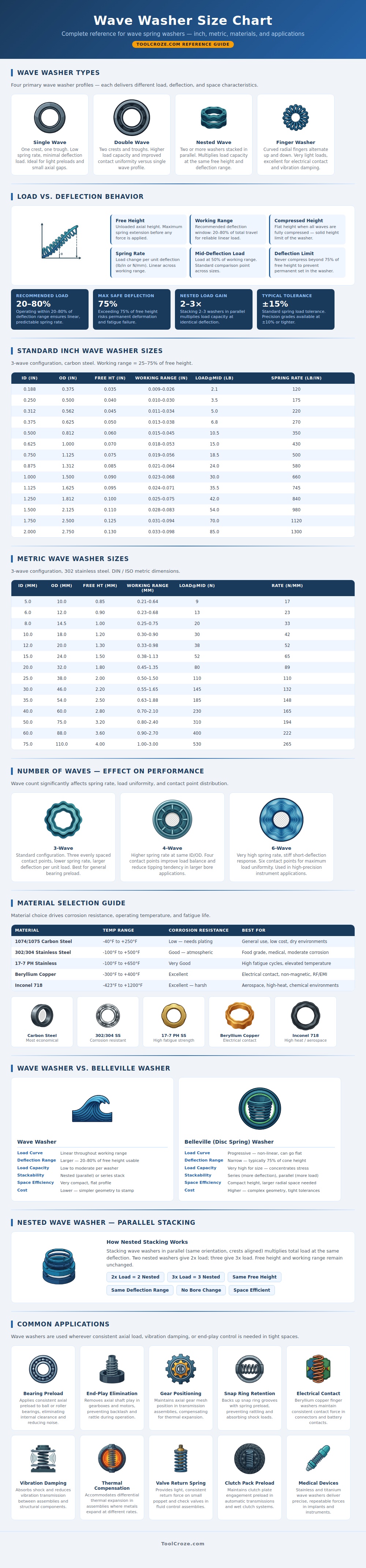
Wave washers fit right into that tiny sweet spot between too little and too much, and here’s just how much space they take up (and what kind of spring force they provide): Beyond varying material and size, the primary difference among the four profiles are the balance between deflection and load.
How to Choose Wave Washers
The most gentle spring rate, good if all you want to do is hold down a lightweight component so it doesn’t rattle, comes with a single wave washer. Adding an extra contact point via double waves increase the force but not proportionally to height. For more force, use nested stacks which multiply force of identical washers one above the other. The chart reflects this as Load climbs while Working Range remain unchanged.
In contrast, finger washers distribute extremely low loads over multiple flexible tabs for delicate vibration control or electrical contacts.
Geometry is important; so too is material selection, since a few washers is going to fail fast due to corrosion and/or temperature. Where cost is most important, carbon steel performs well in room temperature, dry environments. If you add any heat and/or moisture to the equation, you need a stainless grade or maybe even a precipitation hardening (PH) grade of stainless.
The table shows the temperature range for each of these options, but ultimately it depends on whether the application require repeated chemical exposure or thermal cycling. That’s when Inconel or 17-7 PH stainless pay for themselfs through increased service life.
The behavior of wave count is subtle but important. Generally three waves are most common as they strike a good balance between deflection, cost and even contact. Six and four waves increases the spring rate and more evenly distribute load especially in bigger bores where tipping might be an issue. The downside is less deflection prior to bottoming of washer. Match wave count with your true motion of the joint.
In the chart above we compare Belleville discs vs. Wave washers. Belleville washers are able to carry more load and apply it over a smaller deflection range different than wave washers. However, because they do not have a long, steady travel, they are less forgiving than wave washers. For applications requiring consistency in force over a larger gap distance, most often the wave profile will win out. For maximum force within smallest height, consider a Belleville stack instead.
So what is the main point? Simply stated, take your measurements of axial space available, determine how much force you really require from this joint, reference the chart and find a size within 20 to 80 percent deflection range. This places spring rate in that mid-range. This maintains predictability while avoiding any possibility of permanent set. A permanent set will kill its performance over time.
