Paint Calculator Square Footage
Estimate wall and ceiling square footage, subtract openings, add coats, adjust for texture, and convert coverage into gallons or liters.
Paint Estimate Results
| Surface Type | Typical Finish Coverage | Recommended Waste | Best Calculator Setting |
|---|---|---|---|
| Smooth sealed drywall | 325 to 400 sq ft per gallon | 5% to 10% | Smooth texture, sealed condition |
| Light orange peel walls | 285 to 340 sq ft per gallon | 10% to 15% | Light texture, standard waste |
| Knockdown plaster | 240 to 310 sq ft per gallon | 15% | Knockdown texture adjustment |
| Stucco, brick, or block | 100 to 200 sq ft per gallon | 15% to 20% | Rough masonry texture adjustment |
| Opening or Area | Common Size | Square Foot Deduction | When to Change It |
|---|---|---|---|
| Interior door | 3 ft x 7 ft | 21 sq ft | Use 18 sq ft for narrow doors |
| Patio slider | 6 ft x 7 ft | 42 sq ft | Enter as two doors or one custom door |
| Single window | 3 ft x 5 ft | 15 sq ft | Use 20 to 30 sq ft for large windows |
| Closet bifold | 5 ft x 7 ft | 35 sq ft | Count only if the opening is not painted |
| Paint or Primer Spec | Coverage Basis | Coat Planning | Calculator Use |
|---|---|---|---|
| Interior wall paint | 350 sq ft per gallon | Usually 2 finish coats | Default finish coverage |
| Ceiling flat paint | 325 sq ft per gallon | 1 to 2 coats | Use lower coverage for popcorn texture |
| Drywall primer | 250 to 350 sq ft per gallon | 1 coat on new drywall | Use one primer coat |
| Masonry primer | 150 to 250 sq ft per gallon | 1 to 2 coats | Lower primer coverage manually |
| Project Example | Typical Dimensions | Openings | Useful Preset Match |
|---|---|---|---|
| Small bedroom | 10 ft x 12 ft x 8 ft | 1 door, 2 windows | 12x12 Bedroom Repaint |
| Open living room | 20 ft x 24 ft x 9 ft | 2 doors, 4 windows | Open Living Room Refresh |
| Single accent wall | 14 ft x 9 ft | No ceiling area | Dining Room Accent Wall |
| Garage drywall | 22 ft x 22 ft x 9 ft | 1 garage door, 1 entry door | Two-Car Garage Drywall |
Paint is not usualy the trap of home improvement. The math is the trap of home improvement.
You’re standing in the center of your room, holding the can of paint in one hand, the roller in the other. You estimate, or you go on a wild guess off exactly how many square feet of this room need to be covered. Then you grab an additional can “just in case”. That’s fine… except that it cost money. And, more importantly, it fills your garage with half-empty quarts of paint you’ll never use. Knowing the square footage make the process feel less like guessing and more like a plan.
How to Calculate the Right Amount of Paint
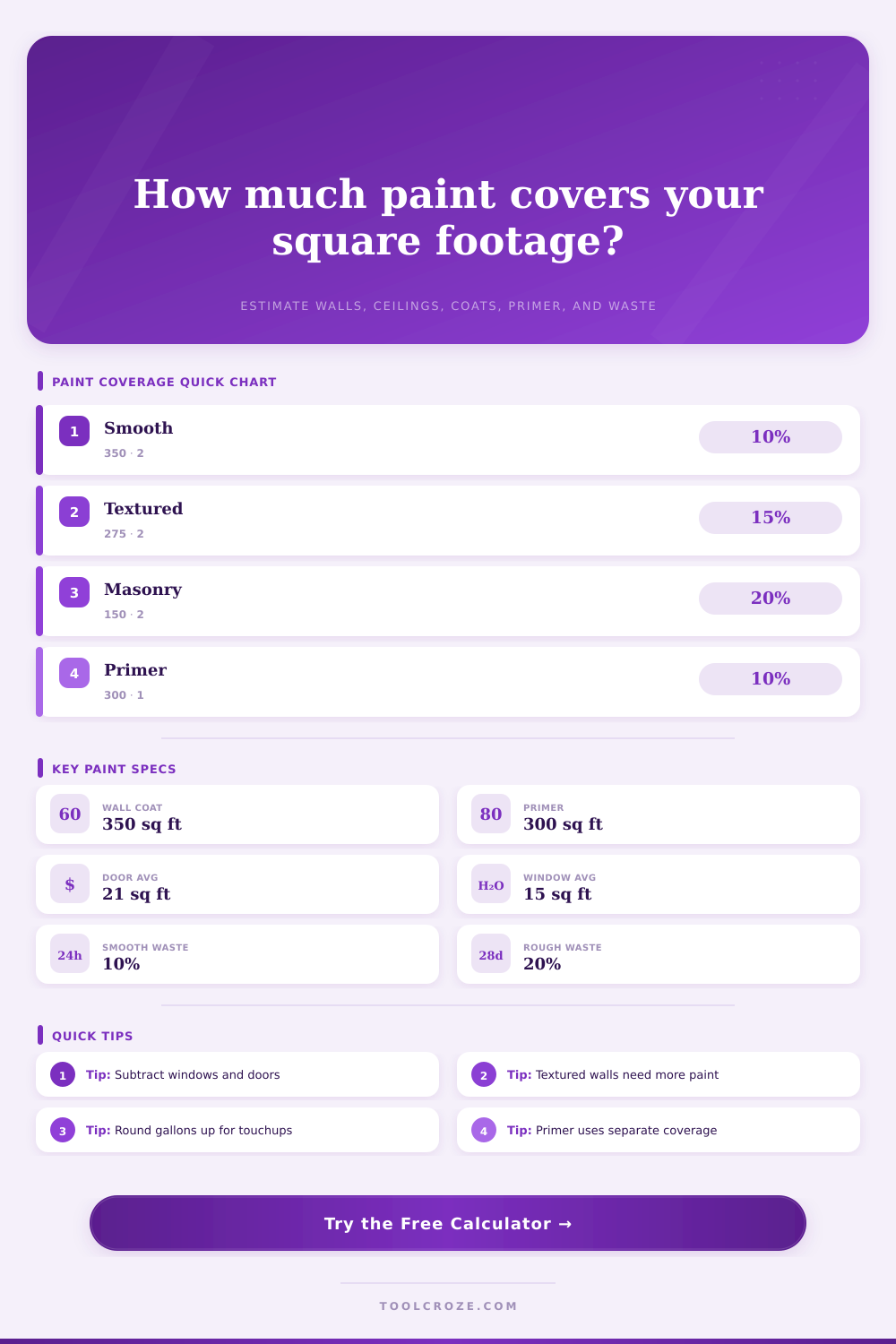
I’ve got an estimate calculator for you here above that will crunch the numbers for you, but it’s good to know what it’s calculating. First, take the raw measurements. Wall area = length x height. Multiply this by the number of walls. Subtract the openings. Here is where most people goes wrong. They forget that a door is about twenty-one square feet of wall that doesn’t require paint and a window is another fifteen. Four windows and four doors? You’re cutting close to two-hundred square feet out of equation. Almost a whole gallon of paint that goes back on the shelf. Sounds small till you consider how much a gallon costs and how much room it occupy.
That being said, texture matter. Smooth drywall will drink up paint well while rough stucco or heavy knockdown plaster will hold onto liquid in their valleys. To account for that, the tool add a percentage to the overall surface area. It does not add to size of the room, but to the amount of paint that sticks to it. Run your hand over your walls, do they feel smooth? Then you don’t need as much coverage. Do they feel like orange peel? You’re going to need a little more. The calculator above do all that math for you; all you have to do is input your dimension and skip the guessing games with conversions and coefficients.
Another variable that throws off estimates are primer. Primer is thinner than topcoat and soaks in differently and doesn’t cover like topcoat. You can’t skip this step if you’re painting new drywall or trying to cover a stain. The tool separates out the primer needs versus the finish coat needs. So you don’t buy the wrong thing in the wrong amount. You may need one gallon of primer and two gallons of finish. If you mix these in your head, you’ll make a trip back to the store mid-job.
The last multiplier is waste. There will be waste. You’ll drip. You’ll roll the edges too much. You’ll have to trim in around outlets. You’ll need a buffer of ten percent; which is standard… Or twenty percent if you’re changing colors significantly, or on a tricky exterior. That’s not because they’re inefficient. That’s because that’s life. They say on the can it covers three hundred fifty square feet, which is, of course, in perfect lab conditions. Your living room ain’t no lab. It’s got corners. Ceilings. Shadows.
Oh yeah, don’t forget about the ceiling! It is the same stuff but a different amount. You can add that to your tool too so all of your shopping stays together. You’ll know exactly how many gallon to pick up for the ceiling and for the walls. And because separating out the ceilings from walls also helps you organize the process, you might want to paint the ceiling first then wait until it dries then go ahead and do the wall-rolling. Quantity matters, but so does the order.
All those little mistakes matter. Almost a gallon less because you didn’t deduct for the doors and windows. Texture change how much paint you’ll need by a certain percentage. And then there’s your waste, which comes back to haunt you when you need a touch-up in three months. Precision matters. Precision saves money. Precision saves time (i.e., trips to the store). Precision turns chaos into an easy, predictable project.
With precision, when you enter that room with exactly the right can of paint? You aren’t guessing. You could of being doing. Knowing that is worth a few extra minutes to get it all measured out.