
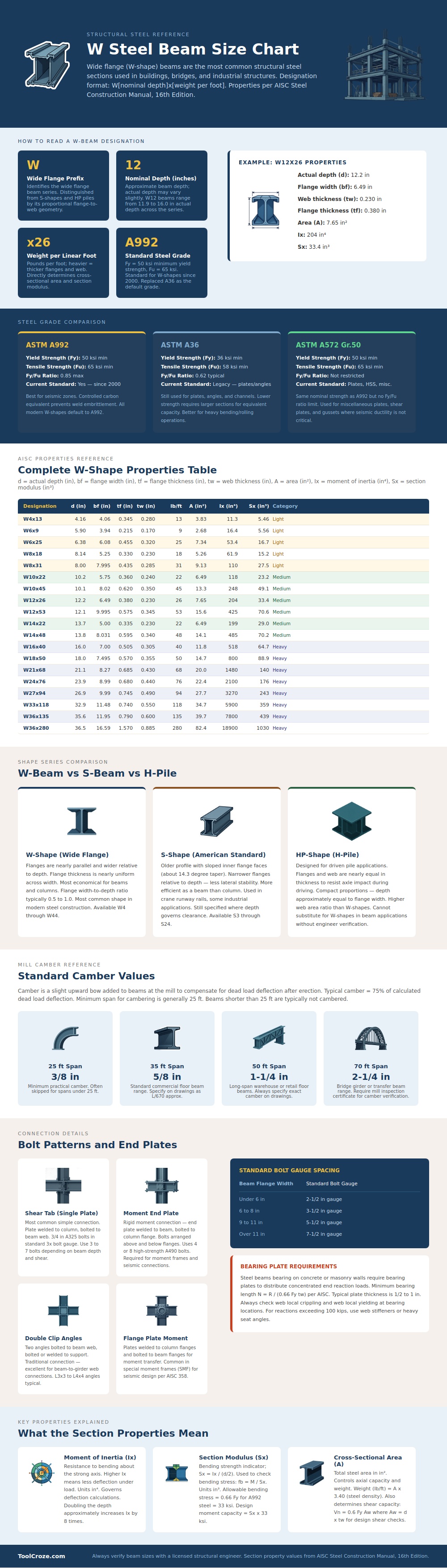
Then there’s the steel beams that has a W12x26 on them… you think it’s some kind of cryptic code from a bygone era. It isn’t a secret, however. There is a method to the madness of the alphabet and numbers… They spells out details of the metal as far as what it will do under load. I’m not asking you to memorize all those numbers from the book. But for projects that need something strong, knowing where to find that information are important.
Knowing what’s a heavy beam and what’s light means difference between something sagging with age versus lasting a long time. That’s where the W-shaped designation comes from, broken down on the chart. Wide flange beams, or “W” shapes, is the most widely used profiles today because they are efficient and strong. The numbers following it show the nominal depth in inches as well as weight per linear foot of that beam.
What Do Steel Beam Numbers Mean?
Why does that matter? Because that weight corresponds direct to the size of its web and flanges. More weight means greater steel cross section area, resisting bending forces better. You’ll notice that if you compare like-depth beams with varying weights, a beam labeled W12x53 will carry much more load then a beam labeled W12x26. That is because W12x53 has higher moment of inertia (the large size) and thus thicker plates to resist loads. Simple math, performance vs. It comes down to cost.
Many overlook the fact that although they’re shaped differently, actual material from which they’re made also makes a big difference. And starting back in 2000, the industry-standard grade for I-beams became ASTM A992, an alloy with greater yield strength then previous grades such as A36. As you can see on the infographic, A992 has improved ductility. This is crucial in areas prone to earthquakes where buildings must flex instead of snap, and it leads to a more efficient design.
Engineers has to compensate if using incorrect grade by specifying bigger sections to maintain the same safety margin. So that’s another price that doesn’t get reflected in the first quote. There’s also the business of finish work and erection to consider, aside from just data itself. Longer-than-twenty-five-foot beams are typically delivered with what they call “camber.”
This is a subtle rise in the center, designed into the beam at the mill to offset the dead weight of roof or floor material when everything is hung together. If you didn’t have camber on long spans, those beams would eventually show some sag. Not good, since your tenant will be driven nuts by uneven flooring. According to the reference guide, providing exact camber values prevents surprises during construction and ensures the final surface is as level as you expected as an architect, rather than sagging slightly.
Read our related article, The Anatomy of a Beam. Precision also matters in the connection. Whether you use double clip angles, moment end plates, or shear tabs, welds and bolts must be strong enough to transfer force from the beam to the structure it supports. To help fabricators get a rough idea of how much space to allow between bolt (based off flange width), this chart details typical bolt gauging.
Missing this mark by much can cause crippling at the supports and local web yielding. To counteract those loads and keep cracks out of concrete and masonry walls that support them, bearing plates spread out the concentrated load. Small items like these are easily forgotten… But they’re what make the structure soundly.
So how do you choose a beam? It’s not quite so simple as choosing the biggest number. It depends on how heavy something is, how deep the beam needs to be, and what kind of material you’re using. You don’t want too much because then you’re overpaying for unnecessary steel, but you also wouldn’t of want too little because then your structure might sag inconveniently over time.
Fortunately, all those properties I mentioned in the table above (like moment of inertia and section modulus) are the tools you need to calculate this correctly. And lastly, if you turn back now to that mysterious-looking W12x26 from before, it begins to make sense. Just a recipe for strength, written in inches and pounds.
