Volume of a Pipe Calculator
Calculate pipe internal capacity, partial fluid fill, annular wall volume, slope-adjusted run length, unit conversions, and common pipe schedule dimensions.
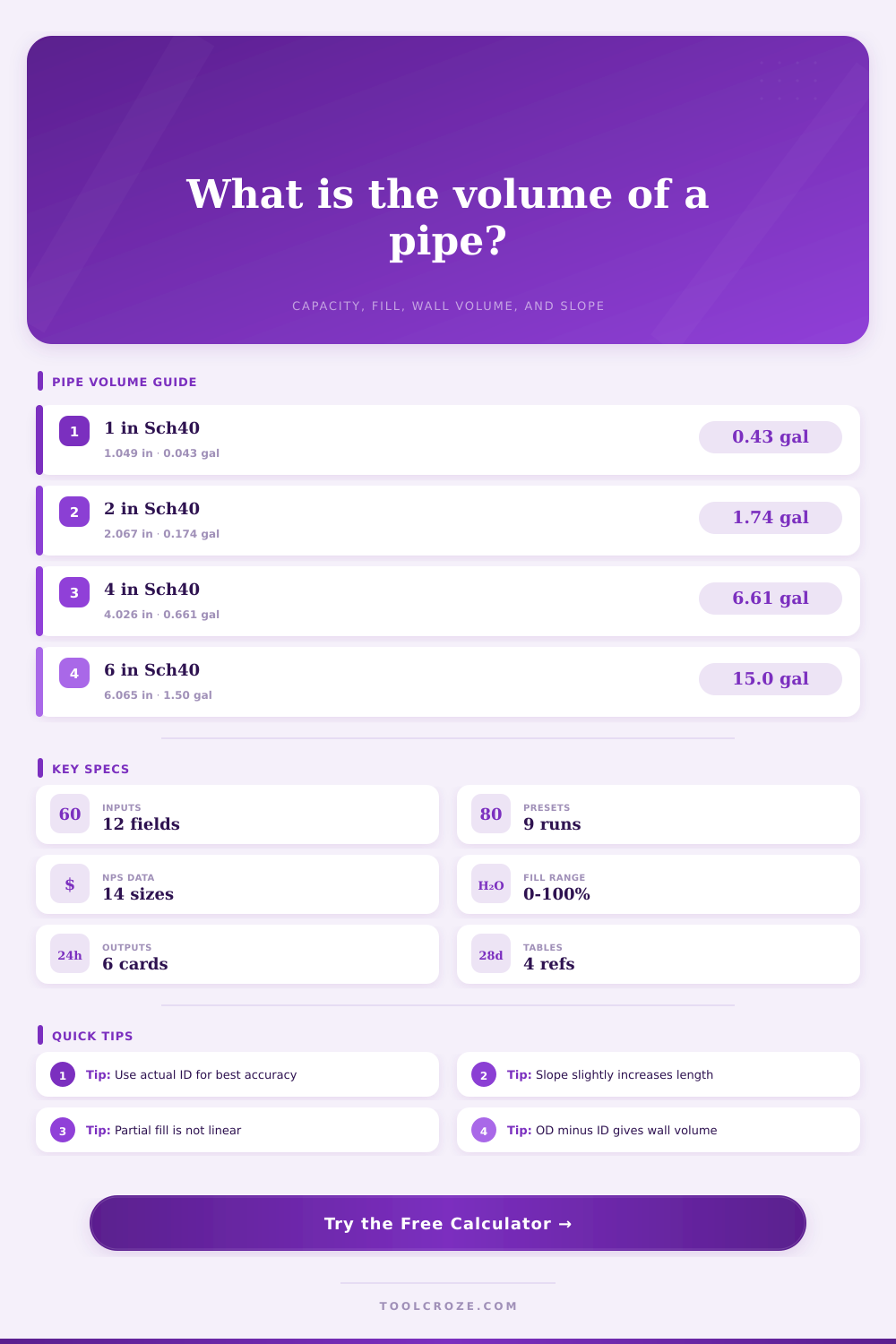
| NPS | OD (in) | Sch 40 ID (in) | Sch 80 ID (in) | Sch 40 gal/ft |
|---|---|---|---|---|
| 1/2 in | 0.840 | 0.622 | 0.546 | 0.0158 |
| 3/4 in | 1.050 | 0.824 | 0.742 | 0.0280 |
| 1 in | 1.315 | 1.049 | 0.957 | 0.0428 |
| 1-1/2 in | 1.900 | 1.610 | 1.500 | 0.1008 |
| 2 in | 2.375 | 2.067 | 1.939 | 0.1740 |
| 3 in | 3.500 | 3.068 | 2.900 | 0.3830 |
| 4 in | 4.500 | 4.026 | 3.826 | 0.6609 |
| 6 in | 6.625 | 6.065 | 5.761 | 1.4997 |
| 8 in | 8.625 | 7.981 | 7.625 | 2.5960 |
| 10 in | 10.750 | 10.020 | 9.750 | 4.0830 |
| Unit | Cubic feet | US gallons | Liters | Use in calculator |
|---|---|---|---|---|
| 1 ft³ | 1.000 | 7.4805 | 28.3168 | Wall volume and large pipe runs |
| 1 in³ | 0.000579 | 0.004329 | 0.016387 | Cross-section by inch dimensions |
| 1 US gallon | 0.133681 | 1.000 | 3.7854 | Fluid capacity output |
| 1 liter | 0.035315 | 0.26417 | 1.000 | Metric capacity output |
| 1 m³ | 35.3147 | 264.172 | 1000 | Large metric pipe volumes |
| Fill depth | Area used | Capacity factor | Hydraulic note | Common use |
|---|---|---|---|---|
| 25% of ID | Small circular segment | 0.196 | Shallow flow | Gravity drain check |
| 50% of ID | Half circle | 0.500 | Wetted perimeter half | Storm and sewer planning |
| 75% of ID | Large circular segment | 0.804 | Air space remains | Open-channel pipe flow |
| 100% of ID | Full circle | 1.000 | Pressurized or full pipe | Water line capacity |
| Spec family | Sizing rule | Volume sensitivity | Best calculator input | Check before use |
|---|---|---|---|---|
| ASME steel Sch 10/40/80 | NPS has fixed OD | Higher schedule lowers ID | NPS plus schedule | Actual published ID |
| PVC SDR 35 | OD divided by SDR | Wall follows outside diameter | Measured ID or SDR preset | Foam or solid wall spec |
| Copper Type L | Tube OD is nominal + 1/8 in | Small wall changes matter | Actual ID from tube table | Type K, L, or M |
| Ductile iron | Nominal service sizes | Lining reduces waterway | Net lined ID | Cement lining thickness |
| HDPE IPS SDR | OD controlled, ID from SDR | SDR strongly changes ID | OD and wall thickness | DR rating and ovality |
Filling a container to capacity gives you a rough idea of volume… except for a long, skinny object such as a drainage pipe. How much liquid can fit into a six-inch pipe buried beneath your driveway? That’s tough for human intuition to figure out; it’s not an easy shape to picture. Fully filled, a hundred-foot run of this particular type of pipe hold approximately fifteen gallons. Most people would guess higher (not surprisingly) and probably couldnt even get close if they were just guessing on there own. The tool above does the geometry for you. You simply choose the length and your material, and there you go: no more mental gymnastics or unit conversions that throw so many DIYers off track.
Nominal size doesn’t equal internal capacity. That’s the largest mistake in this equation: taking the pipe label at face value. Just because it says “2″ on there, doesn’t mean it have a two inch inside diameter. Industry standards set the outside diameter, and the wall thickness varies based off the desired pressure rating (schedule) of the pipe. Thicker walled pipe holds less, despite being the same size from the outside in. Because they appear identical, people will assume that larger nominal size equals more water. It’s the opposite; Schedule 80 is thicker than Schedule 40, and thus contains less water in spite of its nominal size. To determine what’s really going on, you have to understand the schedule. Only then can you know the real inside diameter, and that’s the number you want for your volume.
How to Measure Pipe Volume Correctly
The rulebook changes once more based on material selection. For instance, PVC pipes don’t follow wall thickness schedules. Instead, they’re typically sized based on the Standard Dimension Ratio (hence the name). This means a specified outer diameter may match various inner volumes depending on pressure class of the pipe. Similarly, copper tubing uses a different sizing scheme such that Type M tubing have a thinner wall than Type L. Select the right material family from the drop down menu, and the calculator will adjust to match.
However, if you’re working with some generic black plastic tube whose spec sheet isn’t available, go ahead and grab a set of calipers and measure the actual inside diameter. It takes an additional minute but is worth it. You will be off by a large amount otherwise when trying to estimate the capacity or weight of the fluid.
Now that we’ve got the size right, what’s the plan for using the pipe? Storm drains and most drain lines are never completely full of water, much less fully pressurized. They run partially full, frequently only half as deep as they could hold. Because the cross section of a pipe is round, not rectangular, fluid volume doesn’t scale linearly with depth when it’s all sitting part way up inside. If the pipe is wider than it is deep, half the depth of fluid will not equal half the volume; however, the volume will be exactly half if the fluid reaches the middle of the pipe on a perfectly level surface. The model takes into account that uneven shape so you can avoid overestimating either flow or storage capacity by not assuming it is a simple percentage decrease.
Then there’s slope, something most folks don’t even think about (another wrinkle). Installing pipe at a slight slope so gravity drains it means the actual length of the tubing is not the same as horizontal distance from Point A to B. That hypotenuse factor can be just a few inches across a short run, but over a long trench, it compounds into added volume and material expense. Your grade input will be used by the calc to adjust the centerline length, making sure your fluid weight calculations is correct for your structural plans.
And that’s why we have these precise tools in the first place: so we don’t have to do this with our head. Ultimately, consider whether you even need this number. Are you estimating how much concrete will be needed for a sleeve around a pipe? You would want the annular volume (the space between the inside of the jacket and the outside of the pipe). Do you know how much water or chemical treatment to budget for? That’s an issue of fluid weight (i.e., density) not volume alone. Those types of uses call for slightly different numbers based on the same basic measurements.
So you should of had some kind of check to see if your input values make sense ahead of time. To that end, we created lookup tables at the bottom of the page with common sizes, so you can double-check them quickly when doing any sort of estimation for projects.
The science behind pipe volume is not rocket science and has far more to do with honoring the real world of how full the pipe will be than any complicated calculus equation. Slope changes, partial fill curves, and wall thickness can all be addressed without expensive lessons in the field. The water still goes in the pipes. It just makes sense to get it on paper correctly first so that your math checks out before breaking ground.