
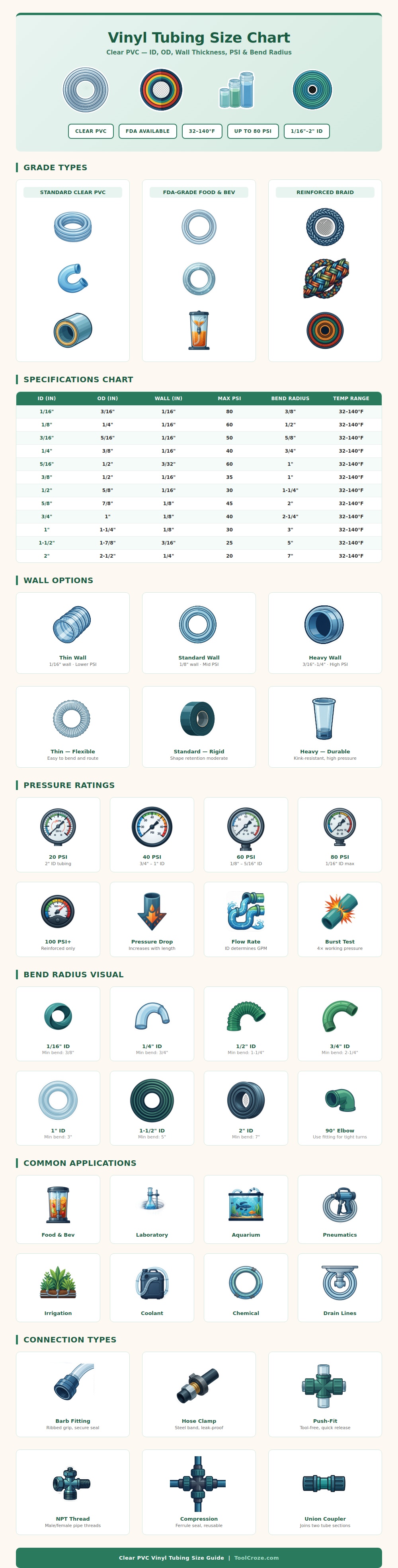
If you’ve used vinyl tubing before, you probably know that it doesn’t always slip on and off of barb fittings easily. It slips right back off under pressure.
Why? Well, it really comes down to basic geometry and material science. It’s not your bad luck; it’s simply due to material science and basic geometry. The size chart explains why and helps you understand how to connect things together proper.
How to Choose the Right Vinyl Tubing
Wall thickness also applies to vinyl tubing. Different types will behave differently. Thinner walled tubing are flexible. It conforms well to the route required in labs or aquariums. The tubing bend easily without kinking. That’s fine for delicate applications with space limitations.
But thin walled tubing lacks the structure found in thicker tubing. As the chart indicates, thinner tubing can only withstand lower pressures. Use a strong pump? Over time, thin-walled tubing can lose its shape and even burst. Match strength of material to force of fluid. For high-flow coolant systems and industrial pneumatic lines, heavy wall tubing are standard.
Why? It resists expanding as the pressure inside increase. As you can see from the infographic, increasing the inner diameter without proportionally increasing wall thickness result in lower pressure ratings. A big tube with thin walls will behave as a balloon would under pressure. You need extra material to hold compressed air or flowing fluids. This might seem odd but it is just how physics works. No matter what we think looks good or costs less, we still need that bulk.
Another spec that can trip people up if not noted is bend radius. Each tube has a minimum bend radius to avoid cracking or restricting flow. The chart maps out the maximum bend of each size. A small diameter will handle tighter bends more than a big one as well. Big diameters requires wider sweeping turns in order to keep water flowing at wanted rates.
You do not want to jam your large hose around a hard corner because what happens is that it creates turbulence within the hose. That cuts down its efficiency and increases wear and tear on the interior of the hose. So proper bending will lead to longer life.
What’s in the tube? PVC in its standard clear version will handle water, air and light chemicals. If you’re running beverages or food products through your system, you’ll need to use a type that’s made for those uses. Otherwise, the plastics can leach nasty stuff (plasticizers) into the liquid over time, not good. Now, this isn’t as much of an issue with a home workshop compressor feed line, but it’s crucial when pumping sensitive reagents around a lab or soda dispensing systems. Don’t assume that something fits just because it looks right; check chemical compatibility.
Whether it all stays together is up to how you attach them. Friction and stiffness of the tubes will hold barb fittings in place. Mechanical force (hose clamps) would of let them blow out from vibration. Push-fit connectors are fast and easy for rapid changes, though only if the cuts are square and clean for good seals. Pick your fitting style based off what matters more: permanence or serviceability?
There’s no such thing as one-size-fits-all when it comes to selecting tubing. There are three main factors: Bend radius, pressure rating and wall thickness. The bigger isn’t always better and the less expensive doesn’t always mean best. By knowing your system requirements, you can choose a tube material within its physical limits to ensure connections stay tight and the system runs smoothly.
Confusion here makes for a project that leaks before it even starts. It actually happens more often than you think with moddern tubings.
