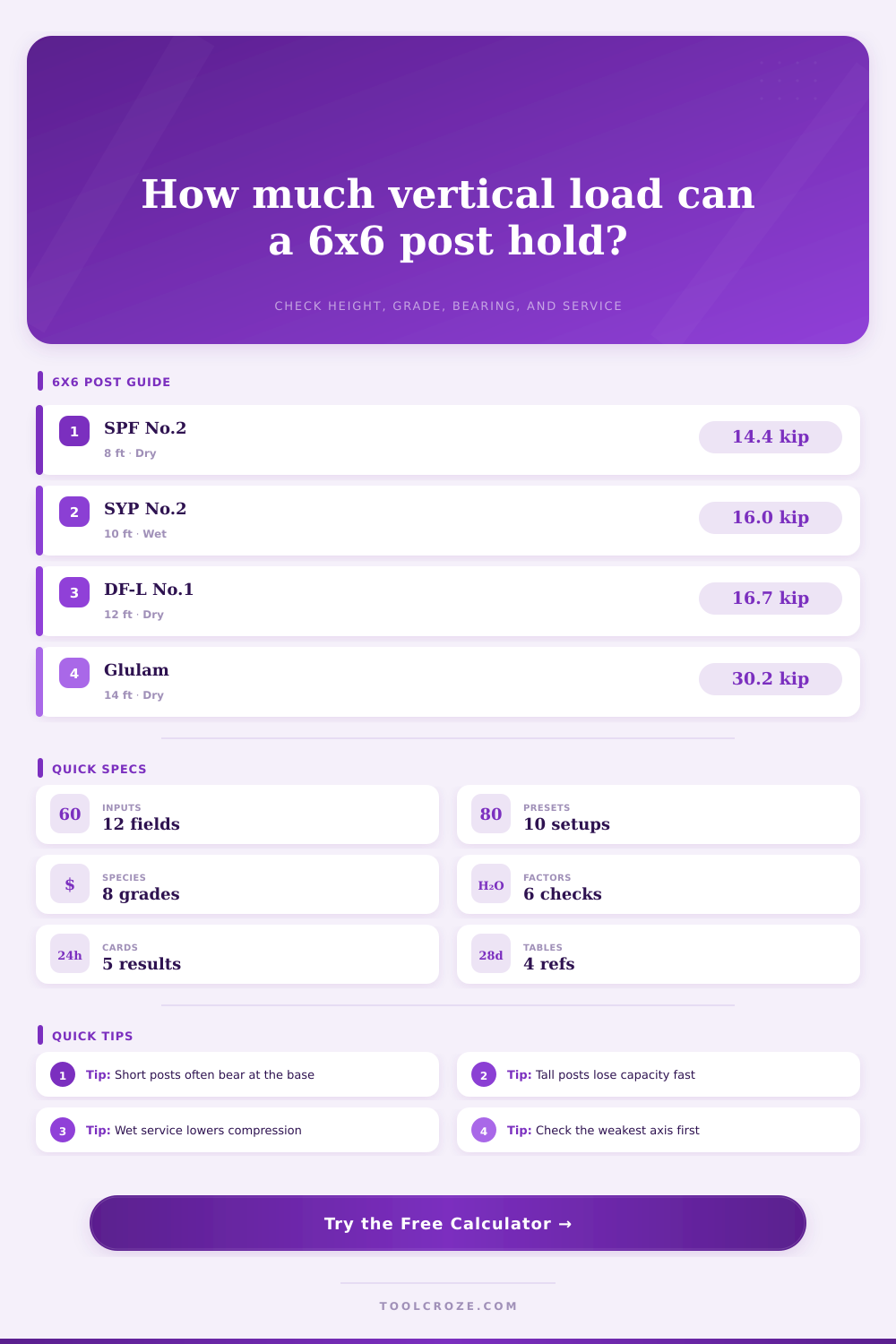
Vertical Load Capacity of 6x6 Post Calculator
Estimate axial capacity for a 6x6 wood post using actual dimensions, unbraced height, species and grade, end condition, service factors, eccentricity, and support bearing.
6x6 Post Capacity Results
| Species / grade | Base Fc | E min | Typical use |
|---|---|---|---|
| SPF No.2 | 875 psi | 425,000 psi | Interior framing posts |
| Southern Pine No.2 | 1,350 psi | 580,000 psi | Deck and porch posts |
| Douglas Fir-Larch No.2 | 1,150 psi | 510,000 psi | General structural posts |
| Douglas Fir-Larch No.1 | 1,500 psi | 625,000 psi | Higher capacity columns |
| Hem-Fir No.2 | 850 psi | 405,000 psi | Moderate dry framing |
| 24F DF Glulam | 1,950 psi | 950,000 psi | Heavy engineered posts |
| Factor | Typical values | Used on | What it represents |
|---|---|---|---|
| CD load duration | 0.90 to 1.60 | Fc | Short loads can use higher allowable stress |
| CM wet service | 0.80 to 1.00 | Fc and E | Moisture lowers wood compression and stiffness |
| Ci incising | 0.80 to 1.00 | Fc and E | Treatment cuts reduce effective strength |
| Ct temperature | 0.80 to 1.00 | Fc and E | Hot service reduces design values |
| Cp stability | 0.10 to 1.00 | Column Fc | Long unbraced posts buckle before crushing |
| End condition | K factor | Example | Effect on capacity |
|---|---|---|---|
| Fixed-fixed | 0.65 | Rigid top and base | Shortest effective length |
| Fixed-pinned | 0.80 | Anchored base, beam seat top | Often realistic for braced posts |
| Pinned-pinned | 1.00 | Simple bearing at both ends | Common conservative default |
| Unknown restraint | 1.20 | Loose or uncertain connections | Extra conservative |
| Cantilever | 2.10 | Freestanding post above brace | Very large capacity reduction |
| Scenario | Main risk | Input to verify | Practical note |
|---|---|---|---|
| Deck roof post | Wet service | CM and bearing plate | Small bases can control capacity |
| Basement support | Bearing on sill | Support psi and contact area | Check crushing at wood caps |
| Tall carport post | Buckling | Unbraced height and K | Add mid-height bracing when possible |
| Snow roof post | Load duration | CD and tributary load | Snow may allow higher CD |
| Pergola post | Eccentric load | Offset from centerline | Bracket geometry matters |
Everyone assumes a 6×6 post is hunk of lumber you toss in some concrete and move on with your life. That’s a mistake, and a dangerous assumption. Most often, it’s all about slenderness (rather than strength) that determine whether your structure will last decades or lean to collapse. A short post crushes because it can’t support pressure of those wood fibers. A tall post buckles because it’s no longer stable long before the material is anywhere near failure. Knowing what to expect alters everything, right up through foundation.
This calculator do all of that complicated math about stability for you (all you have to do is plug in your measurements and the end condition). The big thing to note: whether there is a fixed base or a pinned connection make an enormous difference. A pinned connection means it can rotates around its top point where it meets your metal bracket. So really it is taller then its physical length; it has no restraint at its top. The calculator takes that into account with so-called effective length factors, and adjusts downward accordingly based off the rigidity of both ends. You may be astonished at how much switching from a fixed-fixed situation to a pinned-pinned one reduces the capacity. Often that’s the make-or-break moment: will I have to go up to a glulam, or will my existing design work?
Why Your Wood Post Might Fail
The base-line number comes from material selection, but the service condition modify the number in a way that catches many DIYers by surprise. Wood is hygroscopic, meaning it absorbs water from the surrounding environment. So a post installed in dry indoor conditions will behave different than a post exposed to humidity and rain on an open deck. Wet wood are less stiff and weaker, reducing the load it can carries, both in terms of compression strength and resistance to buckling. The calculator includes reduction factors for high temperature, incising, and even wet service. None of these is a penalty. They’re a reflection of reality. If you ignore the moisture factor, your design looks stronger on paper but fails in practice. Why? Because the actual modulus of elasticity has decreased.
The other common blind spot is bearing. I’ve seen a big column where everything was fine from a buckling standpoint and then it crushed the footing or sill plate it sat on. The tool also looks at the bearing stress at the support interface and makes sure there’s adequate contact surface area to spread out the loads without destroying whatever the thing’s sitting on. Very frequently this results in bigger wooden caps or even steel plates added, not because they look cool, but because piece of wood beneath them won’t stand up to the point load. So it make you consider the load path as a system instead of component by component.
Another dimension not considered by simple axial models is eccentricity. Real-world loading never lines up precisely over centerline of a post. If it’s bolted to a deck beam, that beam shifts the load and introduces a bending moment along with straight-on vertical compression. How much does it matter? Even a small offset can significanly reduce the allowable load because the wood is now working harder on one side than the other. For this geometric imperfection, the calculator offers an eccentricity input that yields more realistic (and thus conservative) estimate.
Pay attention to what controls (state of) limit when running the numbers. Is it bearing or is it column stability? Adding some bracing at mid-height are a low-cost way to increase capacity without changing post sizes if stability is the limiting factor. If bearing capacity is an issue, then you should of spread the load out on a wider plate. It’s about understanding why something holds together, as much as making the number come out. That 6×6 can do many things, but it ain’t infinite. Use the math as a tool for how something behaves physically and your structures will hold up better and longer.